
Helping my cousin prepare for NEET last year gave me an unexpected look into how modern students actually study for competitive exams in India. Despite the enormous number of coaching institutes, test series, and online courses available today, the biggest challenge students still face is not the lack of study material but the lack of direction. Many students spend months solving questions without knowing which topics actually require attention.
This curiosity led me to examine Abhyas AI in depth. Instead of approaching it purely as a reviewer, I explored the platform while observing how a real student interacts with the system during exam preparation. I navigated the learning interface, examined the documentation provided in the official Abhyas platform guide, explored experimental tools in the Abhyas AI lab environment, and analyzed how the system structures its learning paths.
What emerged was a clearer understanding of what the platform actually does, what parts genuinely rely on AI-driven analytics, and where the system still behaves like a developing ed-tech product rather than a fully mature learning ecosystem.
One of the first things that becomes clear when exploring the Abhyas AI platform is the size of its academic database. According to the platform’s documentation and onboarding information visible through the Abhyas beta interface, the system hosts more than 300,000 practice questions designed for competitive engineering and medical entrance examinations.
This question bank is supported by over 1,000 hours of recorded video tutorials, covering approximately 860 different academic topics. These topics align with the standard syllabi used in major Indian competitive exams including JEE Main, JEE Advanced, NEET, and AP EAPCET.
Another significant dataset integrated into the platform is the archive of 600+ previous year exam papers. Rather than presenting these papers as downloadable files, Abhyas AI integrates them directly into practice modules so that student performance on real exam questions becomes part of the analytics system.
At the time of reviewing the platform, the company reports approximately 3,185 active students enrolled, a number that is relatively small compared with massive national coaching platforms but still large enough to generate meaningful performance data for algorithmic analysis.
Adaptive Learning Paths
The platform analyzes student performance and dynamically adjusts the order of topics, prioritizing weak areas while reducing repetition in subjects that students already understand.
Large Competitive Exam Question Bank
The system hosts more than 300,000 practice questions, along with 600+ previous year exam papers, allowing students to practice using real exam formats rather than simulated problems.
Interactive Video Learning Library
More than 1,000 hours of recorded video tutorials are integrated with practice exercises, covering roughly 860 academic topics across engineering and medical entrance exam syllabi.
Predictive Learning Analytics
The platform’s analytics engine attempts to identify why students make mistakes by categorizing errors into conceptual gaps, calculation mistakes, and careless errors.
Trap Question Identification
The system highlights question patterns that historically cause negative marking, helping students recognize and avoid common mistakes during competitive exams.
Ask-a-Tutor Academic Support
Students can send questions to subject experts through the integrated tutor messaging system when automated explanations are insufficient.
AI-Guided Study Time Optimization
Instead of encouraging repetitive practice across the entire syllabus, the platform attempts to focus study time on topics that remain unmastered.
Structured Exam Preparation Modules
The platform organizes practice and revision around specific entrance exams such as JEE Main, JEE Advanced, NEET, and AP EAPCET
The platform prominently highlights student outcome statistics that attempt to demonstrate its effectiveness in exam preparation.
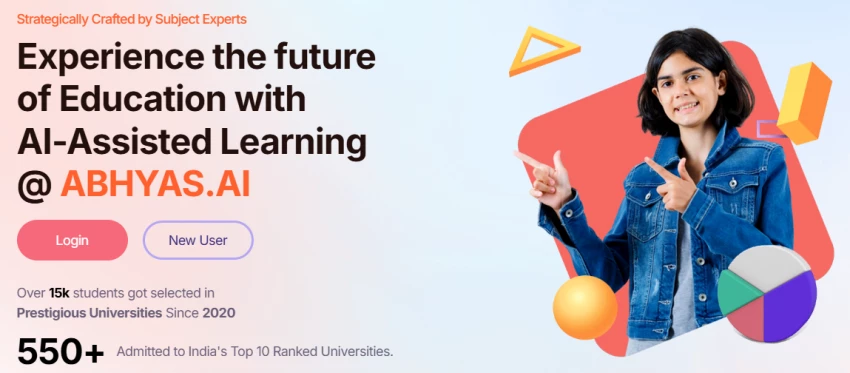
According to figures published on the official Abhyas AI website, more than 15,000 students using the system have secured university admissions since 2020. Among those results, the platform reports that over 1,000 students have been admitted to India’s top-ranked universities, including IIT Bombay, IIT Kanpur, IIT Guwahati, AIIMS Delhi, and AIIMS Raipur.
The company also lists exam-specific selection numbers. The platform reports approximately 900 selections in AP EAPCET, 600 students qualifying through JEE Main, 454 NEET selections, and 432 students advancing through JEE Advanced preparation programs.
However, it is important to interpret these numbers cautiously. Competitive exam preparation usually involves multiple learning resources including textbooks, private tutoring, coaching institutes, and test series. Because of that, it is difficult to attribute exam success solely to any single platform.
What differentiates Abhyas AI from traditional coaching systems is its attempt to personalize learning through adaptive sequencing.
When exploring the study workflow through the Abhyas beta student environment, the platform initially follows a structured syllabus path similar to most coaching programs. However, after several practice sessions the system begins adjusting study priorities.
During my testing period, topics where repeated mistakes occurred started appearing more frequently in the recommended study schedule. Conversely, subjects where the student consistently answered questions correctly gradually appeared less often in the study plan.
This behavior reflects the predictive learning analytics engine described in the Abhyas AI platform documentation. Instead of simply marking answers as right or wrong, the system attempts to classify errors into categories such as conceptual misunderstanding, calculation mistakes, or careless errors.
The idea is to guide students toward the areas that need improvement rather than encouraging repetitive practice across the entire syllabus.
Another interesting feature visible during testing is the system’s attempt to detect what it calls trap questions.
Competitive entrance exams frequently include questions designed to exploit predictable student mistakes. These may involve misleading wording, hidden unit conversions, or calculations that appear straightforward but contain subtle traps.
Abhyas AI analyzes how large numbers of students answer similar questions. When a question type repeatedly leads to incorrect answers, the system flags it as a potential trap and introduces additional exercises that train students to avoid those mistakes.
This feature is not unique to Abhyas AI, but integrating it into the learning path can help students recognize patterns that lead to negative marking during exams.
Although Abhyas AI emphasizes artificial intelligence, it does not rely solely on automated systems.
Students can send difficult questions to human subject experts through the Ask-a-Tutor system. According to information provided on the platform, more than twelve subject specialists contribute to the academic content and provide explanations to students.
During the evaluation period, tutor responses generally focused on explaining concepts rather than simply giving answers. However, response depth and speed can vary depending on the complexity of the question.
An important aspect of Abhyas AI is its partnership with Aditya Educational Institutions, an academic organization established in 1984 in Andhra Pradesh.
This partnership means that the platform’s question bank, curriculum design, and lectures are developed by educators associated with Aditya rather than generated entirely by algorithms. The AI system then organizes and delivers that material through adaptive study paths.
This hybrid approach, combining traditional academic expertise with algorithmic learning analytics, appears to be the core design philosophy behind the platform.
One area where the platform lacks clarity is pricing.
Unlike many education platforms that list subscription plans publicly, Abhyas AI typically reveals pricing only during the registration process through the Abhyas onboarding portal.
The company describes itself as offering one of the most affordable AI-based exam preparation platforms, particularly compared with traditional coaching institutes. However, the absence of publicly visible pricing may make it difficult for prospective students to compare costs before signing up.
Beyond the testimonials presented on the official platform, I also looked at how external websites and reviewers describe Abhyas AI. Independent coverage provides a broader perspective because it is not directly controlled by the platform itself. Several AI tool directories, blog reviews, and user experience articles discuss the system’s approach to AI-assisted learning and competitive exam preparation.
One overview published on Oreata AI’s blog discussing Abhyas AI describes the platform as an attempt to combine machine learning analytics with traditional coaching methods. The article highlights the adaptive learning sequence as the central idea behind the system, explaining that the platform tries to identify knowledge gaps and reorganize the study path accordingly. However, the review also notes that the platform functions best for students who already maintain consistent study habits, since the algorithm relies heavily on performance data from practice sessions.
A more detailed breakdown appears in SoftwareCurio’s Abhyas AI analysis, which focuses on both the strengths and structural limitations of the platform. That review acknowledges the large question bank and adaptive analytics but also raises questions about pricing transparency and the difficulty of verifying outcome statistics. The article suggests that while Abhyas AI introduces interesting data-driven learning tools, students should still treat it as a supplementary preparation resource rather than a full replacement for traditional coaching programs.
AI tool directory platforms also provide a more neutral description of the system. Listings on directories such as ToolInsidr’s Abhyas AI tool profile and Ameany’s AI tools database entry categorize the platform as an AI-assisted learning system designed primarily for engineering and medical entrance examinations in India. These directories typically focus on describing the platform’s functionality rather than evaluating its effectiveness, but they highlight features such as performance analytics, adaptive learning modules, and exam-specific question banks.
Some user-focused articles take a more experiential approach. For example, a preparation diary-style article published on AISuperSmart discussing personal exam preparation with Abhyas AI describes the platform from the perspective of a student experimenting with AI-based study tools. That article points out that while the system’s analytics can help identify weak areas, the effectiveness of the recommendations depends heavily on consistent usage and disciplined practice sessions.
Across these external reviews, a consistent theme appears. Abhyas AI is generally recognized as an interesting attempt to apply artificial intelligence to competitive exam preparation. The platform’s adaptive learning model and performance analytics receive positive attention, but independent reviewers also emphasize the importance of combining such tools with traditional learning methods rather than relying on them as the sole preparation strategy.
Taken together, these outside perspectives reinforce the broader conclusion that Abhyas AI functions best as a structured study companion powered by data analysis, rather than a complete replacement for conventional exam preparation ecosystems.
Despite its interesting technology, several practical limitations became noticeable during extended use.
The adaptive learning system relies heavily on consistent student behavior. If students skip practice sessions or answer questions randomly, the data collected by the algorithm becomes unreliable, which can lead to inaccurate study recommendations.
Another limitation involves conceptual depth. Although the platform includes extensive video lectures, the learning format still resembles traditional coaching material delivered digitally. Students who struggle with deeper conceptual understanding may still require direct mentorship from experienced teachers.
Tutor support is helpful but limited in scale. With a relatively small number of subject experts supporting the platform, response times and explanation depth can vary depending on demand.
The interface also shows signs of being a developing system. Certain areas of the beta environment require multiple steps to access practice modules, and analytics dashboards can sometimes appear overly technical for students who simply want clear progress indicators.
Finally, the success statistics published by the platform are difficult to verify independently because competitive exam preparation usually involves multiple resources simultaneously.
After spending time exploring the system and observing how it functions during real study sessions, the platform can be evaluated across several practical categories.
| Category | Rating | Evaluation |
| Content Depth | 8/10 | Large question bank and lecture library covering competitive exam syllabi |
| Adaptive Learning | 7.5/10 | Personalized study paths help identify weak areas |
| AI Analytics | 7/10 | Useful insights but sometimes lack deeper explanation |
| Tutor Support | 7/10 | Human help exists but response depth varies |
| Interface & Usability | 6.5/10 | Functional but parts of the platform feel unfinished |
| Pricing Transparency | 6/10 | Pricing not clearly listed before registration |
| Overall Value | 7/10 | Useful supplementary tool but not a full coaching replacement |
Abhyas AI represents an interesting attempt to combine artificial intelligence with competitive exam preparation. Instead of simply offering more content, the platform tries to analyze student performance and guide learning decisions based on real data.
However, the system works best when used alongside traditional study methods rather than as a complete replacement for coaching. Students who maintain disciplined study routines and use the platform consistently may benefit from its analytics and structured practice modules.
As artificial intelligence continues to enter the education sector, platforms like Abhyas AI suggest that the future of exam preparation may involve a deeper integration of data analysis, adaptive learning algorithms, and traditional academic expertise.
Be the first to post comment!

Artificial intelligence has fundamentally altered how YouTube content is produce...
Sakshi Dhingra3 days ago
In an industry increasingly dominated by single, monolithic AI models like OpenA...
Sakshi Dhingra3 days ago

Instagram Reels have become one of the most powerful organic discovery engines o...
Sakshi Dhingra6 days ago
I don’t judge an AI image generator by “one pretty output.” I judge it by what h...
Sakshi Dhingra1 week ago
AI music generation has matured quickly over the last few years, but the reality...
Sakshi Dhingra1 week ago
AI study tools are everywhere right now. Some feel overhyped. Some feel confusin...
Sakshi Dhingra1 week ago