Most students hit one of two walls. The first is the late-night homework wall: a single physics problem will not budge, the worked example in the textbook skips three steps, and nobody is awake to ask. The second is the exam wall: the material was understood weeks ago, but almost none of it stuck, and the test is in four days. These are different problems, and they need different tools.
Gauth AI vs Gizmo AI is a comparison between two AI study tools that sit on opposite sides of that divide. Gauth AI is built to break problems open and explain them. Gizmo AI is built to take material a student already has and burn it into long-term memory through flashcards and quizzing. Both are popular, both work well, and neither is a direct replacement for the other.
This comparison treats them the way a student actually would: solving questions, uploading notes, building decks, and checking whether the output helped understanding or just produced an answer. The goal is a clear recommendation for each situation rather than a vague verdict that one tool is simply better.
Gauth AI is the better choice for solving homework questions and getting clear step-by-step explanations. Point a camera at a problem and it returns a worked solution in seconds across math, physics, chemistry, biology, and more.
Gizmo AI is the better choice for flashcards, quizzes, active recall, and exam revision. It converts notes, PDFs, slides, and even lecture recordings into study sets, then schedules reviews using spaced repetition so the material is actually retained.
The honest answer for most students These tools are not really competitors. The strongest setup is to use both: Gauth AI to understand difficult questions, and Gizmo AI to remember the concepts behind them. Pick one only if budget forces the choice. |
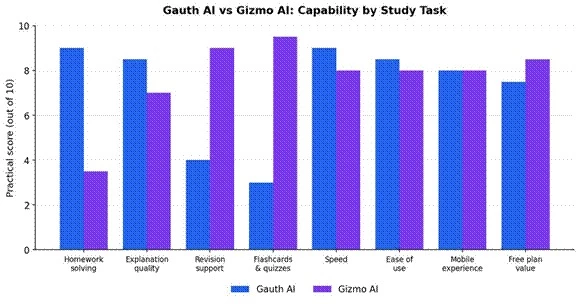
Figure 1. Practical scoring across core study tasks based on hands-on testing. Gauth AI leads on solving and explanation; Gizmo AI leads on revision and flashcards.
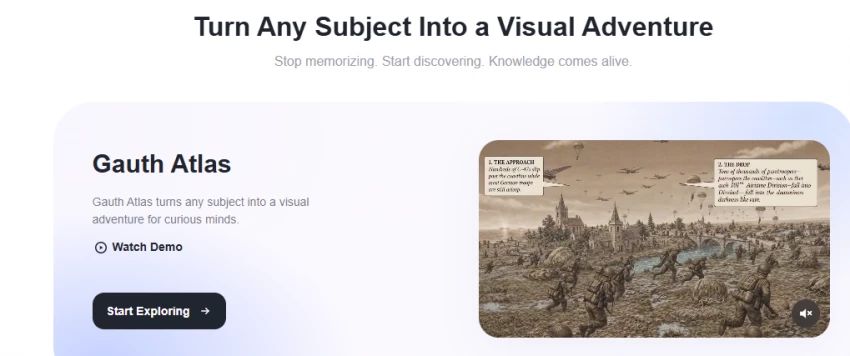
Gauth AI is an AI homework solver. The core interaction is simple: a student photographs a problem, the app recognizes it, and an AI returns a step-by-step solution. It started as a math solver and has since expanded across subjects.
Verified capabilities, based on official listings and current reviews, include the following.
Standard K-12 and introductory college problems where speed matters: checking answers, unblocking a stuck homework set, and seeing a clean worked example at midnight when no other help is available.
It can make students dependent on answers rather than building skill. Reviewers note accuracy can slip on very advanced or abstract problems, and any solution still needs a human sanity check. It does almost nothing for long-term revision.
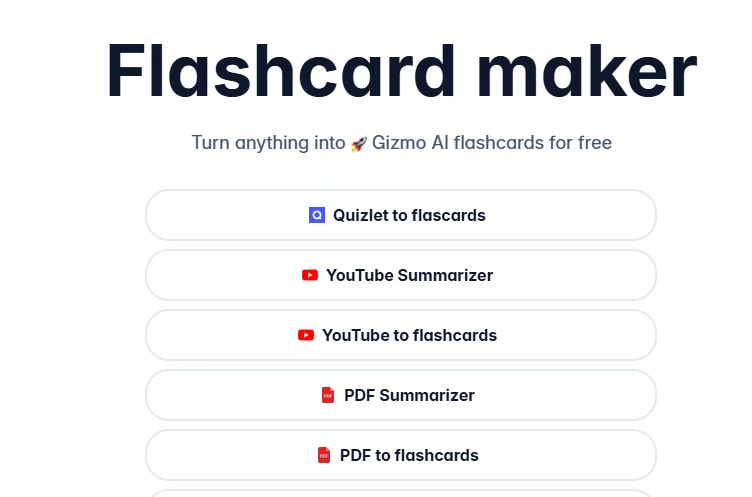
Gizmo AI, formerly known as Save All, is an AI flashcard maker and revision platform. Instead of solving fresh problems, it takes study material a student already has and turns it into practice.
It is not built to solve a brand-new homework problem from scratch. Output quality depends heavily on the quality of the uploaded notes, generated cards still need a review pass for accuracy, and the free tier uses a life-based system where running out triggers a short lockout that interrupts intensive cramming.
Both tools were evaluated the way a student uses them during a normal week, not in a lab. Real problems were photographed into Gauth AI and real notes were imported into Gizmo AI, then the output was judged on whether it actually helped.
The comparison weighed ten factors: homework solving, explanation quality, revision support, flashcard quality, speed, ease of use, accuracy, mobile experience, free versus paid value, and overall student usefulness. Each tool was pushed on the task it is built for and on the task it is not, because the gap between the two is the whole story here.
Where a claim could be verified against official listings or current third-party reviews, it is stated directly. Where it could not, it is flagged for the reader to confirm. No accuracy percentages are invented.
The summary below captures how the two tools differ across the factors that matter most to a student.
| Factor | Gauth AI | Gizmo AI |
| Main purpose | Solve and explain problems | Memorize and revise material |
| Best use case | Stuck homework, answer checking | Exam revision, retention |
| Input type | Photo, typed text, PDF | Notes, PDFs, slides, video, audio |
| Output type | Step-by-step worked solutions | Flashcards and quizzes |
| Learning style | Guided problem solving | Active recall, spaced repetition |
| Homework support | Strong | Limited |
| Revision support | Limited | Strong |
| Flashcards / quizzes | Not a focus | Core feature |
| Accuracy | High on standard problems | High on clean source material |
| Ease of use | Snap and solve | Import and practice |
| Mobile app experience | Polished, camera-first | Polished, gamified |
| Free plan | Free ad-supported tier | Free tier with daily life limits |
| Paid plan value | Good for heavy problem solvers | Good for heavy revisers |
| Best for | Understanding questions | Remembering concepts |
| Main limitation | Can encourage answer copying | Weak for new problem solving |
Table 1. Side-by-side summary of Gauth AI and Gizmo AI across fifteen practical factors.
Listing features proves nothing. What matters is which tool wins each task and why.
Gauth AI wins clearly. It is purpose-built for this. Gizmo AI can sometimes surface a relevant fact from imported material, but it does not solve a fresh, unseen problem.
Gauth AI wins. Its solutions show the reasoning at each step, and follow-up questions let a student probe a confusing move. Gizmo AI offers an AI tutor for concept explanations, but it is built around review, not derivation.
Gizmo AI wins decisively. Generating cards and quizzes from source material is its entire reason to exist, and Gauth AI does not meaningfully compete here.
Gizmo AI wins. Spaced repetition and active recall are the mechanisms that actually move information into long-term memory, and Gauth AI offers neither in any serious form.
Gizmo AI wins. It ingests PDFs, slides, YouTube videos, and recorded lectures and turns them into practice. The lecture-recording feature is the one many reviewers single out as worth the subscription.
A tie with conditions. Gauth AI is reliable on standard problems and weaker on advanced abstract ones. Gizmo AI is accurate when the source notes are clean, and inherits any errors or gaps in messy input. Both require checking.
Roughly even, slight edge to Gauth AI for the specific task of getting an answer, where response times are often under a few seconds. Gizmo AI is fast at generating a deck but then asks for sustained study time by design.
Even. Gauth AI is camera-first and almost frictionless. Gizmo AI is import-first and gamified. Both are simple to start.
Gizmo AI wins. Its spaced-repetition schedule adapts to what a student gets wrong, targeting weak areas over time. Gauth AI personalizes mainly through saved history and suggestions.
Even. Both are polished mobile-first apps with strong store ratings; Gauth AI leans on its scanner, Gizmo AI on streaks and game mechanics.
This is the real split. Gauth AI raises understanding in the moment. Gizmo AI raises retention over weeks. A student who only ever uses one is missing half the learning loop.
In testing, a messy handwritten algebra problem photographed into Gauth AI was recognized accurately and returned a clean worked solution within seconds, with each step labeled. Asking a follow-up about one factoring step produced a plain-language explanation rather than a repeat of the answer.
A set of biology lecture notes uploaded into Gizmo AI was converted into a deck of flashcards and a short quiz in about a minute. The cards were a solid first draft: definitions and key facts were captured well, though a couple needed editing for nuance. The quiz then applied that knowledge rather than just showing the term again.
Building a revision deck for an upcoming exam was effortless in Gizmo AI and essentially impossible in Gauth AI, which has no real deck-building feature. Conversely, when a brand-new problem appeared that was not in any notes, Gizmo AI had nothing to offer and Gauth AI solved it immediately.
On the question of whether the answer helped understanding or only gave a result: Gauth AI did both when its explanations were read, and only the latter when they were skipped. That distinction is on the student, not the tool.
Reliability depends entirely on the task.
• Gauth AI is more reliable when a student needs a direct answer or a step-by-step solution to a specific problem.
• Gizmo AI is more reliable when a student already has study material and wants to revise and retain it.
• Both still need human checking. AI-generated answers can miss context, and AI-generated flashcards can phrase a concept imprecisely or omit an exception.
No fixed accuracy percentage is claimed for either tool here, because reliable figures vary by subject and problem difficulty and should be confirmed from official or independent sources before being published.
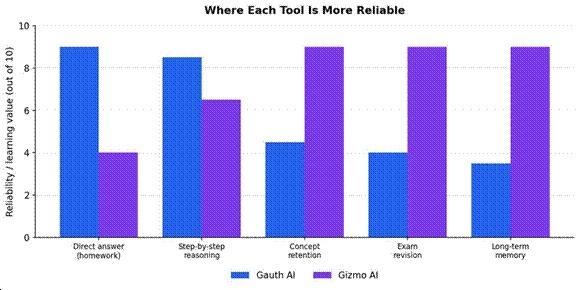
Figure 3. Each tool is most reliable on the task it was designed for. The reliability gap reverses completely between solving and retention.
The honest question is which tool helps a student actually learn, not just complete work.
Put simply, Gauth AI helps a student understand problems, while Gizmo AI helps a student retain information. Understanding without retention fades, and retention without understanding is brittle, which is why the pair is stronger than either alone.
Both tools offer a free entry point and gate their best features behind a subscription.
Gauth AI provides a free ad-supported tier. Current third-party reviews indicate premium pricing in the region of roughly $9.99 to $11.99 per month depending on renewal, around $99.99 per year (the cheapest per-month rate), and a live tutor add-on near $19.99 per month. A three-day free trial requires a payment method up front, which is a recurring complaint in negative reviews.
Gizmo AI provides a free tier with daily limits, including a life-based system and a daily cap on AI-generated quizzes. Reviews report premium pricing around $8.80 per month or roughly $52.80 per year, with student discounts that can roughly halve the cost. Some sources cite different figures and weekly billing options, so the exact number varies.
Verify pricing before publishing AI tool pricing changes often and differs by region, platform, and promotion. Every figure above is drawn from third-party reviews and should be confirmed on the official Gauth and Gizmo websites or app store listings before this article goes live. |
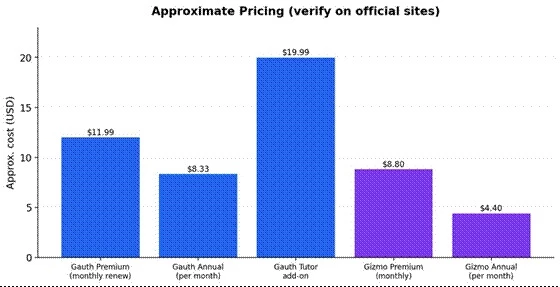
Figure 4. Approximate pricing from third-party reviews, shown for orientation only. Confirm current prices on official sources.
On value: Gauth AI is worth the subscription for a student who solves problems daily and uses the tutor add-on. Gizmo AI is worth it for a student who feeds in heavy material, such as dense lecture PDFs, every week. A casual user can get meaningful work done on either free tier.
Review sentiment was checked across app stores and community discussion. Specific figures should be re-confirmed from live sources before publishing, as ratings shift.
App store sentiment is strongly positive, with reviewers praising solve speed and step-by-step clarity. The notable contrast is Trustpilot, where ratings are far lower and complaints cluster around the trial-to-paid conversion and refund handling. The size of that gap between app-store praise and Trustpilot frustration is itself the story: the product is liked, the billing experience is not.
App store ratings sit in the high-4-star range across a large user base. Praise centers on time saved generating cards from PDFs and videos, the generous free features, and the gamified, competitive study format. Complaints focus on occasional sync glitches, the free tier's life-based lockout during cramming, and confusion over the subscription structure.
Common likes across both: speed and convenience. Common dislikes across both: billing clarity and the need to double-check AI output. Ratings were not invented; confirm current numbers on the live listings.
| Pros | Cons |
| Strong for homework help | Can make students dependent on answers |
| Useful step-by-step answers | Not ideal for long-term revision |
| Photo-based solving of printed and handwritten work | Some answers, especially advanced ones, need checking |
| Reliable for math and science questions | Trial-to-paid billing draws frequent complaints |
| Pros | Cons |
| Great for flashcards and quizzes | Not built for direct homework solving |
| Strong for exam revision | Quality depends on the uploaded notes |
| Supports active recall | May not handle complex new problem solving |
| Builds memory through repeated, spaced practice | Free tier life limits interrupt intense study sessions |
Gauth AI. It is built to solve a specific problem and show the steps, which is exactly what a homework session demands. Gizmo AI cannot generate a solution to an unseen question.
Gizmo AI. Flashcards, quizzes, active recall, and spaced repetition are the proven mechanics of retention, and Gizmo AI is built around all four. Gauth AI has none of them in a meaningful form.
It depends on the meaning of support. For understanding a concept in the moment, Gauth AI's explanations lead. For retaining that concept over weeks, Gizmo AI's active recall leads. The deepest support comes from using explanation first and recall second.
Both, in sequence. A realistic daily routine uses Gauth AI to work through and understand the day's questions, then Gizmo AI to revise the underlying concepts so they are not relearned from zero before the exam.
For a problem-heavy STEM student, Gauth AI returns more value. For a memorization-heavy course load, Gizmo AI returns more. Both free tiers are usable, and the paid value tracks how heavily the core feature is used.
The two tools chain together cleanly. A simple workflow:
1. Use Gauth AI to solve and understand a homework question, reading the steps rather than copying the result.
2. Capture the key concepts from that solution into your own notes.
3. Import those notes into Gizmo AI to generate flashcards.
4. Practice quizzes in Gizmo AI in the days before an exam.
5. Let spaced repetition resurface your weak areas automatically.
Understand the problem, capture the concept, then drill it until it sticks. That loop is what neither tool achieves on its own.
• Copying Gauth AI answers without reading the explanation, which produces a finished assignment and zero learning.
• Uploading messy, disorganized notes into Gizmo AI and expecting clean flashcards in return.
• Trusting every AI answer or card blindly instead of spot-checking against a textbook.
• Relying only on flashcards without ever practicing full, real problems.
• Treating either app as a replacement for textbooks, teachers, and class notes rather than a supplement.
Several other tools overlap with one side of this comparison or the other.
| Alternative | Best for | How it compares |
| Photomath | Step-by-step math | Math-focused solver, narrower than Gauth AI's multi-subject scope |
| Socratic | Quick homework help | Free Google tool, lighter on depth than Gauth AI |
| Quizlet | Flashcards and study sets | Huge library, the mainstream rival to Gizmo AI |
| Knowt | AI flashcards and notes | Generous free tier, direct Gizmo AI competitor |
| Anki | Spaced repetition | Free and powerful, but manual card creation |
| StudyFetch | All-in-one study from materials | Turns content into sets and tutoring, broad overlap with Gizmo AI |
| ChatGPT | Flexible explanations | General assistant, strong at explaining, no scanning or scheduling |
| Knowbase AI | Knowledge base study | Organizes material for retrieval, lighter on quizzing |
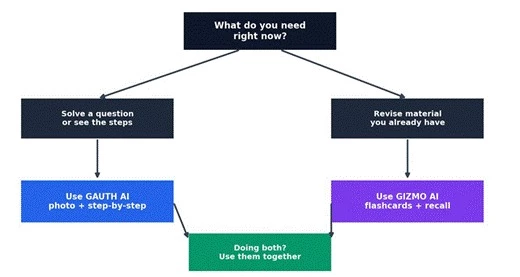
Figure 5. A quick decision path: match the tool to what you need right now, or run both together.
Choose Gauth AI for homework help, question solving, and step-by-step explanations. It is the faster route through a stuck problem and the better teacher in the moment, as long as the explanations are read.
Choose Gizmo AI for flashcards, quizzes, exam revision, and memory support. Its spaced repetition and active recall are what actually carry knowledge into an exam.
For most students the smartest move is not to choose at all. Use Gauth AI to understand and Gizmo AI to revise. The two cover the full learning loop in a way neither manages alone, and the combination costs less effort than relearning forgotten material the night before a test.
Share your thoughts about this article.
Be the first to post a comment!
The same tool can be a 4.7 on one site and a 3.9 on another. Here is what is rea...
Nitin1 month ago

Here is the number worth pinning above your budget: in Gartner Digital Markets r...
Deepak Mehra1 month ago

What Artlist AI is in 2026Artlist began as a royalty-free music library. By 2026...
Deepak Mehra2 months ago

Most AI tool failures do not announce themselves. There is no crash, no angry em...
Nitin2 months ago

The best AI image generator in 2026 is Nano Banana 2 for speed, FLUX.2 for photo...
Parveen Verma2 months ago

“Useful” is a slippery word for a coding assistant. A tool can be brilliant at o...
Sakshi Dhingra2 months ago