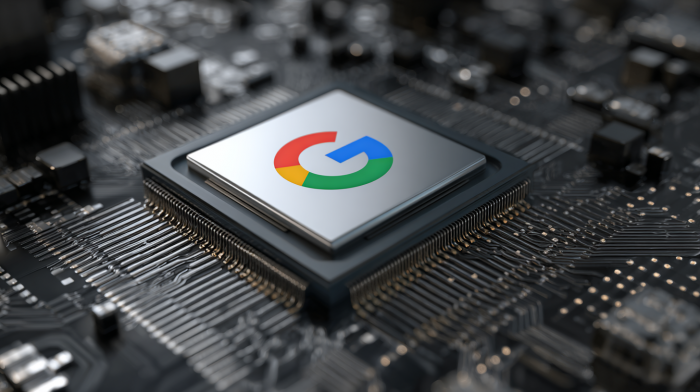
Google has introduced a new generation of its custom AI chips at its Cloud Next 2026 conference, signaling a deeper push into the infrastructure layer of artificial intelligence and a more direct challenge to Nvidia’s dominance in the space. The announcement centers on two new Tensor Processing Units designed to handle different parts of the AI workload, as demand for computing power continues to surge.
At the core of the announcement are two distinct chips: TPU 8t, built for training large AI models, and TPU 8i, optimized for inference, which is the process of running AI systems once they are deployed.
This split reflects a broader shift in the AI industry. Instead of relying on a single type of accelerator, companies are now designing specialized hardware for different stages of AI development. Training requires massive computational power to build models, while inference focuses on speed, efficiency, and real-time responses.
Google says the new chips deliver major performance improvements over previous generations. According to TechCrunch, the latest TPUs are up to three times faster for training, offer around 80 percent better performance per dollar, and can scale to extremely large clusters, enabling more compute at lower cost and energy usage.
The company is also emphasizing efficiency as a key advantage. As AI models grow larger and more complex, power consumption has become a major constraint. Google’s approach focuses on improving performance per watt, which could make its infrastructure more attractive to enterprise customers running large-scale AI workloads.
The new TPU lineup is designed to support what Google calls the next phase of AI, where systems move beyond simple responses and begin to perform tasks autonomously.
At the Cloud Next event, the company framed these chips as foundational hardware for AI agents that can reason, plan, and execute workflows. That shift requires both high-performance training systems and highly efficient inference systems capable of handling real-time interactions at scale.
By separating training and inference into different chips, Google is aligning its hardware strategy with how modern AI applications are evolving.
Despite positioning the new TPUs as a competitive alternative, Google is not abandoning Nvidia hardware.
TechCrunch reports that Google will continue offering Nvidia GPUs within its cloud infrastructure and is even working with Nvidia to improve networking performance for AI systems. The company also plans to support Nvidia’s upcoming chip platforms alongside its own hardware.
This reflects a pragmatic approach. While Google is investing heavily in its own silicon, Nvidia still dominates the AI chip market, and cloud providers continue to rely on its hardware to meet customer demand.
The launch highlights how critical hardware has become in the AI race. As models grow more powerful, access to efficient and scalable compute is emerging as a key competitive advantage.
Google’s TPU strategy is not just about performance. It is about controlling more of the AI stack, from infrastructure to software. By offering its own chips through Google Cloud, the company can optimize costs, improve efficiency, and reduce reliance on external suppliers over time.
At the same time, the move intensifies competition across the cloud industry. Amazon, Microsoft, and other players are also developing custom chips, while continuing to depend on Nvidia for high-end workloads.
Google’s latest TPU announcement shows how the AI battle is shifting beneath the surface. The focus is no longer only on models and applications, but increasingly on the infrastructure that powers them.
By introducing specialized chips for training and inference, Google is betting that the future of AI will require more tailored, efficient systems rather than one-size-fits-all hardware.
The result is a more fragmented but also more optimized computing landscape, where performance, cost, and energy efficiency will determine which platforms lead the next phase of AI adoption.
Share your thoughts about this article.
Be the first to post a comment!
$19.99Pro monthly price (May 2025 hike)$179.99Pro annual (saves 25%)30 daysOur h...
Suraj Malik2 months ago

Meta’s artificial intelligence business may be accelerating, but the company is...
Suraj Malik2 months ago
QUICK ANSWER - Why AI Chatbots Break After 10 MessagesMost AI chatbots brea...
Suraj Malik2 months ago

POLYBUZZ VS JANITOR AI: THE QUICK ANSWERPolyBuzz AI is the better choice for cas...
Suraj Malik2 months ago
Amazon has begun offering new OpenAI products directly through its cloud platfor...
Suraj Malik2 months ago
Abhyas AI vs. Gauth AI: which is better?Abhyas AI is better for Indian students...
Suraj Malik2 months ago