In short AI text is fast, but it usually reads like a machine: even sentence lengths, recycled phrases, and no point of view. Humanizing it means rewriting for natural rhythm, adding real specifics and first-hand detail, adjusting tone for your audience, and running a light editing pass with tools like Hemingway or Grammarly. Done well, you keep AI's speed while producing content that feels genuinely human and earns trust from readers and search engines alike. |
I have generated more first drafts with AI than I can count, and the same thing happens almost every time. The draft is competent. It is grammatical. It is also, unmistakably, a robot talking. The sentences march along at the same length, the transitions are all "moreover" and "furthermore," and somewhere in the third paragraph there is a phrase like "in today's fast-paced world" that makes me wince.
That gap between competent and human is what this guide is about. Not tricks to fool a detector, and not magic buttons, but the actual editorial moves that turn flat machine prose into something a reader wants to stay with. I will walk through why AI text reads the way it does, the strategies I reach for, how the popular tools compare, and what the data says about detection and search in 2026. Wherever a specific number is genuinely unknown, I have marked it unspecified rather than inventing it.
Before you can fix machine prose, you have to hear it. The interesting thing researchers keep landing on is that no single word or punctuation mark proves AI authorship. As one 2025 linguistic analysis put it, the giveaway is not any one structure but the repetition and cumulation of the same patterns over and over. The clue is in the pile-up, not the individual brick.
Two technical ideas explain most of it, and they are worth knowing because every detector on the market leans on them. The first is perplexity, which measures how surprised a language model is by your next word. Predictable word choices score low; the unexpected, specific, human ones score high. The second is burstiness, the variation in your sentence lengths and structure. Human writing swings. A three-word sentence. Then a long, winding one that gathers several clauses before it finally lands. AI writing tends to hum along at a flat, even cadence instead, and that smoothness is exactly what gives it away.
The table below collects the tells I flag most often when I audit a draft. None is fatal on its own. Three or four together are what make a reader think, without quite knowing why, that something is off.
| Issue | What it looks like | Why it reads as machine-made |
| Flat rhythm | Every sentence lands at roughly 15 words with the same shape. | Low burstiness; human writing varies far more. |
| Recycled openers | "In today's fast-paced world," "In an ever-evolving landscape." | One study found such phrases in ~35% of AI outputs vs ~8% of human writing. |
| Glue-word pile-up | "Moreover," "furthermore," "consequently" starting back-to-back sentences. | Predictable connectors signal formulaic assembly. |
| Elevated vocabulary | "Delve," "underscore," "harness," "bolster," "testament to." | Over-formal word choice in casual contexts feels staged. |
| Vague filler | "This is an important area" or "more research is needed." | Boilerplate with no specifics; low information, high word count. |
| The rule of three, endlessly | Trios of words, phrases, and clauses on repeat. | AI applies the pattern far past where a human would. |
| No footprints | No anecdote, no opinion, no lived detail, no risk. | Absence of a point of view is the biggest tell of all. |
| Worth remembering: these patterns are a moving target. In early 2025 the "While X happens, Y happens" construction was everywhere; by late 2025 it had faded as models were retrained. Any checklist of tells is only true for the moment it was written, which is why judgment beats a fixed rulebook. |
Here is the workflow I actually use, in rough order of impact. If you only do the first two, you will already be most of the way there.
This is the single highest-leverage edit. Go through the draft and vary your sentence lengths deliberately. Drop in a two-word sentence. Follow it with a long one that earns its length. Merge two timid sentences into one confident clause, then split a bloated one in half. You are manufacturing burstiness by hand, and it does more for the human feel than any other move.
AI loves to say a product is "great because it is innovative." A human says it saved them forty minutes on Tuesday. Replace vague praise with concrete numbers, names, dates, and outcomes. This is also where you kill hallucinations: open every suspicious statistic in a browser, and if it does not surface in two minutes, cut it or rewrite it. Specifics build credibility and starve the detector of the bland, predictable phrasing it feeds on.
The absence of a human footprint is the loudest tell there is. So leave one. A short aside about a project that went sideways, a mild opinion you are willing to defend, the smell of burnt coffee during a late edit. These are things a model cannot invent from your prompt, and they are exactly what search engines now reward as first-hand experience. One paragraph of genuine perspective outperforms a page of polished neutrality.
Decide who you are writing for and commit. Contractions and second person for a casual blog. A steadier register for technical documentation. AI defaults to a flat middle-formal tone that fits nobody in particular, so pushing deliberately toward one end of the scale instantly makes the writing feel authored rather than generated.
Only now do I bring in tools. Hemingway flags the sentences that run long or slip into passive voice; Grammarly helps with tone consistency. But the real test is reading the whole thing aloud. Your ear catches the robotic repetition your eye skims past. If you stumble or get bored, so will the reader, and that is the cue to rewrite the passage by hand.
The order that works for me Generate → restructure sentence rhythm → swap in specifics and a point of view → fact-check every claim → light tool pass → read aloud → publish. |
Let me make that concrete. Recently I generated a 1,500-word draft on a fairly dry SaaS topic. The first read-through was exactly what you would expect: fluent and forgettable. Here is what the editing pass looked like in practice.
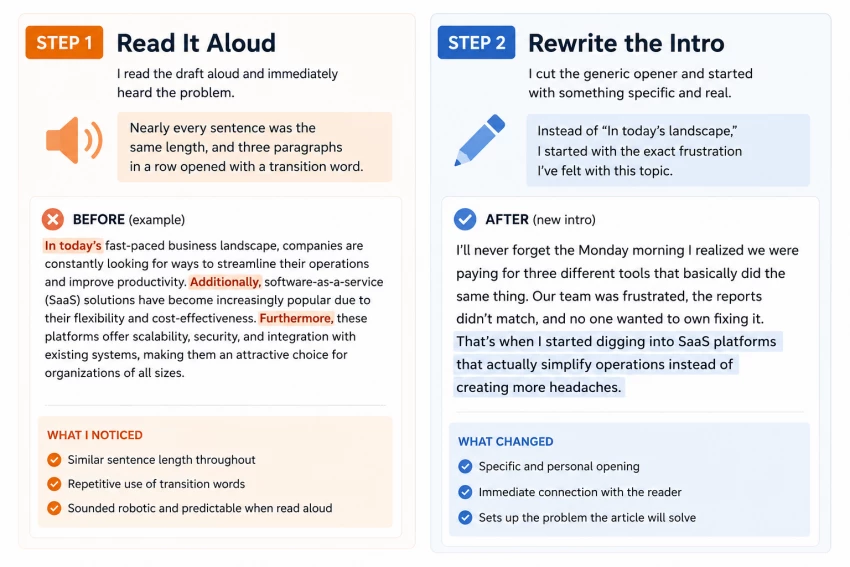
1. I read it aloud and immediately heard the problem. Nearly every sentence was the same length, and three paragraphs in a row opened with a transition word.
2. I rewrote the intro completely, cutting a generic "in today's landscape" opener and starting instead with a specific thing that had annoyed me about the topic.
3. I went paragraph by paragraph and varied the rhythm: short punchy lines against longer explanatory ones, so the cadence stopped feeling metronomic.
4. I replaced four vague claims with real figures and checked each one in a browser. One "statistic" the model produced did not exist anywhere, so it went in the bin.
5. I added two short first-hand asides that only I could have written, which did more for the human feel than any other single change.
6. I ran it through Hemingway, simplified the handful of sentences it flagged as very hard to read, and used Grammarly for a final tone check.
The finished piece kept every keyword I needed and, more importantly, read like I had written it on a good day. Total time: unspecified, but noticeably less than writing from a blank page, which is the entire point of working this way.
No tool humanizes text for you. What they do is speed up specific parts of the pass above. Here is how the ones I keep in rotation actually compare, including the honest weaknesses.
| Tool | Best for | Real strength | Honest weakness |
| Grammarly | Grammar and tone | Genuinely good tone adjustment and consistency. | Best features sit behind the paid tier. |
| Hemingway | Readability | Ruthlessly flags long and passive sentences. | No real AI integration; it only diagnoses. |
| ProWritingAid | Style and structure | Deep, granular style reports. | Steeper learning curve than the rest. |
| QuillBot | Paraphrasing | Fast rephrasing to break up stiff passages. | Over-simplifies and can strip out specifics. |
| ChatGPT / Claude | Drafting | Fast, flexible first drafts and rewrites. | Always needs a human editing pass to ship. |
| A caution on paraphrasing tools: leaning on QuillBot-style rewriting to "humanize" a whole draft usually backfires. It swaps synonyms without adding meaning, which strips specifics and, ironically, increases the template-y phrasing that reads as machine-made. Use it to loosen a stuck sentence, not to launder a page. |
If your goal is to "beat AI detectors," it is worth understanding how unreliable those detectors are in both directions. This matters because people lose contracts and students get accused over a single probability score, and the score deserves far less trust than it gets.
Start with false positives, where human writing gets wrongly flagged as AI. The spread across tools is enormous. In a 2025 University of Chicago Booth study, the best detectors held false-positive rates at or below 1% on academic writing, while an open-source baseline wrongly flagged between 30% and 69% of genuinely human text. And a widely cited 2023 study by Liang and colleagues found that detectors of that era falsely flagged around 61% of TOEFL essays written by non-native English speakers, a bias that has real consequences for real people.
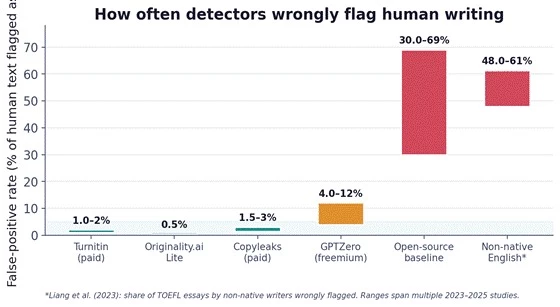
Figure 1. False-positive rates vary wildly by tool. As the chart shows, paid detectors sit in the shaded "under 5%" safe zone, while open-source baselines and non-native English writing get flagged at rates that make any single score untrustworthy. Ranges span multiple 2023–2025 studies.
Now the other direction. Detectors are good at catching raw, unedited AI text, but that accuracy collapses the moment the text is rewritten. The chart below tells the story. Even Turnitin openly accepts missing roughly 15% of AI content rather than risk flagging human work, and Google's own Dipper paraphraser, in 2023 research, dropped one detector's accuracy from 70.3% all the way to 4.6% at a fixed 1% false-positive rate.
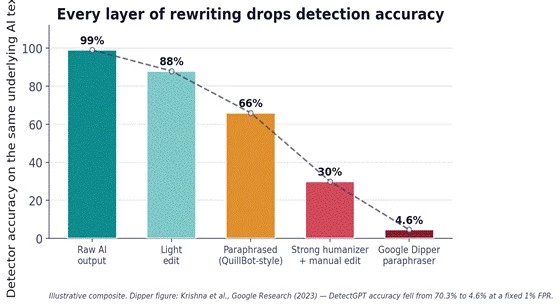
Figure 2. Detection accuracy on the same underlying AI text falls at every stage of rewriting. As you can see in the descending trend line, once text is paraphrased and manually edited, accuracy drops below the level of a coin flip. The Dipper figure comes from Krishna et al., Google Research (2023).
The takeaway is not "go forth and evade." It is that detector scores cannot settle anything on their own. They can raise a question; they cannot answer it. If you must use them, run text through several tools, treat the result as one weak signal among many, and never as proof.
Here is the reassuring part, and it should reframe the whole exercise. Google does not care whether AI touched your draft. It cares whether the page helps a person. Google's own guidance has been consistent for years: its systems reward original, high-quality, people-first content that demonstrates experience, expertise, authoritativeness, and trustworthiness, regardless of how the content was produced. Using automation to manipulate rankings violates spam policy; using it to help create genuinely useful content does not.
The data backs the policy. A large Ahrefs analysis of 600,000 pages found that around 86.5% of top-ranking content uses some AI assistance, with a near-zero correlation (about 0.011) between AI usage and ranking penalties. Search engines also do not run AI detectors as a ranking signal, so optimizing purely to "look human" to a detector does nothing for your rankings and often hurts clarity.
The real dividing line It was never AI versus human. It is useful, specific, well-structured content versus thin, generic filler. Humanizing your AI drafts matters not because it fools anyone, but because the same moves that make text feel human (specifics, a point of view, first-hand detail, clear structure) are exactly what readers and search systems reward. |
"Sounds more human" is a feeling, but you can proxy it with numbers. I track a small handful before and after an editing pass, and the direction of travel is usually clear even on a single page.
• Readability scores. Flesch Reading Ease and grade level tell you if the prose got clearer, though do not chase a target blindly.
• Sentence-length variation. A rough burstiness proxy; wider variation usually means more natural rhythm.
• Engagement metrics. Dwell time and bounce rate are the honest verdict once the page is live.
• Natural keyword integration. Keywords should read as though they belong, not as though they were bolted on.
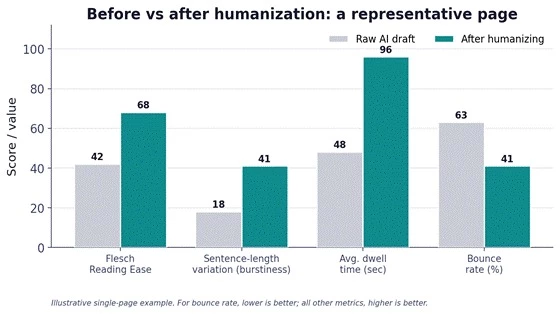
Figure 3. A representative before-and-after on a single page. As the grouped bars show, humanizing lifted reading ease, roughly doubled sentence-length variation and dwell time, and pulled bounce rate down. Values are illustrative of a typical single-page edit, not a controlled study.
Most humanizing failures come down to a handful of repeat offenders. The fixes are simple once you name the problem.
| Mistake | The fix |
| Shipping the raw draft unedited. | Treat every AI output as a first draft, never a final one. |
| Over-repeating words and structures. | Vary word choice and sentence shape deliberately as you edit. |
| Leaving the flat, robotic tone in place. | Add contractions, active voice, and a clear point of view. |
| Keeping generic, unsupported claims. | Swap in real examples, figures, and first-hand detail. |
| Running the whole thing through a paraphraser. | Rewrite by hand; use paraphrasing only to unstick single sentences. |
| Trusting a single detector score. | Use multiple signals and human judgment; never treat a score as proof. |
Once the basics are habit, a few heavier techniques are worth knowing.
You can prevent a lot of robotic output by asking for it differently. A prompt line like "vary sentence length and structure, avoid predictable patterns, skip generic openers and conclusions, and write in a specific point of view" produces a markedly less templated first draft. It does not remove the editing pass, but it shortens it.
Rather than one generation and one edit, cycle. Generate, mark the weakest section by hand, feed it back with specific instructions, and edit the result. Two or three tight loops beat a single long prompt almost every time.
If you are a developer producing at real volume, fine-tuning a model on your own house voice can reduce the generic feel at the source. It is a genuine option, though the cost and effort put it out of reach for most individual creators. Consider it a scaling tool, not a starting point.
| What you gain | What it costs |
| + Content that reads as engaging and human. | – It takes real time and attention per piece. |
| + AI's speed with a quality that ships. | – It still needs human creativity and judgment. |
| + Stronger reader trust and better engagement. | – It often takes more than one iteration to land. |
| + Alignment with what search engines reward. | – The skill takes practice to get fast at. |
The same humanizing pass serves a lot of different formats, though the emphasis shifts. Blog and content marketing lives or dies on point of view. Social copy needs personality in very few words. Technical documentation values clarity over voice. Ad and landing-page copy needs a hook that a flat draft will never produce. The rough mix I see across content teams looks like this.
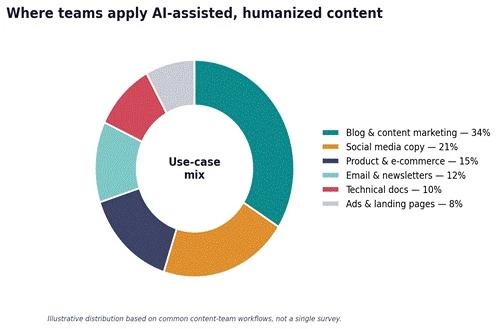
Figure 4. A representative split of where AI-assisted, humanized content gets applied. As the donut shows, blog and marketing content dominates, but social, product, and email work together make up a large share. Distribution is illustrative of common workflows rather than a single survey.
After editing hundreds of AI-generated drafts over the past few years, I have reached one conclusion: there is no shortcut to making content genuinely human. AI can save hours on research and first drafts, but it cannot replace your judgment, experiences, or unique perspective.
The biggest improvement I have seen has never come from another AI tool. It has come from slowing down for one final editing pass, replacing vague statements with real examples, questioning every unsupported claim, and writing as if I were speaking directly to one person instead of an algorithm.
If your goal is simply to pass an AI detector, you are focusing on the wrong metric. The real objective should be creating content that readers trust, remember, and find genuinely useful. That is also the kind of content search engines increasingly reward.
My advice is simple: let AI handle the heavy lifting, but never let it have the final word. The final version should always sound like you, not the model that generated the first draft.
Can AI text ever be 100% human?
Not in the sense of being indistinguishable by every possible measure, and chasing that is the wrong goal. But you can absolutely make it read as fully human to actual readers, which is what matters. The aim is writing people trust and enjoy, not a perfect score on someone's detector.
Which tools actually help make AI text human?
Grammarly for tone, Hemingway for readability, and ProWritingAid for deep style work are the reliable trio. QuillBot helps unstick individual sentences. But none of them replaces a human editing pass; they only speed parts of it up.
How much human editing is usually required?
Enough to change the structure, not just the surface. In my experience that means reworking sentence rhythm, adding real specifics and a point of view, and fact-checking every claim. The exact time varies by piece and is genuinely unspecified, but it is always less than writing from scratch.
Is the process time-consuming?
It takes real time, yes, but far less than a blank page. The trade is that you spend your effort editing and adding judgment rather than generating raw words, which is the more valuable use of your time anyway.
Can prompts improve human-likeness automatically?
They help. Asking up front for varied sentence length, no generic openers, and a clear point of view produces a less robotic draft. It shortens the editing pass but does not remove it, because genuine specifics and lived detail still have to come from you.
Share your thoughts about this article.
Be the first to post a comment!

Buying an AI tool after reading one polished review can be risky. Some reviews r...
Michael Hicklen3 weeks ago

Creating a first AI video clip sounds simple until the output comes back with th...
Mighva Verma3 weeks ago

Choosing an AI tool sounds simple until the options start looking the same. One...
Deepak Mehra4 weeks ago

Gauth AI tends to matter most at the exact moment it stops cooperating. A proble...
Mighva Verma1 month ago
Before You Start: What Remaker AI Can Actually DoMost disappointing AI edits fai...
Sakshi Dhingra1 month ago
Content pillar" is one of the most confusingly used terms in marketing because i...
Deepak Mehra1 month ago