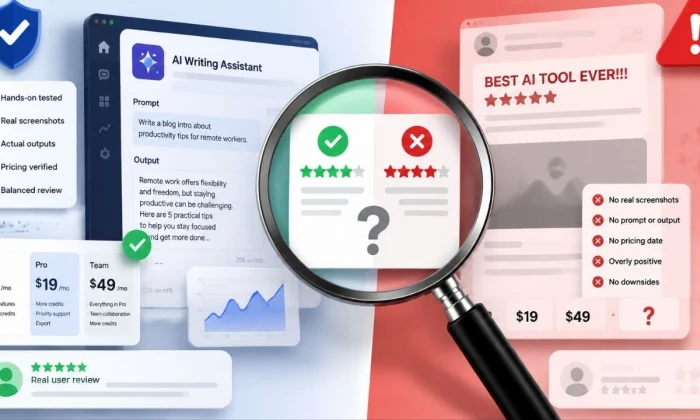
Buying an AI tool after reading one polished review can be risky. Some reviews repeat the product page, hide limitations, use fake screenshots, ignore pricing changes, or recommend every tool because of affiliate commission. Before paying for software, you need to know whether the review is based on real testing, current pricing, and honest limitations.
Here is the uncomfortable part: a review can include screenshots, ratings, pros and cons, and a neat pricing table and still be misleading if the writer never actually used the tool. This guide is about telling the difference. You will learn the warning signs of a weak or fake review, what real testing proof looks like, how to verify pricing and user feedback, how to read affiliate and sponsorship signals, and a simple scorecard to rate any review before you trust it.
| Quick Answer: Fake AI tool reviews often look polished but lack real testing proof, current pricing screenshots, specific limitations, named alternatives, and user-feedback sources. Before buying software, check whether the review includes hands-on screenshots, exact test prompts, actual outputs, a pricing checked date, balanced pros and cons, real user reviews, and clear disclosure of affiliate links or sponsorship. Avoid reviews that sound promotional or repeat the tool's homepage. |
Most weak or fake reviews share the same tells. One on its own is not proof of anything, but several together is a strong signal to slow down. Watch for these:
| Warning sign | Meaning | Buyer risk |
| No real screenshots | Writer may not have used the tool | You trust untested claims |
| No test prompt or output | No proof of performance | Output quality may disappoint |
| No pricing date | Pricing may be outdated | You may face unexpected cost |
| Generic pros and cons | Review may be copied or AI-written | Important limits are hidden |
| Only positive points | Review may be promotional | You ignore the risks |
| No alternatives | Review lacks market context | You may miss better options |
| No author details | Low accountability | Trust is harder to judge |
| No disclosure | Affiliate bias may be hidden | The pick may be financially driven |
A trustworthy review shows real use; it does not just describe features. The clearest proof is the writer putting the tool to work in front of you. Strong reviews tend to include dashboard screenshots, the exact prompt entered, the actual output received, screenshots of settings, exports, or generated results, notes on what worked and what failed, the date of testing, and the device, browser, or app version where it matters.
| Proof element | Strong review example | Weak review example |
| Prompt | Shows the exact prompt entered | Says “we tested it” with no prompt |
| Output | Shows the real result or a screenshot | Only says “the output was great” |
| Screenshot | Shows dashboard, output, settings | Uses a homepage image |
| Testing note | Mentions a specific issue | Says “easy to use” only |
| Date | Adds the tested date | No timing mentioned |
| Failure | Names one failed result | No negative detail |
A real review does not need to be negative, but it should show at least one specific thing the tool did badly. Perfect reviews are rarely useful.
AI tool pricing changes often, so pricing proof matters as much as performance proof. A trustworthy review should include an official pricing-page screenshot, the date pricing was checked, the plan names, the monthly or yearly price, credit limits, free-plan limits, watermark or export limits, refund or subscription notes where available, and a clear disclaimer that pricing can change.
| Pricing detail | Check before trusting |
| Pricing source | Is it from the official pricing page? |
| Date checked | Is the date visible or mentioned? |
| Plan names | Do they match the official site? |
| Credits and limits | Are usage limits explained? |
| Free plan | Are the limits clearly stated? |
| Hidden costs | Are extra credits, API, or team seats mentioned? |
| Disclaimer | Does the review warn that pricing can change? |
Reviews that mention prices without an official source or a checked date should not be treated as reliable buying guidance.
The writing itself often gives a weak review away. Be wary when a review sounds like the tool's homepage, leans only on promotional words, repeats the same claim in different sections, says it is “perfect for everyone,” uses hype words with no substance, avoids real examples, makes vague claims like “it saves time,” gives ratings with no scoring criteria, uses fake certainty like “100 percent accurate,” or claims “no downside” or “best in market” without evidence.
| Suspicious phrase | Better review standard |
| “This tool is a game-changer” | Explain the exact workflow it improves |
| “Perfect for all users” | Mention who should and should not use it |
| “Very affordable” | Show pricing and a value comparison |
| “Highly accurate” | Show a test result and a limitation |
| “Easy to use” | Explain setup and where users may get stuck |
| “Best AI tool” | Compare it with named alternatives |
One of the best moves is to cross-check a review against real user feedback. No single platform is perfect, and reviews there can be incentivized too, but together they help you spot patterns. Useful places to look include G2, Capterra, Trustpilot, Reddit, Product Hunt, the App Store, Google Play, the Chrome Web Store, YouTube comments (read carefully), and official community forums.
| Source | Useful for | Caution | |
| G2 | B2B software feedback | Some reviews may be incentivized | |
| Capterra | SMB software reviews | Check review dates | |
| Trustpilot | Billing and support complaints | Some categories have low volume | |
| Unfiltered user discussion | Verify claims separately | ||
| Product Hunt | Launch feedback | Early praise may not reflect long-term use | |
| App Store | iOS app bugs and subscriptions | Region or version may vary | |
| Google Play | Android app issues | Reviews can vary by device | |
| Chrome Web Store | Extension issues | Check permissions and updates | |
Look for repeated themes, not one dramatic review. If many users mention the same billing issue, output-quality problem, or support delay, treat it as a real risk.
Affiliate content is not automatically bad; plenty of honest reviewers use affiliate links. What matters is transparency. The disclosure should be visible, sponsored posts should be labeled, the review should still include real cons, the alternatives should not all be affiliate links, the writer should explain the testing method, and the article should not manufacture urgency without a reason.
| Signal | Trust level |
| Clear affiliate disclosure plus real testing | Higher trust |
| Sponsored label plus a balanced review | Medium to high trust |
| Affiliate links with no disclosure | Low trust |
| Every tool gets five stars | Low trust |
| No screenshots but many buy buttons | Low trust |
| Cons are vague or harmless | Low trust |
Here is a side-by-side you can run any review through. The more it looks like the left column, the more you can trust it.
| Review element | Trustworthy review | Weak or fake review |
| Author | Named, with background | Anonymous or no context |
| Testing | Shows prompts and outputs | Says “tested” only |
| Screenshots | Real dashboard, output, pricing | Homepage or stock images |
| Pricing | Official source plus date | No source or date |
| Pros and cons | Specific and balanced | Generic or overly positive |
| Alternatives | Named real competitors | No comparison |
| Sources | Official docs and review platforms | No citations |
| Final verdict | Clear fit and non-fit users | Says everyone should buy |
| Disclosure | Affiliate or sponsor disclosed | Hidden monetization |
| Update date | Recently updated | Old or missing date |
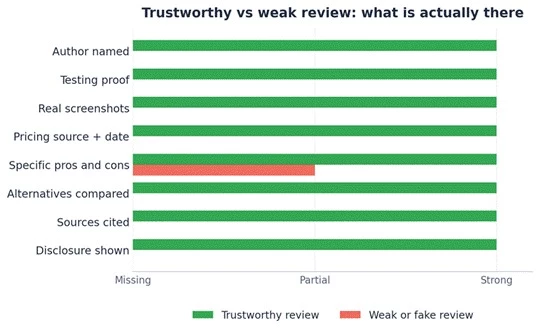
Figure 1: trustworthy vs weak, at a glance. An illustrative profile. A trustworthy review tends to score strong on every element, while a weak or fake one is mostly missing, often with only a vague pros-and-cons section to look balanced.
Before you pay for software based on a review, run through these steps. They take a few minutes and save a lot of regret.
1. Open the official website separately.
2. Check the current pricing page.
3. Compare the review's pricing with the official pricing.
4. Look for real-use screenshots.
5. Check the exact prompt and output examples.
6. Read the negative reviews on user platforms.
7. Compare at least two alternatives.
8. Test the free plan or trial.
9. Check the cancellation and refund rules.
10. Avoid uploading sensitive data during the trial.
11. Calculate the real cost based on credits or usage.
12. Decide after real testing, not only the review.
Not every step needs equal effort. If you are short on time, weight it roughly like this:
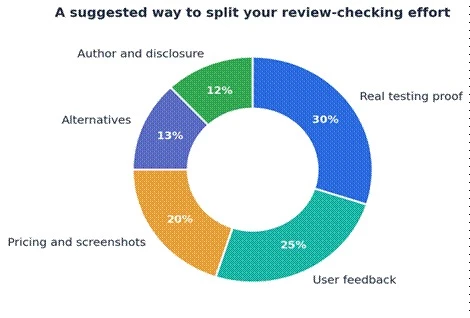
Figure 2: where to spend your checking time. A suggested split, not a rule. The biggest weight goes to real testing proof and user feedback, because those are the hardest things for a fake review to fake.
Flipping it around, here is what a genuinely good AI tool review includes. If you ever write one, this is the bar; if you are reading one, this is the checklist:
A good review is also transparent about who wrote it and how it was tested. A trust block like this near the top or bottom is a healthy sign:
Real Review Example
A quick before-and-after to make this concrete.
Weak review:
| “Tool X is the best AI writing tool for everyone. It saves time, creates amazing content, and is very easy to use. The pricing is affordable and the features are powerful.” |
Why it is weak: no test, no pricing proof, no specific use case, no downside, no alternatives, and a purely promotional tone. It tells you nothing you could not get from the homepage.
Stronger review:
| “Tool X worked well for creating short product descriptions, but the long-form blog draft needed heavy editing. During testing, the prompt asked for five ecommerce descriptions under 80 words. The tool followed the length limit but repeated similar benefit phrases in three outputs. Pricing was checked from the official page on [Date], and users should verify current credit limits before subscribing.” |
Why it is stronger: a specific use case, real testing detail, a clear limitation, a pricing date, and practical buying advice. You can actually decide from it.
If you want a repeatable way to judge a review, score it. Give each factor 0, 1, or 2, then add it up.
| Factor | Score 0 to 2 |
| Real screenshots included | 0 / 1 / 2 |
| Exact prompt and output shown | 0 / 1 / 2 |
| Pricing checked from official source | 0 / 1 / 2 |
| Specific cons included | 0 / 1 / 2 |
| Alternatives compared | 0 / 1 / 2 |
| User feedback cited | 0 / 1 / 2 |
| Author or editor details included | 0 / 1 / 2 |
| Affiliate disclosure clear | 0 / 1 / 2 |
| Security or privacy discussed | 0 / 1 / 2 |
| Final verdict is balanced | 0 / 1 / 2 |
| Score | Meaning |
| 0 to 6 | Low trust |
| 7 to 13 | Needs verification |
| 14 to 20 | More trustworthy |
Scored against a real review, the gaps jump out. Here is an example review run through the scorecard:
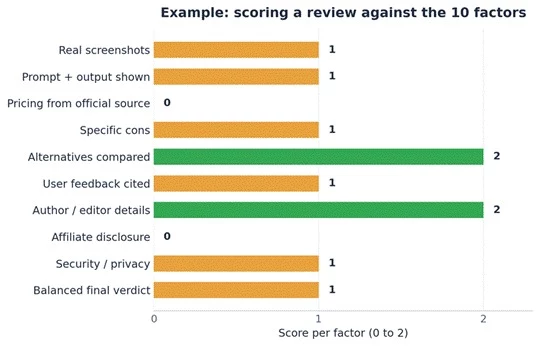
Figure 3: an example scored review. Illustrative scores, not a real product. The two zeros, missing pricing proof and missing disclosure, are exactly the gaps a buyer should chase down before trusting it.
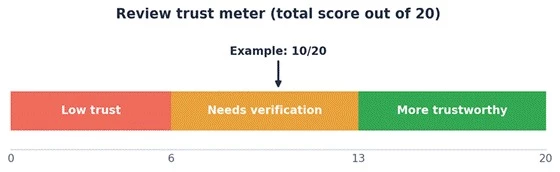
Figure 4: where the total lands. That example adds up to 10 out of 20, which sits in the needs-verification band. The review is not useless, but you would verify the pricing and disclosure yourself before buying.
Each kind of AI tool has one extra tell. If the review skips this, treat it as untested for that category.
| AI tool type | Extra red flag |
| AI writing tools | No sample prompt or output |
| AI image tools | No generated image examples |
| AI video tools | No credit usage or output screenshot |
| AI chatbot tools | No workflow test or support transcript |
| AI SEO tools | No SERP or content-brief example |
| AI coding tools | No code test or error discussion |
| AI meeting tools | No transcript or summary test |
| AI automation tools | No workflow screenshot |
| AI voice tools | No audio sample or voice-settings proof |
| AI data tools | No dataset or dashboard example |
Finally, the buyer-side habits that lead to bad purchases, and what to do instead.
| Buyer mistake | Risk | Better approach |
| Trusting one review | Biased decision | Read multiple sources |
| Ignoring the pricing date | Wrong cost estimate | Check official pricing |
| Skipping the free trial | Tool may not fit | Test with a real task |
| Trusting only star ratings | Ratings can mislead | Read detailed reviews |
| Ignoring negative reviews | Misses repeated issues | Look for patterns |
| Buying an annual plan too early | Harder to switch | Start monthly or trial |
| Uploading sensitive data | Privacy risk | Check the data policy first |
| Believing perfect reviews | Hidden limitations | Look for concrete cons |
A few habits protect both your money and your data:
• Do not buy based only on affiliate hype.
• Do not upload confidential data into unverified tools.
• Check the cancellation policy.
• Check the refund rules.
• Keep screenshots of pricing before you purchase.
• Review the terms before rolling a tool out to a team.
• Use human review for important AI outputs.
• Avoid tools that make unrealistic accuracy or income claims.
• Report misleading reviews where appropriate.
Tick these off before you pay. If most are blank, you are not ready to buy yet.
| Check | Done |
| Official pricing checked | [ ] |
| Pricing date visible | [ ] |
| Real screenshots included | [ ] |
| Exact prompt and output shown | [ ] |
| Specific limitations included | [ ] |
| Alternatives compared | [ ] |
| User reviews checked | [ ] |
| Author or editor identified | [ ] |
| Affiliate disclosure visible | [ ] |
| Privacy and security mentioned | [ ] |
| Free trial tested | [ ] |
| Refund and cancellation terms checked | [ ] |
A real AI tool review should help you avoid mistakes, not push you toward a quick purchase. If a review has no testing proof, no pricing date, no specific downside, and no comparison with alternatives, treat it as a starting point only, not a buying decision.
The safest decision comes from checking proof, not polished language. Verify the official pricing, test the tool yourself on a real task, and look for repeated feedback from real users before paying. Do that, and a glossy fake review loses its power over your wallet.
Share your thoughts about this article.
Be the first to post a comment!
Software rarely gets removed. It accumulates. A team hits a snag, someone finds...
Deepak Mehra1 month ago

⚑ The short versionAn AI detector returns a probability, not a verdict. Th...
Sakshi Dhingra1 month ago
Picture the last time you called a business after hours. You already know the so...
Pritam Singh1 month ago
Here is the uncomfortable truth about buying an AI chatbot for customer support...
Harpreet Singh1 month ago
Cancelling a ChatGPT subscription takes less than two minutes, once you know whe...
Harpreet Singh1 month ago

AI assistants stopped being optional somewhere in the last two years. Four in fi...
Harpreet Singh2 months ago