
Techexample.org looks like a regular tech blog at first. It has categories for Future Tech, Gadgets and Reviews, Latest Tech News, and Tech Trend. It also publishes frequent posts on AI, apps, gadgets, online entertainment, football, casino-related topics, and general digital guides. That mix makes the site active, but it also raises an important question: is Techexample.org a reliable tech source or just a broad content site with weak editorial control?
The short answer is this: Techexample.org is a real website, but it should not be treated as a strong authority source. It has basic pages such as About Us, Privacy Policy, Contact Us, Disclaimer, Terms and Conditions, and Write for Us. However, the site still has major trust gaps, including unclear ownership, generic author identity, mixed-topic publishing, and limited evidence of expert review or source-backed reporting.
TechExample.org is an active website with working pages, a contact form, HTTPS access, legal documents and regularly published content. During the public-page inspection, no forced file download appeared.
Those basic signals are not enough to establish editorial reliability.
The site does not clearly identify its owners, editors or writers. Its About page describes a team but names no team members. Its articles generally use “admin” as the author, and the website openly offers instant do-follow backlinks to guest contributors. Technology content is mixed with gambling material and a large number of unrelated external links.
| Review area | Finding | Assessment |
|---|---|---|
| Website accessibility | Public pages loaded normally | Positive |
| HTTPS connection | The site opened over HTTPS | Basic positive signal |
| Ownership | No named owner or registered company was found | Weak |
| Author transparency | Sampled posts were attributed to “admin” | Weak |
| About page | Available but highly generic | Weak |
| Contact options | Form, email addresses and WhatsApp numbers appear | Mixed |
| Privacy documentation | A detailed Privacy Policy exists | Positive but generic |
| Editorial consistency | Technology content is mixed with gambling and unrelated topics | Poor |
| Source quality | Sampled articles provide limited primary sourcing | Poor |
| External links | Numerous betting and casino links are visible | Major concern |
| Overall trust | Real website but weak editorial accountability | Low |
My overall assessment is 4 out of 10 for trustworthiness. This is an editorial trust score, not a malware-detection result.
The live website was manually inspected on July 24, 2026. The review covered the homepage, About page, Contact page, Privacy Policy, Disclaimer, Terms and Conditions, Write for Us page and a sample of recent articles.
The inspection considered page accessibility, author presentation, ownership disclosures, contact consistency, data-collection statements, topical relevance, article sourcing, external links, guest-post policies and visible download behaviour.
| Test | Result |
| Homepage inspection | Loaded successfully |
| Navigation inspection | Main categories worked |
| About-page inspection | General description found, but no identifiable team |
| Author inspection | Sample articles displayed “admin” |
| Contact-form inspection | Name, email and message fields were present |
| Privacy inspection | Personal data, usage data, cookies and tracking were mentioned |
| Terms inspection | Generic provisions and an unrelated domain reference were found |
| Guest-post inspection | Instant do-follow backlinks were promoted |
| External-link inspection | Numerous casino and betting links were visible |
| Download test | No download was required for the sampled pages |
| Malware test | Not performed |
This was not a forensic security audit. Files were not downloaded, scripts were not reverse-engineered and the website’s server was not penetration-tested. The results therefore support a conclusion about visible trust and editorial quality, not an absolute declaration that every page or external link is technically safe.

Techexample.org positions itself as a general tech information blog, covering a wide range of topics. The site primarily focuses on technology explainers, delving into cloud, DevOps, and software concepts. It also addresses productivity and digital tools, alongside gadgets, apps, and gaming-related content. Additionally, the blog explores various trending tech subjects, offering readers insights into the latest developments in the tech world.
The site does not position itself as a SaaS product, marketplace, or service provider. Instead, it functions purely as a content-driven informational website.
On the surface, nothing about its layout or presentation suggests malicious intent.
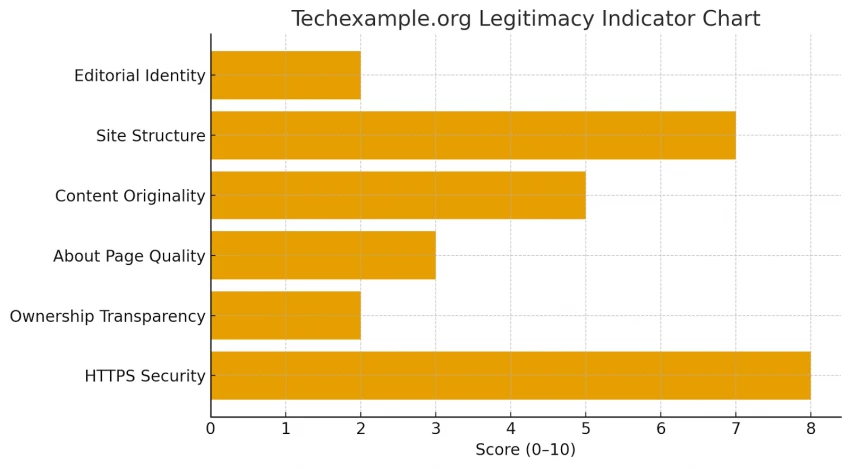
Domain & Website Behavior
Techexample.org:
These are all signals of a real, functioning website, not a fake landing page.
Lack of Public Ownership Details
This is where the legitimacy becomes unclear:
Legitimate websites usually provide at least some identity details.
Techexample.org does not, making it difficult to know who is behind the content.
Generic About Page

The About page provides broad statements like:
“We provide tech knowledge.”
“We help readers understand digital topics.”
but does not mention:
Who runs the platform
This creates a gap in professional legitimacy, even though the site itself is genuine.
Several contact identities appear across the website.
The Privacy Policy and Terms pages provide an [email protected] address. The main footer displays a Gmail address and a Pakistan-linked WhatsApp number. The Write for Us page supplies a different Gmail address and another Pakistan-based number. Banner-rental sections show a separate Gmail address and a United Kingdom number.
Operating with several contact channels is not inherently suspicious. Agencies and publishing networks often use separate editorial and advertising contacts.
The problem is that TechExample.org does not explain who these contacts represent, which business controls the website or why different brands and phone numbers are being used.
A clear company page could resolve much of this uncertainty. At present, the inconsistency weakens accountability.
The Privacy Policy is extensive and states that the website may collect email addresses, usage data, IP addresses, browser information, cookies and tracking data. It also discusses user accounts, purchase contracts, push notifications and saved login details.
Many of those features were not evident during the public-site inspection. This suggests that the policy may be based on a broad legal template rather than a document carefully matched to the website’s actual functions.
The Terms and Conditions page contains an especially unusual detail. Within the definition of the website, an unrelated domain named qasim786.net appears beside the correct TechExample.org address.
That may be a copying, editing or link-insertion error. Regardless of the cause, it shows that the legal page was not adequately checked before publication.
The existence of privacy and terms pages is better than having no policies. Their usefulness is reduced when they include unrelated or apparently inapplicable information.
Technical Safety Indicators
During analysis, Techexample.org demonstrated a clean browsing experience, with no signs of suspicious activity. The website showed no suspicious redirects, malware-like behavior, forced downloads, hidden scripts, or intrusive pop-ups. From a browsing standpoint, it appears to be safe.
Does It Ask for User Data?
No login system, no sign-up form, and no personal data collection were observed.
This reduces risk significantly.
Missing Safety Transparency
While Techexample.org is safe to navigate, it lacks important transparency in terms of safety. The website does not provide a privacy policy, cookie policy, terms of use, or clear data-handling explanations. Without these disclosures, users are left unaware of how the site manages analytics or handles visitor data.
External Links & Article Types
Some articles cover:
This inconsistency doesn’t necessarily indicate danger, but it does indicate loose editorial filtering, which impacts reliability.
Content Structure
The articles on Techexample.org are easy to read, beginner-friendly, and summarized in simple language, making the website a good resource for basic knowledge. Its accessible content structure ensures that even those with limited technical understanding can grasp the concepts.
Lack of Expert Indicators
Techexample.org lacks key expert indicators, such as author qualifications, technical references, source citations, verified data, and evidence of expert review. As a result, the information provided on the site is not independently verifiable, raising concerns about its reliability for in-depth or professional use.
Mixed Topical Focus
Techexample.org features a mixed topical focus, publishing content on tech guides, cloud topics, gaming articles, random trivia, and even casino-related posts. This lack of a clear niche suggests that the site focuses more on content aggregation rather than maintaining an editorial specialization, which can impact its trustworthiness and authority in specific areas.
Signs of AI-Assisted or Template-Based Writing
Many articles on Techexample.org follow identical structures and patterns, which suggests the use of possible AI assistance, outsourced bulk writing, and minimal human curation. While this doesn’t make the content harmful, it does lower the site's credibility by lacking the depth and personalization that comes with thorough human review and expertise.
Good For:
Not Good For:
Techexample.org is informational, not authoritative.
Yes, in the basic sense, Techexample.org is a real and functioning website. It has live content, navigation, policy pages, a contact form, and recent posts.
But if “legit” means transparent, expert-led, source-backed, and editorially reliable, then the answer is weaker. Techexample.org does not provide enough public proof of expertise, ownership, editorial review, or content accuracy.
A fair label would be:
Techexample.org is a real website, but it is a low-authority content site with weak E-E-A-T signals.
During the sampled inspection, the main pages loaded without forcing an executable download. That is a limited positive finding.
It does not justify saying that every external link is safe.
TechExample.org’s own Disclaimer says that the website does not guarantee that its service is free of viruses or harmful components. It also states that it does not control or guarantee the accuracy, relevance or completeness of external websites.
The safest interpretation is therefore:
| Question | Answer |
| Is TechExample.org a real website? | Yes |
| Did the sampled pages force a download? | No |
| Does that prove the whole website is malware-free? | No |
| Are all external links verified? | No evidence of that was found |
| Is the site editorially transparent? | No |
| Is it suitable as a final source for important decisions? | No |
HTTPS secures the connection between a browser and a website. It does not verify the accuracy of an article, the identity of its writer or the safety of every third-party destination.
Techexample.org may be useful when readers only want a light overview. For example, it can help someone discover a topic, understand a basic idea, or browse general tech-style content.
It may be suitable for:
But it is not ideal for:
The biggest caution is not one single article. It is the overall trust pattern.
Techexample.org looks like a tech site, but it also carries unrelated casino and betting links, guest-post language, generic author identity, and broad topic coverage. The combination suggests that the website may be more focused on publishing volume and backlinks than building deep expertise.
Readers should be careful when they see:
| Warning Sign | Why It Matters |
| “Admin” as author | No clear expertise |
| No real editorial team | Low accountability |
| Do-follow backlink offer | Suggests guest-post monetization |
| Betting/casino footer links | Weakens tech-site trust |
| Broad unrelated topics | Reduces topical authority |
| Few source links | Hard to verify claims |
| Generic policy pages | Limited real transparency |
| Category | Score |
| Website functionality | 7/10 |
| Ownership transparency | 2/10 |
| Author accountability | 2/10 |
| Policy availability | 6/10 |
| Policy accuracy and tailoring | 3/10 |
| Content sourcing | 3/10 |
| Topical consistency | 2/10 |
| External-link confidence | 1/10 |
| Commercial disclosure | 2/10 |
| Overall trustworthiness | 4/10 |
The score reflects visible trust and editorial factors. It should not be interpreted as an antivirus rating.
TechExample.org is a real and active website, but it does not currently demonstrate the transparency, authorship or editorial consistency expected from a dependable technology publication.
The strongest concerns are the anonymous “admin” authorship, generic ownership information, instant do-follow backlink offer, extensive gambling links, inconsistent contact identities and poorly tailored legal documents. The unrelated domain found inside the Terms page is another sign of weak editorial review.
There is not enough evidence to label the entire website a scam. There is also not enough evidence to recommend it as a trusted authority.
The fairest conclusion is that TechExample.org is a functioning but low-trust content website. It may help with casual topic discovery, but important claims should be checked against official documentation, named experts and established publications before being acted upon.
Is Techexample.org a scam website?
No. There is no evidence of scams, fraud, or malicious behavior.
Is it safe to open links on Techexample.org?
Yes, based on observed behavior, the site does not use harmful redirects or downloads.
Why doesn’t Techexample.org list authors or owners?
The site does not disclose this information publicly, which affects trust but not safety.
Does TechExample.org collect personal data?
Its Contact page collects names, email addresses and messages. Its Privacy Policy also says it may collect usage data, IP addresses, cookies, browser information and device identifiers.
Share your thoughts about this article.
I’d say it’s decent for beginners who just want simple explanations. But if accuracy really matters, you should cross-check information. It’s more of a general info site than a trusted authority.
Login to replyA lot of articles feel too surface-level. If you’re looking for real technical depth, this isn’t the place. It’s fine for beginners, but beyond that, it doesn’t add much value.
Login to replyMy main concern is trust. There’s no clear information about who is writing the content, so it’s hard to rely on it for anything important.
Login to replyThe content is easy to read, but also very surface-level. It’s good for starting out, but doesn’t go deep enough if you really want to understand something properly.
Login to reply
Quick answerQuillBot and Stealth Writer are both AI rewriting tools, but they do...
Michael Hicklen3 weeks ago

AutoDraft AI looks appealing on the surface. It promises consistent cartoon char...
Muskan Kansay1 month ago
If you write scripts, build products, or publish videos, you have probably wonde...
Sakshi Dhingra1 month ago

Are you tired of spending hours creating invoices for your clients? I was,...
Sakshi Dhingra1 month ago

How I approached this review: I researched Wegic AI through its public site, pri...
Sakshi Dhingra1 month ago

PicLumen has been quietly creeping into AI creator circles for over a year now,...
Sakshi Dhingra2 months ago