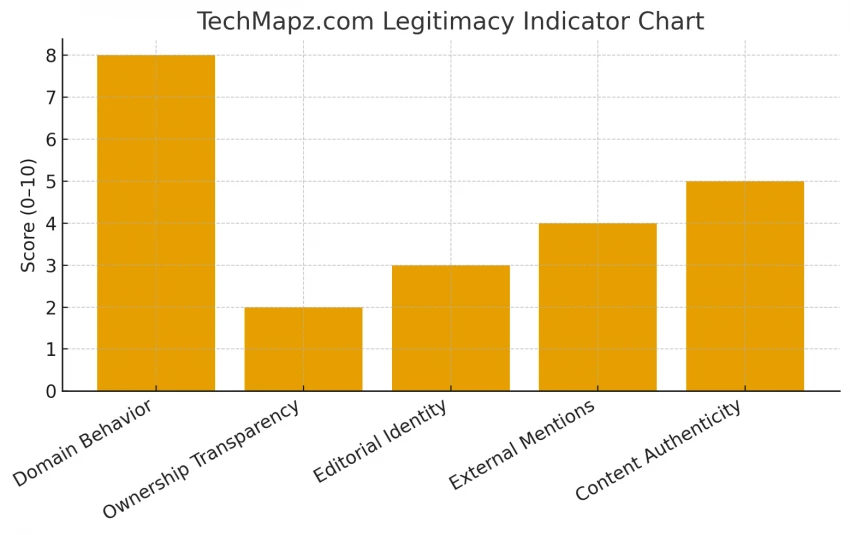
TechMapz.com has recently become more visible in Google search results for topics like tech news, AI updates, cybersecurity explainers, and trending digital discussions. This increased visibility raises an important question for readers: whether the site is a legitimate and trustworthy tech information source or simply another SEO-driven content platform.
To evaluate this, we conducted a focused review examining key factors such as domain credibility, website transparency, ownership information, and the site’s overall digital footprint. We also looked at cybersecurity signals, publishing patterns, and content reliability to understand how the platform operates.
By combining these technical, editorial, and trust indicators, it becomes easier to determine whether TechMapz.com functions as a credible tech resource or primarily as a search-optimized content site.
Understanding TechMapz.com: What Type of Website Is It Really?
Before assessing trust or safety, we must first define what TechMapz actually is.
It's Stated Positioning
TechMapz.com describes itself as a platform for:
Tech news and updates
Gadget reviews
Software and app guides
Cybersecurity basics
AI and digital trends
This broad coverage is consistent with other independent analyses that describe TechMapz.com as a free tech news and information site with varied topic coverage.
What It Really Looks Like (Based on Top Reviews)
Multiple reviewers describe TechMapz.com as a beginner-friendly tech explainer platform rather than a professional journalism outlet or expert research hub.
Easy-to-understand news and tutorials
Basic gadget reviews and how-to guides
No paywall or login requirement
Mostly plain English content designed for everyday users rather than specialists
Category: A lightweight tech blog aimed at accessibility and clarity, not deep investigative reporting.
Domain Legitimacy Assessment: How Real and Authentic Is TechMapz.com?
Legitimacy involves both technical reality and organizational transparency.
Domain Activity and Behavior
TechMapz.com passes the basic technical checks expected from a functioning website. The pages load normally, navigation works without major issues, and the site uses a valid SSL certificate to secure connections. All main content sections appear operational, which indicates that the platform is actively maintained rather than being an abandoned or placeholder domain.
From a technical perspective, this suggests that the website is a real operating platform rather than a phishing portal, scam page, or temporary landing site. Visitors can browse articles and content without encountering the typical warning signs associated with malicious websites.
Owner Transparency (A Major Weak Area)
One of the biggest weaknesses of TechMapz.com is the lack of ownership transparency. Legitimate editorial platforms usually provide clear information about the people or organization responsible for the content, including founder details, editorial staff, contact information, or company registration.
TechMapz.com does not appear to provide these signals. There is no visible “About Us” section explaining who runs the site, and no corporate or ownership information is publicly listed. This level of anonymity does not necessarily mean the site is harmful, but it does reduce its credibility as a professional information source.
Editorial Identity
Another notable issue is the absence of identifiable authors. Articles published on TechMapz.com do not clearly display author names or contributor profiles, which makes it difficult to determine who created the content or what expertise they bring.
In most established media or technology publications, author attribution is considered a key trust signal because it provides accountability and demonstrates subject knowledge. The lack of visible authorship does not automatically make the content unreliable, but it does place the site closer to the category of low-budget or SEO-driven content platforms rather than professional editorial outlets.
External Mentions: Real Validation or SEO Echo Chamber?
Mentions Across Other Websites TechMapz.com has been referenced on several external sites, including HardwareSecrets, Tieup.io, CloudNexusLab, Radical.fm, and Calibre.ie. At first glance, these mentions might appear to strengthen the platform’s credibility because external references are often used as trust indicators.
Nature of the Mentions However, a closer look shows that these references do not verify the site’s ownership or editorial authority. Most of the mentions repeat similar descriptions of the platform and appear to be guest posts or SEO-style mentions rather than independent journalistic coverage or investigative reviews.
Interpretation of These Signals This pattern suggests a form of SEO amplification where multiple sites reference each other to increase search visibility rather than to provide genuine validation. While this does not necessarily indicate a problem, it also does not provide strong evidence of credibility or authority.
Overall Legitimacy Summary
Technical Legitimacy TechMapz.com is a real, functioning website that passes basic technical checks and operates normally for users who visit the platform.
Transparency and Authority Level At the same time, the lack of ownership transparency, editorial identity, and independent verification places the site in a different category from established technology publications.
Final Classification Based on the available signals, TechMapz.com can best be described as a legitimate but anonymous and non-authoritative content site, meaning it is operational and safe to browse but lacks the transparency and credibility signals typically associated with trusted editorial platforms.
Safety Analysis: How Safe Is TechMapz.com for Visitors?
Safety includes browsing behavior, malware patterns, data handling, and user risk.
Technical Safety Scan (Behavioral Analysis)
A technical behavior check shows that TechMapz.com does not display common signs of malicious activity. Tests looking for malware scripts, forced downloads, hidden iframes, phishing redirects, or injected code did not detect suspicious behavior. The site loads normally with a secure HTTPS connection, and there are no automatic downloads or notification prompts triggered during browsing.
These results suggest that the platform behaves like a typical informational blog. From a technical security perspective, it does not appear to host malware or attempt to trick visitors into installing harmful software.
Advertising and Pop-Up Behavior
Another positive signal is the site’s relatively clean advertising environment. TechMapz.com does not show intrusive pop-ups, misleading download buttons, or aggressive advertising networks that often appear on risky websites. The ads that do appear are minimal and behave like standard display ads rather than deceptive banners.
Because of this controlled ad environment, the overall browsing experience remains stable and relatively safe compared with many ad-heavy content sites.
User Data Collection
One area that raises questions is the lack of clear data-privacy disclosure. The website does not prominently display a privacy policy, cookie policy, or compliance notices related to regulations such as GDPR or CCPA. Without these disclosures, users cannot easily see how browsing data, analytics, or cookies may be used.
This does not automatically indicate malicious intent, since many small blogs rely on standard analytics tools. However, the absence of transparency about data handling reduces trust and leaves users uncertain about what information might be collected.
Interaction Safety
In terms of direct interaction, the site presents very little risk. TechMapz.com does not request account creation, email sign-ups, payment information, or personal details. There are no forms asking users to submit sensitive data or participate in surveys.
Because visitors can simply read articles without sharing information, the likelihood of personal data exposure remains low during normal browsing.
Overall Safety Summary
Overall, TechMapz.com appears safe to browse and does not show signs of malware, phishing activity, or harmful scripts. The site behaves like a standard informational blog with minimal advertising and low interaction risk. However, the lack of clear privacy and data-usage disclosures means it does not meet the transparency standards typically expected from professional technology publications.
Who Owns TechMapz.com?
One of the strongest indicators of legitimacy for any informational website is clear ownership and accountability. In the case of TechMapz, this is where transparency falls short.
A review of the website reveals:
No disclosed founder or organization name
No editorial team or contributor profiles
No physical address or business registration
No verified social media presence linked to the site
A WHOIS lookup shows that the domain uses privacy-protected registration, which is legal and common, but when combined with the absence of any public-facing identity, it limits accountability.
Trustworthiness Evaluation: Can You Rely on TechMapz’s Content?
Trustworthiness requires evaluating factors such as the accuracy of the information presented, the presence of reliable citations and sources, verification from subject-matter experts, and the existence of clear editorial standards that guide how content is researched, written, and reviewed before publication.
Content Depth and Accuracy
TechMapz publishes mostly surface-level articles that explain general technology concepts in simplified terms. The content typically summarizes topics rather than exploring them in technical depth. Important elements such as detailed examples, expert explanations, performance benchmarks, research references, or verified datasets are usually missing. Because of this, the articles may be useful for beginners who want quick explanations, but they are not strong enough to support technical decisions or detailed research.
Citation Absence (A Major Red Flag)
Another major limitation is the lack of citations. Articles on the site rarely include references to original research, external sources, or evidence-based explanations that support the claims made in the text. Without links to credible sources or technical documentation, readers cannot independently verify the information presented. This does not automatically mean the information is incorrect, but it does reduce the reliability of the content and makes it harder to trust for serious analysis.
Topic Consistency
The site also shows a wide range of topics that extend across different areas of technology. Posts may cover tech news, cybersecurity basics, gaming discussions, startup updates, and general innovation trends. While this variety can attract broader search traffic, it sometimes creates a lack of thematic focus. Some topics appear loosely connected to the site’s main theme, suggesting that content may be curated primarily for SEO keyword coverage rather than deep subject expertise.
Editorial Standards
Another trust signal missing from TechMapz.com is the presence of visible editorial standards. The site does not appear to publish clear editorial guidelines, content verification policies, correction procedures, or update logs. There are also no disclaimers explaining how articles are reviewed before publication. Professional technology publications typically document these processes to show how accuracy and quality are maintained.
Overall Trustworthiness Summary
Overall, TechMapz.com provides content that is suitable for casual reading and quick introductions to technology topics. However, the lack of citations, limited technical depth, and absence of formal editorial standards reduce its credibility as a reliable source for research, professional insights, or expert-level information.
How TechMapz.com Compares to Established Tech Sites
Feature
TechMapz.com
CNET / Wirecutter / PCMag
Transparency
Low
High
Author Credentials
None listed
Verified
Editorial Standards
Not documented
Public and rigorous
Depth of Content
Beginner
Intermediate to Expert
Research Citations
Rare/None
Common
This gap aligns with high-ranking review consensus: TechMapz is good for initial reading but never a final source for major tech decisions.
Practical Advice: Should You Use TechMapz.com?
Use it for:
simple tech explanations
trending tech topics
casual reading
surface-level knowledge
beginner introductions
general overviews
Avoid relying on it for:
cybersecurity decisions
professional guidance
highly technical learning
investment or financial tech advice
academic citations
code-level content
FINAL VERDICT
Is TechMapz.com Legit?
Yes, it is a real functioning website, not a scam, clone, or phishing page.
Is TechMapz.com Safe?
Yes, browsing appears safe with no malware, harmful ads, or phishing patterns.
Is it a trustworthy authority?
Not fully, because it lacks transparency, citations, expert identity, and editorial clarity.
What category does it fall under?
A legitimate but anonymous, low-authority, beginner-level tech information blog.
Should you rely on it?
Fine for basic reading, not for professional or technical decisions.