
When I first opened Lapzoo.com, it did not look like an obvious scam page. The site loaded normally, had HTTPS, showed categories, published recent articles, and even had basic pages such as About Us, Contact Us, Disclaimer, Privacy Policy, Terms and Conditions, and Write for Us.

But that is exactly why this page needs a closer safety check.
A risky website does not always look broken or suspicious at first glance. Sometimes the risk is not malware or stolen payment details. Sometimes the real problem is weaker: unclear ownership, low editorial accountability, thin content, guest-post style publishing, unrelated topics, and outbound links that make the site feel more like an SEO network than a trusted technology publication.
So, is Lapzoo.com a scam or legit?
My answer is: Lapzoo.com does not appear to be a confirmed scam based on the public signals I checked, but I would not treat it as a fully trustworthy tech source either. It is safer to view it as a low-trust, mixed-signal content site that may be okay for casual reading but not reliable enough for product decisions, finance advice, app downloads, or sharing personal information.
Searches like “Lapzoo scam,” “Lapzoo legit,” and “Lapzoo.com review” usually happen when a site looks polished enough to attract visitors but does not provide enough proof behind its identity.
That is the issue here.
Lapzoo presents itself as a site about smart technology, digital solutions, and online insights. On the surface, that sounds normal. Many tech blogs use similar positioning. The concern starts when you look beyond the tagline and ask simple trust questions:
Who owns the site?
Who edits the content?
Are the authors real specialists?
Are the articles tested or just rewritten from public information?
Why does a tech-style website also show so many casino, betting, finance, celebrity, and guest-post-style topics?
Why are there so many unrelated outbound links in the footer?
Those questions matter because Lapzoo is not just publishing harmless opinion pieces. It covers topics that can influence what readers click, trust, download, or believe. A site that gives tech, finance, business, and app-related information needs stronger accountability than a casual personal blog.
Lapzoo describes itself as a platform for “smart tech solutions” and says it wants to help businesses and individuals with innovation, efficiency, connectivity, automation, artificial intelligence, and digital transformation.
That sounds broad, but also vague.
The About page uses polished language, but it does not clearly tell the reader who is behind the platform. I did not find named founders, a real editorial team, author qualification details, company registration information, or a clear explanation of how content is reviewed before publishing.
That is the first important distinction:
Lapzoo has an About page, but it does not provide the kind of trust information a reader would expect from a serious technology publication.
A strong About page usually answers practical questions. Who runs the site? Where is the company based? What is the editorial mission? What qualifies the writers to review tech products? How are sponsored posts handled? How are corrections made?
Lapzoo’s About page mostly gives broad marketing statements. That is not enough to prove expertise.

I checked Lapzoo’s homepage, About page, Contact page, Write for Us page, and several visible post areas. The first impression was not “dangerous website.” The more accurate impression was “unclear editorial website with mixed trust signals.”
Here is what stood out.
Lapzoo’s navigation includes several broad categories: Tech, Finance, Business, Lifestyle, and Celebrities. That is already a wide content mix for a site that positions itself around smart tech solutions.
The homepage also showed recent posts around online casino, slot-style topics, betting-table content, business loans, gaming, lifestyle, kitchen inspiration, celebrity weight, and AI/data topics. This kind of topic spread makes the site feel less like a focused technology publication and more like a general guest-post content hub.
The bigger concern is the footer. The footer contains a large number of outbound links with casino, betting, slot, lottery, and gambling-related anchor text. For a tech publication, that is a serious trust issue. Even if those links are paid placements or old SEO links, they still affect how a reader may judge the site’s quality and editorial purpose.
I also found a Contact page with a contact form and a stated 24-hour response claim. But the page itself does not solve the ownership issue. Contact information is useful, but it is not the same as transparent editorial accountability.
The Write for Us page is also worth noticing. A site accepting outside contributions is not automatically bad. Many trusted websites accept guest writers. The problem is when guest-post activity becomes the main visible pattern and the site does not clearly separate editorial content, sponsored content, and paid link plaWhat I Noticed During the Live Site Check
To be fair, Lapzoo is not all negative.
The site has HTTPS, which means the connection between your browser and the site is encrypted. That is a basic safety requirement today. It does not prove the site is trustworthy, but its absence would have been a bigger problem.
The site also appears to be accessible, active, and regularly updated. It has multiple public pages, a working layout, recent posts, and normal navigation.
Another point: I did not find enough evidence to call Lapzoo a confirmed scam. Public safety data also points to a mixed result rather than a clear fraud label. Gridinsoft’s report lists a 59/100 trust score, notes an 18-month domain age, shows one provider warning, and describes the site as having both positive and cautionary signals.
That means the correct wording should be careful. “Confirmed scam” would be too strong based on the available evidence. “Fully trustworthy tech source” would also be too generous.
The more balanced label is: mixed trust, low editorial transparency, use with caution.
The biggest issue with Lapzoo is not one single red flag. It is the combination of several smaller trust problems.
First, the ownership is unclear. A reader can see the site name, but not the people or company clearly responsible for the content. For a serious information site, this matters.
Second, the editorial standards are not visible enough. I could not find a clear review policy, correction policy, testing method, sponsored-content disclosure, or author qualification process that would help readers understand how the site maintains accuracy.
Third, the content mix is too scattered. A focused tech publication can still cover adjacent topics, but Lapzoo stretches across tech, lifestyle, finance, celebrity, gaming, casino, and business content. That weakens topical authority.
Fourth, the gambling and betting-style outbound links create a major credibility problem. Readers do not need to be SEO experts to feel something is off when a “smart tech solutions” website has large blocks of unrelated casino links in its footer.
Fifth, the site’s articles often look more informational than investigative. They explain topics, but many visible pieces do not show strong evidence of hands-on testing, original screenshots, benchmarks, interviews, or product-level comparisons.
That is why I would not use Lapzoo as a final source before downloading an app, buying software, trusting a finance-related claim, or clicking through to unknown services.
For basic reading, Lapzoo appears relatively low-risk if you are simply opening an article and not entering personal information.
But “safe to browse” and “safe to trust” are not the same thing.
A site can be technically safe to open and still be weak as an information source. Lapzoo’s bigger risk is not necessarily that it will infect your device. The bigger risk is that the content may not be researched deeply enough, the ownership is not clear enough, and the external links may lead readers toward unrelated or lower-quality sites.
My practical advice is simple:
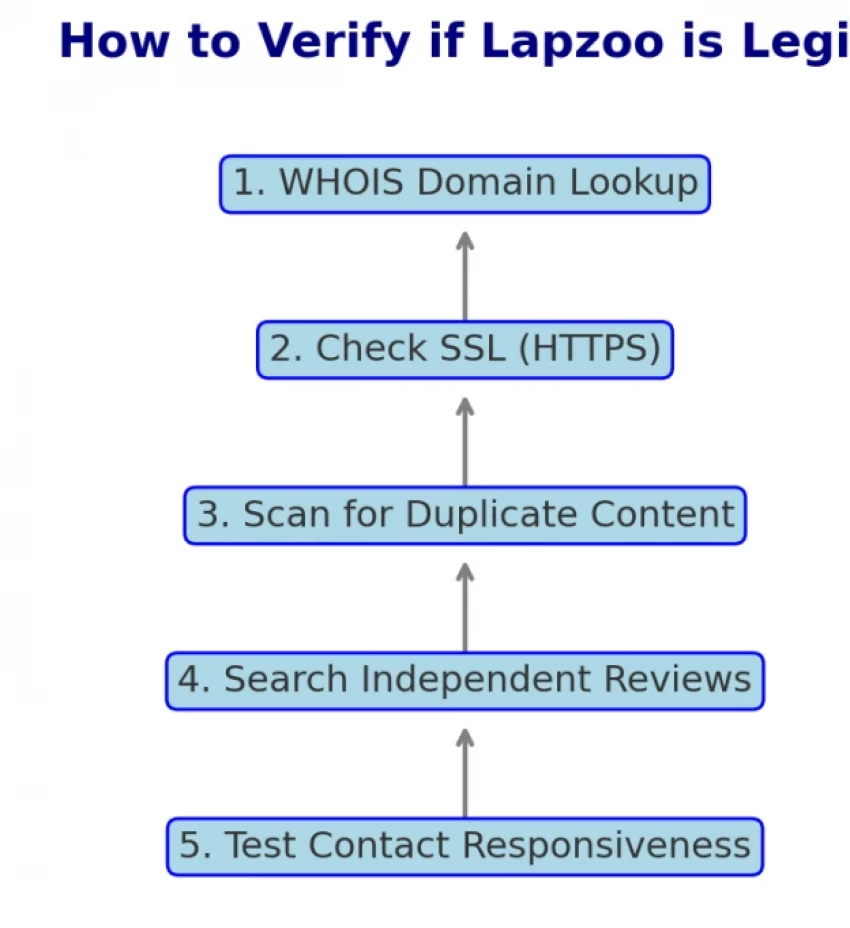
Before trusting Lapzoo, follow these legit-check steps that apply to any questionable website:
1. Run a WHOIS Lookup
Check domain registration details. If ownership is private or recently created, proceed cautiously.
2. Verify Security Protocols
Lapzoo does have SSL (HTTPS), but SSL alone doesn’t guarantee legitimacy — it only secures connections.
3. Cross-Check Content
Look for plagiarism or duplicate content across other blogs. Lack of originality is a red flag.
4. Seek Independent Reviews
Search for “Lapzoo reviews” on platforms like Reddit, Trustpilot, or forums. If feedback is scarce or mostly negative, treat it as suspicious.
5. Test Their Responsiveness
Send a query via their contact form or email. Legitimate sites usually respond promptly; scam-like sites often ignore messages.
I did not find a large body of verified user reviews for Lapzoo.
That matters.
If a site has thousands of users and a strong reputation, you usually see more independent discussion around it. People cite it, review it, complain about it, recommend it, or mention its writers. With Lapzoo, the feedback footprint appears limited and mostly focused on whether the site itself is trustworthy.
The lack of verified reviews does not automatically make a site a scam. Newer or smaller sites often have limited feedback. But when limited feedback is combined with vague ownership, broad content coverage, and questionable outbound links, caution becomes reasonable.
For readers, the best approach is to separate two questions:
“Can I read Lapzoo?”
Yes, casually.
“Should I trust Lapzoo as an authority?”
Not without cross-checking.
Engaging with websites that lack transparency can carry risks:
1. Misinformation Risk
Unverified content can mislead readers into poor tech choices or investments.
2. Data Privacy Concerns
If Lapzoo collects emails or personal info, the lack of ownership accountability creates risk of misuse.
3. Wasted Time & Effort
Relying on weak or copied content can waste valuable research time.
4. Potential Scam Traps
If in the future Lapzoo starts offering “services” or “products,” users may face financial risks if credibility remains unproven.
If you want trusted tech insights, consider:
Compared to Lapzoo, these platforms have:
Lapzoo.com is not a site I would label as a confirmed scam from the evidence currently available. It has HTTPS, public pages, regular posts, and no clear proof of direct fraud from the checks I reviewed.
But it also has several trust weaknesses that are hard to ignore.
The ownership is not clear enough. The About page is too generic. The content strategy feels scattered. The site does not clearly show first-hand testing. The footer contains many unrelated gambling and betting-style outbound links. External reputation data is mixed. User feedback is limited.
So my position is:
Lapzoo.com is probably safe enough for casual browsing, but it is not trustworthy enough to use as a primary source for important decisions.
Use it carefully. Cross-check everything. Avoid sharing sensitive information. Do not click unknown download, casino, betting, or financial links without independent verification.
1. Is Lapzoo.com legit?
Not confirmed. Missing transparency and lack of reviews make it questionable.
2. Is Lapzoo a scam?
No confirmed scam reports exist yet, but multiple red flags indicate high risk.
3. What should I do before trusting Lapzoo?
Perform checks: WHOIS, SSL, plagiarism scan, and review searches.
4. Are there safer alternatives?
Yes — TechRadar, CNET, Wired, and The Verge are more credible choices.
Share your thoughts about this article.
Be the first to post a comment!

Two Android phones can have the same amount of RAM, similar storage capacity, an...
Deepak Mehra3 days ago

A stolen password does not always look suspicious to a login system. If the user...
Deepak Mehra1 week ago

The short versionA Claude API key is created in the Claude Console at platform.c...
Harpreet Singh1 week ago

ChatGPT is owned by OpenAI, a San Francisco-based artificial intelligence compan...
Harpreet Singh2 weeks ago

Most teams already have the video. What they do not have is a way to search it....
Mighva Verma1 month ago

IoT analytics starts with a simple problem: connected devices keep sending data,...
Vesper Barnes1 month ago