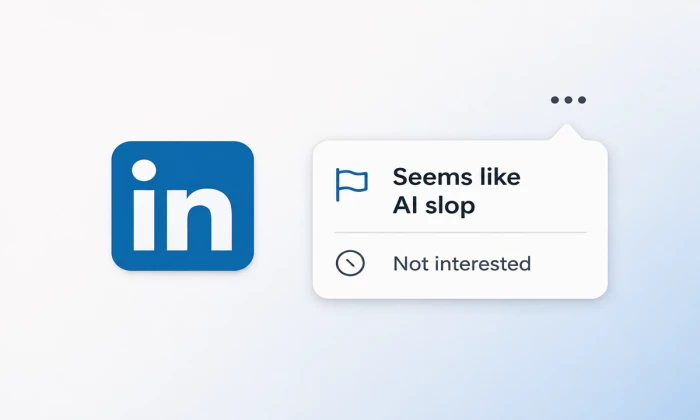
LinkedIn users tired of polished posts that say very little now have a new way to respond. The professional networking platform has introduced a “Seems like AI slop” option that allows members to flag posts and comments they believe are inauthentic, excessively automated or heavily dependent on generative AI.
The feature began appearing on July 30 inside the three-dot menu attached to LinkedIn posts. Selecting it immediately hides the content from that user’s feed and sends the feedback back to LinkedIn. The company says these reports will help improve the systems deciding which posts deserve wider distribution.
However, this is not simply a new content-removal button. LinkedIn appears to be treating each report as a signal for its recommendation models rather than automatically deleting or penalising the reported post.
LinkedIn Chief Product Officer Hari Srinivasan said the company is expanding its ability to let members identify posts and comments that appear to be AI slop.
According to Srinivasan, slop is difficult to define and its meaning continues to change. User reports will therefore be used to tune LinkedIn’s models and improve the quality of its feed. The company is also introducing new classifiers designed to identify both AI slop and generally low-quality content.
Those classifiers will particularly affect suggested posts and content published by people outside a member’s existing network. This means the biggest impact may be on posts attempting to reach large audiences through LinkedIn’s recommendation system, rather than updates shared mainly among established connections.
LinkedIn is additionally testing a private notification inside creator analytics. It could tell a user when other members felt that one of their posts sounded inauthentic or relied too heavily on AI. The platform has not explained how many reports would be needed to trigger such a warning or whether the reports will directly reduce a post’s distribution.
The wording of the button is unusually direct, but LinkedIn is not banning people from using AI to write.
Srinivasan acknowledged that many members use AI to organise, refine or proofread their ideas. LinkedIn’s position is that AI-assisted writing only becomes a problem when the result feels generic, misleading, automated or disconnected from the person publishing it.
That distinction is important because LinkedIn has spent years adding AI tools to its own platform. The company previously offered an “Enhance your post” feature that could rewrite a user’s content. It is now removing that tool and replacing it with a lighter proofreading feature intended to correct writing without changing the author’s voice.
The change suggests LinkedIn is reconsidering tools that encouraged users to transform personal thoughts into the same polished, corporate-sounding style now being criticised across the platform.
Recent research from AI-detection company Pangram estimated that more than 40% of long LinkedIn posts in its dataset were fully AI-generated. LinkedIn posts represented about one-third of all scanned content but accounted for 62% of everything Pangram classified as AI-generated.
Pangram’s findings were based on 1,002,627 posts collected from LinkedIn, Reddit, Medium, Substack and X between April and July 2026. Only content longer than 50 words was included in the analysis. Across all platforms, 13.8% of scanned items were classified as fully AI-generated, rising to 25.72% for posts containing more than 250 words.
LinkedIn has also disclosed the scale of automated activity hitting its platform. Srinivasan said the company now catches hundreds of thousands of automated comment attempts every day and has blocked billions of other automation attempts over the past several months. These include mass posting and other behaviour associated with low-quality content distribution.
The figures show that LinkedIn is dealing with more than employees occasionally using ChatGPT to clean up a paragraph. It is also fighting systems capable of publishing comments and posts at enormous scale.
Allowing users to identify inauthentic content gives LinkedIn a source of feedback that automated detectors cannot provide. It may help the platform identify writing that is technically original but still feels repetitive, empty or mass-produced.
At the same time, users are not reliable AI detectors.
A professionally written post, a carefully edited update or text written by someone using formal English could be incorrectly flagged. The button could also be misused against creators because of personal disagreements, unpopular opinions or coordinated reporting.
LinkedIn appears aware of that risk. Srinivasan said the company wants members to receive feedback from real people rather than depending entirely on an AI detector that may get the decision wrong. The reports are therefore likely to become one of several signals considered by LinkedIn, alongside automated classifiers, engagement patterns and account behaviour.
The new button highlights a wider problem facing professional social networks. LinkedIn depends on users believing that posts represent genuine experience, expertise and opinion. When executives, recruiters and creators begin publishing interchangeable AI-generated advice, the value of following an individual person becomes weaker.
LinkedIn is not attempting to remove AI from the platform. Its own job-search, recruitment, writing and recommendation products continue to rely heavily on artificial intelligence.
Instead, the company is trying to draw a line between AI that supports a person’s ideas and AI that replaces them.
Whether the “Seems like AI slop” button improves the feed will depend on how LinkedIn interprets the reports. Used carefully, it could reduce repetitive thought-leadership posts and automated comments. Used poorly, it could become another dislike button aimed at writing styles or opinions users simply do not enjoy.
For now, the button represents LinkedIn’s clearest acknowledgement yet that AI-generated sameness has become a serious problem for the professional feed.
Share your thoughts about this article.
Be the first to post a comment!

Quick answerTo rank in Google AI Overviews: first get into the organic top 10 (7...
Deepak Mehra4 days ago

Quick picks (if you just want the answer)Best overall: GPT Image 2 (ChatGPT) — #...
Nitin4 days ago

In 2026, the debate over AI coding assistants has effectively collapsed into a t...
Harpreet Singh4 days ago

Artificial intelligence is beginning to influence entire transportation networks...
Deepak Mehra6 days ago

Quick answerBlackbox AI is an AI coding assistant used for generating code, debu...
Harpreet Singh1 week ago

I did not set out to write a warning. I set out to find a cheap, fast tool that...
Nitin1 week ago