I first ran into MotionMuse AI the way many people probably do: by seeing a very direct promise on a clean landing page, take a photo, generate motion, and get a short animated video without needing a full editing stack.
The pitch is simple, almost aggressively so, and that immediately makes it interesting because it’s not trying to be everything at once. MotionMuse AI is positioned as an NSFW AI video generator and the homepage is explicit about that focus, which already separates it from the mainstream “text-to-video for everyone” crowd.
What makes this product worth talking about is not that it is the biggest name in the category; it’s that it is sharply defined. The official site says it turns images into videos, the pricing page lays out a credit system, and the privacy policy makes a strong promise that uploaded images and AI-generated videos are not shared with third parties. That combination, simple workflow, low-friction pricing, and explicit privacy language — is the core of the MotionMuse story.
MotionMuse AI is a browser-based image-to-video generator focused on short motion clips. The homepage says “Bring Your Photos to Live,” and the generator page labels it as an NSFW AI video generator, so its identity is not ambiguous. The product appears built for people who want quick visual animation rather than a long creative workflow with timelines, layers, masks, and manual editing.
The internal structure of the site also tells you what MotionMuse values. There is a “Collection” page for stored creations, a subscription page, and a privacy policy that specifically addresses user content retention and deletion controls. In other words, the product is not just a one-off generator; it is trying to be a repeat-use creation environment.
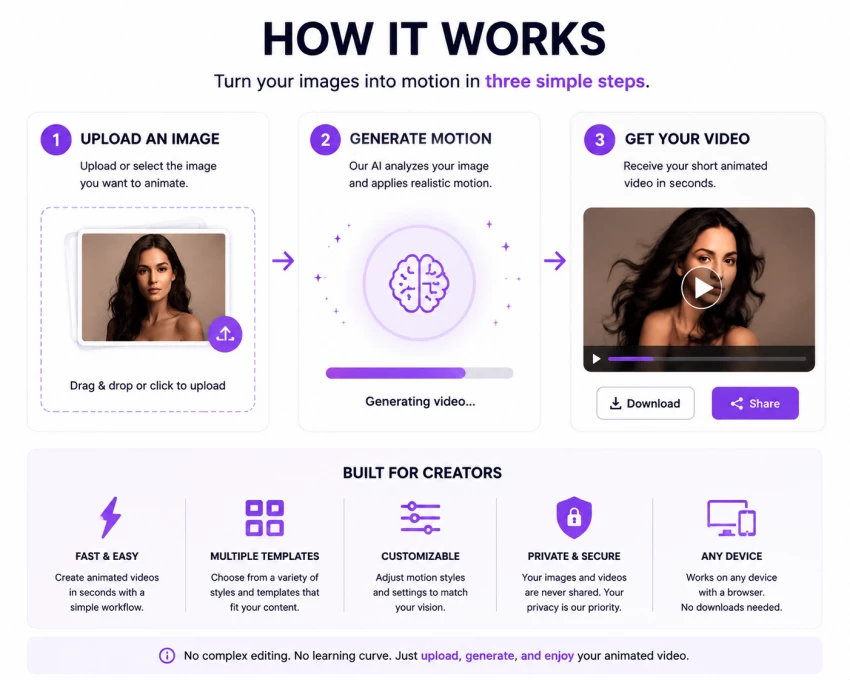
The workflow is refreshingly short. You upload or select an image, generate motion, and receive a short video output. The official copy repeatedly emphasizes speed, templates, and low complexity, which suggests that the product is designed for creators who want results quickly rather than deep control.
The pricing and subscription structure reinforce that idea. Free users get starter credits, while paid users gain larger monthly credit allocations, queue priority, and access to more templates and AI training tools. That makes MotionMuse less of a traditional software subscription and more of a usage-based media engine.
The pricing page is one of the clearest parts of the site, and it is probably the most useful section for buyers comparing value. MotionMuse AI offers four tiers: Free, Basic, Pro, and Premium, with annual billing highlighted as the default and the paid plans scaling by credits and queue access.
| Plan | Price | Credits | Best for | Key limitations |
| Free | $0 | 20 starter credits | Testing the platform | Very limited usage |
| Basic | $4.99/month | 300 credits/month | New creators, hobbyists | Smaller queue and fewer outputs than higher tiers |
| Pro | $14.99/month | 1500 credits/month | Regular creators | Still credit-limited and annual-billing based |
| Premium | $24.99/month | 3000 credits/month | Heavy users, studios | Highest tier, but still tied to credit consumption |
The site also shows crossed-out higher monthly anchor prices, indicating savings with annual billing. Basic is presented as $9.99 before discount, Pro as $29.99 before discount, and Premium as $49.99 before discount, which makes the current prices look intentionally entry-friendly. If you are evaluating MotionMuse seriously, the real question is not whether it is cheap; it is whether the credit system matches your production volume.
The available independent sentiment is limited, but the pattern is fairly clear. A Reddit thread asking for free image-to-video tools includes MotionMuse among alternatives people are actively considering, which suggests the name has some traction in niche creator circles. Another Reddit discussion about NSFW image-to-video options also references MotionMuse in the same category, again showing that it is known in the exact corner of the market it serves.
A separate review-style blog summary says feedback across Reddit, Quora, Facebook groups, and AI communities is mixed but constructive, with positive themes around fast turnaround and workflow simplicity. That fits the product’s own positioning very well: people are not praising MotionMuse because it is a giant feature-rich editor; they are valuing it because it gets to the point quickly.
The privacy policy is another practical strength. MotionMuse says it never shares uploaded images or AI-generated videos with third parties, it does not sell personal data, and content is retained until the user deletes it. For a tool handling sensitive creative content, that level of explicitness is not a minor detail, it is a major trust signal.
The biggest caution sign is that the public review ecosystem is thin. I did not find a meaningful body of G2, Capterra, or TrustRadius reviews for MotionMuse AI, which means there is no large verified enterprise-style review base to lean on. For a writer, that matters because it limits how confidently you can speak about average customer satisfaction.
There are also credibility concerns in some community commentary. One YouTube reviewer of an earlier Motion Muse product was skeptical of the testimonials and implied that the output was decent but not especially compelling for the money. That kind of feedback does not destroy the product’s case, but it does suggest that buyers should test before committing to a paid plan.
Because formal review sites are sparse, the best way to summarize sentiment is by using the scattered community signal that does exist. The tone is broadly mixed: people are interested in the concept, curious about the output, and attracted by the free tier, but they also want stronger proof of quality and consistency.
| Sentiment theme | What people seem to say | Signal strength |
| Positive | Fast generation, simple workflow, useful templates | Moderate |
| Positive | Good niche fit for NSFW image-to-video use | Moderate |
| Neutral | Easy to try because of free credits | Strong |
| Negative | Review coverage is thin and trust is limited | Strong |
| Negative | Some skepticism about testimonials and polish | Moderate |
If you were turning this into a visual for publication, a pie chart of sentiment would likely show a large neutral section, a meaningful positive segment, and a noticeable negative or skeptical slice. Since there is no large public review dataset, the most honest visualization would be labeled as “community signal,” not “verified review average.”
MotionMuse’s privacy policy is unusually important because the product handles user-uploaded images and generated videos. The policy says the company never shares uploaded images or AI-generated videos with third parties, never sells personal data, and only shares limited data with service providers, legal authorities, or in a business transfer context.
It also says content is stored until the user deletes it, rather than being automatically removed. That may be convenient if you want a collection archive, but it also means users should understand the retention model before uploading sensitive material. For a product in this niche, that transparency is one of the strongest parts of the website.
MotionMuse AI sits in a more specialized lane than general-purpose AI video tools. A broader video platform like MiriCanvas markets a general AI video generator for text and image use cases, which makes it more flexible for mainstream creative work. MotionMuse, by contrast, is more focused on a narrow adult-oriented image-to-video workflow.
| Tool | Main use case | Advantages | Disadvantages |
| MotionMuse AI | NSFW image-to-video | Focused niche, simple workflow, free entry | Narrow audience, limited review footprint |
| MiriCanvas video generator | General video creation | Broader mainstream appeal | Not specialized for NSFW use cases |
| Other image-to-video tools mentioned in Reddit communities | Alternatives and tests | More options for experimentation | Quality and reliability vary widely |
For buyers, the key difference is intent. If you want a general studio tool, MotionMuse is probably too niche. If you want a simple, fast, adult-oriented motion generator and like the credit-based model, it may be a good fit.
My honest verdict is that MotionMuse AI is a real niche product with a clear purpose, not a generic AI video platform pretending to be more than it is. It offers a low-friction way to test image-to-video generation, it is transparent about pricing, and its privacy policy is clearer than many tools in the same space.
At the same time, it does not yet have the depth of public reviews or broad trust signals that would make it easy to recommend without caution. The smartest recommendation is to start with the free credits, judge the output quality for yourself, and only move into paid plans if the credit system and generation style genuinely match your needs.
Overall score: 7/10 for niche fit, 5/10 for market trust, 8/10 for ease of trying.
Share your thoughts about this article.
Be the first to post a comment!

What Artlist AI is in 2026Artlist began as a royalty-free music library. By 2026...
Deepak Mehra3 days ago

Most AI tool failures do not announce themselves. There is no crash, no angry em...
Nitin1 week ago

How this assessment was carried outFindings come from primary sources: the publi...
Deepak Mehra1 week ago

Joyland AI won its audience on one promise: an anime character library that keep...
Deepak Mehra1 week ago

Character AI logs around twenty million monthly active users who spend close to...
Deepak Mehra1 week ago

“Useful” is a slippery word for a coding assistant. A tool can be brilliant at o...
Sakshi Dhingra1 week ago