
Multi-Agent AI is a branch of artificial intelligence where multiple autonomous agents operate in a shared environment, interact with each other, and collectively solve problems that are difficult or inefficient for a single agent to handle alone.
Each agent:
● Observes its environment
● Makes decisions independently
● Acts to achieve goals
● Interacts with other agents (cooperate, compete, negotiate)
The system’s behavior emerges from agent interactions, not from a single central controller.
| System Type | What It Is | Key Difference |
| Single-Agent AI | One AI makes all decisions | No interaction or coordination complexity |
| LLM Agent | One AI agent using an LLM to plan & act | Still a single decision-maker |
| Traditional Automation | Fixed rules and workflows | No autonomy or adaptation |
| Multi-Agent AI | Multiple autonomous agents | Distributed decision-making and interaction |
An agent is an autonomous decision-making entity.
An agent has:
● Perception (what it can observe)
● State / memory (what it remembers)
● Policy (how it decides)
● Actions (what it can do)
Example: A delivery drone deciding where to fly next.
The environment is everything the agent interacts with.
Examples:
● A road network
● A stock market simulation
● A warehouse floor
Agents exchange information:
● Messages
● Signals
● Shared memory
Communication can be direct (messages) or indirect (observing actions of others).
Coordination ensures agents do not work against each other.
Example: Multiple robots avoiding collisions while moving packages.
Agents resolve conflicts by bargaining.
Example: Two agents want the same resource and must agree on usage.
| Mode | Description | Example |
| Cooperation | Agents share goals | Warehouse robots |
| Competition | Agents have opposing goals | Trading bots |
| Mixed | Partial cooperation | Ride-sharing pricing |
Observe → Interpret → Decide → Act → Learn → Repeat
Each agent runs this loop independently.
Agent A ──message──▶ Agent B
▲ │
└────feedback──────┘
Large problems are split into sub-tasks:
| Task | Assigned Agent |
| Data collection | Agent 1 |
| Planning | Agent 2 |
| Execution | Agent 3 |
● Short-term memory: recent observations
● Long-term memory: learned patterns
● Feedback updates future decisions
One controller coordinates all agents.
● Easier to manage
● Less scalable
Example: Fleet routing with a central planner.
Agents make decisions locally.
● Highly scalable
● Harder to control
Example: Peer-to-peer energy grids.
Agents arranged in levels.
Manager Agent
├─ Worker Agent A
└─ Worker Agent B
Example: Enterprise AI task orchestration.
Simple agents follow simple rules.
● Complex behavior emerges
Example: Drone swarms, ant colony optimization.
| Domain | How MAAI Is Used |
| Finance | Trading bots, market simulations |
| Robotics | Warehouse robots, drones |
| Gaming | NPC coordination, strategy games |
| Supply Chain | Inventory & routing optimization |
| Cybersecurity | Autonomous threat hunting |
| Autonomous Vehicles | Traffic coordination |
Agents:
● Order Agent
● Restaurant Agent
● Driver Agent
Step-by-step:
1. Order Agent receives customer request
2. Restaurant Agent checks availability
3. Driver Agent evaluates distance
4. Agents negotiate delivery assignment
5. Best option is selected
No single agent controls everything.
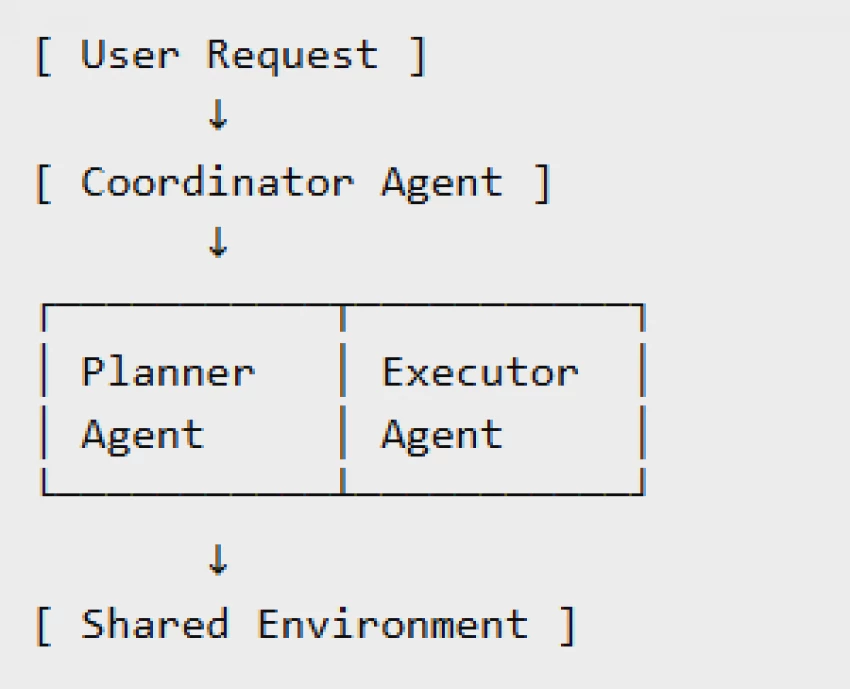
| Feature | Single-Agent | Multi-Agent |
| Scalability | Limited | High |
| Robustness | Low | High |
| Complexity | Low | High |
| Emergent behavior | No | Yes |
| Aspect | Rule-Based | Agent-Based |
| Adaptability | None | High |
| Learning | No | Yes |
| Autonomy | No | Yes |
| Human Teams | Agent Teams |
| Communication delays | Milliseconds |
| Fatigue | None |
| Alignment issues | Still exist |
Benefits-
1. Scalability-
Tasks are divided among multiple agents, so the system can handle larger and more complex problems by adding more agents.
2. Fault Tolerance-
If one agent fails, others continue working, making the system more reliable than single-agent AI.
3. Parallel Problem Solving-
Multiple agents work at the same time on different subtasks, reducing execution time and improving efficiency.
1. Coordination Failures-
Agents may produce conflicting or inconsistent outputs if communication and alignment are poor.
2. Higher Computational Cost-
Running many agents increases compute usage, inference calls, and infrastructure cost.
3. Harder Debugging-
Errors are difficult to trace because failures often arise from interactions between agents, not one agent alone.
| Challenge | Why It Happens |
| Emergent behavior | Local decisions create global effects |
| Alignment | Agents optimize wrong goals |
| Communication overhead | Too many messages |
| Security risks | Agent manipulation |
| Tool | Purpose |
| LangGraph | LLM-based agent orchestration |
| AutoGen | Multi-agent conversations |
| Ray | Distributed agent systems |
| PettingZoo | Multi-agent RL environments |
| JADE | Classical agent framework |
● Basic Python
● State machines
● Simple decision logic
● Reinforcement learning basics
● Game theory
● Distributed systems
● Build 2–3 agents communicating
● Add memory and feedback
● Emergent behavior analysis
● Security & alignment
● Scaling agents
● Complex math proofs
● Large-scale simulations
● Custom model training
Multi-Agent AI is not smarter AI — it is organized intelligence.
It mirrors how real-world systems work:
● Economies
● Ant colonies
● Human organizations
Understanding MAAI means understanding interaction, incentives, and coordination, not just models.
Be the first to post comment!

Why I looked into Leeco AI in the first placeOver the past few years, I have not...
Sakshi Dhingra12 hours ago
When I first came across Skipit, I approached it with a bit of skepticism. The A...
Sakshi Dhingra2 days ago

I didn’t start exploring Dzine AI because I was chasing the latest AI trend. I d...
Sakshi Dhingra3 days ago

The positioning of Promptchan within the AI ecosystem is often misunderstood. Wh...
Sakshi Dhingra1 week ago

A Personal Moment That Made Me Care About Online Coupons AgainA few months ago,...
Parveen Verma1 week ago

Choosing the right software used to be straightforward. You compared features, c...
Suraj Malik2 weeks ago