
Type "openfuture ai" into Google and you will find a strange mix of results. Half the internet says it is the largest AI tools directory on the planet. The other half is asking whether the site is even legit.
Both halves are sort of right, and that is exactly what makes this platform worth a proper look.
I spent a few days living inside openfuture.ai, pulled its complete traffic history from Ahrefs, cross-checked every trust score I could find, and read what actual users and independent reviewers say about it. This is everything I found, the impressive parts and the uncomfortable parts, in one place.
Before we get into the story, here is the fact sheet. Every number below was verified directly on the site or through Ahrefs on 21 July 2026.
| Attribute | Detail |
| Platform name | OpenFuture AI (openfuture.ai) |
| Type | AI tools directory and discovery engine, not an AI model |
| Tools listed | 40,502 total, with 570 marked as recommended |
| Categories | 75 category filters, from image generators to legal assistants |
| Languages | 13, including English, Vietnamese, Chinese, French, and German |
| Launched | Around 2023, during the first wave of AI directories. No official date is published. |
| Founder | Not publicly disclosed. No names, no company registration, no LinkedIn presence. |
| Pricing | Free to browse. Tool makers can submit listings, with paid promotion options. |
| Domain Rating | 55 (Ahrefs), with 1,820 live referring domains |
| Organic traffic | Roughly 143,000 estimated monthly visits from search as of July 2026 |
Table 1: The essential facts about OpenFuture AI, verified in July 2026.
OpenFuture AI is often confused with an AI chatbot or a writing tool. It is neither. The site is a searchable library where every entry points to somebody else's AI product. Think of it as a Yellow Pages for the AI boom. You search, filter, click a listing, read a one-line description, and hit a Visit Site button that takes you to the actual tool.
The homepage banner makes three big claims: largest tools directory, fastest updates, and the most accurate database. The first claim holds up better than the other two.

On size, the numbers are genuinely large. The all-tools view showed 40,502 entries when I checked, spread across 75 filterable categories. Popular sections like productivity, developer tools, and marketing each carry dense listings, and there are niche corners for things like motion capture, SQL assistants, and gift ideas.
None of this makes the directory useless. It is still one of the fastest ways to answer the question "what AI tools exist for X". A German tech publication, Zerlo, landed on a similar conclusion in its own analysis: the site works as a map of the landscape, but checking the quality and safety of any individual tool remains entirely your job.
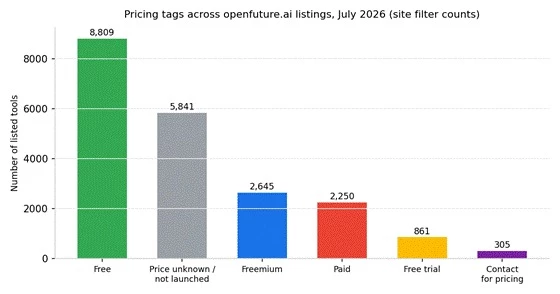
Figure 1: Pricing tags across openfuture.ai listings in July 2026, taken from the site's own filter counts. Free tools dominate, but nearly 5,900 listings carry no pricing data at all.
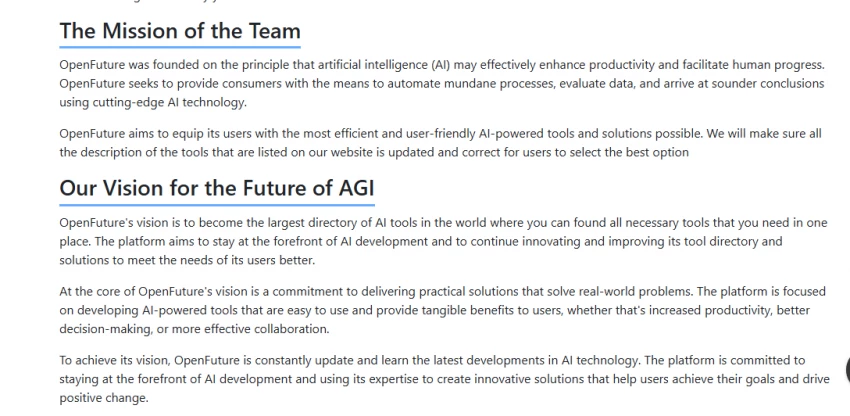
This is where my research hit a wall, and the wall itself is the finding. The About Us page talks about a mission to help people automate routine work and become the world's largest AI directory. What it never mentions is a single human being. No founder name, no team page, no company registration number, no office address, and no press coverage naming an owner.
The only trace of a person anywhere on the platform is a category called "Matt's picks", which suggests someone named Matt curates featured tools. Who Matt is, where he is based, and whether he is the founder is anyone's guess.
The founding year is similarly undocumented. Archive snapshots and third-party coverage place the launch around 2023, right in the middle of the post-ChatGPT directory gold rush, when dozens of similar sites like Futurepedia, Toolify, and FutureTools appeared within months of each other. OpenFuture simply never published an origin story.
For a content site, anonymity is not automatically damning. For a platform that decides which AI tools get recommended to hundreds of thousands of visitors, it matters. You cannot evaluate editorial independence when you do not know who the editor is.
Here is where the data gets genuinely interesting. I pulled the full organic traffic history for openfuture.ai from Ahrefs, going back to January 2024, and the chart looks less like a growth curve and more like a heart monitor.
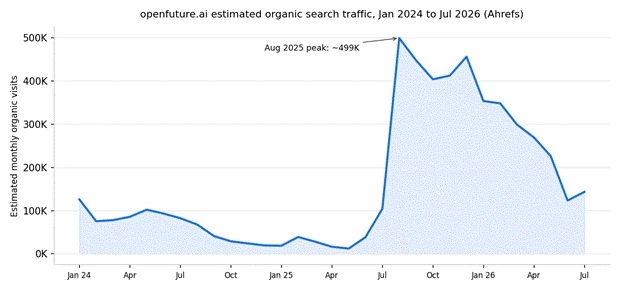
Figure 2: Estimated monthly organic search traffic for openfuture.ai from January 2024 to July 2026, based on Ahrefs data pulled on 21 July 2026.
Three distinct chapters show up in that line:
• Through 2024, the site slowly bled traffic, sliding from about 126,000 estimated monthly visits in January down to under 20,000 by December, which is the classic signature of a directory losing ground in Google's helpful content era.
• In August 2025 something dramatic happened, and traffic exploded from around 104,000 to roughly 499,000 estimated visits in a single month, then held above 400,000 for the rest of the year.
• Since January 2026 the tide has been going back out, with estimated traffic falling steadily to about 143,000 visits by July 2026, less than a third of the peak.
The keyword data explains most of the surge. The overwhelming majority of the site's search traffic is branded, meaning people typing "openfuture ai" or "openfuture.ai" directly into Google. The single keyword "openfuture.ai" pulls an estimated 39,000 monthly searches in the United States alone, and the site ranks first or second for it worldwide. Somewhere in mid 2025, a lot of people suddenly started searching for this site by name, most likely driven by viral social media mentions and listicles, and Google obliged.
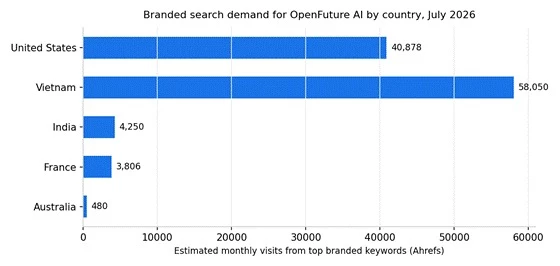
Figure 3: Estimated monthly visits from the top branded keywords by country. Vietnam and the United States together account for the bulk of branded demand, with India third.
Vietnam deserves a special mention. The Vietnamese keyword for a free OpenFuture chat tool alone carries an estimated 49,000 monthly searches, and Vietnamese users make up one of the largest visitor groups. Keep that fact in your pocket, because it becomes relevant again in a minute.
There is no Trustpilot page with thousands of reviews for OpenFuture AI, and no G2 or Capterra profile either, which already tells you something about how the platform positions itself. What does exist is a patchwork of automated trust scanners and independent write-ups, and they disagree with each other in a revealing way.
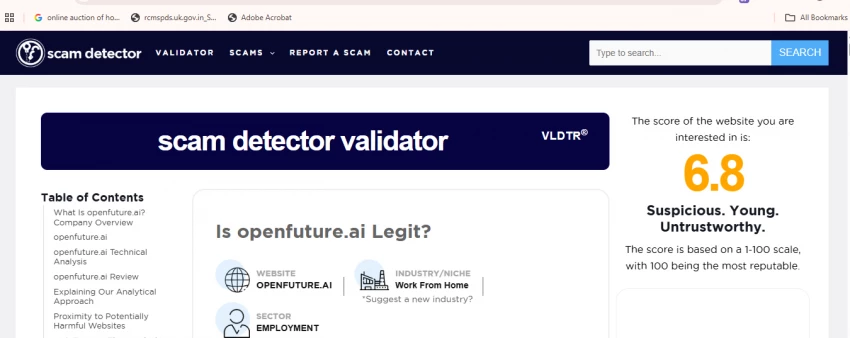
Scam Detector assigns openfuture.ai one of the lowest trust scores on its platform, a 6.8 out of 100, and tags the domain as suspicious based on its automated risk factors.
Gridinsoft, by contrast, scores the same domain 50 out of 100 and flags it as safe to interact with. Meanwhile, ranking platform RankmyAI places OpenFuture at 66 out of 428 among AI tool directories, a respectable mid-table position, while listing its company details, employee count, and country as unknown.
Independent reviewers land somewhere in the middle. The pattern across write-ups from tech blogs is remarkably consistent, and it matches my own testing:
One important warning for readers: a handful of sites in the search results confuse OpenFuture AI with other products entirely. Some describe it as an AI writing assistant that generates content from prompts, and one review site even lists clothing prices for it. Treat any page that describes OpenFuture as something other than a tools directory as unreliable. It is also a completely different entity from openfuture.eu, a European digital policy think tank that shares nothing with it except a similar name.
This is the part of the review I did not expect to write, and I have not seen a single other article mention it.
Scroll to the very bottom of the openfuture.ai homepage, past the tool listings and the category filters, and you will find an affiliate section containing hundreds of outbound links. They do not point to AI tools. They point overwhelmingly to Vietnamese-language online gambling, betting, and casino domains, hundreds of them, packed into the footer as plain anchor-text links.
I counted the links so you do not have to, and the picture it paints answers several questions at once:
To be clear about what this does and does not mean: browsing the directory itself appears safe in the ordinary sense. The AI tool listings are real, the outbound Visit Site links go where they claim, and nothing on the site asks you for money or sensitive data beyond an optional Google or Discord login. But a platform monetizing through a wall of undisclosed gambling links is making a very different trade-off with its credibility than, say, Futurepedia running sponsor banners. You should weigh its recommendations accordingly, especially the paid and promoted placements.
| Area | Strength | Limitation |
| Catalogue size | More than 40,000 AI tools | Large volume makes quality control difficult |
| Categories | Covers mainstream and niche use cases | Some tools may be placed in broad or inaccurate categories |
| Cost | Free to search and browse | Promoted listings may receive greater visibility |
| Tool pages | Provides quick descriptions and external links | Pages often lack detailed testing or comparisons |
| Ratings | Includes community voting features | Many listings have few or no votes |
| Languages | Supports 13 languages | Listing quality may differ across languages |
| Discovery | Useful for finding unfamiliar tools | Not reliable enough for final purchasing decisions |
Browsing the directory appears relatively low risk because visitors can search listings without creating an account or entering payment information. The main action is clicking an external link to visit a third-party AI product.
The greater risk begins after leaving OpenFuture AI. The platform lists tools from many different companies and does not appear to independently verify every product’s privacy policy, data retention practices, pricing claims or security standards.
Before uploading documents, personal information, business data or payment details to a listed tool, users should investigate the individual provider. OpenFuture AI’s inclusion of a product should not be interpreted as a security certification.
OpenFuture AI is most useful for researchers, marketers, founders and casual users who want to quickly discover products within a specific AI category. Its large database can expose users to smaller tools that may not yet rank prominently in Google.
It is less suitable for buyers who need a carefully tested shortlist. Businesses comparing software for sensitive workflows should rely on official documentation, independent testing, customer feedback and security assessments before making a decision.
The platform works better as the beginning of research than the final source used to approve a purchase.
After testing the directory, checking its listing quality, examining its search visibility and looking at its trust signals, I scored OpenFuture AI across the areas that matter most to someone trying to discover and compare AI tools.
| Area tested | Score | My assessment |
| Tool variety | 9/10 | The catalogue is exceptionally large and covers both popular and niche AI categories. |
| Ease of discovery | 8/10 | Categories and filters make it relatively easy to find tools for a specific task. |
| Listing accuracy | 5/10 | Several listings contain incomplete pricing information, short descriptions or outdated details. |
| Comparison value | 4/10 | Tool pages do not provide enough depth for meaningful side-by-side evaluation. |
| Community ratings | 3/10 | Many listings have few or no votes, limiting the usefulness of the rating system. |
| Ownership transparency | 2/10 | The platform does not clearly identify its founder, team or operating company. |
| Trust and credibility | 4/10 | Conflicting trust scores and unrelated footer links create legitimate credibility concerns. |
| Overall usefulness | 6/10 | Useful for discovering tools, but not dependable enough for making a final buying decision. |
My score reflects the platform’s mixed value. OpenFuture AI performs well as a broad discovery engine because its database contains more than 40,000 tools across 75 categories. However, its limited listing depth, weak rating activity, anonymous ownership and questionable footer links prevent it from becoming a fully trusted recommendation source.
I would use OpenFuture AI to generate an initial list of options, especially when researching a niche AI category. I would not rely on its descriptions, ratings or recommended labels without checking the tool’s official website, pricing page, privacy policy and independent user feedback.
OpenFuture AI succeeds at one clear task: helping users see the enormous range of AI products currently available. Its catalogue of more than 40,000 listings gives it an advantage over smaller directories, particularly when someone is searching for an unusual or highly specific tool.
Its real traffic history also shows that the platform has achieved genuine recognition. However, traffic and catalogue size are not the same as editorial authority. Thin descriptions, incomplete metadata, limited community engagement, unclear ownership and unrelated gambling links weaken the confidence users can place in its recommendations.
Based on my testing and scorecard, OpenFuture AI earns 6 out of 10. It is worth using as a discovery platform, but it should not be treated as the final source for deciding whether an AI tool is safe, reliable or worth paying for. The strongest approach is to find potential tools through OpenFuture AI and then independently verify each option before signing up or sharing sensitive information.
OpenFuture AI is two things wearing one domain. It is a genuinely large, free, and occasionally useful catalog of AI tools. It is also an anonymous, thinly maintained site whose real business model appears to have little to do with helping you pick software.
My honest recommendation splits by use case:
• Use it as a discovery net when you want to quickly scan what exists in a category, because 40,000 listings will surface names that smaller curated directories miss.
• Do not use it as a decision-making source, because the descriptions are too thin, the ratings are too empty, and the incentives behind recommended placements are too opaque to trust.
• Verify every tool independently before signing up, checking its own website, real user reviews, and its data practices, since OpenFuture does none of that vetting for you.
• If you are a tool maker considering a paid listing, weigh the domain's declining traffic curve and its footer neighborhood before spending, because a backlink from this site carries baggage along with its Domain Rating of 55.
The AI directory boom of 2023 produced hundreds of these sites, and most are quietly dying. OpenFuture AI survived by getting big and getting famous, at least for one viral stretch in late 2025. Whether it survives the current traffic slide with its credibility intact will depend on choices its unnamed operators have so far shown little interest in making.
Share your thoughts about this article.
Be the first to post a comment!
Job hunting in 2026 feels like a part-time job you never applied for. You refres...
Deepak Mehra1 day ago

You-TLDR is useful when you do not want to sit through a full YouTube video just...
Harpreet Singh1 day ago
Every week someone asks me the same thing. Should I keep paying for Quizlet, or...
Harpreet Singh2 days ago

MotionMuse AI pulled off something remarkable. It launched in April 2025 and was...
Deepak Mehra2 days ago

Every few months, a new earning app shows up in WhatsApp groups and YouTube comm...
Harpreet Singh2 days ago

The most common reason people search for Dippy AI alternatives is not bad writin...
Deepak Mehra4 days ago