Two SEO platforms. One small site, one client account, ninety days of side-by-side testing. Here's what the marketing pages don't tell you and which tool actually deserves your money in 2026.
TL;DR — THE 30-SECOND ANSWER If you do serious SEO across multiple sites, run paid search, or care about AI visibility , pick Semrush. If you're a solo operator, blogger, or small business who needs clean reporting and the industry's most-quoted authority metric, pick Moz. The price gap is real, but so is the capability gap. PICK SEMRUSH IF Multi-channel marketing, agency work, AI Overview tracking, deeper backlink filters, large content programs. PICK MOZ IF Tight budget, simple workflows, you live by Domain Authority, generous crawl limits without a tier upgrade. |
Most "comparisons" online are affiliate pages dressed up as reviews. I wanted to do this properly. So in early 2026 I ran both tools side by side for ninety days on the same two sites a niche content site I own (around 220 published posts, ~9,000 monthly organic sessions) and a small e-commerce client account I help manage. Same keywords, same competitors, same crawl cadence.
For the first three weeks I forced myself to run every workflow in both platforms — keyword research, site audits, competitor gap analysis, backlink monitoring, rank tracking. Not as a stunt. Just so I could feel where each tool's design philosophy actually shows up in daily work. Because the marketing pages all promise the same thing: "the all-in-one SEO platform."
They are not the same tool. They aren't even close.
A small disclosure. I paid for both subscriptions out of pocket — Semrush Guru and Moz Pro Standard — using the annual billing rate. No vendor sponsored this piece. If anything, the conclusions might annoy both their marketing teams.
Both tools maintain their own crawl of the web. The numbers they advertise as of early 2026:
Semrush: ~27.8 billion keywords, ~43 trillion backlinks, ~808 million domains.
Moz: ~1.25 billion keywords, ~45.8 trillion backlinks, ~1 billion domains.
On paper, Moz's backlink index is actually slightly larger. Semrush's keyword database is dramatically larger — roughly twenty times. Both vendors update these numbers, and "index size" is partly a marketing flex, but the directional gap on keywords is consistent with what I felt while using them.
Index sizes as reported by each vendor. Bars scaled within category; labels show absolute values.
In practice, the keyword index size shows up immediately. When I queried niche, long-tail topics in Semrush's Keyword Magic Tool I'd often get 3–5x more variations than Moz's Keyword Explorer surfaced for the same seed. For broad, popular topics the gap closes, both find the obvious stuff. But content programs live in the long tail, and that's where Semrush has a measurable edge.
The backlink picture is murkier. On a few competitor sites I tested, Ahrefs found dramatically more referring domains than either tool, and between Semrush and Moz, results were within ~15% of each other on most domains. Bigger index doesn't automatically mean "finds the right links for your niche." Moz did surface a handful of older, lower-authority links Semrush had pruned. Semrush more often caught freshly-acquired links Moz hadn't indexed yet.
This is where the two tools' philosophies diverge most clearly.
Semrush's Keyword Magic Tool is the most comprehensive keyword research environment I've used. You enter a seed, and it returns thousands of variations with intent classification, SERP feature flags, keyword difficulty, CPC, trend lines, and (on Guru and up) AI Overview presence. The filters are surgical, you can carve a 10,000-keyword pile down to 47 high-intent, low-difficulty terms in about ninety seconds.
The downside: it's overwhelming if you don't already know what you're doing. The first time I used it I had eight tabs open and still wasn't sure which keywords to actually pursue.
Moz Keyword Explorer is built around a different question: which of these keywords should I actually go after? The Priority Score combines volume, difficulty, and Organic CTR opportunity into a single number. It's less data, but more guidance. For a beginner or someone managing one site, Moz gets you to a content brief faster.
One thing worth flagging: Moz's Keyword Difficulty tends to score easier than Semrush or Ahrefs for the same query. That's because Moz's KD is based primarily on Page Authority of ranking pages, not the deeper backlink profile data Semrush and Ahrefs factor in. Independent testing has shown Semrush correlates more closely with actual ranking difficulty in competitive niches. Practical takeaway: if Moz tells you a competitive query has KD 35, double-check it in another tool before committing content investment.
| Capability | Semrush | Moz Pro |
| Database scale | ~27.8B keywords | ~1.25B keywords |
| Variations per seed (niche) | 3–5x more | Solid for head terms |
| Difficulty calibration | Closer to actual SERPs | Tends to under-score |
| Decision aid for beginners | Steep learning curve | Priority Score is excellent |
| SERP features & intent | Granular filters | Yes, simpler |
| AI Overview tracking | Built-in (Semrush One) | Basic flag only |
My honest take: if you're publishing more than a few articles a month, Semrush will pay back its higher price within a quarter just on keyword discovery alone. If you're writing slowly and deliberately, Moz will save you hours of decision paralysis.
Backlink analysis is where Moz earned its reputation in the first place. Domain Authority — the 0–100 score Moz invented, has somehow become the lingua franca of the SEO industry. Outreach pitches reference it. Sponsored-post sellers price by it. Even Ahrefs and Semrush had to invent their own equivalents because the market refused to stop using DA.
That brand equity is real, and it's a genuine reason some teams stay on Moz even after testing Semrush. If your client reports lead with Domain Authority, swapping to Semrush's Authority Score means re-educating everyone in the chain.
Filtering depth. Semrush's Backlink Analytics lets you slice by anchor text, link type, country, traffic, follow/nofollow, and toxicity score in combinations Moz simply doesn't offer.
Toxic Links + auto-disavow. The Backlink Audit tool flags suspicious links and exports a Google-ready disavow file. Moz has Spam Score, but the workflow is more manual.
Freshness. Semrush surfaced new links on test domains noticeably faster than Moz over the 90-day window.
Backlink Gap analysis. Compare your link profile against up to four competitors at once. Moz's link intersect is functional but less polished.
The metric itself. DA's industry adoption is a feature, not a bug.
Spam Score. The triage layer for cleaning up a messy backlink profile is, frankly, easier to read than Semrush's toxicity scoring.
Cheap, transparent API access. Moz's standalone API tiers are a fraction of Semrush's enterprise API pricing. If you're a developer building dashboards, this is significant.
This category produced the most interesting tradeoff of the whole test.
Semrush's Site Audit is, technically, the deeper of the two. It checks 140+ on-page and technical issues, integrates Core Web Vitals, supports log file analysis, and surfaces issues clustered by severity with clear fix instructions. On the client e-commerce site I tested, Semrush flagged 3,800+ combined issues and gave me a way to triage them.
Moz's On-Demand Crawl is less granular. It catches the major categories — broken links, redirect chains, duplicate content, missing meta — but won't go as deep into rendering issues or schema validation. However, Moz lets you crawl up to 5 million pages a month on its top tier — Semrush caps at 1 million pages on Business. For very large sites, Moz gives you more rope.
For most people, Semrush's depth is more useful than Moz's volume. For an enterprise site with 500,000+ URLs, the calculation changes.
| Capability | Semrush | Moz Pro |
| Issue check coverage | 140+ checks, deeper schema/JS | Core checks, lighter on rendering |
| Core Web Vitals | Integrated | Limited |
| Log file analysis | Yes | No |
| Max pages crawled / month | 1M (Business) | 5M (Large) |
| Crawl frequency | Configurable, daily on Business | Weekly |
Here's the part that almost nobody was talking about a year ago, and almost everyone is talking about now: search has fundamentally changed. ChatGPT, Perplexity, Google's AI Overviews, Claude, these are real traffic sources, and they don't care about your blue-link rank. They care about whether your brand gets cited in their answers.
This is the one category where Semrush has decisively pulled ahead. The Semrush One bundle includes a full AI Visibility toolkit: track which prompts mention your brand across major LLMs, monitor citation counts, see competitor visibility in AI answers, and watch AI Overview presence on tracked keywords. Semrush ranked #1 in G2's Spring 2026 reports for both SEO and the new "Answer Engine Optimization" category.
Moz, as of this writing, offers only a beta AI Visibility flag (in the Medium plan and up) and basic AI Overview detection inside keyword reports. It's catching up, but it's behind. If you're building a 2026 SEO strategy and you don't have a plan for AI search yet, that gap will start to bite within a quarter.
Real-world test. I tracked five branded prompts across ChatGPT and Perplexity for the niche site over six weeks. Semrush's AI Visibility tool caught a citation drift I would not have spotted manually, a competitor started getting cited for one of our core query patterns, and we adjusted content within days. That single insight justified the Semrush One upgrade for the year.
Specs only matter if you'll actually open the tool every morning. So: which one do I actually like using?
Moz wins this category, and it's not particularly close. The interface is calm. The reports are clean and client-presentable without much customization. Moz's free Whiteboard Friday content and Q&A community make it the easiest tool to get genuinely good at quickly. There's a reason agencies keep Moz around even when they have Semrush, sending a Moz report to a CMO produces fewer follow-up questions than sending a Semrush report.
Semrush is denser. Initially, it feels overwhelming — there are over 55 tools across the platform, and the navigation has accumulated layers of tabs and sub-tabs that betray years of feature additions. Once you settle into the four or five tools you actually use, it gets out of your way. But the first two weeks involve a lot of "where is the thing I clicked yesterday."
The white-label reporting in Semrush Guru and up is excellent, but you have to build it. Moz's templates are out-of-the-box client-ready.
I'm one tester on two sites. Worth checking the wisdom of crowds:
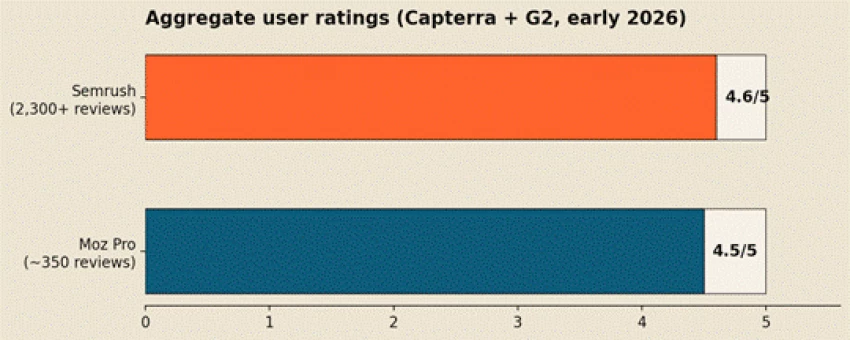
Aggregate user ratings across Capterra and G2, early 2026.
Both score well. Semrush has 6–7x more public reviews, which usually correlates with broader market adoption. The qualitative themes are consistent with my own experience: Semrush praised for depth, criticized for complexity. Moz praised for usability, criticized for narrower scope and keyword data depth.
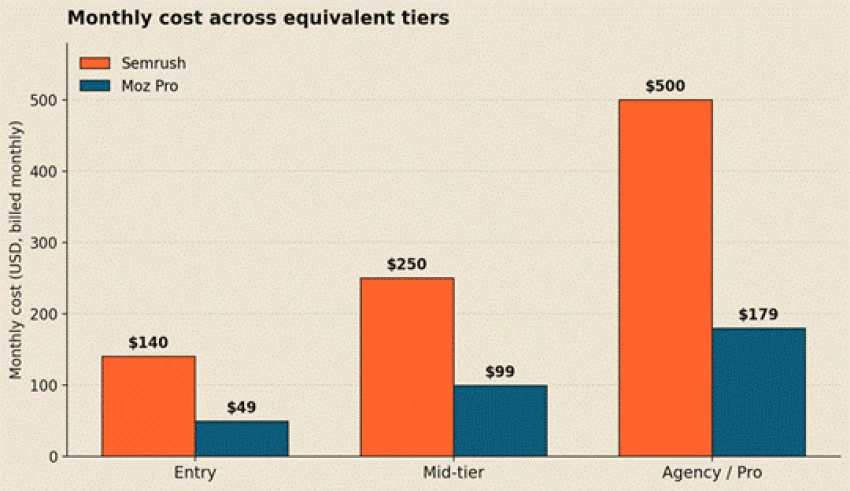
Let's get this out of the way first, because price is usually what kicks people toward a decision before they've even looked at features.
As of this writing, Semrush starts at $139.95/month for the Pro plan ($117.33 effective monthly with annual billing). Guru is $249.95/month, Business is $499.95/month. There's also a newer Semrush One bundle starting at $199/month that adds AI visibility tracking on top.
Moz Pro starts at $49/month for the Starter plan ($39 annual). Standard is $99/month, Medium is $179, Large is $299. Same broad shape, four tiers, but the entry point is roughly a third of Semrush's.
PRICING TIERS COMPARED (MONTHLY, BILLED MONTHLY)
| Capability | Semrush | Moz Pro |
| Entry | $139.95 (Pro) | $49 (Starter) |
| Mid-tier | $249.95 (Guru) | $99 (Standard) |
| Agency / Pro | $499.95 (Business) | $179 (Medium) |
| Top tier | $199–$549 (One) | $299 (Large) |
| Free trial | 7 days | 30 days |
| Annual discount | ~17% | ~20% |
I'm going to resist giving you a single winner because there isn't one. Both tools are good. Both are still being actively developed. The right answer depends entirely on the work in front of you.
FROM $139.95 / MO Semrush For when SEO is one part of a bigger growth machine → Agencies juggling multiple clients and reports → In-house teams running paid + organic + content + social → Anyone serious about AI visibility in 2026 → Content programs publishing weekly or faster → Competitive niches where keyword difficulty calibration matters | FROM $49 / MO Moz Pro For focused SEO work without the operational tax → Solo SEOs, freelancers, and small agencies → Brands whose stakeholders quote Domain Authority → Large-site owners who need generous crawl budgets → Beginners who want guidance, not a firehose → Developers who want affordable, transparent API access |
For my own niche site, a one-person operation publishing two posts a month, I'd keep Moz Pro Standard at $99. The data is more than enough, the workflow is calmer, and Domain Authority is what my outreach contacts speak. The $1,800/year I save vs. Semrush Guru funds a freelance writer for several months.
For the e-commerce client account, five-person marketing team, paid + organic, growing content investment, I'd renew Semrush Guru without hesitation. The keyword depth and AI visibility tools have already paid for themselves in two campaigns. The complexity becomes an asset once you know the platform.
The honest truth most "vs." articles won't tell you: a lot of serious teams run both, plus Ahrefs. Each has at least one feature the others can't fully replicate. If you're at that level of seriousness, the pricing argument is moot. If you're not, picking based on the situation above will save you a year of regret.
“There isn't a winner. There's a fit. Be honest about which one you actually are.”
Share your thoughts about this article.
Be the first to post a comment!

Every second DTC founder says they want to "tell their story better." Then they...
Parveen Verma1 month ago

Plenty of sales teams burn through their week chasing leads that were never goin...
Deepak Mehra3 months ago

A solo newsletter with 800 subscribers and a Shopify store running three automat...
Sakshi Dhingra3 months ago
Understanding Knowledge Management in PracticeKnowledge management, in a practic...
Sakshi Dhingra4 months ago

A performance marketing team does not need the greatest possible number of tools...
Sakshi Dhingra6 months ago

Growth marketing today relies on a combination of experimentation, analytics, au...
Sakshi Dhingra6 months ago