Growth marketing today relies on a combination of experimentation, analytics, automation, and creative execution. Artificial intelligence has become the connective layer that enables these activities to operate at scale. Instead of manually analyzing campaigns, creating dozens of variations of marketing assets, and tracking performance across platforms, marketing teams increasingly rely on AI-powered tools that automate large parts of the growth process.
Industry surveys show that around 95% of marketers say AI tools help them spend less time on repetitive tasks and more time engaging with customers, which explains why companies are rapidly integrating AI into marketing workflows.
However, no single AI tool performs every growth marketing function. Successful marketing teams typically rely on a stack of tools that address different parts of the growth funnel, including content creation, search optimization, campaign automation, analytics, and customer lifecycle management. Understanding how each tool contributes to growth marketing is essential for building an effective AI-driven marketing strategy.
Brand-consistent blogs, ads, emails, and marketing copy
Surfer SEO
SEO optimization
Content optimization and search visibility
Semrush
SEO & competitive intelligence
Keyword research, competitor analysis, and market insights
HubSpot AI
Marketing automation
CRM workflows, lead scoring, and personalization
Sprout Social
Social media analytics
Audience intelligence and social listening
Hootsuite
Social media management
Campaign scheduling and publishing automation
BuzzSumo
Content intelligence
Trend discovery and competitor content research
Although these platforms are often grouped together as AI marketing tools, they solve different business challenges. Some specialize in generating ideas and content, while others focus on optimizing search rankings, automating customer engagement, or identifying emerging market opportunities. Understanding these differences helps organizations invest in technology that supports measurable business objectives rather than simply adding another AI subscription.
One trend has become increasingly clear across modern marketing teams: specialization consistently outperforms generalization. Instead of expecting one platform to manage every marketing activity, businesses often achieve better results by combining tools that excel within specific parts of the growth funnel.
How AI Supports the Growth Marketing Funnel
Growth marketing extends across every stage of the customer journey, from attracting potential customers to retaining existing ones. AI now contributes throughout this lifecycle by reducing manual effort while providing faster access to insights that influence business decisions.
During the awareness stage, AI assists with keyword research, audience analysis, competitor monitoring, and content planning. As prospects move into consideration, AI helps personalize messaging, optimize landing pages, and generate multiple campaign variations for testing. Once customers enter the conversion phase, marketing automation platforms improve lead qualification, nurture prospects, and deliver more relevant communications based on customer behavior.
The process does not end after a sale. AI continues to support retention by identifying engagement patterns, predicting customer behavior, analyzing feedback, and helping marketers refine future campaigns using real performance data.
Growth marketing is no longer defined by how many campaigns a business launches. It is increasingly defined by how quickly teams can learn from customer behavior and turn those insights into measurable improvements.
ChatGPT
Among today's AI platforms, ChatGPT has become one of the most versatile assistants for marketing teams. Rather than serving as a dedicated campaign management platform, it functions as an intelligent workspace where marketers can brainstorm ideas, organize research, refine messaging, and accelerate creative workflows.
One of its biggest strengths is reducing the time required to move from an initial concept to a workable campaign. Instead of starting with a blank page, marketers can generate multiple headline variations, explore different audience segments, draft email sequences, summarize market research, or outline long-form content within minutes. This allows teams to evaluate more ideas before investing resources into production.
Unlike specialized marketing software, ChatGPT is intentionally flexible. It can support content strategy discussions one moment and help simplify technical documentation or summarize competitor information the next. This adaptability makes it valuable across different marketing functions rather than limiting it to a single workflow.
Where ChatGPT Adds the Most Value
Feature
Marketing Benefit
Common Growth Marketing Use Cases
Content Generation
Produces multiple messaging variations quickly
Blog outlines, product descriptions, ad copy, email campaigns
Market Research
Summarizes industry reports and public information
For growth marketers, speed alone is not the primary advantage. The greater benefit lies in accelerating experimentation. Teams can quickly compare different messaging approaches, identify alternative positioning strategies, and prepare campaign drafts before moving into production or testing.
However, ChatGPT should not be viewed as a replacement for marketing expertise. The quality of its output depends heavily on the instructions it receives, and generated content still requires human review to ensure factual accuracy, brand consistency, regulatory compliance, and alignment with business objectives.
Its flexibility also means that it lacks many of the workflow capabilities found in dedicated marketing platforms, such as campaign analytics, CRM integration, publishing automation, and performance tracking. For this reason, ChatGPT is often used alongside specialized software rather than replacing it entirely.
The greatest value of ChatGPT is not that it creates marketing content faster, it helps marketers explore more strategic possibilities before committing resources to execution.
Jasper: AI Content Generation Built for Marketing Teams
While general-purpose AI assistants can support many different business activities, Jasper focuses specifically on the needs of marketing organizations. The platform is designed to help teams produce content at scale while maintaining greater consistency across campaigns, making it particularly relevant for organizations managing multiple products, brands, or marketing channels.
One of Jasper's distinguishing characteristics is its emphasis on brand governance. Rather than generating isolated pieces of content, the platform allows businesses to define brand voice, messaging guidelines, and stylistic preferences that can be applied across different marketing assets. This helps reduce inconsistencies that often arise when multiple writers or departments contribute to campaigns.
For growth marketing teams producing blogs, landing pages, advertising copy, email campaigns, and social media content simultaneously, maintaining a consistent brand identity becomes increasingly difficult as output scales. Platforms like Jasper address this operational challenge by combining AI-assisted writing with structured marketing workflows.
Beyond content creation, Jasper integrates with broader marketing processes, allowing generated copy to move more efficiently into campaign development and collaboration. This reduces the amount of manual editing required before content progresses to review or publication.
Rather than replacing creative teams, Jasper is best viewed as a productivity tool that shortens production cycles while helping organizations maintain consistent messaging across multiple customer touchpoints.
As content production scales, consistency often becomes a greater competitive challenge than creativity. AI platforms built for marketing teams are increasingly focused on solving that operational problem rather than simply generating more words.
Organic search continues to be one of the most cost-effective customer acquisition channels, but ranking consistently has become increasingly difficult as search engines evaluate content on relevance, expertise, topical depth, and user intent rather than keywords alone. This has made content optimization platforms like Surfer SEO an important part of many growth marketing workflows.
Unlike traditional SEO tools that primarily report rankings or keyword data, Surfer SEO focuses on improving the quality and competitiveness of individual pages before they are published. It analyzes hundreds of on-page signals from top-ranking search results, helping marketers understand how successful pages are structured and where their own content may be missing important topics or optimization opportunities.
Rather than relying on assumptions about what Google prefers, marketers receive data-driven recommendations while creating content. These recommendations typically include content structure, semantic keyword coverage, heading distribution, internal topic relevance, readability, and overall content depth. The objective is not to copy competitors but to identify patterns that consistently appear across high-performing pages.
For businesses investing heavily in content marketing, this type of optimization reduces much of the guesswork associated with SEO while helping writers produce articles that better align with search intent.
Key Strengths of Surfer SEO
Feature
Business Benefit
Typical Growth Marketing Use
Content Editor
Real-time optimization guidance
Blog writing and landing page creation
SERP Analysis
Identifies ranking patterns
Competitive content research
NLP & Semantic Coverage
Improves topical relevance
Long-form SEO articles
Content Scoring
Measures optimization quality
Editorial review before publishing
One of Surfer SEO's greatest strengths is helping marketing teams create comprehensive content instead of narrowly optimized pages. Modern search engines increasingly reward articles that answer related questions, cover supporting topics, and demonstrate topical authority. By highlighting content gaps, the platform encourages marketers to think beyond primary keywords and build resources that satisfy broader user intent.
The best-performing SEO content is rarely the article with the highest optimization score. It is the article that combines strong optimization with original expertise, useful insights, and genuine value for reade
Semrush: AI-Powered SEO and Competitive Intelligence
If Surfer SEO focuses on improving individual pieces of content, Semrush provides a much broader view of digital marketing performance. It functions as a comprehensive intelligence platform that helps businesses understand how they compare with competitors across search visibility, keyword rankings, backlinks, paid advertising, and content opportunities.
Growth marketing depends as much on understanding competitors as it does on improving internal campaigns. Semrush helps organizations identify where competitors are gaining traffic, which topics attract the most search demand, and how market trends are changing over time. These insights allow marketing teams to prioritize opportunities with the greatest potential business impact rather than relying solely on intuition.
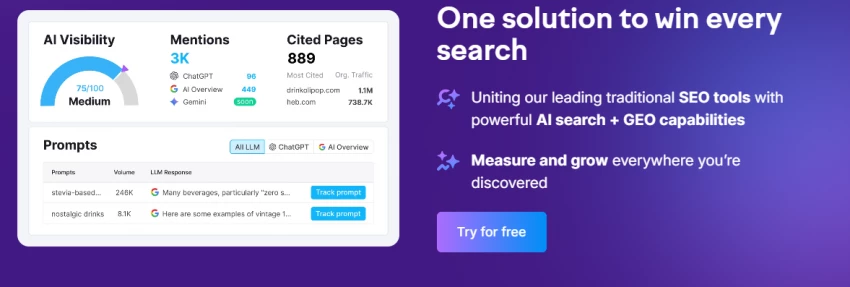
The platform combines keyword research, competitor monitoring, backlink analysis, rank tracking, site auditing, and content planning within a single ecosystem. AI-assisted recommendations further simplify large datasets by highlighting actionable improvements instead of overwhelming marketers with raw metrics.
Why Semrush Is Valuable for Growth Marketing
Feature
Business Value
Growth Marketing Application
Keyword Research
Identifies search demand
Content planning and SEO strategy
Competitor Analysis
Reveals market opportunities
Competitive positioning
Backlink Analytics
Evaluates authority signals
Link-building strategy
Site Audit
Detects technical SEO issues
Website optimization
Rank Tracking
Measures visibility changes
Performance monitoring
One of Semrush's most significant advantages is that it supports decision-making across multiple marketing disciplines rather than focusing exclusively on SEO. Marketing teams can evaluate competitors, identify emerging keyword opportunities, monitor search performance, analyze advertising strategies, and uncover content gaps from a single dashboard. This broader perspective makes it easier to align SEO initiatives with wider business objectives.
Another practical benefit is prioritization. Marketing teams often have hundreds of possible optimization tasks competing for attention. Platforms like Semrush help identify which keywords, pages, or competitors deserve immediate focus based on available search demand and competitive difficulty.
Despite its comprehensive feature set, Semrush should be viewed as a decision-support platform rather than an automated growth engine. The insights it generates still require interpretation within the context of business goals, customer behavior, available resources, and broader market conditions.
Competitive intelligence creates value only when it leads to better decisions. Collecting more data does not improve growth unless that data influences meaningful action.
HubSpot AI: Marketing Automation and Customer Lifecycle Analytics
Attracting visitors is only the first stage of growth marketing. Sustainable business growth depends on converting prospects into customers, nurturing long-term relationships, and improving retention over time. Marketing automation platforms such as HubSpot are designed to support these later stages by combining customer relationship management with AI-assisted personalization and workflow automation.
HubSpot has steadily integrated artificial intelligence throughout its platform to help organizations manage customer interactions more efficiently. Rather than focusing on content generation alone, its AI capabilities assist with lead prioritization, email creation, workflow recommendations, CRM organization, customer segmentation, and performance reporting.
One of its most valuable applications is predictive lead scoring. Instead of treating every lead equally, AI models analyze behavioral signals such as website visits, email engagement, content downloads, and previous interactions to identify prospects who are more likely to convert. This allows sales and marketing teams to prioritize outreach more effectively.
HubSpot AI Features for Growth Teams
Feature
Business Benefit
Marketing Application
Predictive Lead Scoring
Prioritizes qualified prospects
Sales and marketing alignment
AI Email Assistance
Speeds campaign creation
Personalized email marketing
Workflow Automation
Reduces repetitive tasks
Customer nurturing
CRM Intelligence
Organizes customer data
Lifecycle management
AI Reporting
Highlights performance trends
Campaign optimization
Another important strength is personalization. Modern customers expect communications that reflect their interests and previous interactions rather than generic marketing messages. HubSpot's automation capabilities help businesses deliver more relevant experiences across email, websites, and CRM workflows while reducing the manual effort required to manage large customer databases.
For growth marketers, this means spending less time on repetitive operational work and more time optimizing customer journeys, improving conversion rates, and refining lifecycle strategies based on measurable outcomes.
However, automation should support customer relationships rather than replace them. Excessive reliance on automated messaging without meaningful personalization can reduce engagement and weaken long-term brand trust.
The objective of marketing automation is not to remove people from the customer journey, it is to ensure that every interaction is more timely, relevant, and informed by data.
Social Media AI Platforms for Engagement and Campaign Management
Social media has evolved into one of the most influential growth channels for modern digital businesses.
AI-driven social media platforms allow marketing teams to automate repetitive tasks, analyze engagement patterns at scale, and detect trends that may influence campaign performance.
Sprout Social is an AI-enhanced social media management platform that combines publishing, reporting, engagement management, and social listening. Its main value for growth marketers lies in helping teams understand conversations happening around a brand, industry, competitor, or campaign.
The platform’s social listening capabilities analyze public conversations across supported networks to identify patterns in brand mentions, customer sentiment, emerging topics, and audience reactions. This provides a broader view of market perception than standard engagement metrics such as likes, shares, or comments.
For example, a campaign may generate high engagement while still attracting negative reactions. A basic performance report might suggest that the campaign is succeeding, but sentiment analysis can reveal whether the attention is strengthening or damaging the brand. This distinction is critical because visibility alone does not always translate into meaningful growth.
Key Sprout Social Capabilities
Feature
Business Benefit
Growth Marketing Application
Social Listening
Tracks conversations and market sentiment
Brand monitoring and trend detection
Audience Analytics
Reveals engagement patterns
Audience segmentation and campaign planning
Unified Inbox
Organizes customer interactions
Community management and support
Performance Reporting
Measures channel results
Campaign optimization
Publishing Tools
Coordinates content schedules
Multi-platform campaign execution
Sprout Social can also help organizations compare performance across channels, identify which content formats generate stronger engagement, and evaluate how different audience segments respond over time. These insights are useful when deciding where to allocate creative resources or advertising budgets.
Its broader advantage is the ability to connect qualitative audience feedback with quantitative performance data. Instead of evaluating a campaign only through clicks or impressions, marketers can also examine the conversations and emotions surrounding it.
The most valuable social media insight is not simply that engagement increased. It is understanding why audiences responded and whether that reaction supports long-term business goals.
Hootsuite
Hootsuite is widely used for social media publishing, scheduling, campaign coordination, and performance monitoring. Its AI-supported capabilities help teams manage large content calendars while making more informed decisions about timing, format, and audience engagement.
For organizations managing several brands or social accounts, one of the biggest operational challenges is maintaining consistency without slowing down execution. Hootsuite addresses this by allowing teams to organize posts, approvals, campaigns, and reporting through a centralized platform.
The platform can analyze historical engagement data to identify posting times and content formats that have previously performed well. This does not guarantee future success, but it gives marketers a stronger starting point than publishing based entirely on assumptions.
Key Hootsuite Capabilities
Feature
Business Benefit
Growth Marketing Application
Content Scheduling
Reduces manual publishing work
Multi-channel campaign management
Engagement Analytics
Identifies performance patterns
Content optimization
AI Writing Assistance
Speeds up post creation
Caption and campaign drafting
Social Monitoring
Tracks brand and competitor activity
Reputation and market analysis
Team Collaboration
Improves approvals and coordination
Large-scale campaign execution
Hootsuite is especially useful when campaign consistency matters across multiple channels. A growth team may be running a product launch, promotional offer, educational series, and retargeting campaign at the same time. Centralized scheduling helps maintain coordination while reducing the risk of duplicated, delayed, or conflicting messages.
Its analytics also support ongoing optimization. Marketers can compare performance across platforms, identify which content receives meaningful engagement, and adjust future campaigns accordingly.
Automation makes social media easier to manage, but it does not make weak content more valuable. Operational efficiency matters only when it supports stronger creative and strategic decisions.
Buzzsumo
BuzzSumo focuses on content intelligence, trend discovery, and competitor analysis. Rather than managing social accounts directly, the platform helps marketers understand which topics, formats, and publishers are attracting attention across the web.
This makes it especially useful during the research and planning stages of growth marketing. Before producing a campaign, marketers can examine which topics are already generating engagement, which headlines are being shared, and how competitor content is performing.
The platform analyzes large volumes of content and social interaction data to reveal patterns that may be difficult to identify manually. Growth teams can use these insights to develop content ideas, identify potential outreach opportunities, monitor competitors, and understand how audience interests are evolving.
Key BuzzSumo Capabilities
Feature
Business Benefit
Growth Marketing Application
Content Discovery
Identifies high-performing topics
Editorial planning
Trend Monitoring
Detects emerging conversations
Timely campaign development
Competitor Analysis
Shows what performs in the market
Content gap identification
Influencer Discovery
Finds relevant creators and publishers
Outreach and distribution
Content Alerts
Tracks new mentions and activity
Brand and competitor monitoring
BuzzSumo can help reduce the risk of creating content around topics with little evidence of audience interest. It can also reveal where the market is overcrowded, giving marketers an opportunity to approach a subject from a more specific or differentiated angle.
However, popularity data should not be treated as a substitute for strategy. A widely shared topic may attract attention without generating qualified leads, sales, or long-term customer value. Marketers still need to evaluate whether a trend aligns with their audience, product, brand, and commercial goals.
Trend data is most useful when it helps a business make better timing and positioning decisions, not when it encourages every brand to publish the same content.
How to Build an AI Growth Marketing Stack
The most effective AI marketing stack is not necessarily the one with the largest number of tools. Each platform should have a clearly defined role and should contribute to a measurable objective.
A practical stack may begin with ChatGPT for ideation, research summaries, and campaign drafts. Jasper can support structured content production where brand consistency is essential. Surfer SEO can improve the topical completeness of individual pages, while Semrush can guide keyword strategy and competitive research.
HubSpot AI can then manage customer lifecycle activities such as lead scoring, email automation, and CRM workflows. Sprout Social and Hootsuite can support social listening, publishing, and engagement management, while BuzzSumo can contribute to trend discovery and content research.
The challenge is ensuring that these platforms work as part of a connected process rather than as isolated subscriptions.
A useful workflow might look like this:
Workflow Stage
Recommended Tool Role
Market and Content Research
Semrush, BuzzSumo, ChatGPT
Campaign Planning
ChatGPT, Jasper
SEO Content Production
Jasper, Surfer SEO
Search Opportunity Analysis
Semrush
Lead Management and Personalization
HubSpot AI
Social Campaign Execution
Hootsuite
Audience and Sentiment Analysis
Sprout Social
Trend Monitoring
BuzzSumo
Each organization will require a different combination depending on its growth model. A content-led company may rely heavily on Semrush and Surfer SEO, while a sales-led organization may gain more value from HubSpot. A consumer brand with a strong social presence may prioritize Sprout Social, Hootsuite, and BuzzSumo.
The best AI stack is not built around feature quantity. It is built around removing the most expensive bottlenecks in a company’s growth process.
Why Growth Marketing Requires an AI Tool Stack
An important observation from modern marketing teams is that growth marketing rarely relies on a single AI platform. Instead, organizations typically combine several specialized tools.
Content creation platforms generate marketing assets. SEO tools optimize those assets for search visibility. Automation systems manage customer interactions, while analytics tools measure campaign performance and identify opportunities for improvement.
This layered ecosystem allows marketing teams to experiment rapidly while maintaining data-driven decision-making across every stage of the growth funnel.
AI tools do not replace marketers; they amplify the marketer’s ability to test ideas, analyze results, and adapt strategies in real time.
How to Choose the Right AI Tool for Growth Marketing
Choosing an AI marketing tool should begin with the problem a business needs to solve, not with the popularity of the platform.
Many companies adopt AI software because it appears innovative, only to discover that the tool duplicates capabilities they already have or fails to integrate with existing workflows. A more effective approach is to identify the most expensive or time-consuming marketing bottleneck and then evaluate which platform can reduce it.
For a business struggling to produce enough high-quality content, a tool such as Jasper may offer greater value than a social listening platform. A company losing visibility in search may benefit more from Semrush or Surfer SEO. A growing sales operation dealing with inconsistent lead follow-up may see a stronger return from HubSpot AI.
The right tool therefore depends on the business model, marketing maturity, available data, and the stage of the customer journey that requires improvement.
AI Tool Selection Framework
Business Need
Most Relevant Tool
What to Evaluate Before Choosing
Faster ideation and campaign planning
ChatGPT
Output quality, review process, team usage
Scalable brand-consistent content
Jasper
Brand controls, workflows, approval needs
On-page SEO optimization
Surfer SEO
Content volume, search strategy, editorial process
Keyword and competitor intelligence
Semrush
Market size, reporting needs, SEO maturity
Lead nurturing and CRM automation
HubSpot AI
CRM adoption, data quality, sales alignment
Social listening and audience insight
Sprout Social
Channel coverage, reporting depth, team size
Social scheduling and coordination
Hootsuite
Number of accounts, approval workflows, publishing volume
Trend and content discovery
BuzzSumo
Content strategy, research needs, outreach goals
Final Thoughts
After working with various AI tools, I've realized they’re not here to replace growth marketers, but to enhance how we work. The true value comes from using AI to speed up experimentation and automate tedious tasks. But, it’s the combination of AI systems that unlocks the real power, whether it’s generating content ideas, analyzing customer behavior, or optimizing campaigns. AI tools work best when paired with human judgment, helping us make informed, strategic decisions.
The key takeaway is that AI is a tool, not the decision-maker. By integrating the right tools into a structured growth strategy, marketers can build a more proactive, data-driven approach to growth that drives measurable results.
_1773403326.webp)

_1773403393.webp)
_1773403456.webp)
_1773403736.webp)
_1773402978.webp)
_1773403078.webp)