Song lyrics carry meaning that rarely survives a first listen. Metaphors reference events listeners never lived through, slang shifts between decades and regions, and roughly half the world's most-streamed music is written in a language the average listener does not speak. For students analyzing lyrics as literature, curators writing playlist notes, and fans simply trying to understand a favorite track, that gap between hearing a song and understanding it has historically been filled by forums, annotation communities, and scattered blog posts of uneven quality.
SongMeanings AI, operating at the domain songmeaning.io, approaches the same gap with automation. The platform maintains a catalog of 159,800 entries at the time of this analysis, attaches AI-generated interpretations to each one, pairs those interpretations with a dedicated lyric translation module, and organizes everything under artist pages and a twelve-language interface. This analysis examines what the platform verifiably does, where its documentation falls silent, and how it measures against seven competing services, from community giants like Genius to audio-analysis specialists like SONOTELLER.
The first task in evaluating this platform is untangling its name, because three similarly branded properties occupy the same search results.
Songmeaning.io is the AI-driven platform this article analyzes, branded simply as Songmeaning on-site and commonly referenced as SongMeanings AI or SongMeaning AI in tool directories.
SongMeanings.com is an entirely separate, long-running community website where human users have contributed interpretations since the early 2000s.
A third variant, songmeaning.ai, appears in some directory listings but does not resolve to the platform under review. Every claim in this article refers to songmeaning.io unless stated otherwise.
Direct inspection of the live site confirms four functional pillars in the primary navigation: song meaning pages, a lyric translation section, singer pages that group content by artist, and an AI music generator hosted at the /create path.
The site displays a running counter of 159.8K total entries across 799 index pages, offers alphabetical and date-based browsing archives, publishes an editorial blog of song-analysis articles, and gates account features behind an email-based login. A Google AdSense publisher tag in the site's source code indicates advertising as at least one active monetization channel, which matters later in the pricing discussion.
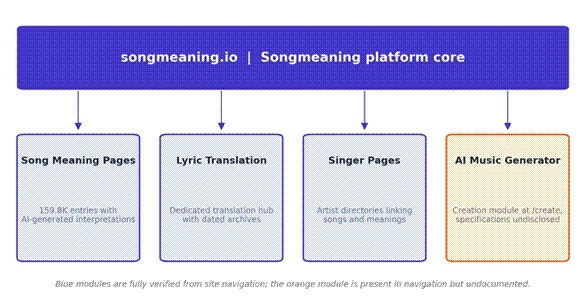
Figure 1. The four verified modules of songmeaning.io, with the undocumented AI music generator highlighted.
The distinction between the blue and orange modules in Figure 1 frames the rest of this analysis. Three of the four pillars can be verified end to end by browsing the public site, while the AI music generator exists as a navigation item and a promotional banner claiming over 1.15 million users generating, yet publishes no specifications, samples policy, or licensing terms. That pattern, strong visible functionality with thin documentation behind it, repeats throughout the platform.
The feature table below separates what direct inspection confirms from what remains unspecified, a distinction most directory listings blur. Verified items were observed on the live site; unspecified items are absent from both the site and any official documentation located during research.
| Feature | Description | Status |
| Song meaning pages | Per-song pages carrying AI-generated interpretations, organized in a browsable 159.8K-entry catalog | Verified |
| Lyric translation | Dedicated translation section with per-song pages and daily archive listings dated through 2026 | Verified |
| Singer (artist) pages | Artist directories linking each performer's cataloged songs and meanings | Verified |
| Multilingual interface | Twelve interface localizations selectable from the site header | Verified |
| Login and accounts | Email-based login and sign-up flow | Verified |
| AI music generator | Creation module at /create with a usage counter but no published specifications | Unspecified |
| API access | No developer documentation, endpoints, or integration guides published | Unspecified |
| Pricing | No pricing page; advertising via AdSense is the only visible monetization signal | Unspecified |
| AI model disclosure | No statement of which model or method generates interpretations | Unspecified |
| Licensing framework | No published lyric licensing or copyright policy | Unspecified |
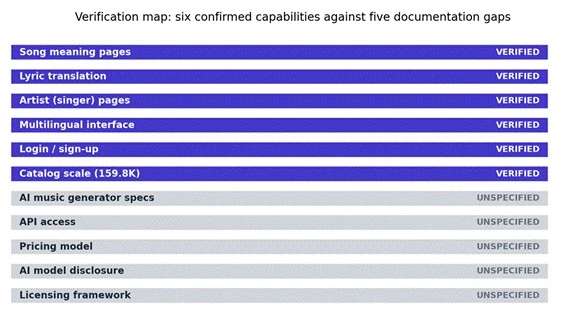
Figure 2. Verification map separating confirmed capabilities from documentation gaps.
Figure 2 visualizes the split, and the ratio is instructive. Six confirmed capabilities cover everything a casual visitor touches, while all five gaps sit on the professional side of the platform: integration, procurement, model provenance, and rights management. A student reading one interpretation never encounters those gaps; a developer, educator, or business evaluating the platform runs into all five at once.
One finding from direct catalog inspection deserves separate attention. Alongside conventional songs, the entry stream includes poems by Rabindranath Tagore and Samuel Taylor Coleridge, a chapter of a Charles Chesnutt novel, a Friedrich Schiller play excerpt, interview transcripts, and battle-rap rounds from Russian hip-hop forums. This composition indicates a bulk-ingested text corpus rather than a curated music database. The practical consequence cuts both ways: coverage of obscure, international, and long-tail content is genuinely unusual for the category, but users cannot assume every entry is a song or that metadata has passed human review.
The platform's reading experience requires no account. Visitors browse by alphabet, by date archive, or through artist pages, open any song, and read the interpretation immediately, with the login gate appearing only around creation features. That zero-friction reading path is a meaningful accessibility decision, since competitors increasingly meter interpretations behind credits or subscriptions.
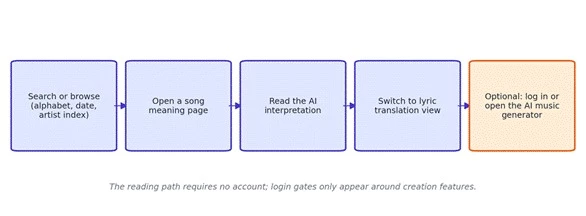
Figure 3. The visitor workflow on songmeaning.io, with account-gated steps marked in orange.
The workflow in Figure 3 also exposes the platform's most significant navigational weakness. Discovery relies on precomposed indexes, alphabetical lists, date archives, and artist pages, rather than a prominent, fast search experience.
On a catalog approaching 160,000 entries, index-based browsing scales poorly, and users arriving with a specific song in mind will frequently reach it faster through an external search engine than through on-site navigation.

Localization is the strongest part of the interface story. The header exposes twelve full interface languages, shown in Figure 4, spanning European, East Asian, and Turkish markets. Combined with a catalog that already contains Russian, Korean, Chinese, Burmese, Georgian, Hebrew, and Arabic-language entries, the platform is structurally positioned for non-English music discovery in a way most English-first competitors are not.
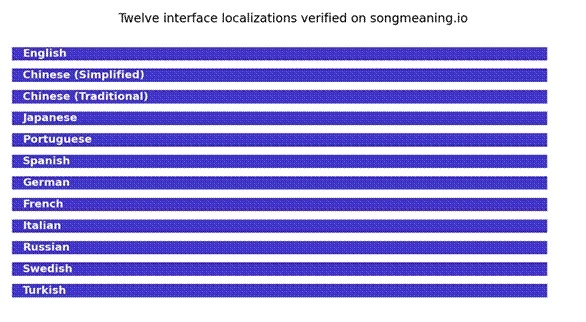
Figure 4. The twelve interface localizations available from the site header.
Independent traffic estimation from the Creati.ai directory places the platform at roughly 88,300 monthly visits, a figure that should be read as a third-party estimate rather than an audited number.
For context, that volume positions songmeaning.io as a mid-tier destination in the AI lyrics niche: far below the mainstream reach of Genius or Musixmatch, but with an established audience that a newly launched tool would take years to build. The date archives on the translation module, which run continuously into 2026, indicate the catalog is still being actively extended rather than sitting as a static scrape.
Three functional dimensions determine day-to-day usefulness, and each lands differently. Content coverage is the standout, since a 159.8K-entry catalog with deep international representation exceeds what most AI-only interpreters offer. Retrieval speed is the weak point, for the navigational reasons described above.
Interpretation quality sits in the middle: AI-generated readings are consistent in structure and tone, strong on surface themes and emotional arcs, but inherently probabilistic, and the platform provides no community layer to correct an interpretation that misses an artist's documented intent. Users comparing an AI reading against a Genius annotation verified by the artist will find the difference immediately.
It is worth stating plainly that no public benchmarks exist for this platform's translation accuracy or interpretation quality, and this analysis does not invent them. The scorecard later in this article is an editorial assessment built from feature verification and comparative context, labeled as such, rather than a measurement.
Four gaps deserve individual treatment because each blocks a specific audience.
• The absence of an API or developer documentation means the catalog cannot be integrated into apps, research pipelines, or classroom tools, closing off the audience that platforms like SONOTELLER explicitly court with dedicated endpoints.
• The undisclosed AI model prevents any assessment of interpretation methodology, training data, or update cadence, which matters to educators deciding whether outputs are citable.
• The missing pricing page leaves monetization ambiguous; the AdSense tag confirms advertising, but nothing states whether the AI music generator or future features carry costs, making budgeting impossible for institutional users.
• The unpublished licensing framework is the most consequential gap, since displaying lyrics and derivative translations at scale normally requires publisher agreements of the kind Musixmatch has made central to its business. Nothing on songmeaning.io describes how lyric rights are handled.
None of these gaps prevents casual use, and none is unusual among small AI tools. Collectively, however, they define the platform's ceiling: songmeaning.io currently serves readers, not builders, buyers, or institutions.
The lyric-interpretation market splits into three architectures. Community platforms such as Genius and SongMeanings.com derive meaning from human contributors. Licensed-data platforms, led by Musixmatch, build on formal publisher agreements and synced-lyrics distribution. AI-native platforms, including SongMeanings AI, Songtell, WhatTheBeat, itsMong, and SONOTELLER, generate interpretations computationally, differing mainly in whether they analyze text alone or full audio. The matrix below compares all eight across six dimensions.
| Platform | Song Meaning | Translation | AI Generation | Community | Licensing Transparency | Pricing |
| SongMeanings AI | Yes | Yes | Music generator present, undocumented | Low | Low | Unspecified |
| Genius | Yes | Partial | No | High | Medium | Free / Premium |
| Musixmatch | Yes | Yes | No | Medium | High | Free / Premium |
| Songtell | Yes | Partial | No | Low-Medium | Low | Freemium, from $0.99 |
| SONOTELLER | Partial | Partial | Full audio analysis | Low | Low | Free demo / API custom |
| WhatTheBeat | Yes | Partial | Partial | Low | Unspecified | Unspecified |
| itsMong | Yes | Partial | No | Low | Low | Unspecified |
| SongMeanings.com | Yes | No | No | Medium | Low | Free |
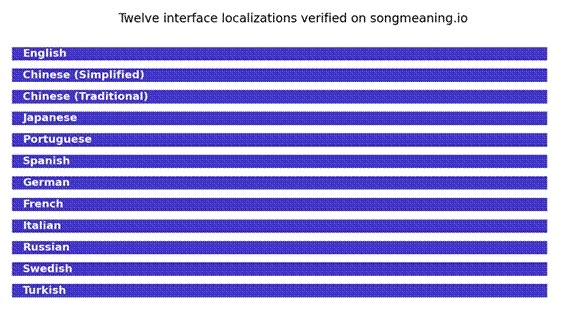
Figure 5. Feature strength across the eight platforms, rated on a four-level editorial scale.
Figure 5 makes the market's shape visible. No platform is strong everywhere, and the strongest columns belong to different players: Genius owns community, Musixmatch owns licensing, SONOTELLER owns audio intelligence, and SongMeanings AI holds the combination of free AI interpretation plus dedicated translation plus multilingual interface. Reading across the SongMeanings AI row, its two red cells, community and licensing, are exactly the two dimensions that cannot be fixed by better AI, which is why the competitive positioning below matters more than any single feature.
• Against Genius, SongMeanings AI trades verified human context for instant machine coverage; Genius answers questions about famous songs better, while songmeaning.io covers obscure and non-English tracks Genius contributors never annotate.
• Against Musixmatch, the comparison is licensing versus interpretation, since Musixmatch delivers rights-cleared synced lyrics and translations at streaming scale but offers nothing comparable to narrative meaning analysis.
• Against Songtell, the closest direct rival, SongMeanings AI competes on price and catalog breadth, while Songtell counters with human-reviewed interpretations, mobile apps, poster merchandising, and a clearly published freemium model starting at $0.99 for ten analyses.
• Against SONOTELLER, the platforms barely overlap: SONOTELLER analyzes actual audio for genre, mood, BPM, key, and instrumentation, serving labels and music supervisors through an API, a professional lane songmeaning.io does not enter.
• Against WhatTheBeat and itsMong, SongMeanings AI wins primarily on catalog scale and localization depth, while those smaller tools compete on cleaner single-song experiences.
• Against SongMeanings.com, the legacy namesake, the trade is decades of authentic human discussion versus consistent, immediate AI coverage of a far larger and more international catalog.
The scorecard below condenses the preceding analysis into six metrics on a ten-point editorial scale. Scores reflect verified functionality, catalog inspection, and competitive context as of July 2026, not automated benchmarking.
| Metric | Score (1-10) | Basis |
| Coverage | 8 | 159.8K entries with unusual international and long-tail depth, offset by uncurated non-song content |
| Usability | 8 | Zero-friction reading path and clean pages, held back by weak on-site search |
| Translation | 7 | Dedicated, actively updated module across many languages, without published accuracy validation |
| Community engagement | 6 | Accounts and a blog exist, but no annotation, comment, or correction layer |
| AI features | 5 | Interpretations are consistent and instant, yet the model is undisclosed and the music generator undocumented |
| Licensing transparency | 4 | No published rights framework, the platform's most significant institutional risk |
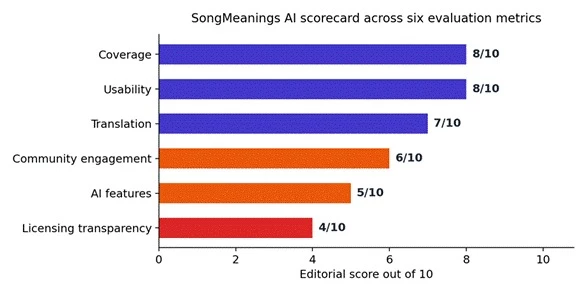
Figure 6. Editorial scorecard results, with color indicating relative strength.
The pattern in Figure 6 is a descending staircase from content strengths to governance weaknesses, and that staircase is the platform's honest summary. Everything users can see scores well; everything institutions need to know scores poorly.
Matching the verified feature set to real workflows produces four primary audiences.
• Music fans and playlist curators gain instant thematic summaries for tracks that lack any community annotation, particularly non-English releases, and can lift concise meaning notes into playlist descriptions.
• Language learners can pair a song's original lyrics with the platform's translations, using music as vocabulary-in-context material across the twelve supported interface languages.
• Educators and students can use AI interpretations as discussion starters for analyzing lyrics as literature, provided outputs are treated as prompts for debate rather than citable authority, given the undisclosed model.
• Content creators, including podcasters and short-form video producers, can compress research time on song-explainer content, cross-checking any factual claims against artist interviews before publication.
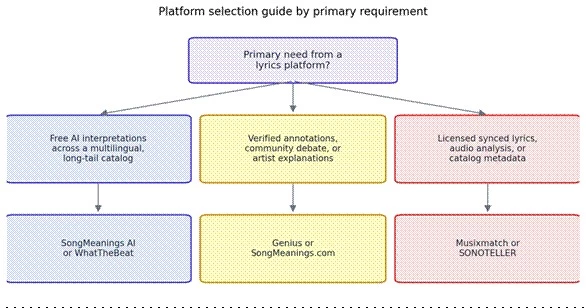
Figure 7 frames the selection logic as a single question about primary need. Users whose requirement is free, immediate, multilingual interpretation land on SongMeanings AI or WhatTheBeat; users who need verified human context land on Genius or SongMeanings.com; users with professional licensing or audio-metadata requirements land on Musixmatch or SONOTELLER. The branches are complementary rather than exclusive, and experienced researchers routinely combine one platform from each branch.
The category's mainstream standard, built on crowd-sourced annotations, verified artist explanations, and an ad-supported free tier with an optional premium upgrade. It remains the first stop for popular Western music, with the trade-offs of contributor-dependent coverage and comment-thread noise on ambiguous lines.
The licensing leader, whose rights-cleared catalog and synced lyrics power displays inside major streaming services. Its translations are extensive and legally grounded, making it the safe institutional choice, though it interprets far less than it transcribes.
The nearest architectural sibling to SongMeanings AI, launched in late 2022 as one of the first AI song-meaning databases. It differentiates through human-reviewed interpretations, iOS and Android apps, purchasable meaning posters, and transparent freemium pricing from $0.99, at the cost of metering that songmeaning.io does not impose.
A professional-grade audio analysis engine that listens to actual recordings, extracting genre, subgenre, mood, instrumentation, BPM, key, and explicit-content flags, with API endpoints aimed at labels and catalog managers. It is the recommendation for anyone whose need is metadata rather than meaning.
A lighter, discovery-oriented AI interpreter with a modern interface, best suited to casual fans who value presentation over catalog depth and do not require the archival breadth songmeaning.io provides.
SongMeanings AI is best understood as a coverage play in a market where its rivals compete on depth, rights, or audio intelligence. Its verified strengths are real: a catalog approaching 160,000 entries with rare international reach, a genuinely free and frictionless reading experience, an actively maintained translation module, and localization into twelve languages. Its weaknesses are equally concrete and cluster entirely on the governance side, where an undisclosed model, absent API, unpublished pricing, and silent licensing posture cap the platform at consumer use.
For the audiences it serves, that trade is favorable, since no competitor combines free AI interpretation, translation, and multilingual breadth in one place. For everyone else, the market has already specialized: Genius for human truth, Musixmatch for licensed scale, Songtell for reviewed AI analysis with clear pricing, and SONOTELLER for professional audio metadata. The most effective research workflow treats SongMeanings AI as the wide net cast first, with a specialized platform pulled in whenever verification, rights, or audio data become requirements.
What is SongMeanings AI?
SongMeanings AI, hosted at songmeaning.io, is an AI-driven platform that publishes machine-generated interpretations of song lyrics across a catalog of roughly 159,800 entries, alongside lyric translations, artist pages, and an AI music generation module.
Does SongMeanings AI provide lyric translations?
Yes. A dedicated lyric translation section operates alongside the meaning pages, with dated archives showing continuous updates into 2026 and a twelve-language interface supporting international access.
Is SongMeanings AI free or paid?
All observable reading features are free and require no account, and the site carries advertising. No pricing page exists, so the cost structure of the AI music generator and any future premium features remains unspecified.
Can developers access SongMeanings AI data through an API?
No public API, developer documentation, or integration guide has been published. Developers requiring programmatic access should evaluate SONOTELLER, which offers documented endpoints, or licensed providers such as Musixmatch.
Share your thoughts about this article.
Be the first to post a comment!
The same tool can be a 4.7 on one site and a 3.9 on another. Here is what is rea...
Nitin1 month ago
Here is the number worth pinning above your budget: in Gartner Digital Markets r...
Deepak Mehra1 month ago

What Artlist AI is in 2026Artlist began as a royalty-free music library. By 2026...
Deepak Mehra1 month ago
Most AI tool failures do not announce themselves. There is no crash, no angry em...
Nitin1 month ago

The best AI image generator in 2026 is Nano Banana 2 for speed, FLUX.2 for photo...
Parveen Verma1 month ago

“Useful” is a slippery word for a coding assistant. A tool can be brilliant at o...
Sakshi Dhingra1 month ago