If you have landed here, you are probably hitting a wall with Stealth Writer and wondering whether something out there does the job better, cheaper, or with fewer headaches. That is a fair question, and this guide answers it honestly. Before we compare anything, though, it helps to be clear about what Stealth Writer actually is, because the answer changes which tools are genuinely worth switching to.
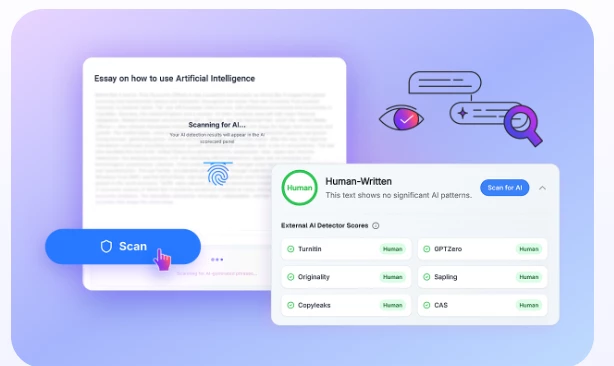
Stealth Writer is not a full content-writing suite in the way people sometimes assume. At its core it is an AI humanizer and detection checker. You paste AI-generated text from ChatGPT, Claude, or Gemini, and it rewrites that text so it reads as naturally human and slips past detectors like GPTZero, Turnitin, and Originality.ai. It also scans your text and shows a before-and-after detection score. So when we talk about the best alternatives, we are really talking about tools that do that same job, and we will keep the comparison honest to that reality rather than pretending these are all sprawling SEO platforms.
THE SHORT ANSWER
For most people leaving Stealth Writer, Walter Writes AI is the strongest overall alternative in 2026, posting the highest detection-bypass rates in independent testing while keeping a genuine free tier. Undetectable AI is the best-known runner-up and a safe pick for marketing content, and StealthGPT is worth a look if you need heavy API access. If your real goal is full SEO writing rather than humanizing, a suite like Writesonic fits better.
How We Evaluated These StealthWriter Alternatives
We compared these tools using five practical criteria rather than relying only on the claims shown on their homepages:
Evaluation area
What we examined
Rewrite quality
Whether the output remained readable and preserved the original meaning
Editing effort
How much manual correction a typical rewrite would require
User control
Available tones, rewrite modes and input limits
Workflow suitability
Whether the tool works best for occasional use, bulk content or API automation
Value
Free access, entry price, word limits and restrictions
This comparison should not be read as a guarantee that a tool will produce the same detector score every time. AI detectors can disagree with one another, and their results may change after an update. We therefore placed more weight on readability, meaning preservation and editing effort than on a single “human” percentage.
Quick Comparison at a Glance
Here is the whole field on one screen before we go deeper. Read this first, then jump to whichever tool matches how you actually work.
Tool
Best for
Edge over Stealth Writer
Free tier
Entry price
Walter Writes AI
Highest-stakes bypass, academic long-form
Top tested bypass rate, semantic rewriting, real free credits
Yes
~$9.99/mo
Undetectable AI
Marketing and blog content at scale
Biggest brand, Chrome extension, Zapier, API on higher tiers
250-word trial
~$9.99-$19/mo
StealthGPT
Developers and high-volume pipelines
High API rate ceilings, pay-as-you-go billing
Limited
~$14.99/mo
Humbot
Non-English content
50+ language coverage, multiple output variations
~100-300 words
~$14.99/mo
One honest caveat up front: almost every ranking of these tools is published by a company that also sells one of them. Bypass-rate numbers in particular swing depending on who ran the test. I have leaned on independent roundups and cross-checked pricing against the vendors' own pages, but you should still test any tool on your own content before paying. Detector scores drift from one run to the next, so a single good result is a signal, not a guarantee.
The Alternatives, One by One
Walter Writes AI
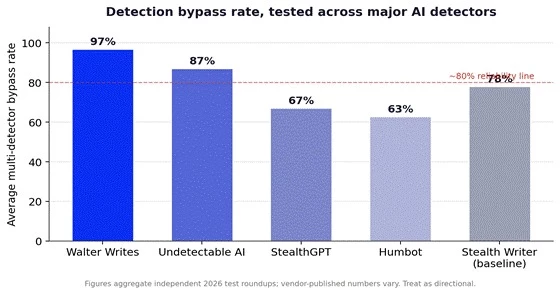
Walter Writes keeps showing up at the top of independent 2026 testing, and the reason is technical rather than marketing. Instead of swapping words for synonyms, which modern detectors are specifically trained to catch, it restructures sentences at the meaning level and rebuilds them. In one multi-detector study across hundreds of documents it cleared roughly 96 to 98 percent of checks, comfortably ahead of the pack.
The free tier is the part that sets it apart. You get real daily word credits with no credit card, using the same model as the paid plans, so you can verify quality before you commit. Paid access sits around $9.99 per month, which undercuts several noisier competitors.
Feature
Walter Writes AI
Stealth Writer
Detection bypass
Highest in independent tests
Solid, mid-70s to high-70s%
Rewrite approach
Semantic restructuring
Rephrasing / humanization
Tone & readability modes
Yes, 4 modes
Yes, light/medium/aggressive
Genuine free tier
Yes, daily credits
Yes, capped daily use
MCP / Claude connector
Yes
Not advertised
Table 2. Walter Writes AI versus Stealth Writer on the features that matter for humanizing
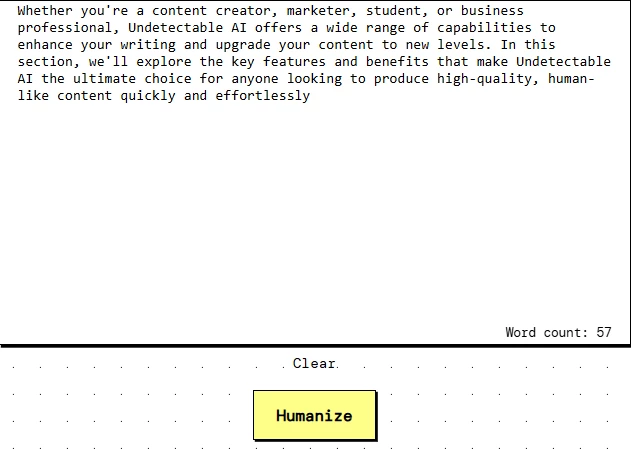
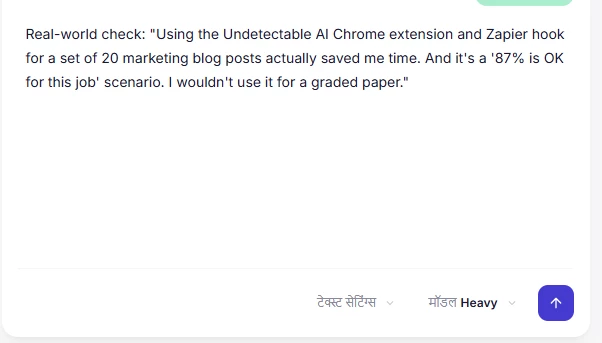
Undetectable AI is the tool your colleague has probably already heard of. It claims more than twenty million users and shows up everywhere, and that visibility is a real advantage if you value a large support community and a mature product. In independent testing its average bypass rate lands around 87 percent, which is genuinely good for marketing and blog content where the stakes are lower.
Where it gets shakier is high-stakes academic work. Reviewers repeatedly find its Turnitin performance hovering near the flag threshold, and its post-humanization scores can drift on reruns. It is also paid-first: the free trial is only 250 words, so you cannot really evaluate it properly before spending. Monthly pricing is quoted anywhere from about $9.99 to $19 depending on word volume and source, dropping to roughly $5 per month on annual billing.
StealthGPT
If you are wiring humanization into a product or a content pipeline rather than pasting text by hand, StealthGPT is the one to look at. Its API offers high rate ceilings and pay-as-you-go billing, which suits teams that process large monthly word volumes and want to pay for exactly what they use. It also markets consistent scoring against Turnitin, GPTZero, and Originality.ai.
For a solo writer this is probably more machinery than you need. For an agency automating rewrites across dozens of client sites, the flexible billing and rate limits are the whole point.
Humbot
Humbot's standout is language coverage: 50-plus languages, the broadest in this group, which makes it the sensible choice if a lot of your content is not in English. Its English bypass rates in independent tests are middling, in the low-to-mid 60s percent, and its free allowance is thin, often around 100 to 300 words. It also gives you multiple output variations per input and a readability grade, which is a nice touch when you want to pick the version that sounds most like you.
Performance and Output Quality, Visualized
Numbers make the trade-offs concrete. The chart below aggregates independent 2026 bypass testing. The dashed line marks the rough 80 percent mark, below which you are re-running content often enough that the sticker price understates the real cost.
Figure 1. Average detection-bypass rate across major AI detectors. Vendor-published numbers run higher; these are directional figures from independent roundups.
Tool
Strongest practical advantage
Main limitation
Best fit
StealthWriter
Generous daily usage structure
Paid plan begins at $20 monthly
Frequent manual rewriting
Walter Writes AI
Focused humanization workflow
Performance claims need independent verification
Individual writers
Undetectable AI
Clear word-based plans and API access
Limited evaluation before payment
Marketing teams
StealthGPT
MCP, n8n, API and WordPress workflows
More complex than casual users need
Agencies and developers
Humbot
Broad writing and study toolkit
Less specialised as a pure humanizer
Multilingual and student workflows
Pricing and Value
Monthly price is a vanity number on its own. What matters is cost per thousand words of content that actually passes, because a cheap tool with a weak bypass rate makes you pay for failures in reruns and manual edits. Keep that in mind as you read the tiers.
Platform
Free tier
Entry price
Enterprise / API
Notes on value
Stealth Writer
Yes, capped
~$20/mo
Yes
Solid humanizer; mid-70s% bypass in tests
Walter Writes AI
Yes, daily
~$9.99/mo
Yes
Best value; top bypass plus real free tier
Undetectable AI
250-word trial
~$9.99-$19/mo
Yes, API on top tier
Great tooling; weaker Turnitin performance
StealthGPT
Limited
~$14.99/mo
Yes, pay-as-you-go
Best for developers and high volume
Humbot
~100-300 words
~$14.99/mo
Yes
Pick for non-English content
Table 3. Pricing snapshot. Annual billing lowers several of these toward $5/mo. Stealth Writer's own tiers range roughly $20 to $50/mo depending on the review source, so confirm before buying.
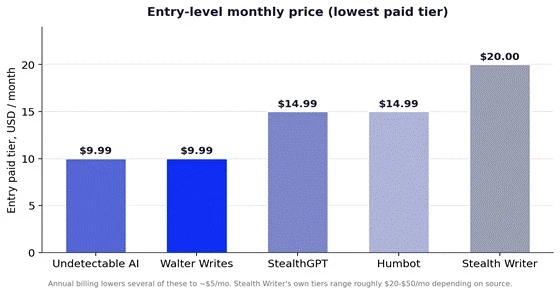
Figure. Entry-level monthly price by tool. Annual commitments cut several of these substantially.
A Workflow That Actually Works
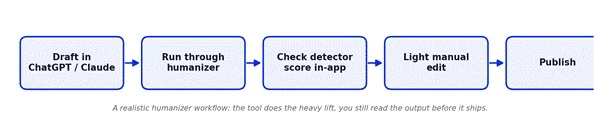
Whichever tool you land on, the process that produces publishable results looks the same. The humanizer does the heavy lifting, but you stay in the loop for the last mile, because no tool clears every detector every time and readers can feel an unedited rewrite.
Figure 4. The realistic humanizer workflow. Skipping the manual-edit step is where most people get flagged or publish something that reads off.
Two quick scenarios to make it real. For an SEO blog post: “I generate the draft, humanize it, confirm the detector score, then spend five minutes adding a personal anecdote and varying a few sentence lengths by hand.” For a batch of social posts: “I run a week's worth through the humanizer in one sitting, skim for anything that sounds off-brand, and schedule them.”
Pros and Cons, Distilled
Need
Best pick
Why it wins
Highest-stakes bypass
Walter Writes AI
Leads independent testing and rebuilds text at the meaning level
Marketing content at scale
Undetectable AI
Mature tooling, extensions, and a big support community
Developer / API pipelines
StealthGPT
High rate ceilings and pay-as-you-go billing
Non-English content
Humbot
Widest language coverage in the group
Actual SEO writing
A full suite (e.g. Writesonic)
Generation plus optimization, not just humanizing
Table 4. If you remember one table, make it this one.
A Simple Decision Guide
Match your situation to a line and you are done deliberating:
• Choose Walter Writes AI when the content is high-stakes and you want the strongest tested bypass with a free tier to prove it first.
• Choose Undetectable AI for marketing and blog volume where you value a big, well-supported product and browser tooling.
• Choose StealthGPT if you are a developer or agency automating rewrites and need serious API headroom.
• Choose Humbot when a meaningful share of your work is in languages other than English.
• Choose a full suite instead if you realize you wanted an SEO writing platform, not a humanizer, in the first place.
My Final Take
There is no universally best StealthWriter alternative because these tools solve slightly different workflow problems.
Undetectable AI currently looks like the safer choice for users who need a recognised platform, clear monthly word allowances and API access. StealthGPT is more compelling for agencies building automated content pipelines, while Humbot offers more supporting writing tools beyond humanization. Walter Writes AI may appeal to users who want a simpler, focused rewriting experience, but its strongest performance claims should be verified with personal samples before subscribing.
My main reservation applies to the entire category: detector scores are too unstable to be treated as proof of writing quality. A tool may change a score while also removing personality, weakening factual precision or introducing awkward language.
For blog and marketing work, I would choose the tool that preserves meaning and requires the least editing—not the one displaying the most impressive “human” percentage.
A useful humanizer should reduce editing work. If you must repair its wording, facts and tone after every rewrite, it has only exchanged one content problem for another.