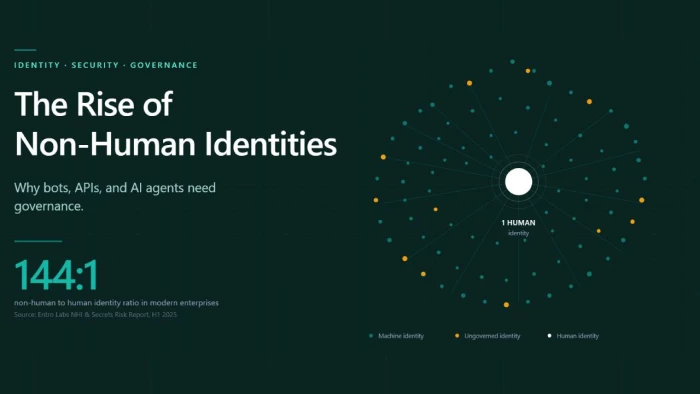
Every modern enterprise now operates two workforces. The first is the employees, contractors, and partners visible in the HR system. The second is the silent majority: service accounts, OAuth applications, API keys, certificates, IAM roles, SSH keys, workload identities, automation bots, and, increasingly, autonomous AI agents. Research from Entro Labs published in July 2025 found that non-human identities (NHIs) outnumber human identities at a ratio of 144 to 1, up from 92 to 1 only a year earlier, and growing roughly 44 percent year over year. CyberArk's 2025 State of Machine Identity Security Report puts the average at 82 machine identities per employee, while Veza's 2025 global study reports that ratio climbing to 40,000 to 1 in cloud-native environments. The math is now decisive: the population of credentials inside an enterprise is overwhelmingly machine, and the governance apparatus around them has not kept pace.
This is no longer a DevOps housekeeping problem. The Identity Defined Security Alliance (IDSA) found that 97 percent of organizations experienced an identity-related incident in the prior year. GitGuardian's State of Secrets Sprawl 2026 recorded 28.65 million hardcoded secrets pushed to public GitHub in 2025 alone, a 34 percent jump year over year, with AI service credentials growing 81 percent to 1.27 million incidents. Behind every recent landmark breach (Microsoft Midnight Blizzard in January 2024, Okta's support system compromise in November 2023, Internet Archive's Zendesk incident in October 2024, and the Salesloft Drift OAuth campaign of August 2025) sat a non-human identity that nobody owned, nobody had rotated, and nobody was monitoring.
A non-human identity is any digital credential that authenticates a software entity rather than a person. The category is broader than most security programs treat it. OWASP's working definition, codified in its 2025 Non-Human Identities Top 10 project, covers applications, workloads, APIs, bots, and automated systems that authenticate using passwords, certificates, tokens, keys, or attestation-based mechanisms. In practice, the inventory looks like this:
| NHI category | What it authenticates | Typical credential | Where it lives |
|---|---|---|---|
| Service accounts | Backend processes, scheduled jobs, app-to-app connections | Username/password or key pair | Active Directory, cloud IAM, databases |
| OAuth applications | Third-party SaaS integrations acting on behalf of an organization | Access and refresh tokens | SaaS app registries (Salesforce, Google Workspace, Microsoft 365) |
| API keys | Microservice-to-service and external API consumers | Bearer string (often long-lived) | Code, config files, secrets vaults |
| IAM roles and service principals | Cloud workloads assuming permissions on demand | STS/short-term tokens via AssumeRole, Managed Identity | AWS, Azure, Google Cloud |
| X.509 certificates and SSH keys | mTLS service identity, infrastructure access | Public/private key pair | PKI, certificate authorities, key stores |
| Workload identities (SPIFFE SVIDs) | Cryptographically attested workloads in zero-trust meshes | Short-lived X.509-SVID or JWT-SVID | Kubernetes, service meshes, SPIRE deployments |
| RPA bots | Robotic process automation acting against business systems | Vaulted human-style credentials | UiPath, Automation Anywhere, Blue Prism estates |
| AI agents | Autonomous reasoning systems calling tools, APIs, and other agents | OAuth tokens, scoped API keys, attested credentials, MCP sessions | Agentic platforms, MCP servers, internal orchestrators |
The defining property is not what the identity does but what it is not. NHIs are not tied to a person, not subject to interactive login, not protected by MFA in any normal sense, and rarely subject to the access reviews that govern human accounts. As OWASP's introduction to the NHI Top 10 puts it, "common human user security measures do not apply to them."
The numbers from primary research published in 2025 and early 2026 establish the dimensions of the governance gap. Each figure below comes from a named source rather than vendor marketing.
| Metric | Value | Source | Reporting period |
|---|---|---|---|
| NHI-to-human ratio (average enterprise) | 144:1 | Entro Labs NHI & Secrets Risk Report | H1 2025 |
| Year-over-year NHI growth | 44% | Entro Labs | H1 2024 to H1 2025 |
| Machine identities per employee | 82 | CyberArk State of Machine Identity Security Report | 2025 |
| NHI-to-human ratio in cloud-native environments | 40,000:1 | Veza global identity study | 2025 |
| NHI credentials older than 12 months | Nearly 50% | CyberArk | 2025 |
| Permissions classified as safe | Dropped from 70% to 55% | CyberArk | Year-over-year, 2025 |
| Ungoverned permissions | Rose from 5% to 28% | CyberArk | Year-over-year, 2025 |
| Hardcoded secrets pushed to public GitHub | 28.65 million | GitGuardian State of Secrets Sprawl 2026 | 2025 calendar year |
| AI service credentials leaked | 1.27 million (+81% YoY) | GitGuardian | 2025 |
| Organizations experiencing an identity-related incident | 97% | Identity Defined Security Alliance | Past 12 months, 2025 |
| Security leaders confident their IAM can manage AI agents | 18% | Strata Identity AI Agent Identity research | 2026 |
| Organizations with a formal enterprise strategy for AI agent identity | 23% | Strata Identity | 2026 |
| Enterprises planning dedicated NHI investment within 12 months | 60% | NHI Management Group State of Non-Human Identity Security | 2025 |
Two distinct trend lines emerge from this data. The first is volume: NHIs are multiplying faster than any program built around quarterly access reviews can absorb. The second is governance quality: the percentage of identities classified as overprivileged, stale, or completely unowned is growing, not shrinking, even as awareness rises. The market response is sized accordingly. Meticulous Research valued the global NHI access management market at USD 11.3 billion in 2025, projecting USD 38.8 billion by 2036 at a 12.2 percent CAGR.
Identity and Access Management as a discipline was engineered around human assumptions. Users log in interactively, type passwords, receive MFA prompts on phones, get hired through HR, get fired through HR, and submit access requests through ticketing systems. Every control in the standard IAM playbook (MFA enrollment, periodic password rotation, joiner-mover-leaver workflows, quarterly access certification, conditional access policies based on device posture) presumes a human at the keyboard. None of those assumptions hold for non-human identities.
The mismatch produces five structural failures that recur across breach post-mortems:
The aggregate effect is what Veza describes as access drift: permissions accumulate, credentials age, and the actual blast radius of any single compromised identity expands quietly over time until a breach reveals what nobody mapped.
No incident illustrates the NHI governance gap more cleanly than the Salesloft Drift compromise of August 2025. The mechanics are worth examining in detail because every failure point reflects a control that should have existed but did not.
Between March and June 2025, according to Mandiant's investigation summarized by UpGuard, the threat cluster tracked as UNC6395 (also called GRUB1) gained access to Salesloft's GitHub account. The attackers downloaded code repositories, added a guest user, and established persistent workflows. From the code, they moved into Drift's AWS environment, where they exfiltrated OAuth access and refresh tokens issued by Drift's customers to their connected SaaS platforms. Between August 8 and August 18, 2025, the attackers used those stolen tokens to authenticate as the Drift application against more than 700 customer Salesforce instances, executing automated SOQL queries with custom user-agent strings designed to blend in with legitimate API traffic.
The scope expanded rapidly. Google's Threat Intelligence Group confirmed that beyond Salesforce, the tokens granted access to Google Workspace accounts integrated with Drift Email. WTW's analysis documented further reach into Slack, Amazon S3, Microsoft Azure, and OpenAI integrations. Confirmed impacted organizations included Cloudflare, Google, PagerDuty, Palo Alto Networks, Proofpoint, SpyCloud, Tanium, Zscaler, Workday, Fastly, Dynatrace, Elastic, Toast, and Sigma Computing. The threat actor's primary intent, per Cloudflare's post-incident statement, was credential harvesting at scale: stolen records were searched for plaintext AWS keys, VPN credentials, Snowflake tokens, and passwords that had been pasted into Salesforce support cases.
"This pattern suggests UNC6395 is likely to continue pursuing supply-chain vectors, underscoring the need for stronger controls around third-party integrations." (Anomali, December 2025 retrospective)
The technical lessons map directly to OWASP NHI Top 10 categories. The OAuth tokens were long-lived (NHI7:2025) and overprivileged (NHI5:2025), allowing one credential to access multiple downstream systems. The third-party integration itself was the entry point (NHI3:2025, vulnerable third-party NHI). Monitoring of the OAuth application's behavior was insufficient to flag bulk SOQL exports as anomalous. Token rotation hygiene had lapsed across hundreds of customer organizations because no internal team owned the Drift integration end-to-end. Salesforce ultimately removed Drift from its AppExchange and Salesloft took the Drift application offline pending remediation.
The breach also marked an inflection in how the industry talks about supply chain risk. Obsidian Security researchers estimated the blast radius of the Drift compromise at roughly ten times that of prior SaaS supply chain attacks, because the OAuth tokens granted persistent, broadly scoped access to customer environments rather than requiring direct platform compromise. The single weak link, a chatbot integration with broad token scopes, became a transitive breach across hundreds of enterprises.
Treating AI agents as a new flavor of service account understates the problem. A traditional service account performs fixed operations with static permissions. An AI agent reasons about what action to take, selects tools dynamically, may invoke other agents, and operates across context boundaries that no static role definition anticipated. Strata Identity's 2026 research frames the difference plainly: agentic identities are dynamic, ephemeral, and self-directed, and the legacy NHI model cannot represent them adequately.
The scale forecast is severe. IDC projects up to 1.3 billion AI agents in operation by 2028. Gartner predicts that 40 percent of enterprise applications will embed task-specific AI agents by the end of 2026, up from less than 5 percent in 2025, and that 30 percent of enterprises will deploy AI agents operating with minimal human oversight. Every one of those agents needs an identity, a credential, a scope, and an audit trail. Most existing IAM stacks were not designed to issue or revoke any of those at machine speed.
| Dimension | Traditional service account | AI agent identity |
|---|---|---|
| Behavior model | Deterministic, scripted | Probabilistic, goal-directed reasoning |
| Permission scope | Static, defined at creation | Dynamic, context-dependent, may escalate during task |
| Credential lifespan | Months to years | Minutes to hours (when designed correctly) |
| Action diversity | Predictable set | Open-ended tool selection from a registry |
| Delegation | None, or human-administered | Agent-to-agent chains across trust boundaries |
| Auditability | Log who did what | Log subject, actor, delegation chain, intent, and policy decision |
| Compromise impact | Bounded by static permissions | Bounded by the agent's reasoning and connected tools |
The Model Context Protocol (MCP), now the de facto standard for connecting agents to tools, has expanded the attack surface accordingly. A live RSA Conference 2026 session demonstrated a complete Azure tenant takeover via an MCP vulnerability combined with remote code execution, confirming that MCP servers must be governed with the same rigor as API gateways. Microsoft published its Agent Governance Toolkit under MIT license in April 2026 specifically to address the ten OWASP Agentic Application risks (goal hijacking, tool misuse, identity abuse, memory poisoning, cascading failures, and rogue agents among them) with deterministic, sub-millisecond runtime policy enforcement.
The governance challenge is not theoretical. Strata Identity's 2026 survey reported that only 18 percent of security leaders express high confidence that their IAM systems can effectively handle agent identities. Just 23 percent of organizations have a formal, enterprise-wide strategy for agent identity. Fewer than half believe they could pass a compliance review focused on agent behavior. Teams are routinely sharing human credentials and access tokens with agents because no alternative governance model exists in production.
OWASP released the Non-Human Identities Top 10 in 2025 as the first standardized framework for ranking NHI risk. The list was constructed using OWASP's Risk Rating Methodology against four dimensions: exploitability, prevalence, detectability, and impact. Data inputs included documented breaches from the prior three years, the National Vulnerability Database (CVE scores), and survey data including Datadog's State of Cloud Security reports from 2022, 2023, and 2024.
| Rank | Risk | Description | Real-world manifestation |
|---|---|---|---|
| NHI1:2025 | Improper Offboarding | NHIs not deactivated when their purpose ends, leaving persistent access | Service accounts from decommissioned projects retaining production permissions |
| NHI2:2025 | Secret Leakage | High-impact credentials exposed in code, logs, or config files | 28.65 million hardcoded secrets in public GitHub in 2025 (GitGuardian) |
| NHI3:2025 | Vulnerable Third-Party NHI | Compromised third-party apps with broad access to enterprise data | Salesloft Drift OAuth breach affecting 700+ Salesforce instances |
| NHI4:2025 | Insecure Authentication | Deprecated or weak authentication mechanisms for sensitive integrations | Microsoft Midnight Blizzard exploiting a legacy OAuth app with full privileges |
| NHI5:2025 | Overprivileged NHI | Identities granted permissions far exceeding what their workload requires | Ungoverned permissions rising from 5% to 28% YoY (CyberArk) |
| NHI6:2025 | Insecure Cloud Deployment Configurations | CI/CD pipelines with static credentials or poorly validated OIDC claims | GitHub Actions workflows with overscoped AWS access |
| NHI7:2025 | Long-Lived Secrets | API keys, tokens, and certificates with expiration dates years out | Nearly 50% of NHI credentials older than one year (CyberArk) |
| NHI8:2025 | Environment Isolation | Reusing NHIs across development, staging, and production | A test-tier service account with production database access |
| NHI9:2025 | NHI Reuse | Sharing one identity across multiple workloads to avoid provisioning effort | One IAM role assumed by every microservice in a cluster |
| NHI10:2025 | Human Use of NHI | Administrators using service account credentials for manual operations | Anetac's research finding 75% of organizations misuse service accounts |
The taxonomy is not academic. Orca Security's research validated the rankings against billions of cloud scans, and Cloud Security Alliance has adopted the framework as a reference standard. For any organization building an NHI program, the Top 10 functions as the closest equivalent to the human-identity controls codified in NIST SP 800-63 or ISO 27001 Annex A.9.
An NHI governance program needs the same architectural completeness applied to human identity decades ago: discover, own, scope, rotate, monitor, and retire. The difference is that every control must run at machine speed and machine scale, with policy decisions evaluated continuously rather than at quarterly review points.
The first deliverable of any NHI program is a unified inventory across cloud IAM, SaaS app registries, secret managers, code repositories, CI/CD pipelines, on-premises directories, and increasingly AI agent platforms and MCP servers. Astrix Security's research consistently finds that the largest source of risk in initial discovery sweeps is "shadow" NHIs that no current employee created or remembers. Inventory must include the identity itself, its credentials, its permissions, its actual usage pattern, and most critically a human owner.
Every NHI needs a named human owner with revocation authority. The NHI Management Group's 2025 industry research found that 85 percent of organizations lack full visibility into third-party vendors connected via OAuth apps, 38 percent have no or low visibility, and 47 percent have only partial visibility. Without an ownership graph, no other governance control can function: rotation has no decision-maker, decommissioning has no trigger, and incident response has no contact.
Permissions assigned to NHIs should be the smallest set that lets the workload function, refreshed against actual usage. AWS Access Analyzer, Azure Privileged Identity Management, and Google Cloud Recommender all surface unused permissions; the discipline is consuming those signals and acting on them. For AI agents specifically, BigID's 2026 governance framework recommends mapping each agent role to the minimum data classification it requires and enforcing those boundaries at the data layer, not the application layer.
Long-lived secrets are the operational debt of the NHI category. The remediation pattern is to replace static credentials with short-lived ones wherever the platform supports it: AWS IAM Roles via STS, Azure Managed Identities, Google Cloud Workload Identity Federation, and the cloud-agnostic SPIFFE SVIDs. OWASP's introduction to the NHI Top 10 explicitly calls out short-term, attestation-derived credentials as the preferred direction. Where static secrets remain unavoidable, automated rotation through a vault is the minimum bar.
NHI behavior must be baselined and anomalies escalated. The OAuth queries used in the Salesloft Drift attack were detectable: bulk SOQL exports with unusual user-agent strings, executed outside the integration's normal pattern. The detections existed in principle but not in production for most victims. Modern NHI platforms route activity through SIEM and SOAR systems with behavioral analytics tuned to machine traffic, and the most mature deployments (Identity Threat Detection and Response, or ITDR) treat NHI compromise indicators as first-class alert categories.
For AI agents specifically, runtime authorization is the layer that traditional IAM does not provide. Microsoft Entra Agent Identity, launched in April 2026, introduced a Policy Enforcement Point (PEP) and Policy Decision Point (PDP) architecture that evaluates each agent action against business and regulatory context at the moment of invocation. The Yubico-Delinea hardware-attested human-in-the-loop integration announced at RSAC 2026 represents another emerging pattern: high-risk agent actions trigger step-up authentication tied to a verifiable human decision, producing a traceable chain of control from agent action back to authorized human intent.
The NHI security market has matured through three distinct approaches, which the Cremit RSAC 2026 retrospective notes are now converging into unified NHI lifecycle management platforms. Each approach addresses a different layer of the problem.
| Category | What it solves | Representative vendors | Notable acquisition activity |
|---|---|---|---|
| Secrets scanning and shift-left | Detects and blocks credential exposure in code, CI/CD, containers, and IaC | GitGuardian, Cremit | Independent |
| Secrets management and vaulting | Centralized storage, rotation, and access control for static credentials | HashiCorp Vault (IBM), Akeyless, CyberArk Conjur, AWS Secrets Manager, Azure Key Vault | HashiCorp acquired by IBM |
| NHI governance and posture management | Discovery, ownership mapping, lifecycle, and policy enforcement across NHIs | Astrix Security, Oasis Security, Entro Security, Clutch Security, Natoma, SlashID | Cisco's intended acquisition of Astrix announced for USD 400 million |
| Workload identity and secretless authentication | Cryptographic workload attestation, short-lived credentials, mTLS at scale | Aembit, Teleport, SPIRE (open source), Corsha, Trustfour | Independent |
| Identity threat detection and response (ITDR) | Behavioral analytics and response for compromised identities | Silverfort, Permiso Security, CrowdStrike Identity, Microsoft Defender for Identity | CrowdStrike and Check Point active in identity acquisitions |
| Privileged access for machines | Privileged session control extended to service accounts and machine identities | CyberArk, BeyondTrust, Delinea, Saviynt, SailPoint, Ping Identity (Thales) | Palo Alto Networks announced acquisition of CyberArk |
| Agentic AI identity and runtime authorization | Identity, scope, delegation, and authorization for autonomous AI agents | Microsoft Entra Agent Identity, Strata Maverics, Geordie AI, Astrix Agent Control Plane | Geordie AI winner of RSAC 2026 Innovation Sandbox |
The Futurum Group's December 2025 Cybersecurity Decision Maker survey identified "strict role-based and policy-based AI access controls" as the most-cited primary measure for securing agentic AI, which explains the consolidation pressure: Cisco's pursuit of Astrix, Palo Alto Networks' CyberArk acquisition, and the active acquisition posture of CrowdStrike and Check Point all reflect a thesis that NHI and agentic identity governance will sit inside platform security suites rather than persist as a standalone category.
Three standards bodies are defining the substrate that future NHI and agent governance will rely on.
SPIFFE (Secure Production Identity Framework For Everyone) and its reference implementation SPIRE provide a platform-agnostic standard for cryptographically attesting workload identity. A SPIFFE ID (for example, spiffe://acme.com/billing/payments) is bound to a workload through node and process attestation rather than a stored secret. The SPIFFE Verifiable Identity Document (SVID), issued as either an X.509 certificate or a JWT, carries the identity and is verified locally by receiving services. Uber and Google have publicly described production deployments using SPIFFE-based identity and Envoy-mediated mTLS, with short-lived credentials (hours to a day) that make revocation operationally tractable. SPIFFE eliminates the chicken-and-egg credential distribution problem by deriving identity from what a workload is and where it runs, not from what secret it holds.
OAuth 2.1 consolidates a decade of OAuth 2.0 best practices into a single specification, with mandatory PKCE, exact redirect URI matching, and the deprecation of bearer-token-in-URL flows. For non-human integrations, OAuth 2.1 is the foundation for delegation, scoped access, and token security. Strata Identity's 2026 analysis identifies OAuth 2.1 with extensions for agent delegation as the best near-term foundation for agentic identity, because it already supports the cross-domain trust patterns AI agents need.
The Model Context Protocol (MCP), originated by Anthropic and adopted broadly across the agent ecosystem through 2025 and 2026, defines how agents discover and call tools. MCP security has become a first-class concern; the RSAC 2026 Azure tenant takeover demonstration showed that an MCP server with insufficient authentication checks is a credential boundary, not a convenience layer. Microsoft's Authorization Fabric for AI Agents, published in April 2026, treats MCP requests as the natural enforcement point for runtime authorization, evaluating each call against policy before it reaches a target resource.
NHI governance is moving from security best practice to compliance requirement. The regulatory calendar through 2026 makes this concrete.
| Framework | Effective date | NHI and agent identity implications |
|---|---|---|
| EU AI Act high-risk obligations | August 2026 | Auditable identity logs required for any autonomous agent acting on human behalf |
| Colorado AI Act | June 2026 | Algorithmic accountability requirements, applying to consequential AI decisions |
| NIST AI Agent Standards Initiative | Launched February 2026 | Agent security and identity designated core pillars of the framework |
| OWASP Top 10 for Agentic Applications | Published December 2025 | First formal taxonomy for agentic risks (goal hijacking, tool misuse, identity abuse, memory poisoning, cascading failures, rogue agents) |
| OWASP Non-Human Identities Top 10 | Published 2025 | Standardized NHI risk taxonomy now referenced in audit playbooks |
The compliance posture being built into these frameworks is observability-first. Authorities are not yet prescribing specific controls; they are requiring that organizations can produce verifiable evidence of which agent or NHI took which action against which resource under which authorization. Strata Identity's 2026 research notes that fewer than half of surveyed organizations believe they could currently pass a compliance review focused on agent behavior. That gap closes only with telemetry built into the identity layer itself.
NHI program maturity progresses through identifiable stages. The progression typically takes six to twelve months between levels with dedicated resources and executive support, according to research published by Permiso Security in 2025.
| Maturity level | NHI visibility | Credential rotation cadence | Governance posture | Typical state of AI agent program |
|---|---|---|---|---|
| Level 0: Ad hoc | Less than 10% | Never, or only after incident | No ownership, no inventory | No agents in production, or shadow agents only |
| Level 1: Reactive | 10% to 30% | On compliance trigger | Manual inventory in spreadsheets | Pilot agents using human credentials |
| Level 2: Defined | 30% to 70% | Annual or semi-annual | Ownership assigned, basic policies | Agents with dedicated service accounts |
| Level 3: Managed | 70% to 99% | Quarterly with vault automation | Continuous discovery, lifecycle workflows | Agents with short-lived credentials, basic runtime policy |
| Level 4: Optimized | Over 99% | On-demand and event-driven | Automated remediation, ITDR-integrated, behavioral baselining | Full agent identity governance with PEP/PDP runtime authorization |
The practical sequence for moving up the maturity curve follows a pattern that has held across documented programs:
Three forces will shape the next 24 months. The first is volume: if Entro Labs' 44 percent year-over-year NHI growth holds and Gartner's projection of 40 percent of enterprise applications embedding AI agents by end of 2026 is accurate, the identity population inside the average enterprise will roughly double again before mid-2027. No spreadsheet-driven inventory will survive that growth curve.
The second is consolidation. Cisco's intended USD 400 million acquisition of Astrix, Palo Alto Networks' acquisition of CyberArk, and the active acquisition posture across CrowdStrike, Check Point, and the major identity incumbents (Okta, SailPoint, Saviynt, Ping Identity) signal that NHI governance is being absorbed into platform security suites. For buyers, this changes evaluation criteria from feature checklists to telemetry depth, control coverage, and lifecycle integration. For practitioners, it accelerates the moment when NHI controls become a default expectation rather than a specialized purchase.
The third is regulatory alignment. The EU AI Act's high-risk obligations taking effect in August 2026, the Colorado AI Act in June 2026, and the NIST AI Agent Standards Initiative all converge on the same requirement: organizations must be able to produce auditable records of which non-human or autonomous actor took which action, on whose authority, against which resource. That capability is built at the identity layer or not at all.
The Salesloft Drift breach was not an outlier. It was a preview. The mechanics that compromised 700 organizations in August 2025 (an unmanaged third-party OAuth integration with long-lived, overprivileged tokens and no behavioral monitoring) describe the default state of NHIs across the global enterprise base. The organizations that close the gap before the next breach in this pattern will be the ones that treated NHI governance as an architectural commitment rather than a vendor purchase. As CyberArk's data shows, the trend lines for ungoverned permissions and stale credentials are still moving in the wrong direction. The decision in front of every security and identity team in 2026 is whether to reverse that trajectory deliberately, or to inherit the consequences of leaving it unmanaged for another year.
Share your thoughts about this article.
Be the first to post a comment!

Here is the exact moment most people end up asking this question. You have final...
Nitin5 days ago

Two Android phones can have the same amount of RAM, similar storage capacity, an...
Deepak Mehra1 week ago

A stolen password does not always look suspicious to a login system. If the user...
Deepak Mehra2 weeks ago
The short versionA Claude API key is created in the Claude Console at platform.c...
Harpreet Singh2 weeks ago
ChatGPT is owned by OpenAI, a San Francisco-based artificial intelligence compan...
Harpreet Singh3 weeks ago
Most teams already have the video. What they do not have is a way to search it....
Mighva Verma1 month ago