Toolify looks like the answer to a growing problem. Thousands of AI products now compete for attention, while new image generators, writing assistants, agents and automation platforms appear almost every day. Instead of searching across launch sites, social media posts and scattered reviews, Toolify places them inside one searchable directory.
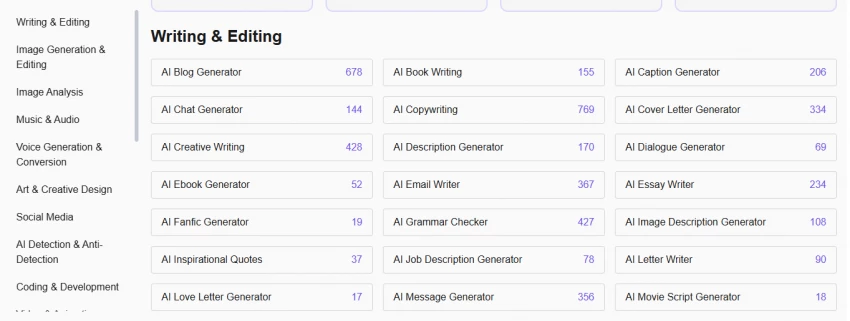
The scale is difficult to ignore. During our July 2026 review, Toolify displayed 29,937 AI products across 459 categories and said its directory and GPT listings were updated daily using ChatGPT. The platform also included free-tool collections, traffic rankings, revenue-oriented rankings, browser extensions, mobile apps, prompts, AI models and recently launched products.
That breadth makes Toolify useful, but scale alone does not make a directory reliable. We found that Toolify works well for discovering categories and finding unfamiliar products, yet its individual listings can contain outdated pricing, old product descriptions and questionable alternatives. Its rankings are useful for observing visibility and traffic, but they should not be interpreted as independent measurements of product quality.
Toolify Review Summary
Review area
Our finding
Best suited to
Exploring AI categories, discovering unfamiliar products and researching market activity
Less suitable for
Final software selection, pricing verification and security or procurement decisions
Directory size during review
29,937 AI listings across 459 categories
Account required to browse
No
Expedited tool submission
$99 at the time of review
Strongest feature
Breadth of tools, categories and traffic information
Main weakness
Listing freshness and recommendation relevance vary
Overall assessment
6 out of 10
Review completed
July 2026
What We Actually Checked Before Scoring Toolify
This was not a summary assembled from other Toolify reviews. We examined Toolify’s public website directly and followed the paths a normal visitor or software founder would use.
Our review covered the homepage, category directory, Most Used section, Free AI Tools area, revenue ranking, AI Resume Builder category, individual ChatGPT and Claude listings, alternative recommendations, user-review sections, privacy policy and paid submission workflow.
We did not purchase the $99 submission, create a publisher account or contact customer support. We therefore do not claim to have tested the paid dashboard, listing approval process, refund handling or support response times.
Our assessment focused on six practical questions.
Test area
Evidence examined
Discovery
Whether relevant categories and established tools were easy to locate
Listing usefulness
Whether individual pages provided enough information to understand a product
Data freshness
Whether pricing and product descriptions matched current official sources
Recommendation quality
Whether suggested alternatives performed a similar function
Commercial transparency
Whether advertisements and paid placements were identifiable
Trust
Whether rankings, reviews, privacy information and update methods were sufficiently explained
This approach matters because Toolify is not an AI application that generates an output. It is an information platform. Its quality therefore depends on the freshness, relevance and transparency of the information it presents.
How Toolify.ai Positions Itself as an AI Tool Directory
Toolify presents itself as a comprehensive AI catalog, similar to an app store but with far broader coverage. The homepage highlights categories, rankings, and trending lists, while also featuring sections like Most Used Tools this Month or Top by Revenue. For a new user, it creates the impression of authority: if something is listed here, it must be important.
However, this authority is assumed rather than proven. Toolify does not clearly explain how these rankings are calculated. Some appear to be based on internal click data, others on user saves, but none are independently verified. In this way, the platform functions less as a trusted evaluator and more as a signal aggregator, showing what’s visible rather than what’s objectively “best.”
First Impressions
Toolify’s homepage communicates its scale immediately. The navigation includes New AIs, Most Saved, Most Used, mobile apps, browser extensions, GPTs, AI models, rankings, prompts, jobs and tool-submission options.
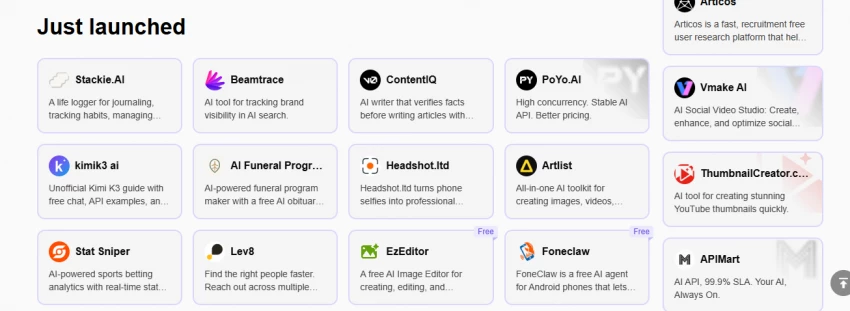
The platform is information-dense. On one page, a visitor may see new listings, sponsored products, category tags, AI news, prompts and free-tool categories. That density is helpful for users who want to scan the market, but it also creates visual competition between editorial navigation and promoted products.
Sponsored content was not hidden during our walkthrough. Toolify used labels such as “Sponsor,” “Sponsored by,” “Featured” and “AD” around paid placements. That is more transparent than the previous version of this article suggested. The real issue is not that advertisements are invisible; it is that they appear frequently enough to interrupt the research flow.
Category Browsing Is Better Than Its Tool Recommendations
Toolify performs best when the visitor starts with a clearly defined category.
The AI Resume Builder page, for example, displayed 401 products and immediately surfaced recognizable platforms such as Teal, CVwizard, Kickresume, Rezi, Resume Worded, Simplify and VMock. Visitors could change the sorting between Best, Most Saved, Recent and Relevant.
This is a useful discovery experience. Someone researching resume software can quickly identify established products, scan less familiar alternatives and move between several pricing types.
The quality dropped when we moved from category pages to the alternative recommendations attached to individual listings.
Toolify’s ChatGPT alternatives included Zyka.ai, Chathero AI and Cronbot. Those products overlap with ChatGPT in limited ways, but they are not the substitutes most buyers would naturally compare with ChatGPT. More direct alternatives such as Claude, Gemini or Perplexity were not prioritized in the visible recommendation section we reviewed.
The Claude listing produced an even clearer mismatch. Its suggested alternatives included an instructor grading assistant, a browser extension for airline pilots and a study platform. These products shared broad “AI assistant” tags but were not practical Claude replacements.
This suggests that Toolify’s category system is stronger than its per-product recommendation engine. The site appears capable of grouping products with related tags, but shared tags do not always indicate that two products solve the same problem.
The Listing Accuracy Test Revealed Outdated Information
The most important issue we found was not the number of advertisements. It was the freshness of product-level information.
Toolify’s ChatGPT page contained useful material, including a product summary, use cases, user ratings, estimated traffic and pricing. However, its pricing section still referred to GPT-4o mini, GPT-4o, o4-mini, GPT-4.5 and older Team-plan details.
OpenAI’s official pricing page in July 2026 instead listed Free, Go, Plus and Pro plans and described current access using GPT-5.5 and GPT-5.6 models. This means Toolify’s ChatGPT pricing information had not kept pace with the official product.
The Claude page showed a similar problem. Toolify still described the product as “Claude 2,” labelled pricing as “Contact for Pricing,” and provided only a very basic feature description.
Anthropic’s current documentation listed an individual Free plan, a $20 monthly Pro plan, a $100 Max 5x plan and a $200 Max 20x plan. Anthropic also offered separately priced Team plans.
These two examples do not prove that every Toolify listing is outdated. They do show why visitors should verify price, model availability and plan limits on the vendor’s official website before purchasing.
The inconsistency is especially notable because Toolify says its directory is updated daily using ChatGPT. Daily automation can help identify and classify new websites, but it does not guarantee that every existing product page has been manually checked against current official documentation.
Toolify’s Rankings Measure Attention, Not Product Quality
Toolify provides several ranking systems, but users need to understand what each one represents.
The Most Used section is described as a list of AI products with the highest website traffic measured through monthly visits. It does not mean those products have been tested or rated as the most useful by Toolify’s editors.
The Most Saved section reflects the number of Toolify users who have saved a listing. This is closer to a platform-engagement signal, but it still does not measure product reliability, customer satisfaction or long-term retention.
The revenue ranking requires even more caution. Toolify describes it as a high-revenue ranking based on payment-platform information and actual monthly website traffic. The table shows payment processors and monthly visitor estimates, but it does not display verified revenue figures for the companies.
Calling this a revenue ranking may give readers the impression that the companies have been ordered using audited sales data. Based on the visible methodology, it is more accurately understood as a commercial-traction proxy that combines detected payment systems with traffic information.
That information can still be valuable. Founders can use it to identify popular categories, frequently used payment platforms and products with substantial web visibility. It should not be used to estimate a competitor’s actual income or decide which software offers the best performance.
The Free AI Tools Section Makes a Strong Verification Claim
Toolify maintains a separate Free AI Tools directory that promises to help visitors avoid misleading trials. The page says every listed product is selected because it qualifies as a free AI tool and claims the available offers are vetted by its team.
That is a stronger claim than the general directory makes.
The free-tool page includes categories and marks some individual listings as “Free.” It also contains clearly labelled featured placements. During our walkthrough, however, the visible cards did not consistently show the exact usage allowances promised in the explanatory section, such as the number of monthly generations, words or credits.
This creates a difference between the page’s promise and the immediately visible evidence. A product may technically offer a free version while still requiring payment for exports, commercial usage, higher-quality results or meaningful monthly capacity.
Toolify’s Free AI Tools section is therefore useful for producing an initial shortlist, but the free allowance should still be checked directly on the provider’s pricing page.
Paid Submission Changes How Listings Should Be Interpreted
Toolify is free for visitors, but it also sells visibility and submission services to AI companies.
At the time of our review, its submission form displayed a $99 payment for placement within 48 hours without a queue. Toolify said the package included a highlighted border, permanent listing, launch badges and at least six dofollow links. The form also allowed listing information to be generated by Toolify, with content and translations produced using AI.
This does not automatically make a submitted product unreliable. Paid listings are common across software directories and launch platforms. The important distinction is that inclusion confirms the product was submitted and published; it does not prove the product was independently tested or approved for quality.
The AI-generated listing option also helps explain why descriptions can feel generic or age poorly. Automated summaries can classify a product quickly, but they may miss important changes in pricing, ownership, models, security policies or available features.
For founders, Toolify’s submission package may provide backlinks and visibility. For buyers, a Toolify profile should be treated as vendor and directory information rather than an independent endorsement.
User Reviews
Product Hunt displayed a 3.0 rating based on only two reviews for the original Toolify launch during our research. It also showed several separate Toolify-related launches for products such as its free-tool directory and social-listening feature.
Two reviews are far too few to establish broad customer sentiment.
Toolify’s own product pages also contain ratings and comments, but sample sizes can be very small. Its Claude listing had two reviews, while the ChatGPT page had nine. Those numbers do not provide the volume or verification detail needed for a confident purchasing decision.
The platform can show that a product has attracted some attention, but users should combine its reviews with verified software-review platforms, current app-store feedback, independent tests and the provider’s own documentation.
User Complaints Summarized
Here are the main issues users have reported:
Scraping: Some developers claim their tools were added without permission.
Attribution gaps: Listings occasionally omit or misrepresent tool sources.
Ad clutter: Sponsored results sometimes dominate category pages.
Update friction: Developers must spend “coins” to correct outdated details.
These repeated concerns suggest Toolify prioritizes growth and visibility, sometimes at the cost of accuracy and trust.
While this system seems structured, it creates friction. As noted by reviewers, the coin model feels like a barrier. Instead of encouraging accuracy, it reportedly discourages smaller teams from keeping listings current. This weakens the platform’s credibility, since stale entries remain uncorrected.
Privacy Information Is Available but Needs Updating
Toolify publishes a privacy policy describing the collection of account details, email addresses, names, usage information, device data, IP addresses and cookie-related activity. It also explains that information may be processed by service providers and business partners.
The concern is that the policy displayed a last-updated date of October 12, 2022 and stated that it had been created with the help of a privacy-policy generator.
An older policy does not prove that Toolify mishandles personal data. It is nevertheless a weak trust signal for a platform that has expanded significantly and now includes accounts, publisher submissions, advertising, AI-generated content and multiple new discovery products.
Casual visitors can browse much of the directory without creating an account. Users submitting company information, paying for placement or saving products should review the current terms and privacy details before providing sensitive information.
Toolify Compared With Other AI Directories
Toolify is not automatically the best directory for every type of user. Its main advantage is inventory size, while competing platforms place more emphasis on curation, task-based search or educational content.
Platform
Strongest use
Main difference
Toolify
Broad AI-market exploration and traffic data
Largest visible inventory in this comparison, but listing freshness varies
Futurepedia
Curated tools and AI education
Promotes more than 4,000 curated products alongside courses and practical lessons
TopAI.tools
Finding software for a specific task
Uses task-oriented AI search, filters, role-based stacks and playbooks
AIxploria
Browsing free tools and community rankings
Uses views, votes and additional criteria for category rankings
Product Hunt
Discovering newly launched products
Provides maker participation and launch-day community feedback rather than a structured software catalog
Toolify Scorecard
Area
Score
Reason
Directory breadth
9/10
Nearly 30,000 listings and hundreds of categories
Category discovery
8/10
Strong coverage and useful sorting options
Navigation
7/10
Many routes are available, though pages can feel crowded
Listing detail
7/10
Product pages combine features, traffic, pricing, reviews and alternatives
Data freshness
4/10
Major listings contained outdated pricing and product descriptions
Alternative quality
4/10
Some recommendations shared tags but were not practical substitutes
Ranking transparency
5/10
Ranking signals are partly described, but labels can imply more than the data proves
User-review value
3/10
Review samples are generally too small for strong conclusions
Advertising disclosure
7/10
Sponsored and featured placements were visibly labelled
Overall
6/10
Strong discovery platform, weak final verification layer
The overall rating reflects Toolify as a research directory, not the performance of every product listed on it.
Toolify’s Main Strengths and Limitations
Strengths
Limitations
Large catalog spanning hundreds of categories
Individual descriptions and prices may become outdated
No account required for basic browsing
High listing volume makes consistent manual verification difficult
Useful category, traffic and regional views
Traffic and saves do not measure product quality
Includes web tools, apps, extensions, GPTs and models
Some alternative recommendations are poorly matched
Sponsored placements are generally labelled
Advertising appears frequently throughout the browsing experience
Helpful starting point for founders and researchers
Small review samples provide limited buyer confidence
Who Will Get the Most Value From Toolify?
Toolify is most valuable for marketers, researchers, founders, writers and early adopters who want to understand the size of a category or discover products they may not encounter through a normal search.
A founder researching the AI resume market can use Toolify to identify hundreds of competing products. A content team can examine category language and emerging use cases. An investor or market researcher can use traffic and regional information as a directional signal.
A company choosing software for employees should not stop there. Pricing, data retention, integrations, model providers, security certifications and contract terms must be confirmed through primary sources.
The safest workflow is to discover products on Toolify, create a small shortlist, read independent reviews and then verify every important claim on the vendor’s official website.
Final Verdict
Toolify is one of the broadest AI discovery platforms available in 2026. Its directory makes it easy to see how crowded the market has become, move between hundreds of categories and find products that conventional software directories may not yet cover.
The public browsing experience also offers more depth than a simple list. Tool pages can contain estimated traffic, geographic data, pricing, reviews, use cases and competing products.
The weakness is that the amount of information can create an impression of verification that the platform does not always support. Our checks found outdated ChatGPT pricing, an old Claude 2 description and alternative recommendations that were only loosely connected to the original product.
Toolify is therefore best viewed as a discovery engine and market map. It can show you what exists, what receives traffic and which categories are expanding. It cannot reliably tell you which product is the safest, most accurate or best value without additional research.
Use Toolify to begin the search, not to end it.
FAQs About Toolify.ai
1. Is Toolify.ai free to use? Yes, browsing is free, but developers often need to pay coins to update their listings, and ads/sponsored placements shape the experience.
2. Can I trust Toolify’s rankings? Not entirely. They are based on signals like clicks or saves, not transparent metrics. Use them as starting points, not final verdicts.
3. How does Toolify compare to alternatives? Toolify has scale, while There’s An AI For That has longevity, TopAI.tools has simplicity, and Creati.ai has curation. Each serves different needs.
4. Why do some developers criticize Toolify? Complaints include scraping allegations, attribution gaps, ad overload, and friction in updating listings.
5. Should enterprises rely on Toolify? It’s better for exploration. Enterprises should treat it as a discovery map, not a procurement guide
_1757655958.webp)