
Content pillar" is one of the most confusingly used terms in marketing because it means two completely different things depending on who's saying it. In *social media marketing, a content pillar is a recurring theme or category you post about, like education or behind-the-scenes content. It's a planning framework, not a piece of content. In **SEO and content strategy*, a content pillar is a comprehensive long-form page covering a broad topic in depth, with related "cluster" content linking back to it. It's an actual deliverable, not a category. Both definitions are correct. They serve different goals. And if you don't know which one your team or agency is talking about, you'll spend three months building the wrong thing. This guide explains both, when you need each one, and how to tell which conversation you're in.
| Feature | Social Media Content Pillar | SEO Content Pillar (Pillar Page) |
|---|---|---|
| Definition | A recurring theme or content category | A specific long-form page on your site |
| Form | Planning bucket (no physical asset) | Deliverable (one URL, often 3,000+ words) |
| Quantity | 3–6 per brand | 5–20 across a site, one per major topic |
| Primary Purpose | Consistency, brand cohesion, post variety | Topical authority, organic search rankings |
| Location | Strategy document | Published on your website |
| Example | "Customer success stories" as a recurring category | A 4,000-word page titled "The Complete Guide to Email Marketing" |
| Users | Social media managers, brand strategists | SEOs, content marketers, HubSpot-trained teams |
If you read three articles on "what is a content pillar" and end up confused, this is why. The articles aren't wrong. They're describing different things and assuming you know which.
When a social media manager talks about content pillars, they mean the *categories you post within*. The pillars are a planning framework that prevents your feed from becoming either repetitive (90% product promotion) or scattered (no clear identity).
A health and fitness brand's social media content pillars might be:
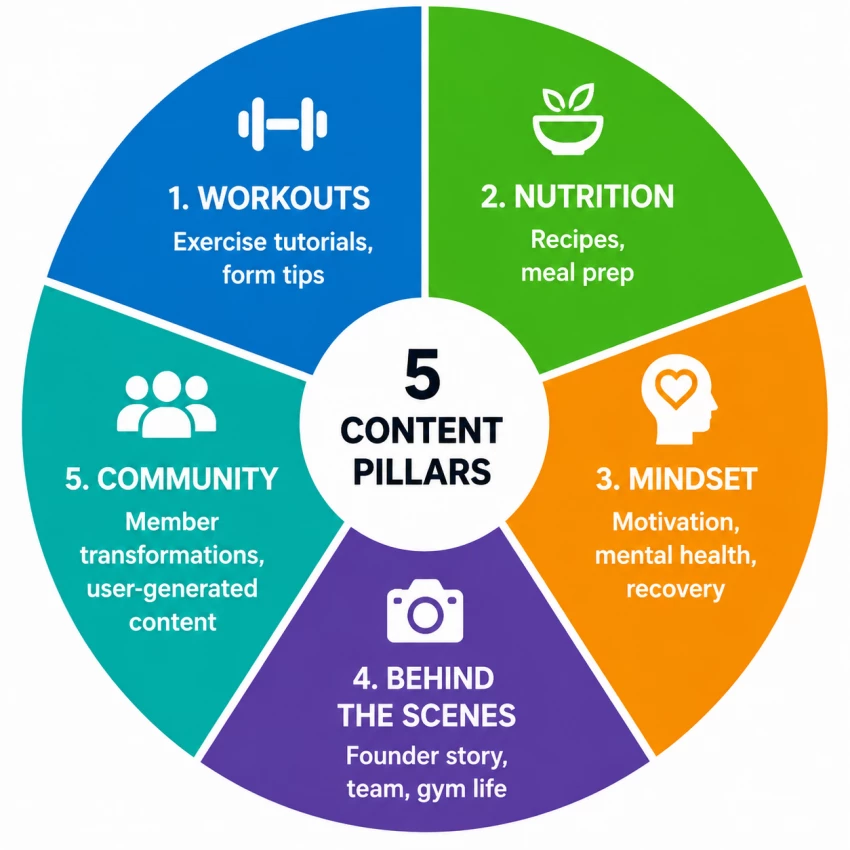
Every social post fits into one of those five buckets. The framework forces variety. You can't post workouts every day for a month, because three other pillars need attention. It also forces strategic alignment. If a post idea doesn't fit a pillar, you have to ask whether the post belongs on this brand's feed at all.
This is the definition Sprout Social, Later, Buffer, and most social-first marketing publications use. Sprout's 2026 Social Media Content Strategy Report notes that consumers increasingly want brands' primary focus on social to be human-generated content and meaningful engagement. Both become easier to deliver consistently when you've defined the buckets you're posting into.
Most brands settle on 3–6 social pillars. Fewer than 3 and you don't get variety. More than 6 and you can't actually execute against all of them. Pillars 5 and 6 quietly die within a quarter.
When an SEO or a HubSpot-trained content marketer says "content pillar," they almost always mean a *pillar page*. This is a comprehensive, long-form page on your website that covers a broad topic in depth and links out to a cluster of more specific articles on subtopics.
A SaaS company selling email marketing software might build a pillar page titled "The Complete Guide to Email Marketing." That page is 3,000–6,000 words, covers the topic broadly, and internally links to 15–30 "cluster" articles on narrower subtopics: "how to write a subject line," "best send times by industry," "GDPR compliance for email," "automation workflow examples," and so on. Each cluster article links back to the pillar page.
This structure does three things:
HubSpot popularized this model in the late 2010s, and it's now the default SEO architecture for content-heavy sites. The Content Marketing Institute has consistently flagged it as a structural advantage that compounds over time: organized topic clusters tend to outrank scattered article-by-article publishing on the same topics.
A pillar page is a real deliverable. You can point at it. You can measure its traffic. It isn't a strategy document; it's content.
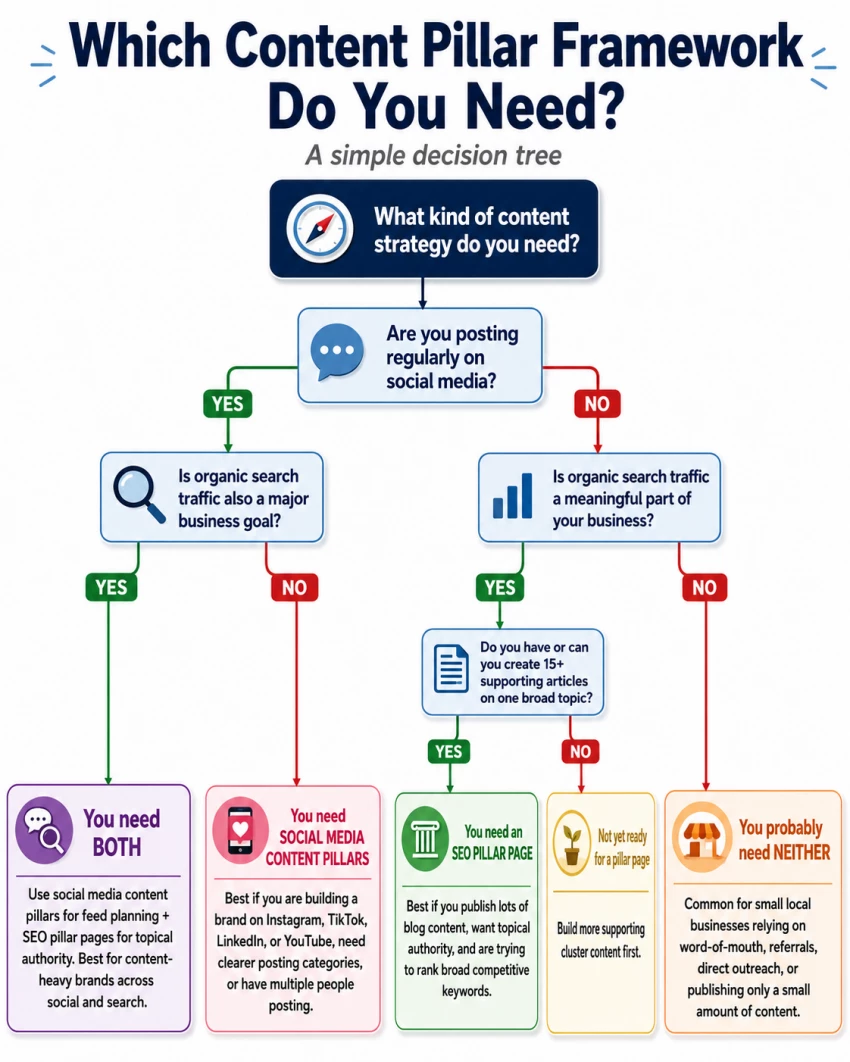
This is the question every "what is a content pillar" article should answer and most don't.
The honest decision tree:
*You need social media content pillars (Definition 1) if:*
- You're building a brand on Instagram, TikTok, LinkedIn, or YouTube
- Your content feels scattered or repetitive and you need a framework to fix it
- You have multiple people posting on behalf of the brand and need shared categories to stay aligned
- You're not particularly focused on organic search traffic
*You need an SEO pillar page (Definition 2) if:*
- Organic search traffic is a meaningful part of your business
- You publish a lot of blog content and it feels disconnected, with no topical authority accumulating
- You're trying to rank for broad, competitive keywords (where pillar-plus-cluster structures outperform standalone articles)
- You have or can produce 15+ supporting articles on a single broad topic
*You need both if:* you're running a content-heavy brand across both social and search. Most mid-size B2B companies and e-commerce brands with substantial blog programs fall here, as do creator businesses. The two pillar frameworks serve different goals and don't conflict. Your social pillars organize what you post to feeds. Your SEO pillar pages organize what you publish to your site.
*You probably need neither if:* you're a small local business that mostly relies on word-of-mouth, referrals, and direct outreach. Pillar frameworks are organizational tools for content programs at scale. If you're publishing 2 things a month, you don't have a content scale problem to solve.
Every article on content pillars tells you to "align them with your audience and brand values." That's true and useless. Here's the actual process that produces pillars worth using.
*For social media pillars:*
1. *Write down the 10 specific reasons someone would follow your brand.* Not "they want our content." Specific reasons like "they want to learn beginner Spanish," "they want behind-the-scenes of a working bakery," or "they want quick lunch ideas under $5." If you can't name 10, you don't yet know your audience well enough to set pillars.
2. *Cluster those 10 reasons into 4–6 groups.* Each group is a pillar candidate. Name each one in 1–3 words.
3. *Stress-test each pillar against "can I generate 20 posts in this category right now?"* If the answer is no, the pillar is too narrow and will die within a month. Either broaden it or cut it.
4. *Drop the weakest one or two.* Most teams over-include because they want to feel comprehensive. Three strong pillars beat six mediocre ones.
*For SEO pillar pages:*
1. *Identify the 3–5 broad topics your business has the strongest claim to.* Not topics you wish you owned. Topics where you already have some content, expertise, and authority.
2. *For each broad topic, run a keyword research pass.* You're looking for a high-volume "head term" that anchors the pillar page (e.g., "email marketing") and 15–30 longer-tail queries that become cluster articles (e.g., "best email subject lines for cold outreach").
3. *Audit what you already have.* Most teams discover they have 60% of the cluster content already, just disconnected and unoptimized. The pillar project is often more reorganization than net-new writing.
4. *Build the pillar page last, not first.* Counterintuitive but practical: the pillar page is supposed to summarize and link to the cluster. If you write it before the cluster exists, you'll have to rewrite it twice.
## The failure mode nobody warns you about
Content pillars share one dominant failure mode across both definitions. They get defined once, documented in a Notion page, and then nobody references them again.
I've seen this pattern more times than I can count. A team holds a half-day strategy workshop. They emerge with five beautifully named content pillars. The slide deck is shared. Three months later, the social calendar shows no clear connection to those pillars, and the website's blog is publishing whatever the writer found interesting that week. The pillars existed in a document, not in the workflow.
The fix is structural, not motivational.
Pillars only work when:
If your team doesn't have the operational discipline to enforce these habits, the pillar exercise is decorative. Skip it and use your time on something with execution behind it.
The other failure mode is the opposite problem. Pillars become rigid and start blocking good content. A team defines five pillars, and then a great piece of content idea comes up that doesn't fit any of them, and the team kills the idea because "it's off-pillar." That's the framework working against you.
The right posture is to treat pillars as 80% of your content, not 100%. Five pillars covering 80% of output means you have room for 20% experimental or off-brand content that may or may not become a sixth pillar over time. Strict 100% adherence kills the responsiveness that good content programs need.
If you're being asked about content pillars and you don't know which definition is in play, ask. The question "do you mean social media themes or SEO pillar pages?" sounds basic and is the single most useful clarification you can make in a content strategy conversation. The two aren't the same project. They don't share deliverables and they require different skills to execute.
For most brands worth advising:
*Define 3–5 social media content pillars* if you're posting to social regularly. Use them as planning buckets. Tag every post.
*Build SEO pillar pages* only after you have substantial cluster content (15+ articles) on a topic and a real reason to consolidate organic search authority around it.
*Don't build either* if you're publishing two pieces of content a month. You don't have a content scale problem yet; you have a content volume problem. Solve that first.
The pillar that doesn't show up in your weekly workflow is not a strategy. It's a document.
How many content pillars should I have?
For social media: 3–6, with most brands landing on 4. Fewer than 3 and your feed becomes repetitive; more than 6 and you can't execute against all of them. For SEO pillar pages: usually 5–20 across a full site, one per major topic your business covers.
What's the difference between a content pillar and a topic cluster?
A pillar (in the SEO sense) is the central long-form page on a broad topic. A topic cluster is the pillar page plus the group of narrower articles that link to it. So the pillar is one piece of the cluster, specifically the hub.
Can a content pillar be a single piece of content?
In the SEO definition, yes. A pillar page is a specific URL. In the social media definition, no. The pillar is the category, and individual posts are instances of that category.
Do content pillars actually improve SEO?
Pillar pages with strong cluster content do, because they signal topical authority. Social media pillars don't directly affect SEO, but they affect brand recognition, which influences branded search volume, which is a ranking signal. The effects are different and shouldn't be confused.
Should I name my pillars publicly or keep them internal?
Almost always internal. Pillars are an operational framework, not customer-facing positioning. Customers don't care that your "education" pillar is called education. They care that they keep getting useful content.
How often should I review my content pillars?
Quarterly is the standard cadence. Look at actual output by pillar and audience engagement by pillar. Note any that have gone dormant. Cut pillars that aren't working; promote experimental themes that have organically become consistent.
Can I use AI tools to define my content pillars?
AI can help you brainstorm themes and cluster your existing content. It's poor at the judgment calls that matter: which themes match your actual brand position, which pillars your team can realistically execute against, and which audiences you genuinely serve versus the ones you wish you did. Use AI for the organizational work; keep the strategic calls human.
Are content pillars still relevant in 2026?
Yes, more than ever, in both definitions. AI-generated content has made the marketing internet noisier, and brands that publish under a clear thematic framework cut through that noise better than brands posting reactive, scattered content. Pillars are how you maintain coherence at scale.
Share your thoughts about this article.
Be the first to post a comment!

Software rarely gets removed. It accumulates. A team hits a snag, someone finds...
Deepak Mehra1 month ago

⚑ The short versionAn AI detector returns a probability, not a verdict. Th...
Sakshi Dhingra1 month ago

Picture the last time you called a business after hours. You already know the so...
Pritam Singh1 month ago

Here is the uncomfortable truth about buying an AI chatbot for customer support...
Harpreet Singh1 month ago

Cancelling a ChatGPT subscription takes less than two minutes, once you know whe...
Harpreet Singh2 months ago

AI assistants stopped being optional somewhere in the last two years. Four in fi...
Harpreet Singh2 months ago