Marketing automation is the use of software to handle repetitive marketing tasks automatically—such as sending emails, following up with leads, or tagging customers—based on predefined rules or user behavior.
In simple terms:
Instead of manually sending messages or tracking every lead, the system does it for you.
Examples:
● Sending a welcome email when someone signs up
● Following up with a lead who downloaded a guide
● Notifying sales when a prospect is ready to talk
Marketing automation was not created to replace human marketers. Instead, it exists to solve scale and consistency challenges that appear as a business grows.
When a business is small, it’s possible to personally follow up with every lead, remember every conversation, and send custom messages manually. However, as the number of leads, customers, and channels increases, this approach quickly becomes unreliable and time-consuming.
1. Leads are forgotten or followed up too late-
Without automation, leads often depend on manual reminders or spreadsheets. This leads to delayed follow-ups or missed opportunities, especially when teams are busy or handling many inquiries at once.
2. Every customer gets the same generic message-
Manual marketing usually results in one-size-fits-all messaging. This reduces relevance and engagement because customers at different stages of the buying journey receive the same communication.
3. Sales and marketing don’t share data properly-
When tools are disconnected, marketing may not know which leads sales has contacted, and sales may not see a lead’s previous interactions. This creates confusion and inconsistent customer experiences.
4. Manual work consumes time better spent on strategy-
Repetitive tasks like sending emails, updating records, or tracking responses take up valuable time. This leaves less room for planning, creative work, and optimization.
1. Ensures no lead is ignored:
Automation systems automatically trigger follow-ups based on user actions, ensuring that every lead receives timely attention without relying on memory or manual tracking.
2. Delivers timely, relevant communication:
Messages are sent based on behavior, interest, or stage in the journey. This makes communication more relevant and increases the chances of engagement.
3. Aligns marketing and sales teams:
With shared data and automated handoffs, both teams see the same information. This improves collaboration and reduces friction between departments.
4. Saves time while improving consistency:
Automation handles repetitive tasks reliably, allowing teams to focus on higher-value work while maintaining consistent communication across all customers.
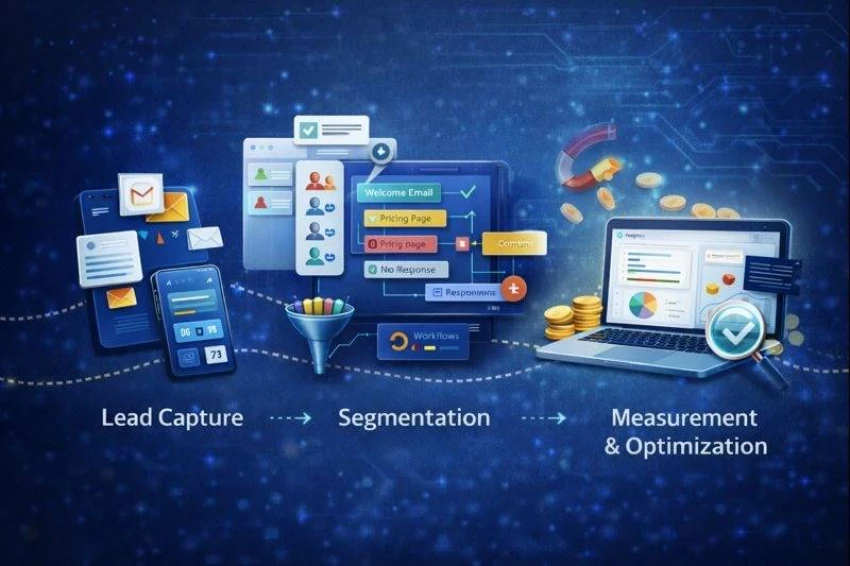
Most marketing automation systems follow the same basic flow.
A user takes an action:
● Fills a form
● Subscribes to a newsletter
● Downloads a resource
● Requests a demo
This information is stored automatically.
Leads are grouped based on:
● Behavior (pages visited, emails opened)
● Demographics (industry, role, location)
● Stage in the buying journey
Example:
New subscribers vs returning customers
Workflows define what happens next.
Examples:
● If a user signs up → send welcome email
● If a user clicks pricing page → notify sales
● If no response in 7 days → send reminder
This is where automation does the heavy lifting.
The system tracks results:
● Open rates
● Click-through rates
● Conversions
● Drop-off points
These insights help improve future campaigns.
Marketing automation is not just about email. Here are the most common and practical uses.
| Use Case | What It Does | Why It Matters |
| Email nurturing | Sends relevant emails over time | Builds trust before selling |
| Lead scoring | Ranks leads by engagement | Helps sales focus on ready buyers |
| CRM integration | Syncs marketing and sales data | Prevents missed opportunities |
| Customer journeys | Guides users step-by-step | Improves experience and conversions |
| Re-engagement | Targets inactive users | Reduces churn |
Different tools serve different needs. Choosing the wrong category often causes frustration.
Best for newsletters, drip campaigns, and simple automation.
● Mailchimp – Email campaigns and basic automation
● ConvertKit – Creators, bloggers, and simple funnels
Best for: Small businesses, creators, early-stage automation
Marketing and sales automation in one system.
● HubSpot – All-in-one CRM, email, workflows
● Zoho CRM – CRM-first automation for SMBs
Best for: Businesses with sales teams
Automation across email, SMS, push notifications, and web.
● ActiveCampaign – Advanced workflows and segmentation
● Klaviyo – E-commerce-focused automation
Best for: E-commerce and multi-channel marketing
Use AI to optimize timing, content, or predictions.
● Marketo – Large-scale, enterprise automation
● Customer.io – Event-based, data-driven automation
Best for: Data-heavy, growth-focused teams
● Follow-ups
● Onboarding emails
● Status updates
● Sensitive customer issues
● High-value sales conversations
● Crisis communication
Automation supports humans—it doesn’t replace them.
Bad data leads to bad automation.
● Keep forms short
● Clean your contact list regularly
● Segment based on behavior, not assumptions
Personalization is good. Over-automation feels robotic.
● Name, context, behavior-based content
● Overusing first names
● Too many automated messages
● Irrelevant triggers
● Open and click rates
● Conversions
● Drop-offs in workflows
Small improvements over time outperform complex setups.
One common mistake is trying to automate every marketing task from the start. When a business is still small, automation can add unnecessary complexity. Without enough data or clear processes, automated workflows may send the wrong messages or trigger at the wrong time.
Why this matters:
Automation works best after you understand your customers and processes. Automating broken or unclear processes only makes problems scale faster.
Some businesses create a single workflow and apply it to everyone, regardless of interest, behavior, or stage in the buying journey. This leads to irrelevant messages and lower engagement.
Why this matters:
Not all users have the same needs. A first-time visitor and a returning customer should not receive the same communication. Segmentation is essential for effective automation.
Marketing teams sometimes build automation workflows without consulting sales teams. As a result, leads may be passed too early, too late, or without the right context.
Why this matters:
Sales teams often know which signals indicate real buying intent. Ignoring their input can lead to poor lead quality and frustration on both sides.
Once automation is set up, it’s easy to forget about it. Over time, products change, customer behavior shifts, and messaging becomes outdated.
Why this matters:
Automation that worked six months ago may no longer reflect your current business goals or customer expectations. Regular reviews help keep workflows relevant and effective.
Automation is often seen as a one-time setup, but it requires ongoing attention. Without monitoring performance, businesses miss opportunities to improve results.
Why this matters:
Effective automation depends on testing, measurement, and optimization. Open rates, conversions, and drop-offs should guide continuous improvements.
Marketing automation works best when it’s simple, intentional, and customer-focused.
1. Pick one clear goal (e.g., better lead follow-up)
2. Choose a tool that matches your business size
3. Build one simple workflow
4. Measure results and improve gradually
Done right, marketing automation saves time, improves consistency, and helps businesses grow—without losing the human element.
Be the first to post comment!

Performance marketing is evolving at an unprecedented pace. With a growing relia...
Sakshi Dhingra1 day ago

I didn’t come across Influencers Gone Wild through recommendation or advertising...
Sakshi Dhingra4 days ago

Growth marketing today relies on a combination of experimentation, analytics, au...
Sakshi Dhingra1 week ago

Online reviews are often framed as a decision-making tool for buyers. But behind...
Suraj Malik2 weeks ago

Magento stands out as one of the most robust solutions for growing brands that w...
Mighva Verma1 month ago
Paid survey apps are everywhere now, but most people are unsure which ones actua...
Sakshi Dhingra4 months ago