Technology
8 min read
Writeless AI: Can It Meet Modern Academic Standards?
Academic writing is more demanding than ever. Universities now use AI-detection tools, advanced plagiarism scanners, stricter originality checks, and mandatory citation accuracy. With this pressure, tools like Writeless AI claim to offer a shortcut: fast academic essays with real citations, plagiarism-free writing, and even AI-detector bypass capabilities.
But does Writeless actually meet the expectations of modern academic standards, or does it fall short when compared with more established competitors?
This review breaks down its real functionality, strengths, weaknesses, user sentiment, and how it stacks up against competitors built specifically for academic rigor.
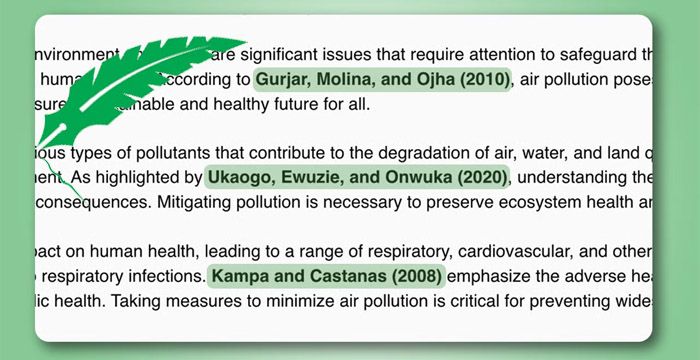
Writeless AI markets itself as an academic writing assistant that can generate essays, reports, and assignments with citations. Its public positioning emphasizes fast writing, citation support, plagiarism-free output, and AI detection resistance. The company description on Trustpilot also says the tool supports styles such as academic, argumentative, and casual writing, and claims to help users produce work with verifiable citations.
That is a strong promise, but it needs to be separated into three different claims.
The first claim is speed. This is believable. Most AI essay tools can generate a structured draft quickly, and Writeless appears built around that kind of guided essay flow.
The second claim is citation support. This is useful, but also risky. A citation-looking sentence is not the same as a verified academic source. A real academic workflow requires checking whether the source exists, whether the author/title/year are correct, whether the source actually supports the claim, and whether the in-text citation matches the final reference list.
The third claim is AI-detection resistance. This is where the article needs to be careful. “Undetectable” sounds attractive, but it is not a reliable academic safety standard. Detection systems vary, false positives happen, and institutions can use human review, writing history, oral questioning, document metadata, or process evidence alongside software.
Undetectable is not an academic standard; verifiable is.
That one line matters because Writeless is being judged in an academic context, not just as a general AI writer. A tool can produce clean paragraphs and still fail the most important test: can the student explain, defend, cite, and revise the work?
Writeless AI makes the most sense when the user is stuck at the starting line.
If you have an essay topic but no structure, it can help you see a possible introduction, body flow, and conclusion. If you are unsure how many sections an essay might need, the generated draft can act like a rough skeleton. If you want a quick example of how a prompt could be expanded, Writeless can reduce the blank-page problem.
That is the best version of the tool: not a replacement writer, but a draft scaffolder.
The guided workflow also makes it easier for non-technical users. Instead of opening a blank chatbot and writing a detailed prompt manually, users can choose essay type, writing style, citation preferences, and length. Other reviewers who tested the flow also found that the interface is straightforward and that the quality depends heavily on how specific the initial prompt is.
That last point is important. Generic prompts create generic essays. If a student enters a broad topic like “climate change and business,” the output will usually sound broad too. Writeless does not magically add course context, lecture notes, professor expectations, or original argumentation unless the user supplies that direction.
The tool is most useful for:
That is a narrow but real use case.
The biggest weakness is not that Writeless uses AI. The weakness is that it appears to encourage a one-click academic workflow in a world where universities increasingly care about process, authorship, and evidence.
A generated essay may look polished, but academic work is not only about polished sentences. It is about argument quality, source selection, interpretation, critique, and the ability to explain why a claim belongs in the paper.
This means students face risk from both sides. A tool may fail to bypass detection, but a detector may also wrongly accuse a human writer. Either way, relying on “undetectable” as a strategy is not smart academic practice.
The safest use of Writeless is not “submit this for me.” It is “show me a rough path, then I will do the thinking myself.”
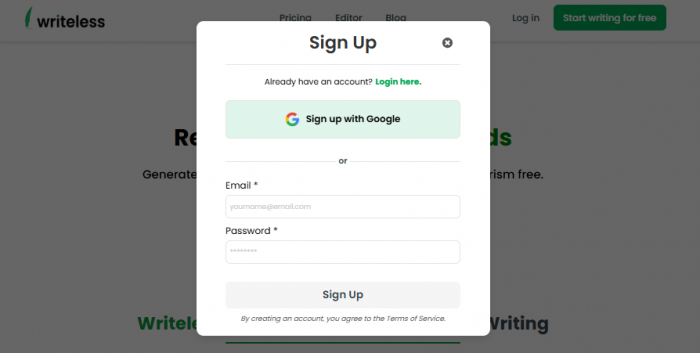
Sign Up: Create an account on the Writeless website.
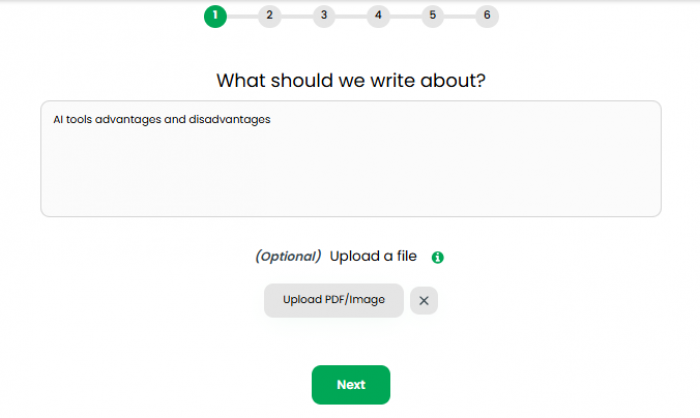
Input Topic: Enter your essay prompt or research question.
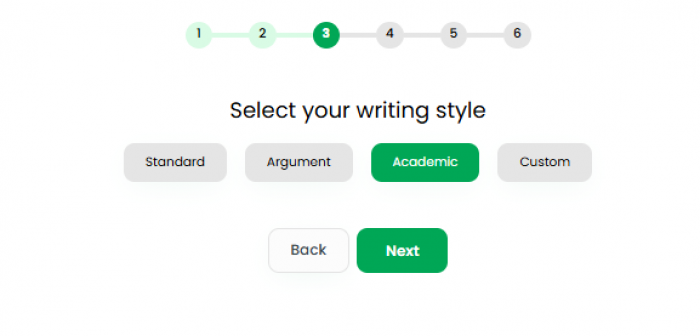
Select Writing Style: Choose the desired tone (formal, persuasive, analytical).
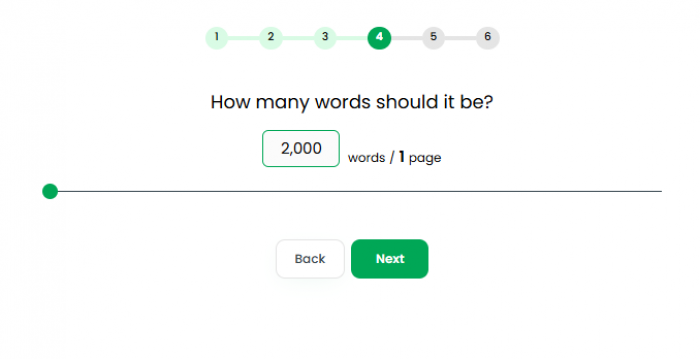
Adjust Word Count:
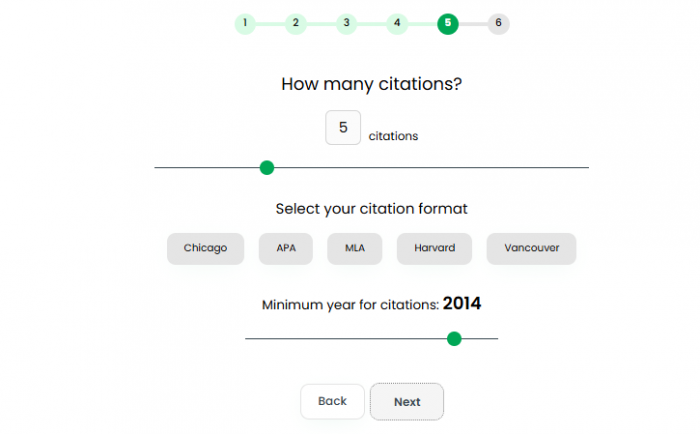
Set Citation Preferences: First, set the number of citations, and then pick your preferred citation style and number of references.
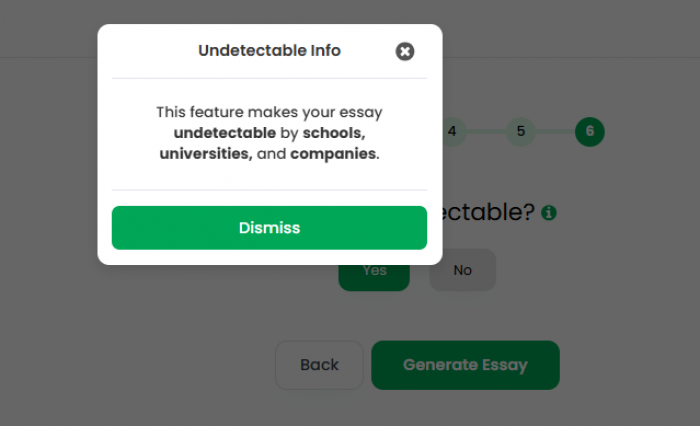
Make it Undetectable: Select according to your requirement
Review & Edit: Check the essay for accuracy, make edits, and use the built-in AI detector to ensure it remains undetectable.
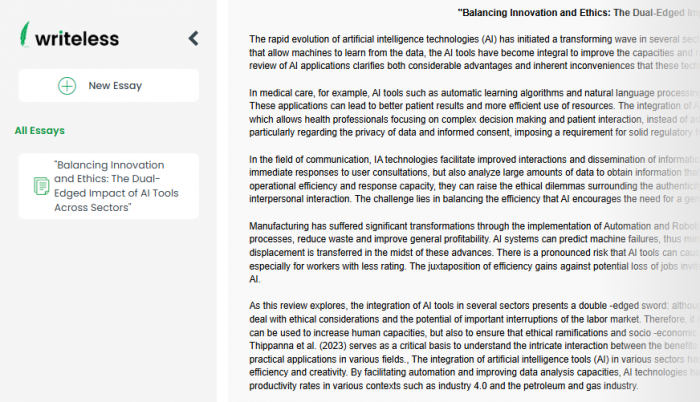
Download or Copy: Export your completed essay for submission.
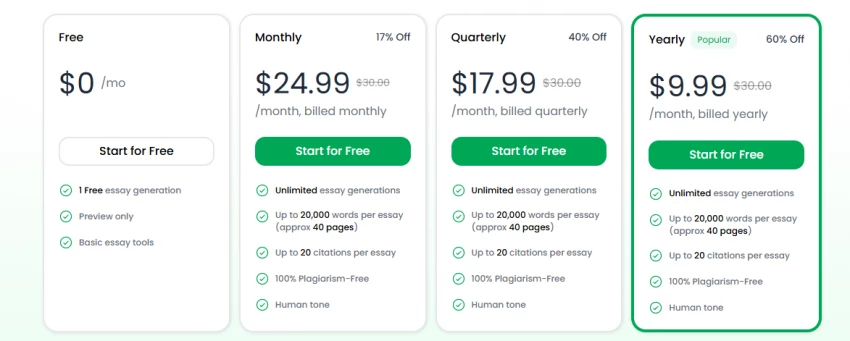
User feedback shows a strong positive response to Writeless AI, with most users praising its accuracy and time-saving features.
Trustpilot currently shows Writeless with 54 reviews and a 3.4/5 average rating. The distribution is highly split: 39% of reviews are 5-star, while 41% are 1-star. Trustpilot also notes that the company has not recently invited reviews and has not replied to negative reviews.
That is not a normal “mostly positive” pattern. It is a polarized pattern.
Some users appear to like the speed and convenience. Others complain about quality, usability, subscription experience, or output value. A polarized review profile usually means the tool may work for a specific kind of user but disappoint people who expect polished, submission-ready academic work.
| Signal | Current reading |
|---|---|
| Review volume | Limited, with 54 Trustpilot reviews |
| Average rating | Mixed at 3.4/5 |
| Positive reviews | Strong praise from some users |
| Negative reviews | Almost equal 1-star share |
| Editorial takeaway | Not enough consistency to call it reliably excellent |
| Tool | Best fit | Main strength | Main weakness |
| Writeless AI | Fast academic-style draft creation | Quick essay structure with citation options | Risky if treated as submission-ready |
| Jasper | Marketing teams and business content | Brand workflows, governance, compliance signals | Not built for academic essays |
| Rytr | Short-form writing and everyday copy | Affordable, simple, broad use cases | Not research-first or citation-first |
| PerfectEssayWriter | Student writing toolkit | Multiple academic utilities, free account limits | Still requires manual source checking |
| Samwell | Research-heavy essay workflows | Long-form writing, source upload, academic editor | More complex than a quick draft tool |
The key point is that Writeless should not be compared only by price. It should be compared by academic responsibility.
The best academic AI tool is not the one that writes the most words. It is the one that leaves the student with the clearest evidence trail.
Writeless AI is not useless. It can be helpful for students who need a quick starting point, a basic essay outline, or a first draft to react against. It is simple, fast, and clearly designed around academic-style writing rather than generic marketing copy.
But it does not fully meet modern academic standards if the user expects the tool to produce a final essay that is safe, original, deeply researched, citation-perfect, and institution-ready.
That is too much to ask from a one-click essay generator.
Compared with Jasper and Rytr, Writeless is more relevant for academic writing. Compared with PerfectEssayWriter and Samwell, it feels more like a fast draft generator than a complete research workflow. Its public review profile is also mixed, with Trustpilot showing nearly equal shares of 5-star and 1-star reviews, which suggests inconsistent user satisfaction.
My recommendation is simple:
Use Writeless AI for structure, not submission.
Use it for brainstorming, not replacing research.
Use its citations as leads, not proof.
Use detection claims with caution, not confidence.
Writeless can help you start an essay, but it cannot make the essay academically yours. That part still has to come from you.
Share your thoughts about this article.
Be the first to post a comment!
Quick answer: ChatGPT is owned and operated by OpenAI Group PBC, a for-profit pu...
Sakshi Dhingra4 days ago

Here is the exact moment most people end up asking this question. You have final...
Nitin1 week ago

Two Android phones can have the same amount of RAM, similar storage capacity, an...
Deepak Mehra2 weeks ago

A stolen password does not always look suspicious to a login system. If the user...
Deepak Mehra3 weeks ago

The short versionA Claude API key is created in the Claude Console at platform.c...
Harpreet Singh3 weeks ago
ChatGPT is owned by OpenAI, a San Francisco-based artificial intelligence compan...
Harpreet Singh1 month ago