Ford Rehires Veteran Engineers After AI Quality Issues
by Michael Hicklen - 2 months ago - 5 min read
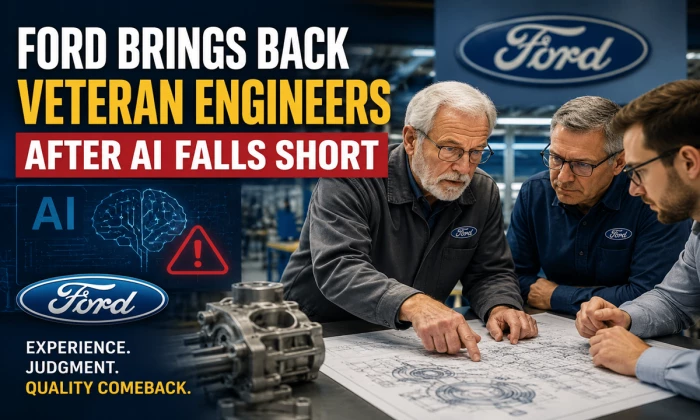
Ford’s recent quality turnaround has opened a bigger debate inside the auto industry: artificial intelligence can help build better vehicles, but it cannot fully replace experienced engineers who understand real-world product failures.
According to reports from TechCrunch, Business Insider and The Verge, Ford hired, promoted or brought back around 350 experienced technical specialists, including former employees and supplier-side experts, after its AI and automated quality systems did not deliver the level of vehicle quality the company expected. Ford’s own official update also confirms that roughly 300 veteran engineers are now involved in weekly design reviews as part of its broader quality reset.
Veteran Engineers Return To Ford’s Quality Team
Ford executives have admitted that the company had leaned too heavily on automation and artificial intelligence in its quality process. Charles Poon, Ford’s vice president of vehicle hardware engineering, said AI is a strong tool, but only when the information used to train it is strong enough. He also admitted that Ford had wrongly assumed AI could produce better quality simply by ingesting design requirements.
This is where the “gray beard” engineers come in. These are senior technical specialists with years of hands-on experience across multiple vehicle-development cycles. Their job is not just to replace AI, but to improve it by adding the human judgment that automated systems missed.
Ford says these experienced engineers now help:
- Mentor younger engineering teams
- Lead weekly design reviews
- Identify failure points before parts reach factory floors
- Improve data used by AI tools
- Strengthen coordination between design, manufacturing, software and supply chain teams
Ford’s official post says the company has created a unified industrial system since 2023, bringing vehicle engineering, manufacturing, supply chain and quality teams closer together. It also says suppliers are now being brought in earlier, helping cut launch issues by 30% year over year.
AI Still Has A Role, But Not Alone
This story is not simply about Ford rejecting AI. In fact, Ford is still using automation and AI in its quality systems. The difference is that the company now appears to be treating AI as a support tool rather than a replacement for experienced engineering judgment.
The Verge reported that Ford also created a dedicated 40-person software quality assurance team and added more than 100,000 AI-powered automated tests to catch software issues and edge cases before vehicles reach customers.
That point matters because modern vehicles are no longer purely mechanical products. They are packed with software, driver-assistance features, screens, connectivity systems and sensors. One weak link between hardware and software can create problems that are hard for a basic automated system to catch.
JD Power Result Gives Ford A Big Boost
Ford’s strategy is already showing visible results in one major industry ranking. In the 2026 J.D. Power U.S. Initial Quality Study, Ford ranked as the top mass-market brand with a score of 152 problems per 100 vehicles. Nissan ranked second among mass-market brands with 156 PP100, while Buick came third with 162 PP100.
Ford’s official update says this is the first time since 2010 that Ford has ranked No. 1 among mainstream brands in the J.D. Power Initial Quality Study. It also says Ford improved by 41 fewer problems per 100 vehicles compared with last year, the biggest year-over-year improvement among mainstream brands.
Ford vehicles also performed strongly at the model level. J.D. Power listed the Ford F-150, Ford Mustang and Ford Super Duty as segment winners in the 2026 study.
Industry Data Shows Wider Quality Improvement
Ford’s improvement came during a year when overall vehicle quality also improved across the industry. Reuters reported that the industry average improved from 192 problems per 100 vehicles last year to 175 PP100 this year, marking the strongest year-over-year improvement since 1997.
J.D. Power said its 2026 study was based on data collected from June 2025 through May 2026. The study combines owner feedback from 227 voice-of-customer questions with repair data, covering areas such as infotainment, driving assistance, powertrain, exterior, interior, climate and overall driving experience.
Key quality numbers:
- Ford mass-market score: 152 PP100
- Nissan mass-market score: 156 PP100
- Buick mass-market score: 162 PP100
- Industry average: 175 PP100
- Ford improvement: 41 fewer PP100 year over year
- Ford segment winners: F-150, Mustang, Super Duty
Recall Pressure Still Clouds Ford’s Comeback
Ford’s quality win does not mean all problems are solved. Reuters reported that Ford still leads the industry in recalls this year, with 51 recalls, compared with 19 for Stellantis. Business Insider also reported that Ford issued 152 recalls in 2025, showing that the company’s quality reputation still has a long road ahead.
Ford executives argue that many recall problems are linked to older vehicle platforms designed between 2013 and 2020, meaning recall numbers can lag behind current quality improvements. That makes the J.D. Power result an encouraging sign, but not final proof that Ford has fully fixed its long-term quality issues.
Human Experience Becomes Ford’s Real Advantage
Ford’s latest move sends a clear message to the wider auto and tech industries. AI can speed up testing, scan for defects and process large amounts of data, but it still needs strong human experience behind it.
For Ford, the solution was not choosing between AI and engineers. It was combining both. The company’s veteran engineers are now helping train younger teams, improve AI systems and catch problems earlier in the design process.
That shift may become more important as cars become more software-heavy. In industries where safety, durability and real-world performance matter, AI can assist decision-making, but it cannot fully replace people who have spent decades understanding how products fail.