General Intuition’s $2.3B Vision: Turning Gameplay into Real-World Intelligence
by Mighva Verma - 3 months ago - 2 min read
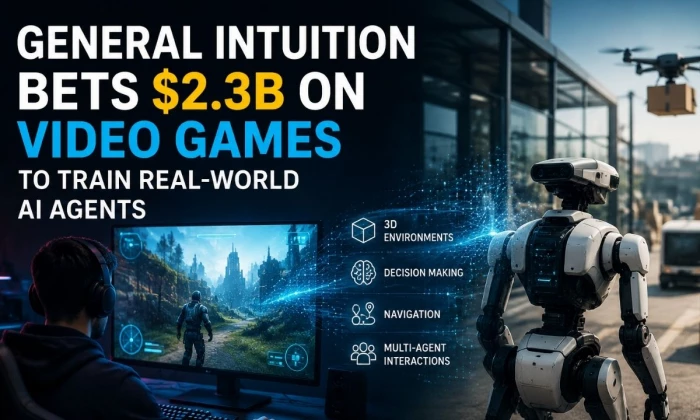
A new wave of AI development is pushing a bold idea forward: that video games can act as training environments for real-world intelligent agents. One of the companies leading this direction, General Intuition, is reportedly building AI systems trained on large-scale gameplay data, aiming to transfer those learned skills into real-world applications.
The company has gained major attention in the AI investment space, with reports placing its valuation around $2.3 billion, reflecting growing confidence in “world model” approaches that learn from simulated environments rather than only real-world data.
Why Video Games Matter for AI Training
Video games offer structured, interactive environments where AI systems can learn decision-making, planning, and spatial reasoning without real-world risk. Unlike real environments, games provide consistent rules, fast feedback loops, and rich 3D simulations that closely resemble real-world complexity.
This makes them ideal for training reinforcement learning systems that improve through repeated trial and error, building behaviors that can later be adapted to physical or digital real-world tasks.
From Gameplay to World Models
At the core of General Intuition’s approach is the concept of world models, AI systems that don’t just react, but predict and simulate future outcomes.
By learning from gameplay data at scale, these models aim to understand how environments evolve, enabling better planning and decision-making. The long-term goal is to create AI agents that can generalize beyond games and operate in real-world settings such as robotics, logistics, and autonomous systems.
The Challenge of Reality Transfer
Despite strong progress, moving from game environments to the real world remains difficult. Games are controlled and predictable, while real-world environments are noisy, incomplete, and far less forgiving.
Researchers continue to highlight that true generalization, where AI systems reliably transfer skills across domains—is still one of the biggest unsolved problems in AI development.
Conclusion
General Intuition’s $2.3B valuation highlights a growing belief that video games could become one of the most powerful datasets for training next-generation AI agents. While the approach is still experimental, it reflects a broader shift toward building AI systems that learn through simulated experience before entering the real world.