Meta’s AI Agent Push Hits Reality Check as Zuckerberg Admits Slow Progress
by Michael Hicklen - 3 months ago - 8 min read
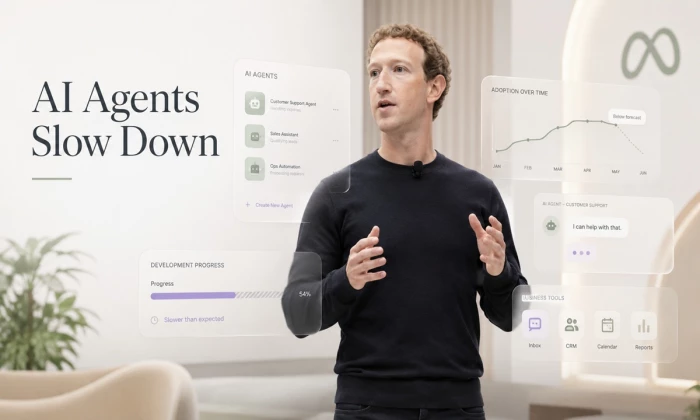
Meta’s Agent Push Hits a Slower Phase
Meta’s race to build AI agents has run into a more complicated phase than the company expected. In an internal town hall reported by Reuters on July 2, 2026, CEO Mark Zuckerberg acknowledged that development of AI agents has not accelerated as quickly as Meta had hoped. These agents are designed to carry out tasks for users instead of simply answering questions, which makes them central to Meta’s broader plan for AI across Facebook, Instagram, WhatsApp, Messenger, business messaging, and future personal assistants.
The update is important because Meta has spent the past year presenting AI agents as one of its biggest opportunities. The company wants these systems to help users, advertisers, creators, developers, and businesses complete real actions across its apps. But Zuckerberg’s latest comments suggest that the gap between agent demos and dependable real-world automation is still wider than expected.
The Restructuring Has Not Produced Fast Results Yet
Reuters reported that Zuckerberg told employees Meta’s recent restructuring was not as clean as it could have been and that the company misjudged the timing of some changes. The restructuring included major job cuts and the reassignment of roughly 7,000 employees to AI-focused teams in May, which created internal pushback and concerns about morale.
The broader idea behind the restructuring was simple: Meta wanted to move faster, reduce organizational friction, and redirect more people toward AI-assisted work. But according to the Reuters report, Zuckerberg said the company’s agentic development trajectory over the past four months had not accelerated in the way executives expected. That makes this moment less of a product delay and more of a management test for Meta’s AI strategy.
Heavy AI Spending Raises the Stakes
Meta’s AI ambitions are not small experiments. In its first-quarter 2026 results, the company said it expected 2026 capital expenditures, including finance lease payments, to reach between $125 billion and $145 billion, up from its earlier range of $115 billion to $135 billion. Meta said the higher outlook reflected component pricing and additional data center costs for future capacity.
That spending makes the agent slowdown more sensitive for investors. Meta reported strong Q1 2026 financial results, including $56.31 billion in revenue, up 33% year over year, and $26.77 billion in net income. But investors are watching whether the company can turn its massive AI infrastructure buildout into visible product gains and revenue opportunities.
Zuckerberg reportedly told employees that he still expects more meaningful benefits from AI investments in the next three to six months. That gives Meta a near-term window to show whether its spending, hiring, and internal reorganization can convert into stronger products rather than just bigger infrastructure bills.
Business Agents Remain Meta’s Most Practical AI Opening
Even as internal progress looks slower than expected, Meta is already moving aggressively in business-facing AI agents. On June 3, 2026, the company launched a Business Agent designed to help companies handle daily operations across WhatsApp, Messenger, Instagram, and eventually wider business systems. Reuters reported that the tool can answer customer questions, qualify leads, escalate complex issues to human staff, book appointments, and help close sales.
This is one of Meta’s strongest practical advantages in the AI agent race. Unlike many AI companies that must convince users to adopt new workspaces, Meta already sits inside the communication channels used by millions of businesses. Reuters reported that more than 1 million businesses had already used earlier chatbot versions of these agents on WhatsApp and Messenger before the new version was announced.
Meta is also building a broader Business Agent Platform connected to outside systems such as Shopify, Zendesk, and Shopee. That shows the company does not only want agents inside its own apps. It wants to become part of the operating layer for commerce, customer support, ads, and business workflow automation.
Consumer AI Assistant Plans Are Still Bigger Than Current Results
Meta’s consumer-facing agent ambitions are even larger. Reuters previously reported, citing the Financial Times, that Meta was developing a highly personalized AI assistant for billions of users, including agentic tools powered by its Muse Spark AI model. The goal is not just to answer questions, but to carry out everyday tasks for users.
That is where the latest town hall comments become more serious. A business chatbot can begin with narrower tasks, but a personal agent that acts across apps, messages, content, calendars, shopping, ads, and social interactions needs higher reliability. It must understand context, avoid mistakes, protect privacy, handle permissions, and know when to hand control back to a human. Meta’s slower progress reflects a wider industry problem: useful agents are easy to demo but difficult to make dependable at global scale.
Superintelligence Labs Adds Pressure to Deliver
Meta has also reorganized its AI work under Meta Superintelligence Labs. Reuters reported in 2025 that Zuckerberg created the division and brought in Alexandr Wang, the former Scale AI CEO, as chief AI officer. The same report said former GitHub CEO Nat Friedman would co-lead parts of the effort focused on AI products and applied research.
That restructuring showed how urgently Meta wanted to catch up with OpenAI, Google, Anthropic, and other AI leaders. Reuters also reported that Zuckerberg personally led aggressive AI hiring efforts and brought in researchers from OpenAI, Anthropic, and Google. When a company hires heavily, reorganizes teams, and commits more than $100 billion in annual capital spending, even a short slowdown becomes headline news.
Employee Trust Becomes Part of the AI Story
The town hall also touched on Meta’s controversial mouse-tracking software. Reuters reported that Meta had paused a program that tracked employee mouse movements and digital activity for AI training after a data security review. CTO Andrew Bosworth reportedly told employees that the review found no employee data had been included in AI training and said that, if the program returns, it would be opt-in rather than mandatory.
This matters because internal AI adoption depends on trust. If employees believe AI systems are being trained through heavy monitoring, even technically useful programs can create backlash. Meta wants its own workforce to use AI more deeply, but the company also needs to show that AI productivity efforts will not come at the cost of employee confidence, privacy, or morale.
The Global AI Agent Race Is Still Moving Fast
Meta’s slower-than-expected progress does not mean the AI agent race is slowing down. OpenAI introduced Operator in 2025 as an agent that can browse the web and perform tasks by clicking, typing, and scrolling. OpenAI described it as one of its first agents and said the research preview had limitations but would evolve with feedback.
Anthropic is also pushing agentic tools through Claude Code, which the company describes as an agent that can read a codebase, edit files, run commands, and work across terminals, IDEs, desktop apps, browsers, and Slack. That makes coding one of the clearest early markets where AI agents are already producing visible workflow changes.
Google is moving in the same direction with Gemini, while Meta is trying to connect AI agents to social apps, messaging, ads, commerce, smart glasses, and business tools. The global competition is not just about who has the best chatbot. It is about who can build agents that are useful, safe, affordable, and trusted enough to act on behalf of people and companies.
Reliability Is the Real Barrier
The latest Meta update highlights a bigger truth about AI agents: autonomy is harder than conversation. Chatbots can be useful even when they occasionally make mistakes, because the user remains in control. Agents are different because they may book, buy, reply, edit, move data, trigger workflows, or change business outcomes. A small error can become expensive quickly.
This is especially important for Meta because its agents may operate inside high-volume environments such as WhatsApp business chats, Instagram commerce, Facebook ads, and customer support. The more deeply agents are connected to payments, accounts, user data, business systems, and private messages, the more careful Meta must be before scaling them globally.
The Next Few Months Will Test Meta’s AI Strategy
Zuckerberg’s comments should not be read as a retreat from AI. Meta is still investing heavily, reorganizing around AI, launching business agents, building personal assistant tools, and expanding its AI infrastructure. The news is more about timing and execution. Meta expected agentic development to move faster, but the company is now acknowledging that the benefits have not arrived as quickly as planned.
The next three to six months will be important for Meta. Investors will want proof that its AI infrastructure spending can produce returns. Employees will want clearer direction after restructuring and monitoring concerns. Businesses will want agents that can actually complete tasks without creating new risks. Users will want AI that feels helpful rather than intrusive.
For Meta, the challenge is no longer simply building AI agents. The challenge is making them reliable enough for billions of people and millions of businesses to trust.