Microsoft Steps Up AI Rivalry With OpenAI and Anthropic
by Michael Hicklen - 3 months ago - 4 min read
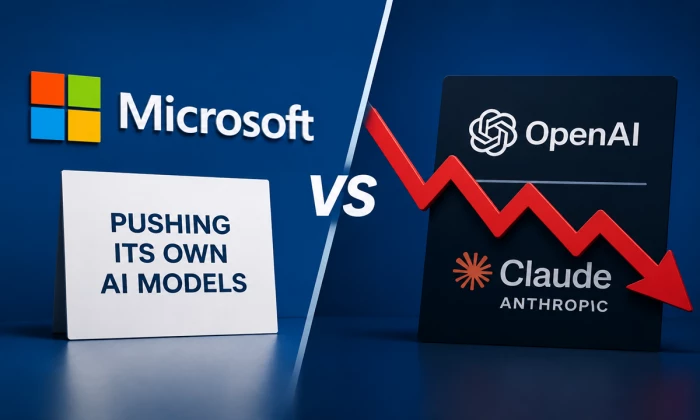
Microsoft is reportedly reshaping its enterprise AI sales strategy by encouraging sales representatives to position the company's in-house AI models as stronger alternatives to offerings from OpenAI, Anthropic, and Google. The reported move reflects a broader shift in Microsoft's AI priorities as it seeks to reduce reliance on external model providers while expanding adoption of its own AI technology across business customers.
The strategy marks a notable change in Microsoft's relationship with OpenAI. While Microsoft remains one of OpenAI's largest strategic partners and investors, the company is increasingly promoting internally developed AI models for cost efficiency, performance optimization, and greater control over its AI ecosystem.
Internal Sales Strategy Focuses on Microsoft's Own AI Models
According to reports from Bloomberg, discussed by multiple technology publications, Microsoft executives recently held an internal strategy meeting ahead of the company's new fiscal year. During the session, sales teams were reportedly coached to emphasize the advantages of Microsoft's proprietary AI models when speaking with enterprise customers.
Rather than simply promoting Microsoft products, the guidance reportedly included comparisons highlighting perceived weaknesses in competing models from OpenAI, Anthropic, and Google. Areas of comparison reportedly included:
- Operating costs
- Inference efficiency
- Enterprise deployment
- Integration within Microsoft's software ecosystem
- Long-term scalability for business workloads
The company has not publicly confirmed the detailed contents of the internal presentation.
A Significant Shift in Microsoft's AI Position
The reported strategy is significant because Microsoft's recent AI success has been closely tied to OpenAI.
Over the past several years, Microsoft integrated OpenAI models into products including:
| Microsoft Product | AI Integration |
|---|---|
| Microsoft Copilot | OpenAI models powering assistant capabilities |
| Azure OpenAI Service | Access to GPT models for enterprise customers |
| GitHub Copilot | AI coding assistance |
| Microsoft 365 | AI features across Word, Excel, Outlook and PowerPoint |
Now, Microsoft appears to be balancing that partnership with greater investment in its own MAI (Microsoft AI) models and other internally developed systems. Industry reports suggest the company wants more flexibility over AI costs, infrastructure, and future product development.
Cost Control Is Becoming a Major Competitive Advantage
Training frontier AI models requires billions of dollars in infrastructure investment, while inference—the cost of serving AI responses—has become one of the industry's largest ongoing expenses.
Reports published earlier this month indicated Microsoft has already begun replacing some OpenAI and Anthropic models inside Microsoft 365 applications with its own AI models in certain workloads. The objective is reportedly to reduce operating costs without sacrificing user experience.
This approach aligns with Microsoft's broader strategy of controlling more of the AI technology stack instead of depending entirely on external model providers.
The AI Market Is Entering a New Competitive Phase
The latest development highlights how quickly relationships between major AI companies are evolving.
Only two years ago, Microsoft was widely viewed as OpenAI's closest commercial ally. Today, the company is simultaneously:
- Continuing its partnership with OpenAI.
- Developing proprietary frontier AI models.
- Promoting those models to enterprise customers.
- Competing more directly with OpenAI and Anthropic for AI infrastructure spending.
This increasingly complex relationship reflects the rapid maturation of the enterprise AI market, where strategic partnerships and competitive positioning often exist side by side.
Enterprise Customers Could Gain More Choice
For businesses adopting generative AI, Microsoft's evolving strategy could ultimately increase flexibility.
Instead of relying on a single AI provider, organizations may soon have multiple options within the Microsoft ecosystem, including:
- Microsoft-developed AI models
- OpenAI models through Azure
- Third-party foundation models where appropriate
This broader portfolio could allow enterprises to choose models based on pricing, latency, regulatory requirements, or workload-specific performance rather than committing to one provider.
AI Spending Continues to Accelerate
The competition arrives during a period of unprecedented investment in artificial intelligence.
Analysts estimate that major hyperscale technology companies, including Microsoft, Amazon, Alphabet, and Meta—are expected to invest roughly $650 billion in AI infrastructure during 2026. Much of this spending is focused on expanding data centers, acquiring advanced AI chips, and improving large-scale model deployment.
With infrastructure costs rising rapidly, improving inference efficiency has become just as important as building increasingly capable AI models.
Industry Impact
If Microsoft's reported sales strategy expands beyond internal guidance, it could further intensify competition among the world's leading AI developers.
Rather than competing solely on model intelligence, vendors are increasingly differentiating themselves through operating costs, enterprise integration, deployment flexibility, security, and total cost of ownership.
For enterprise customers, this growing rivalry may ultimately deliver faster innovation, more deployment options, and stronger pricing competition as Microsoft, OpenAI, Anthropic, Google, and other AI companies race to secure long-term leadership in the enterprise AI market.