OpenAI Launches $230 Codex Keyboard Amid Hardware Legal Battle
by Harpreet Singh - 3 months ago - 4 min read
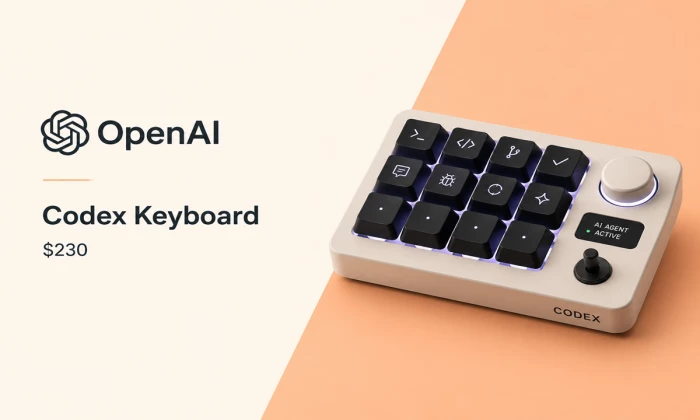
OpenAI has introduced its first commercial hardware product, a compact $230 Codex Micro keyboard designed specifically for developers using its AI coding assistant, Codex. The launch comes at a time when the company is facing growing legal scrutiny over its hardware ambitions, making the release notable both as a product announcement and as a strategic statement.
Developed in collaboration with mechanical keyboard maker Work Louder, the Codex Micro is positioned as a physical command center for managing AI coding agents rather than a traditional keyboard. The limited-edition device targets software engineers, AI enthusiasts, and professional developers who increasingly rely on AI-assisted programming.
A New Kind of Hardware for AI Workflows
Instead of replacing a standard keyboard, the Codex Micro functions as a programmable controller dedicated to AI-assisted development.
The device includes:
| Feature | Purpose |
|---|---|
| 13 programmable mechanical keys | Launch Codex commands and shortcuts |
| Illuminated Agent Keys | Show live AI agent status |
| Rotary dial | Adjust AI reasoning level |
| Programmable joystick | Trigger coding workflows |
| Touch sensor | Quick interaction with Codex |
| Custom keycaps | Personalize shortcuts and commands |
OpenAI says the hardware is intended to help developers manage multiple AI coding agents without constantly switching between application windows. Users can customize controls through the ChatGPT desktop application to fit their workflow.
Built Around the Growing Popularity of Codex
The launch reflects OpenAI's increasing investment in Codex, its AI-powered coding platform designed to assist with writing, debugging, editing, and reviewing software.
Rather than typing every instruction manually, developers can assign common actions such as code review, debugging, approvals, or voice prompts to dedicated buttons. The device also displays whether an AI agent is actively working, waiting for approval, or has completed a task.
This physical interface aims to reduce friction as developers begin managing multiple AI agents simultaneously instead of interacting with a single chatbot.
Launch Comes During Hardware Legal Challenges
The timing of the announcement has drawn significant attention.
Just days before unveiling the Codex Micro, OpenAI found itself involved in a legal dispute related to its expanding hardware ambitions. Reports indicate that Apple has accused OpenAI of misusing hardware-related trade secrets connected to former Apple engineers now working on OpenAI's hardware initiatives.
OpenAI has denied any wrongdoing, maintaining that its planned hardware products are fundamentally different from Apple's existing devices.
Although the Codex Micro itself is unrelated to those allegations, its release demonstrates that OpenAI is moving ahead with consumer hardware while the broader legal issues continue.
A Different Direction From OpenAI's Rumored AI Companion
The Codex Micro is not the AI companion device that has generated widespread speculation over the past year.
Reports continue to suggest OpenAI is developing a larger consumer hardware product with former Apple designer Jony Ive, a screen-free AI companion intended for everyday use. That project remains under development and has not been officially unveiled.
The newly announced keyboard instead focuses on professional developers, offering a niche productivity tool rather than a mass-market AI device.
Enterprise AI Is Expanding Beyond Software
OpenAI's move highlights a broader shift in the AI industry.
Companies are increasingly experimenting with dedicated hardware that makes interacting with AI models faster and more natural. Microsoft's Copilot key has already appeared on new Windows PCs, while startups continue exploring AI wearables and specialized devices.
The Codex Micro represents another step toward blending physical controls with AI-powered software workflows, particularly for technical users who spend hours managing code and AI agents.
Pricing and Availability
The Codex Micro is priced at $230 and will be sold as a limited-run product through OpenAI's Supply platform.
Buyers can choose between clicky and silent mechanical switches, and each unit includes customizable Codex-themed keycaps for assigning shortcuts and commands. Because production is limited, availability may vary depending on demand.
Industry Outlook
The Codex Micro may appeal to a relatively small audience today, but it signals a broader trend in AI computing. As AI agents become more capable and begin handling increasingly complex development tasks, specialized hardware could become a standard part of professional workflows.
For OpenAI, the launch is also symbolic. It marks the company's first commercial step into hardware while reinforcing its ambition to build an ecosystem that extends beyond AI models and software, despite ongoing legal challenges surrounding its future hardware plans.