Runway Ships Its Biggest Update Wave of 2026
by Cheshta Upmanyu - 3 months ago - 5 min read
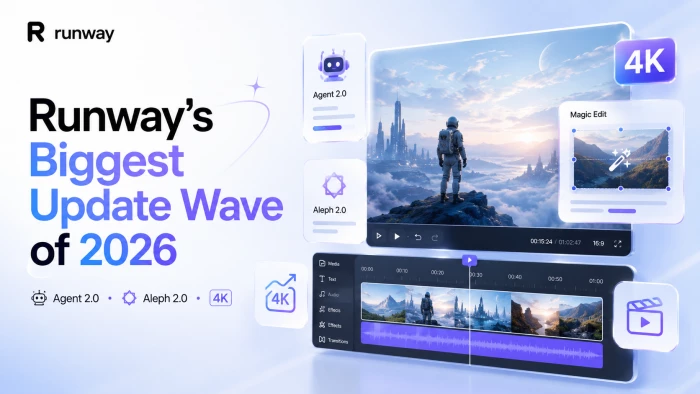
Runway has spent the past five weeks in shipping mode, and the result is one of the most substantial platform overhauls any AI video company has delivered this year. Between late May and early July 2026, the company rolled out Runway Agent 2.0 for end-to-end marketing campaign creation, an upgraded video editing model called Aleph 2.0 inside a new Edit Studio, a Studio Trim tool for finishing videos without leaving the platform, a professional video upscaler in the API, and native 4K output across its generation endpoints.
Taken individually, each update is incremental. Taken together, they signal a clear repositioning: Runway is no longer selling a video generator. It is selling a full production pipeline, from first prompt to final export, with an AI agent increasingly doing the coordinating.
Runway Agent 2.0 Moves From Video Maker to Marketing Department
The most ambitious piece is Runway Agent 2.0. The original Runway Agent, launched earlier this year, worked as an AI creative partner that could develop and produce a finished video within a single conversation. Version 2.0 expands the scope dramatically: according to Runway, the agent now creates entire campaigns, analyzes data to improve creative output, and scales marketing across platforms, formats, and markets.
That framing puts Runway in direct competition not just with other video models but with creative agencies and marketing automation platforms. Instead of prompting for one clip at a time, a brand can hand the agent a campaign objective and receive coordinated assets across formats. It mirrors the industry-wide shift happening in 2026, where standalone generation tools are being wrapped in agents that plan, produce, and iterate with less human coordination at every step.
Aleph 2.0 and Edit Studio Bring Frame-Level Editing to Everyone
The second headline is Aleph 2.0, Runway's upgraded video editing model, now available inside a new Edit Studio for paid plans. The workflow is genuinely novel: edit a single frame the way you want it, and Aleph 2.0 edits the rest of the video to match. That inverts the usual AI editing pattern of describing changes in text and hoping the model interprets correctly.
Aleph 2.0 also went live in the Runway API on June 2, per the official changelog. Developers can edit existing videos with text prompts and optional keyframe images placed at specific timestamps, with support for input videos from 2 to 30 seconds and up to 5 keyframe images. Combined with Studio Trim, a new tool for trimming, stitching, reordering, and exporting a final video in one place, Runway users can now go from raw generations to a delivered edit without touching traditional editing software.
The API Quietly Became a 4K Production Pipeline
On the developer side, Runway's API changelog shows a rapid sequence of upgrades through June. On June 11, the Magnific Video Upscaler arrived, capable of upscaling input videos up to 30 seconds to 720p, 1K, 2K, or 4K output, with controls for creativity, sharpening, smart grain, and fps boost. On June 24, native 4K output went live across the text to video, image to video, and video to video endpoints, with six new 4K aspect ratios ranging from 21:9 cinematic to 9:16 vertical, billed at 150 credits per second.
The 9:16 vertical 4K option is the quietly important one. Vertical is where short-form platforms live, and native 4K vertical generation means AI clips can be produced at a quality ceiling above what most platforms even display, leaving headroom for cropping, zooming, and reframing in post.
A Model Hub Strategy Hiding in Plain Sight
The June changelog also confirms how far Runway has leaned into hosting third-party models alongside its own Gen-4.5 family. The API now carries ByteDance's video models in three tiers, Google's Nano Banana Pro image model with support for up to 14 reference images at up to 4K resolution, and OpenAI's GPT Image 2 with up to 16 reference images. Runway has effectively become both a frontier lab and an aggregator, competing on its own models while selling access to everyone else's.
For creators, the practical benefit is consolidation. One subscription and one API surface now covers generation, editing, upscaling, trimming, and multi-model comparison, work that previously required three or four separate tools.
The Takeaway for Creators and Developers
Runway's update wave lands at a moment when the AI video market is consolidating around platforms rather than models. Google folded video generation into Gemini Omni's conversational workflow this summer, and ByteDance is positioning its next release as a production system rather than a clip generator. Runway's answer is the same thesis executed from the other direction: keep the models interchangeable, and own the workflow around them.
For working creators, the immediate wins are Edit Studio and Studio Trim, which remove the export-to-editor round trip for most short-form work. For developers, the 4K endpoints and the Magnific upscaler turn the API into a legitimate finishing pipeline rather than a draft generator. And for brands, Agent 2.0 is the one to test carefully: if an AI agent really can plan and produce a coherent cross-platform campaign, the economics of content production shift again, and not gently.