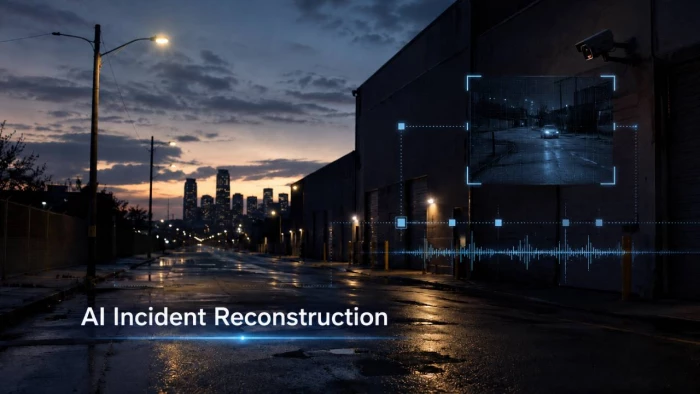
Most serious incidents no longer leave behind one clean record. They leave fragments.
A camera captures a few seconds. A wearable records sudden movement. A machine stores a fault code. A phone logs a location change. A building system records access. A cloud platform preserves a timestamp. Alone, each signal may be incomplete. Together, they can help rebuild what happened.
That is where AI is changing incident reconstruction. Its value lies in organizing scattered records, comparing patterns, detecting contradictions, and turning fragmented signals into a timeline that can be tested.
For years, reconstruction depended on photos, witness statements, physical damage, reports, and expert inspection. Those still matter, but they are no longer enough in a world filled with connected systems.
A warehouse incident may involve camera footage, barcode scans, wearable safety tags, machine diagnostics, inventory movement, and maintenance logs. A smart building event may involve access cards, elevator logs, motion sensors, alarm records, HVAC activity, and Wi-Fi connections. A product failure may involve app activity, firmware history, error codes, support tickets, and cloud logs.
The challenge is not always a lack of information. Often, it is the opposite. There are too many partial records sitting across too many systems, each with its own format, timestamp, retention policy, and technical limits.
AI helps reduce that disorder. It can scan large datasets, group related timestamps, find repeated patterns, highlight missing records, and show which signals support or challenge the same version of events.
A strong reconstruction usually starts by asking:
● Which systems were active before, during, and after the incident?
● Which records are original, and which are screenshots or summaries?
● Do the timestamps match across devices and platforms?
● Are there missing logs, overwritten files, or unexplained gaps?
● Which signals support the same timeline, and which ones conflict?
AI makes the raw material easier to examine by turning scattered records into patterns, gaps, and questions that can be tested.
One digital record can mislead. A camera may miss what happened outside the frame. A sensor may detect motion without explaining the cause. A phone may show location activity without proving what a person was doing. A machine log may record an error without showing whether the error caused the incident or appeared afterward.
The strength comes from layering. If several independent records point to the same sequence, the reconstruction becomes stronger. If they conflict, that conflict can reveal where the investigation needs to go deeper.
| Digital Signal | What It May Reveal | Why It Needs Context |
| Camera footage | Movement, visibility, object position | Footage may be incomplete, obstructed, compressed, or poorly timed |
| Wearable data | Sudden motion, fall patterns, biometric shifts | The device may not have been worn correctly or synced in real time |
| Machine logs | Faults, resets, warnings, operating state | A code does not always explain the root cause |
| Access records | Entry, exit, badge use, authorization | A badge event does not always prove who physically entered |
| Phone and app data | Location, account activity, user interaction | Background activity can be mistaken for intentional use |
| Maintenance records | Repairs, inspections, repeated failures | Records may be incomplete or written after the event |
AI-supported reconstruction works best when these signals are treated as puzzle pieces, not standalone proof. The goal is to build a defensible sequence, not force one data point into a conclusion.
The strongest analysis looks for three things: consistency, timing, and causation. Consistency shows whether records support each other. Timing shows the order of events. Causation asks whether a signal actually explains the incident or only happened near it.
Many incidents are not single moments. They are chains of events.
A warning appears. A person enters a space. A device behaves differently. A machine slows down. A sensor detects abnormal movement. A camera records part of the scene. A technician later resets the system. A report is written hours after the event.
Traditional investigation often starts after the incident and works backward. AI can help reconstruct the order from the first available digital trace. It can sort timestamps, cluster related events, compare logs across platforms, and separate routine background activity from unusual behavior.
This becomes useful when systems do not speak the same language. One platform may record local time. Another may use server time. A wearable may sync minutes later. A camera may store video separately from metadata. A machine may record only threshold-based events.
AI can help align these records, but a clean timeline can still be technically weak if the timestamps, sync delays, or source systems are not checked carefully.
Common timeline problems include:
● A device clock that was never correctly set.
● A cloud platform storing upload time instead of event time.
● A wearable recording activity locally but syncing later.
● A camera clip with accurate footage but weak metadata.
● A software system logging only certain threshold-based events.
A useful timeline is not just neat. It is explainable.
Digital twin technology is becoming a major part of technical reconstruction. A digital twin is a virtual model of a physical object, environment, system, or process. It allows experts to test how a system may have behaved under different conditions.
This matters because many incidents cannot be recreated safely. A manufacturing failure, building-system malfunction, product defect, equipment breakdown, or infrastructure issue may be too dangerous, expensive, or complex to repeat in the real world.
A digital twin can test different possibilities. What if a warning appeared earlier? What if a sensor was miscalibrated? What if a software update changed the system response? What if load, speed, temperature, pressure, visibility, or timing changed slightly?
Digital twins are most useful when they test the boundaries of what is possible. When combined with real logs, photos, inspection reports, sensor records, and expert analysis, they can make reconstruction more practical and easier to explain.
Where they help most:
● Testing a failure path without repeating a dangerous event.
● Comparing different scenarios under the same assumptions.
● Showing how timing, load, visibility, or pressure may affect the result.
● Helping non-technical audiences understand complex system behavior.
● Separating possible explanations from explanations that do not fit the data.
The value is not visual drama. The value is controlled testing.
Video has always been useful, but AI makes it easier to review large amounts of footage. Computer vision can help detect objects, track movement, compare frames, estimate direction, identify scene changes, and highlight moments that need closer human review.
This does not mean AI can fix bad footage. It cannot recover missing frames. It cannot remove uncertainty from poor lighting, blind spots, compression, obstruction, or bad angles.
Its real value is speed and structure. Instead of manually watching hours of footage, analysts can use AI to find relevant moments faster. They can compare multiple camera feeds, check whether movement patterns match other records, and identify visual gaps that need explanation.
Computer vision also supports 3D mapping and photogrammetry. A physical space can be photographed or scanned from multiple angles, then converted into a model that preserves distance, position, and sightlines. This can be valuable when a scene changes quickly because equipment is repaired, debris is removed, or the area is cleaned.
Still, every AI reading needs review. A detection label is not a finding. A tracked object may be misidentified. A movement path may depend on camera angle. A measurement may be affected by lens distortion, distance, compression, or missing calibration.
AI reconstruction becomes more serious when fragmented digital signals are tied to responsibility, safety, product behavior, insurance disputes, or high-value claims. At that point, the question is not only what the technology found. The question is whether the data was preserved properly, analyzed responsibly, and explained clearly.
A timeline built from AI tools, sensor records, software logs, camera footage, and expert modeling can influence how a dispute is evaluated. But if the data is incomplete, poorly preserved, or overstated, it can create confusion instead of clarity.
In complex cases involving product behavior, technical failure, serious harm, and disputed timelines, legal teams often need to work with engineers, forensic analysts, reconstruction experts, and data specialists. Firms such as Langdon & Emison Attorneys at Law may become relevant in that kind of setting because the central challenge is not simply finding digital records. It is understanding how those records fit into a larger factual, technical, and evidentiary picture.
The legal value of AI reconstruction usually depends on a few practical standards:
● Was the original data preserved before it changed or disappeared?
● Can the collection and analysis method be explained clearly?
● Were the limits of the AI tool stated?
● Were expert assumptions separated from verified facts?
● Does the reconstruction match physical evidence, records, and witness accounts?
AI reconstruction works best when it is part of a disciplined process, not when it is treated as a shortcut. The strongest legal and technical analysis still depends on chain of custody, expert interpretation, clear methodology, and a careful distinction between what the data shows and what people infer from it.
Fragmented digital signals often contain sensitive personal information. Location records can show routines. Wearables can reveal body-level data. Cameras can capture unrelated people. Access logs can show workplace behavior. Smart devices can expose private activity inside homes, offices, hospitals, schools, or commercial spaces.
That makes privacy a core part of reconstruction, not a side issue. Just because data exists does not mean all of it should be collected or analyzed.
A responsible review should be narrow. It should focus on records that are relevant to the incident, time period, and technical question. If an incident happened during a short window, the review should not automatically expand into months of unrelated personal activity.
Good analysis asks:
● What specific question is the data supposed to answer?
● Which records are directly relevant?
● Which records contain unnecessary private information?
● Who controls the data?
● How long is it retained?
● How can unrelated information be filtered or protected?
AI makes it easier to process huge amounts of data. That also makes restraint more important. The best reconstruction is not the one that collects the most information. It is the one that collects the right information and handles it responsibly.
One danger of AI-assisted reconstruction is that it can make uncertainty look more certain than it is. A clean chart, movement path, 3D model, or timeline can appear authoritative even when some underlying records are incomplete.
This is why explainability matters. A reconstruction should show what is known, what is missing, what is inferred, and what assumptions were used. It should also explain the confidence level behind key findings.
| Weak Overstatement | Better Framing |
| AI proved what happened | AI helped identify a likely sequence based on available records |
| The sensor confirms the cause | The sensor shows an event that must be compared with other evidence |
| The timeline is complete | The timeline is based on available records and known gaps |
| The model recreated the incident | The model tested one possible scenario using defined assumptions |
This distinction matters. AI should make reconstruction clearer, not more misleading. If the method cannot be explained, the conclusion becomes harder to trust.
The safest approach is to make uncertainty visible. Verified facts should be labeled as verified. Inferences should be labeled as inferences. Missing data should be stated plainly.
Many organizations already collect the records needed for AI reconstruction, but they are not prepared to use them properly. Their data is spread across vendors, devices, apps, cloud accounts, dashboards, and internal systems. Retention policies may be unclear. Access rights may be poorly controlled. Privacy notices may be outdated. Logs may disappear before anyone knows they are important.
That creates problems after an incident. The first few days often decide whether useful data is preserved or lost.
Businesses that rely on connected systems, smart buildings, wearables, robotics, fleet tools, industrial equipment, safety platforms, or cloud-connected products should create a digital incident-readiness plan.
| Readiness Area | Why It Matters |
| Data inventory | Identifies which systems create useful records |
| Retention rules | Prevents logs, clips, and metadata from disappearing too early |
| Vendor access | Clarifies who can export cloud-held records |
| Privacy controls | Limits unnecessary collection of personal data |
| Chain of custody | Protects authenticity and reliability |
| Expert review | Reduces the risk of misreading technical records |
The organizations that benefit most from AI reconstruction will not be the ones with the most sensors. They will be the ones that know what their systems record, where the records live, how long they last, and how to preserve them when needed.
AI is rebuilding real-world incidents by connecting fragmented digital signals that used to remain scattered across devices, platforms, cameras, wearables, machines, cloud systems, and software logs.
Its strongest value is structure. AI can align records, detect patterns, compare timelines, support simulations, and highlight contradictions that might otherwise stay buried inside disconnected systems. But reliable reconstruction still depends on careful preservation, verified timestamps, privacy-aware review, and clear interpretation.
The future of incident reconstruction will be shaped by teams that understand both the power and the limits of AI. The most reliable conclusions will not come from the cleanest visualization. They will come from disciplined methods, tested assumptions, strong technical review, and a clear explanation of what the data can actually prove.
Share your thoughts about this article.
Be the first to post a comment!
For most of working history, speed was evidence of mastery. A skilled technician...
Parveen Verma3 weeks ago
A machine stops, a vehicle changes direction, or a network account is breached....
Parveen Verma3 weeks ago
Service search is no longer a simple list of links. It is now shaped by AI summa...
Parveen Verma1 month ago

The modern website is no longer a digital brochure. It is becoming the first pla...
Parveen Verma1 month ago

A digital service does not fail only when the final outcome is poor. It often fa...
Parveen Verma1 month ago

In its landmark crash-causation survey, the National Highway Traffic Safety Admi...
Parveen Verma1 month ago