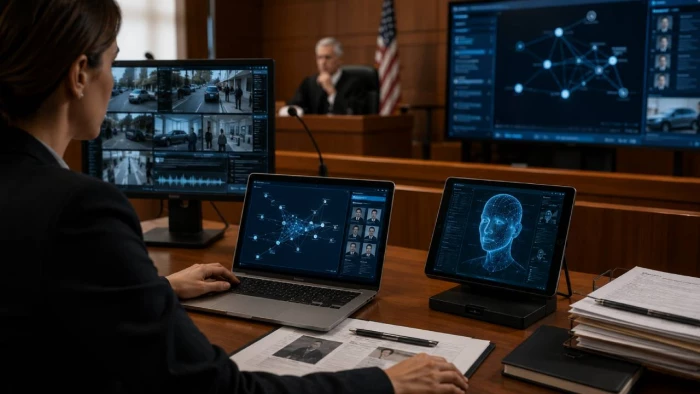
Court cases are becoming less dependent on memory alone and more dependent on the digital record people leave behind. A single dispute may now include phone location data, medical portals, CCTV clips, vehicle telematics, workplace messages, emails, cloud files, metadata, wearable-device records, and AI-reviewed document sets.
This change matters because digital evidence does not simply add more material to a case. It changes how a case is investigated, how facts are tested, how timelines are built, and how lawyers explain technical evidence in court.
The growth of eDiscovery shows how large this shift has become. ComplexDiscovery estimated the global eDiscovery market at $16.89 billion in 2024, with projected growth to $25.11 billion by 2029. Fortune Business Insights gives an even larger longer-term forecast, valuing the global eDiscovery market at $18.73 billion in 2025 and projecting it to reach $46.06 billion by 2034.
That growth is not happening because lawyers suddenly want more software. It is happening because modern evidence is too large, too scattered, and too technical to manage through manual review alone.
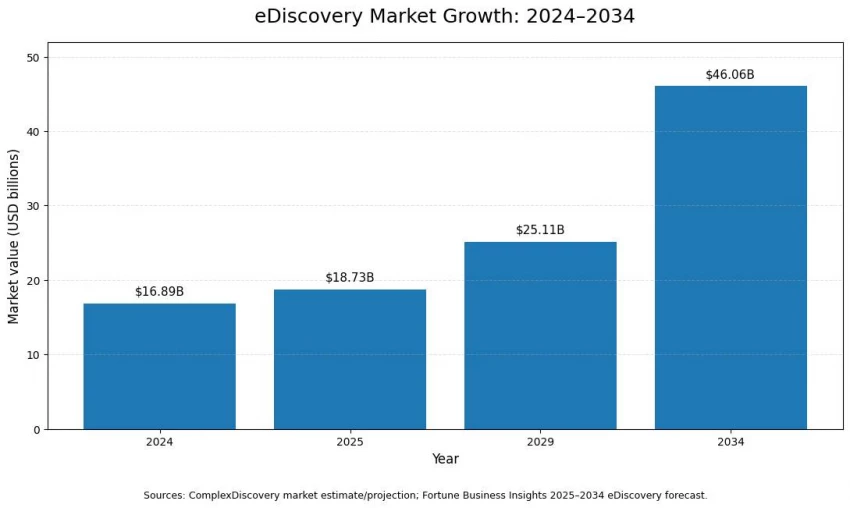
This chart should show how fast legal evidence review is becoming a technology-driven industry. The stronger point is not just market growth. The stronger point is that courts, law firms, corporations, insurers, and investigators are now dealing with evidence volumes that require search, filtering, categorization, analytics, and AI-supported review.
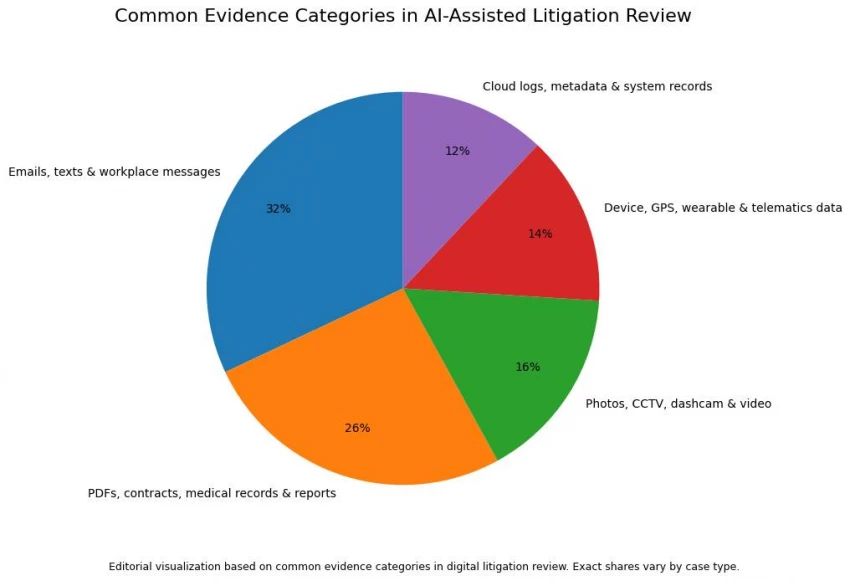
Digital evidence is valuable because it can turn a disputed claim into a testable timeline. A person may say a warning was ignored, but workplace emails, maintenance tickets, Slack messages, or internal reports may show whether that warning existed. A driver may deny speeding, but vehicle telematics, dashcam footage, GPS data, or phone records may help reconstruct the moments before impact. A company may claim it acted quickly, but timestamps inside emails and document-management systems may show delay.
This is why digital evidence has become important in personal injury, employment disputes, corporate investigations, product liability, insurance disputes, data breach cases, and business litigation.
The challenge is that digital evidence rarely explains itself. A phone location record may show movement, but not intent. A wearable may show activity, but not pain. A social media photo may show a person smiling, but not medical recovery. A timestamp may show when a file was modified, but not who made the key decision behind it.
That is where legal interpretation still matters.
| Evidence Source | What It Can Prove | Where It Can Mislead |
| Smartphone location data | Movement, route, timing, approximate presence near an event | Location accuracy may vary depending on GPS, Wi-Fi, tower data, and app permissions |
| CCTV or dashcam footage | Sequence of events, impact, visibility, conduct before or after incident | Camera angle may miss context outside the frame |
| Vehicle telematics | Speed, braking, acceleration, impact timing | Data may need expert explanation and proper extraction |
| Workplace emails and chats | Prior notice, internal warnings, instructions, decision-making | Individual messages can be taken out of context |
| Medical portals | Diagnosis, treatment timeline, referrals, symptoms | Medical records may not capture every symptom or functional limitation |
| Wearables and fitness apps | Activity trends, sleep changes, movement patterns | Activity does not always equal ability, recovery, or absence of pain |
| Cloud files and metadata | File creation, edits, access history, sharing activity | Metadata can be misunderstood without technical review |
| Social media posts | Public statements, photos, location tags, timeline clues | Posts often show selected moments, not full reality |
Digital evidence has become powerful because it can support or weaken courtroom arguments before a witness even speaks. If two people describe the same event differently, the digital record may help test which version fits the timeline. If an organization denies knowledge of a problem, internal communications and system logs may show whether the issue was previously reported. If an injury is disputed, medical records, work records, and digital activity patterns may help show how life changed after the incident.
But a record is not useful merely because it exists. It must be collected properly, preserved correctly, authenticated, interpreted, and presented in a way that a judge or jury can understand.
In serious litigation, especially where damages, liability, expert testimony, and technical evidence overlap, working with an experienced California Trial Lawyer can matter because the legal value of digital evidence depends on how effectively it is connected to the facts, the law, and the trial strategy.
This is the backlink placement. It is smooth because the anchor appears inside a legal-strategy discussion, not as a random promotional sentence.
AI is entering litigation because legal teams are facing more digital material than traditional review teams can process efficiently. AI tools can help identify duplicate documents, group similar records, summarize long files, detect patterns, extract dates, find names, classify documents, and help lawyers prioritize what deserves deeper review.
The broader legal technology market reflects this shift. Grand View Research estimated the global legal technology market at $28.74 billion in 2025 and projected it to reach $69.69 billion by 2033, with a 12.2% CAGR from 2026 to 2033. Fortune Business Insights placed the 2025 market even higher at $33.97 billion, projecting growth to $77.93 billion by 2034.
These numbers show that legal work is moving toward software-assisted research, document review, case management, contract analysis, compliance monitoring, analytics, and litigation support. AI is not the whole legal-tech market, but it is becoming one of its strongest accelerators.
| Source | 2025 Market Size | Forecast Year | Forecast Value | CAGR |
| Grand View Research | $28.74 billion | 2033 | $69.69 billion | 12.2% |
| Fortune Business Insights | $33.97 billion | 2034 | $77.93 billion | Noted as strong projected growth |
This chart should compare 2025 values against forecast values. The article should explain that market forecasts differ because research firms use different definitions of legal technology, but both sources point in the same direction: legal work is becoming more software-driven.
AI can speed up legal work, but legal work has a low tolerance for unsupported claims. A wrong citation, missing document, false summary, or privacy mistake can affect a filing, settlement position, discovery response, or court argument.
The clearest warning is the Mata v. Avianca sanctions case, where lawyers submitted fake case citations generated by ChatGPT. The problem was not only that the AI produced false legal authorities. The problem was that the output was used without proper verification.
That case became a turning point because it showed courts that generative AI can create confident but incorrect legal content. It also showed lawyers that AI cannot be treated like a legal database unless its output is checked against reliable sources.
The American Bar Association’s Formal Opinion 512, issued in July 2024, explains that lawyers using generative AI must still consider duties of competence, confidentiality, communication, supervision, and reasonable fees. The National Conference of Bar Examiners summary also notes that AI is being used for discovery review, contract analytics, litigation outcome prediction, and legal research improvement, but professional responsibility remains with lawyers.
| Litigation Task | AI Usefulness | Risk Level | Human Review Required |
| Duplicate document detection | High | Low | Moderate |
| Keyword and concept search | High | Medium | High |
| Timeline extraction | High | Medium | High |
| Document summarization | Medium to high | High | Very high |
| Legal citation generation | Low to medium | Very high | Mandatory |
| Evidence relevance assessment | Medium | High | Very high |
| Courtroom argument preparation | Supportive only | Very high | Mandatory |
This visual will make the article stronger because it does not blindly praise AI. It shows where AI is genuinely useful and where it becomes dangerous without lawyer review.
A digital record becomes useful only when the court can trust that it is what the party claims it is. In U.S. federal courts, Rule 901 of the Federal Rules of Evidence requires enough evidence to support a finding that an item is authentic.
This matters because digital evidence is easy to misunderstand. A screenshot may be incomplete. A message may be edited or selectively captured. A file may have metadata that changes during transfer. A location record may need technical explanation. A cloud document may have multiple versions. A video may need chain-of-custody support.
Federal Rules of Evidence 902(13) and 902(14), effective since December 2017, also allow certain electronic evidence to be authenticated through certification, including records generated by electronic systems and copied data from electronic devices. However, authentication does not automatically solve every legal issue. A document can be authentic and still face objections based on relevance, hearsay, privacy, unfair prejudice, or proportionality.
| Challenge | What the Other Side May Argue | What Legal Teams Need to Show |
| Authenticity | The record is not what the party claims | Source, collection method, metadata, witness or certification support |
| Completeness | The evidence is selective or missing context | Full thread, full file, full video, or surrounding records |
| Relevance | The data does not prove the disputed fact | Clear connection between record and legal issue |
| Reliability | The system or device may be inaccurate | Technical explanation, logs, device settings, expert support |
| Privacy | The request is too broad or invasive | Narrow scope, protective order, redaction, proportionality |
| Hearsay | The record contains out-of-court statements | Exception, non-hearsay purpose, or supporting testimony |
| Chain of custody | The record may have been altered | Preservation steps, collection logs, hash values, certified copies |
Injury cases often involve facts that are difficult to see from one document alone. A person may suffer a serious injury, but the harm may appear across many records rather than one perfect piece of proof.
A traumatic brain injury, for example, may involve emergency records, neurological evaluations, therapy notes, employment changes, family observations, sleep disruption, cognitive symptoms, phone-use changes, missed appointments, and reduced daily functioning. Digital evidence can support this picture when it shows changes before and after the event.
At the same time, the opposing side may use digital evidence to challenge the claim. They may point to photos, app activity, movement records, social posts, or work communications. That does not automatically defeat an injury claim, but it does force lawyers to explain context. A single social media photo does not prove full recovery. A short walk recorded by a wearable does not prove absence of pain. A sent message does not prove normal cognitive function.
The legal strength comes from connecting digital records with medical evidence, expert opinions, witness testimony, and the timeline of the injury.
| Evidence Type | Example | Legal Purpose |
| Emergency medical records | ER visit, diagnosis, imaging orders | Establishes immediate treatment |
| Specialist records | Neurology, orthopedics, neuropsychology | Supports severity and causation |
| Phone records | Calls, messages, app activity changes | Shows disruption in daily life |
| Wearable data | Sleep, steps, activity changes | Supports functional change when properly explained |
| Work records | Absences, reduced hours, performance issues | Supports economic damages |
| Family messages | Symptom complaints, care needs | Supports lived impact |
| Photos and videos | Visible injuries, mobility changes, accident scene | Supports visual context |
| Insurance communications | Claim timeline, adjuster responses | Shows dispute history |
Court cases often depend on sequence. AI can help extract dates from medical records, emails, contracts, reports, text messages, invoices, and system logs. That is useful because case timelines are rarely stored in one clean document. They are scattered across different systems and formats.
A good AI-assisted timeline can help lawyers see when a risk was reported, when treatment began, when a company responded, when a document changed, when a party sent notice, or when symptoms were first recorded.
But AI can also create timeline errors. A record date is not always the event date. A forwarded email may include older content. A medical note may refer to symptoms from weeks earlier. A file modification date may reflect copying rather than authorship.
So the best use of AI is not “let the tool create the final timeline.” The best use is “let the tool find timeline candidates, then let lawyers verify them.”
| Stage | What Happens | Main Risk |
| Collection | Emails, records, images, videos, device data, and cloud files are gathered | Missing sources or overbroad collection |
| Processing | Files are indexed, deduplicated, converted, and organized | Metadata loss or incomplete ingestion |
| AI Review | AI groups documents, extracts themes, flags names, dates, and issues | False positives, missed context, bad summaries |
| Lawyer Verification | Attorneys review key records and test legal relevance | Time pressure or overreliance on AI |
| Expert Analysis | Technical, medical, accident, or financial experts explain complex evidence | Weak expert foundation |
| Court Presentation | Evidence is presented through exhibits, testimony, timelines, and argument | Authentication, relevance, or fairness objections |
Digital evidence and AI are reshaping court cases because the facts of modern life are now stored across devices, platforms, apps, records, and systems. The legal question is no longer only what happened. It is also where the data came from, whether it was preserved, whether it can be authenticated, and whether it truly proves the point being argued.
AI helps legal teams handle scale. It can organize documents, detect patterns, extract dates, summarize records, and reduce review time. But it cannot replace legal judgment, ethical responsibility, expert interpretation, or courtroom strategy.
The future of litigation will belong to legal teams that can combine technology with proof. The winning advantage will not come from having more data. It will come from turning the right data into evidence that is accurate, admissible, and persuasive.
Share your thoughts about this article.
Be the first to post a comment!

The first wave of generative AI was built for a world of documents, dashboards a...
Parveen Verma1 week ago
A single car crash today produces more documentation in ten seconds than a 1990s...
Parveen Verma3 weeks ago

More information does not always make a decision easier. A medical report, loan...
Parveen Verma1 month ago

Would you rather spend an hour taking notes by hand or let AI do all the legwork...
Parveen Verma1 month ago
Fireflies.ai crossed a $1 billion valuation in 2026 and has built one of the lar...
Parveen Verma1 month ago

Building cross-platform digital experiences, shipping software tutorials, or lau...
Parveen Verma2 months ago