In its landmark crash-causation survey, the National Highway Traffic Safety Administration (NHTSA) found that a driver was the critical reason behind 94 percent of crashes, the last decision in the chain before impact. That figure reframed road safety around a single idea: the most reliable way to prevent a crash is to catch the human error before it happens. A layer of digital systems now does exactly that, reading the road, watching the driver, and warning of dangers the eye never sees.
Road crashes remain one of the largest preventable causes of death worldwide. The World Health Organization counts roughly 1.19 million road deaths each year and identifies them as the leading killer of people aged 5 to 29. In the United States, 39,254 people died on the roads in 2024, the first year below 40,000 since 2020, and early projections put 2025 lower still at about 36,640.
NHTSA's 94 percent figure is widely cited and widely misread. The agency attributes that share to the driver as the final link in the causal chain, not as the sole cause, since road design, weather, and vehicle condition often contribute. Within driver-related causes, recognition failures such as inattention and distraction account for about 41 percent, decision errors such as speeding or misjudging a gap for 33 percent, and performance errors such as overcorrection for 11 percent.
That pattern defines the technology's job. Most crashes trace to a lapse in perception, judgment, reaction time, or impairment. Digital safety systems are built to supplement each of those weak points: alerting a distracted driver, braking faster than a human can, or stopping an impaired vehicle from starting at all.
Advanced driver assistance systems, or ADAS, form the most mature and best-evidenced layer of road safety technology. These features do not replace the driver. They intervene in the narrow moments when attention or reaction fails. Independent crash studies, most of them from the Insurance Institute for Highway Safety (IIHS), now measure how much each one actually helps.
| System | What it does | Crash type addressed | Measured effect (IIHS) |
| Automatic emergency braking with forward collision warning | Detects an imminent front collision and brakes if the driver does not | Front-to-rear crashes | About 50 percent fewer, and 56 percent fewer with injuries |
| Forward collision warning alone | Alerts the driver to a closing gap, without braking | Front-to-rear crashes | About 27 percent fewer |
| Lane departure warning and lane keeping | Warns or steers back when the vehicle drifts out of its lane | Single-vehicle, sideswipe, head-on | 11 percent fewer, and 21 percent fewer with injuries |
| Blind spot detection | Flags a vehicle sitting in the adjacent blind zone | Lane-change crashes | 14 percent fewer, and 23 percent fewer with injuries |
Two caveats shape these numbers. First, the benefit depends on drivers leaving the system switched on. IIHS has found that many drivers disable lane departure warning because they find the alerts intrusive, which blunts its real-world effect, while blind spot detection tends to stay on and deliver more consistent gains.
Second, system quality varies. Early pedestrian detection performed poorly after dark, a gap that newer testing and regulation now target directly. Pedestrian automatic emergency braking, which brakes for a person in the vehicle's path, is a newer addition that crash research links to roughly 30 percent fewer vehicle-to-pedestrian collisions, and it now sits at the center of both EU and U.S. mandates.
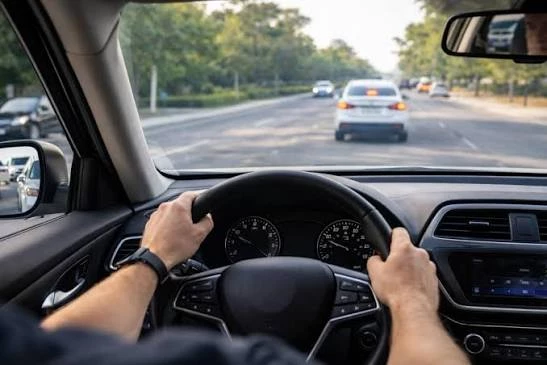
Some of the deadliest behaviors happen inside the cabin, where road-facing sensors cannot help. Driver monitoring systems address this by pointing a camera at the driver. Using infrared tracking of eye movement, eyelid closure, and head position, they detect drowsiness and distraction, then escalate from a soft chime to a firm warning. The European Union now requires driver drowsiness and attention warning on new vehicles, a mandate that is accelerating the technology globally.
The problem these systems target is large. NHTSA recorded 3,208 deaths in distraction-affected crashes in 2024 and acknowledges that inconsistent police reporting likely understates the true total. Drowsy driving is harder to measure still, with 633 deaths formally attributed in 2023 and broad agreement among researchers that fatigue is heavily underreported, with one AAA Foundation analysis estimating the real toll many times higher.
No single behavior illustrates the limits of human judgment more starkly than impaired driving. Alcohol-impaired crashes killed 11,904 people in the United States in 2024, roughly 32 deaths a day, or one every 44 minutes, and made up about three in ten of all traffic deaths. Repeat behavior compounds the danger: drivers with illegal alcohol levels in fatal crashes are about three times more likely than sober drivers to carry a prior conviction for driving while impaired.
The most effective technological countermeasure is the ignition interlock, an in-car breath tester that prevents a vehicle from starting when it detects alcohol above a set limit. The Centers for Disease Control and Prevention reports that interlocks cut repeat impaired-driving offenses by about 70 percent while installed, and that laws requiring them for all offenders are linked to 26 percent fewer alcohol-impaired drivers in fatal crashes. Adoption remains the weak point: only about one in five people arrested for impaired driving has an interlock fitted, even though 34 states and Washington, D.C. now require the devices for all first-time offenders.
Technology can reduce impaired driving, but it does not erase what follows a charge. An ignition interlock is itself usually a court-ordered condition rather than a voluntary safety choice, and the broader consequences tend to be heavier and more variable than most drivers expect.
Those consequences shift sharply from one state to the next, spanning license suspension, mandatory interlock periods, fines, and criminal exposure that escalates for repeat offenses. For that reason, drivers facing a charge often turn to a specialist such as a New Hampshire DWI lawyer to understand the rules that apply where they live and how interlock and licensing requirements are enforced locally.
Regulators want to move impairment detection from the courtroom into every dashboard. The 2021 federal infrastructure law directed NHTSA to advance a standard for technology that can passively detect and prevent impaired driving, pointing toward sensors built into future vehicles rather than devices fitted only after a conviction.
Every assistance and automation feature depends on one question: how well can the car perceive its surroundings. Most systems combine several sensor types, each with a different strength. Cameras read lane lines, signs, and pedestrians but struggle in glare and darkness. Radar measures distance and closing speed and works in poor weather but resolves shape poorly. LiDAR builds a precise three-dimensional map but is costly and degrades in heavy rain or fog. Ultrasonic sensors handle close-range tasks such as parking. Sensor fusion merges these inputs so the weaknesses of one are covered by the strengths of another, which is why higher-end systems rarely lean on a single sensor.
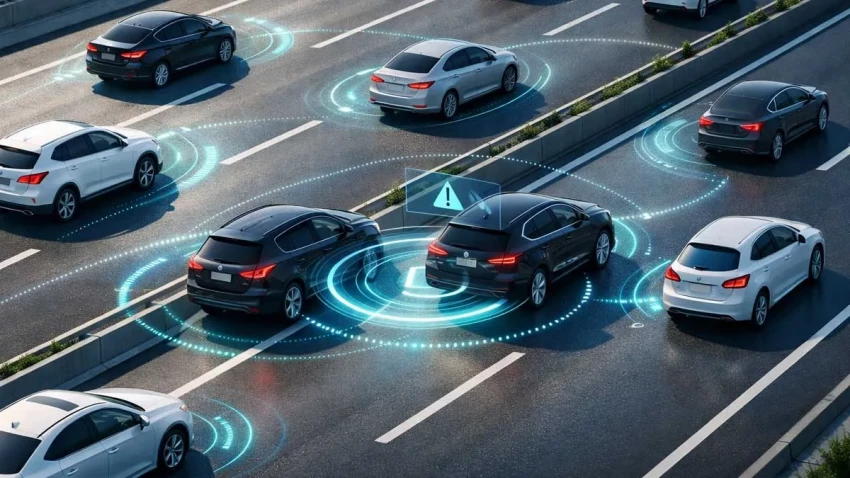
The next frontier extends perception beyond the line of sight. Vehicle-to-everything, or V2X, communication lets a vehicle exchange data with other vehicles, with roadside infrastructure, and even with pedestrians' devices over dedicated 5.9 GHz wireless spectrum. It can warn of a car braking hard two vehicles ahead, a driver about to run a red light at a blind intersection, or a cyclist hidden behind a truck.
The safety ceiling is high. NHTSA has estimated that vehicle-to-vehicle communication alone could address up to 80 percent of crashes involving unimpaired drivers. In August 2024 the U.S. Department of Transportation published a national plan to accelerate V2X, setting a target of at least a dozen interoperable deployments by 2028 and more than 50 mature deployments by 2036. Related telematics already shorten emergency response: automatic crash notification places an emergency call and transmits a vehicle's location the moment a serious impact is detected. Deployment has trailed the technology itself, held back in part by a long fight over the 5.9 GHz radio spectrum the system depends on.
Connectivity also turns everyday driving into data. Telematics units, whether built into the vehicle or plugged into its diagnostic port, log speed, braking, cornering, and phone handling, then feed that record back to drivers and insurers. Usage-based insurance prices premiums on how a person actually drives rather than on demographics alone, which gives a direct financial reason to brake gently and leave the phone alone.
The sharpest gains appear in commercial fleets, which adopted these tools early: a study of lane departure warning fitted to U.S. trucks found it cut the rate of relevant crashes by nearly half, well above the effect measured in passenger cars, partly because fleet policy keeps the systems switched on.
Roads are gaining intelligence alongside vehicles. Adaptive traffic signals adjust timing to real demand and reduce the rear-end and angle crashes that cluster at intersections. Connected work zones broadcast lane closures directly to approaching cars. Road and weather sensors flag ice, flooding, or stopped traffic ahead. These systems form the infrastructure half of V2X, and their value grows as more vehicles can receive what they transmit.
Public attention fixates on self-driving cars, but the term spans a wide range. SAE International's J3016 standard, the global benchmark since 2014, sorts driving automation into six levels that define exactly how much the car does and who holds responsibility.
| Level | Name | Who is driving | Reality in 2026 |
| 0 | No automation | The human does everything; the car only alerts | Most pre-2015 vehicles |
| 1 | Driver assistance | Human drives; one function assists, such as adaptive cruise control | Common |
| 2 | Partial automation | Human supervises; system steers and controls speed together | Widely sold as highway assist suites |
| 3 | Conditional automation | System drives within set limits; human must resume when prompted | Rare; some systems paused |
| 4 | High automation | System handles everything within a mapped zone; no human fallback | Robotaxis in select cities |
| 5 | Full automation | System drives everywhere, in all conditions | Not commercially available |
The gap between the levels and the headlines is wide. Levels 1 and 2 sell across the market today, yet they remain driver-support features that demand constant supervision. Level 3 has proven commercially difficult: Mercedes-Benz fielded the first Level 3 system certified for U.S. consumers, then paused it amid high sensor costs and thin demand. Level 4 is advancing fastest as robotaxis, with Waymo running driverless fleets in cities including Phoenix, San Francisco, Los Angeles, and Austin, though strictly inside mapped, geofenced zones. Level 5, a car that drives anywhere in any condition, does not yet exist as a product.
Much of the fastest progress is no longer optional. In the European Union, the General Safety Regulation has, since July 2024, required every new car to include assistance features such as automatic emergency braking, intelligent speed assistance, driver drowsiness and attention warning, and emergency lane keeping. Many of these systems reactivate at the start of each trip, and a further phase from 2026 adds dedicated distraction warning and expanded pedestrian and cyclist braking.
In the United States, NHTSA's 2024 rule, FMVSS No. 127, requires automatic emergency braking, pedestrian detection, and forward collision warning on all new light vehicles by September 2029. The standard includes avoiding contact with a stopped car at up to 62 mph and braking for pedestrians in daylight and darkness. NHTSA estimates it will save at least 360 lives and prevent more than 24,000 injuries a year. The rule has since faced litigation and a regulatory freeze, and in March 2026 the Department of Transportation said it would propose pushing the deadline back by about two years, though the 2029 date still stands for now. Mandates matter because they turn proven safety features from paid options into standard equipment across the fleet.
For all the measurable gains, road safety technology carries real limitations that honest coverage should name.
● Sensors degrade in bad conditions. Rain, snow, fog, low sun, and a dirty camera lens can blind a system at the exact moment a driver needs it most.
● Automation breeds complacency. The better a system performs, the more some drivers disengage, treating supervised assistance as if it were full autonomy.
● Performance is uneven. Features that excel in one scenario, such as braking for a stopped car in daylight, can falter in another, such as detecting a pedestrian at night.
● Connected systems widen the attack surface. A vehicle that talks to the road and to other cars also becomes a target, which puts cybersecurity at the center of V2X design.
● Access is unequal. The newest safety technology reaches expensive vehicles first, leaving older and cheaper cars, and the people who drive them, furthest behind.
The clearest near-term gains will not come from removing the driver but from making proven assistance universal, which is exactly what the current wave of mandates is doing. The harder question is whether drivers will let the systems work, since the largest measured benefits depend on features staying switched on and on people staying engaged behind the wheel.
The throughline across every layer, from a braking alert to a robotaxi, is the same. Technology works best when it backstops human limits rather than inviting drivers to ignore them. The roads of the next decade will be safer not because cars finally drive themselves, but because the systems that catch a moment of inattention, an unseen vehicle, or an impaired start are becoming standard equipment rather than luxury options.
Source Note: The data mentioned in the article draws on published crash data and rulemakings from NHTSA, the Insurance Institute for Highway Safety, the Centers for Disease Control and Prevention, the World Health Organization, and the U.S. Department of Transportation. Effectiveness figures come from agency and peer-reviewed crash studies and reflect real-world results, which vary with system design, driver behavior, and road conditions. Last updated June 2026.
Share your thoughts about this article.
Be the first to post a comment!

For most of working history, speed was evidence of mastery. A skilled technician...
Parveen Verma3 weeks ago
A machine stops, a vehicle changes direction, or a network account is breached....
Parveen Verma3 weeks ago

Service search is no longer a simple list of links. It is now shaped by AI summa...
Parveen Verma1 month ago

The modern website is no longer a digital brochure. It is becoming the first pla...
Parveen Verma1 month ago

A digital service does not fail only when the final outcome is poor. It often fa...
Parveen Verma1 month ago
Technology is no longer just something people use. It has become something that...
Parveen Verma2 months ago