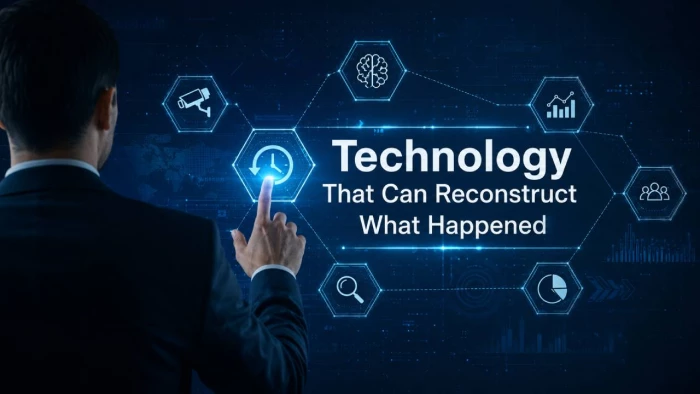
A machine stops, a vehicle changes direction, or a network account is breached. The event may last only seconds, yet it can leave records across cameras, sensors, control units, phones, cloud platforms, and communication systems.
Modern reconstruction technology turns those fragments into an ordered sequence. AI can track movement, compare timestamps, find anomalies, and test competing explanations. The result may be more detailed than any single witness account. It is still not a perfect replay. Every reconstruction depends on what was recorded, what was missed, and which assumptions bridged the gap.
Most systems do not record an event to explain it later. They collect information to operate equipment, monitor performance, enforce access rules, document work, or trigger a safety response. Reconstruction is usually a secondary use of data created for another reason.
A connected building may preserve badge entries, elevator activity, camera footage, alarm states, and environmental readings. A factory may generate machine temperatures, motor loads, emergency-stop events, maintenance entries, and worker proximity alerts. A business system may retain login attempts, file changes, administrator actions, IP addresses, and authentication records.
Some systems record continuously. Others save data only when a threshold is crossed, such as an impact, failed login, temperature spike, or equipment fault. NHTSA describes vehicle event data recorders as devices that preserve technical vehicle and occupant information for a brief period measured in seconds, not minutes, around a crash. Depending on the system, that information may include pre-crash dynamics, driver inputs, crash signatures, restraint status, and post-crash notifications.
No source provides the entire event. A camera may show movement without machine status. A sensor may record a warning without showing who noticed it. A message may reveal an instruction without proving it was read. Reconstruction begins by accepting that the record is distributed and incomplete.
Collecting files is only the first step. The harder task is establishing when each record belongs in the sequence.
Two systems can describe the same moment with different timestamps. One clock may be several seconds fast. A cloud dashboard may display an alert after a network delay. Video may run at 30 frames per second while a location service records a point every minute. One device may store local time while another uses Coordinated Universal Time.
Investigators and engineers look for shared reference points. A power loss may appear in a machine log, camera recording, and building alarm. An impact may correspond with a sharp acceleration change, a microphone spike, and an emergency call. Once one common event is identified, the surrounding records can be shifted into alignment.
| Data source | Useful contribution | Important limitation |
| Camera footage | Shows movement, visibility, object position, and approximate timing. | It cannot show activity outside the frame or explain why a person acted. |
| Device location | Establishes route, position, direction, and movement intervals. | Accuracy and sampling frequency may be too low for second-by-second conclusions. |
| Equipment telemetry | Records braking, temperature, pressure, faults, or system status. | It does not prove that a person saw or understood the reading. |
| Access records | Identifies accounts, badges, or credentials used at a particular time. | A recorded identity does not always establish who physically performed the action. |
| Messages and calls | Places instructions, warnings, and decisions in the timeline. | Delivery does not prove attention, comprehension, or compliance. |
A reliable timeline keeps original timestamps, documents every correction, and explains the basis for synchronization. Quietly replacing raw times with adjusted ones can hide the degree of uncertainty.
AI does not remember the original event. It processes representations captured by other systems.
Computer vision can follow a person or vehicle across frames, estimate direction, detect objects, and flag sudden movement. Speech recognition can turn recordings into searchable transcripts. Anomaly-detection systems can compare machine behaviour with its normal operating range. Sequence models can rank possible orders when records overlap. Data-matching tools can identify files referring to the same device, user, location, or incident despite naming differences.
These abilities matter because the material can exceed what a person can inspect efficiently. Stanford’s 2026 AI Index reported that 88 percent of surveyed organizations used AI in 2025, while 70 percent used generative AI in at least one business function. Reconstruction is part of that wider move from manual review toward machine-assisted analysis.
The practical advantage is triage. A model can search hundreds of hours of video for a particular vehicle shape, isolate unusual network activity from routine events, or identify repeated equipment alarms before a failure. It narrows the field so specialists can examine the most relevant material.
The limitation is equally important. A model may identify correlation without establishing cause. If a gate opens seconds before a machine stops, the sequence does not prove that one event caused the other. AI can propose a connection. The connection must still be tested against system design, physical conditions, and alternative explanations.
Digital records often fail at the point where certainty is most desirable. A camera view may be blocked. A sensor may sample too slowly. A device may lose power. A file may be overwritten by normal retention settings. A network outage may delay cloud records. A user may have disabled tracking. Data may also exist under an account or vendor system that has not yet been identified.
Reconstruction software can estimate movement between known points, calculate a likely path, or generate a visual model from measurements. Those functions are useful, but inferred information must remain separate from recorded information.
Consider a camera that captures a vehicle at one end of a street and again four seconds later after an obstruction clears. Software can interpolate a smooth route between the two positions. That route may be physically plausible, but the camera did not record it. The vehicle could have changed speed, crossed a lane line, or responded to another road user during the hidden interval.
The same caution applies to image enhancement. Increasing contrast may reveal a shape that was difficult to see. It cannot recover a licence plate number the sensor never resolved. Frame generation may smooth playback, but the inserted frames are calculations rather than observations.
Confidence ranges are more honest than exact-looking answers. A defensible reconstruction may place an action within a two-second window or provide a range of possible speeds. Stating uncertainty shows where evidence ends and estimation begins.
A timeline establishes order. It does not automatically explain behaviour. A sudden stop could indicate deliberate braking, loss of power, automatic intervention, or obstruction. A temperature spike could reflect overload, failed cooling, a defective sensor, or incorrect calibration. A security account used at midnight might indicate unauthorized access, scheduled maintenance, or a service operating under shared credentials.
Meaning comes from comparing the digital sequence with equipment design, maintenance history, weather, visibility, road geometry, staffing, training, operating procedures, prior warnings, and witness accounts.
Suppose a proximity system records that a worker entered a restricted zone at 2:14:08 and a machine stopped at 2:14:10. The gap appears clear, but several questions remain. How far was the worker from the hazard when detected? Where was the sensor mounted? Who received the warning? What was the stopping distance under the actual load? Had similar alerts been ignored because of repeated false alarms?
The answers determine whether the system created a meaningful opportunity to respond. Raw timestamps become useful only after they are placed inside the physical and operational environment that produced them.
Commercial transport provides a clear example of distributed evidence. A single journey may create records across engine-control modules, telematics platforms, electronic logging devices, dashboard cameras, dispatch systems, maintenance databases, phones, and roadside infrastructure. Those systems do not all record the same facts. FMCSA states that an electronic logging device synchronizes with the engine to record driving time and duty status, while required ELD data does not include braking, steering, or other vehicle-performance parameters.
For example, when an incident in Chicago leaves conflicting records or unexplained gaps, the review may extend beyond scene measurements and visible vehicle damage. In that setting, a truck accident lawyer in Chicago may compare the digital timeline with vehicle condition, road design, weather, company procedures, and witness accounts. The purpose is not to treat every electronic record as definitive, but to determine what each system measured and whether independent sources support the same sequence.
A reconstruction is only as trustworthy as the path from the original record to the final explanation. That path is known as provenance.
Useful provenance answers demanding questions. Where did the file originate? Was it copied from the original device or exported through a dashboard? Who had access? Was it converted, compressed, enhanced, or edited? Which software version processed it? Can another examiner repeat the same steps?
Metadata can record creation times, modification history, device identifiers, location fields, and software details. File hashes can help determine whether a copy matches the material originally collected. Audit logs may reveal who viewed, exported, or changed a record. These controls do not prove that the content is accurate, but they help establish that later analysis used the material first collected. NIST’s definition of digital forensics emphasizes preserving information integrity, maintaining chain of custody, using validated tools, and producing repeatable results.
A defensible reconstruction should clearly show:
● Which details were captured directly and which were calculated, enhanced, translated, or inferred by software.
● How separate clocks were aligned, including the reference event and size of every adjustment.
● Whether original files remain available so another specialist can inspect them without relying on the final presentation.
● Which gaps, conflicts, and alternative sequences remain unresolved after analysis.
This documentation matters because a polished animation can disguise a weak foundation. A plain timeline with traceable sources is more useful than a cinematic replay whose assumptions cannot be inspected.
The same methods used after a failure are increasingly used before one. A near miss may leave almost the same traces as a damaging event: a proximity alert, sudden brake application, abnormal temperature, emergency login, or last-second machine shutdown. The difference is that the system recovered before the consequence became severe.
One near miss can be dismissed as unusual. A hundred similar sequences can expose a structural problem. Repeated alerts in one warehouse aisle may show that shelving blocks a sensor. Frequent harsh braking at one junction may point to poor sight distance. A cluster of unauthorized login attempts followed by access may reveal weak identity controls. Recurring temperature spikes before resets may identify a maintenance issue before breakdown.
AI can compare large numbers of low-severity events and identify a shared pattern. Instead of asking only what failed, the system can ask what repeatedly came close to failing and which control prevented escalation.
Post-event analysis explains a completed failure. Near-miss reconstruction identifies fragile safeguards and warning patterns while there is still time to redesign the process.
As reconstruction tools become more capable, they also make it easier to create evidence-like material. Video can be altered, voices cloned, screenshots fabricated, and summaries generated with details absent from the source. Less obvious transformations can be just as influential. Software may stabilize footage, sharpen edges, interpolate frames, remove noise, or create a three-dimensional animation. Each step may improve readability while increasing the distance from the original recording.
NIST defines synthetic content broadly to include images, video, audio, and text significantly altered or generated by algorithms. Its guidance identifies provenance tracking through metadata and watermarks as one way to record origins and modification history, but notes that the effectiveness of many transparency techniques has not been fully established.
Reconstruction systems therefore need visible categories:
● Recorded material that comes directly from a device or original file.
● Enhanced material in which existing information has been made easier to perceive.
● Calculated material based on measurements, physical models, or synchronized data.
● Synthetic material generated to illustrate a possible sequence rather than document an observed one.
A label should travel with the content rather than appear only in technical notes. Without that separation, a plausible visualization can acquire more authority than the evidence supports.
The strongest reconstruction is not the version that tells the cleanest story. It is the version that remains stable when challenged.
Independent review may uncover a clock error, overlooked maintenance entry, alternate camera angle, or misunderstanding of a sensor trigger. A sound process allows revision without hiding the earlier assumption. It preserves raw files, records analytical steps, and keeps competing explanations visible until evidence rules them out.
Organizations should also prepare for reconstruction before an incident. Retention periods should reflect how long problems take to surface. Critical systems need synchronized clocks. Logs should distinguish user actions from automated processes. Export tools should preserve metadata rather than leave screenshots as the only record. Access controls should protect evidence without blocking legitimate review.
These details determine whether a later investigation can separate a technical failure from a human decision, a genuine record from an altered file, and a measured fact from a persuasive estimate.
Technology can rebuild events from traces no witness could gather alone. Cameras supply movement, sensors preserve system states, logs document actions, and AI connects records at a scale manual review cannot match.
Yet more detail does not guarantee more truth. Every reconstruction contains boundaries created by sampling rates, blocked views, missing files, clock errors, model assumptions, and incomplete context. Responsible use depends on making those boundaries visible.
The most advanced system will not be the one that produces the smoothest replay. It will show where each detail came from, mark what was inferred, preserve original evidence, and allow another person to test the sequence independently. Used that way, reconstruction can explain past failures and reveal warning patterns that help prevent the next one.
Share your thoughts about this article.
Be the first to post a comment!

For most of working history, speed was evidence of mastery. A skilled technician...
Parveen Verma3 weeks ago
Service search is no longer a simple list of links. It is now shaped by AI summa...
Parveen Verma1 month ago

The modern website is no longer a digital brochure. It is becoming the first pla...
Parveen Verma1 month ago
A digital service does not fail only when the final outcome is poor. It often fa...
Parveen Verma1 month ago

In its landmark crash-causation survey, the National Highway Traffic Safety Admi...
Parveen Verma1 month ago
Technology is no longer just something people use. It has become something that...
Parveen Verma2 months ago