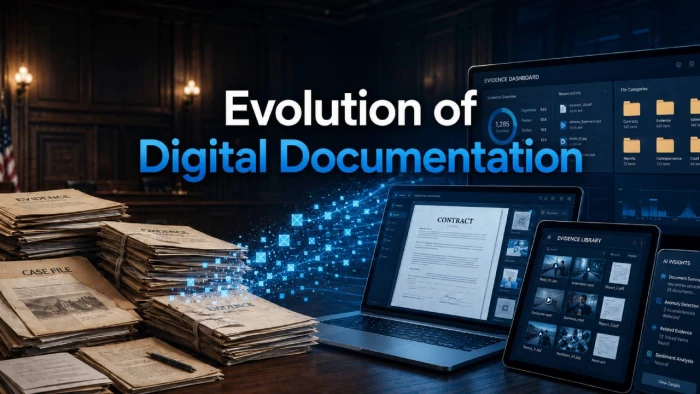
A single car crash today produces more documentation in ten seconds than a 1990s accident file gathered in a year. Dashcam video, airbag module readings, GPS pings, smartphone photos, a recorded emergency call. Nobody wrote any of it down. The machines did.
That flood of automatic records has quietly rewritten an old question. We no longer ask whether documentation of an event exists. We ask whether it can be trusted, and artificial intelligence now sits on both sides of that question, generating records at scale while also making them easier than ever to fake. This article traces how we got here and what turns raw data into evidence that holds up.
For most of history, documentation earned trust through scarcity. Creating a record took effort, so the record's existence meant something. A wax seal, a notary's stamp, a wet-ink signature: each was hard enough to forge that its presence carried weight.
Digitisation broke the scarcity model without replacing it. A digital file copies perfectly and infinitely, so an original and its thousandth duplicate are indistinguishable. For two decades we papered over that problem with access controls and institutional trust, assuming the file on the server was the file that was saved.
The legal system papered over it too. Rules of evidence built for ledgers and letters were stretched to cover emails and spreadsheets, mostly by trusting the businesses that produced them. It worked because fabricating a convincing digital record still demanded skill and left traces.
Generative AI removed even that comfort. When software can produce a photorealistic image, a cloned voice, or a plausible invoice in seconds, the mere existence of a record proves nothing at all. Documentation has been forced to evolve a new property it never needed before: the ability to prove its own origin.
The scale of the problem is easy to underestimate. Organisations that once worried about missing records now drown in them, and buried in that volume sit fabrications that no human reviewer can reliably spot. Controlled studies consistently show that people identify high-quality synthetic video at rates worse than a coin flip.
The pressure is no longer hypothetical for anyone. A 2025 Gartner survey of cybersecurity leaders found that 62 percent of organisations had already faced at least one deepfake attack in the previous year. Fabrication has moved from a fringe risk to a line item in ordinary operational planning.
Institutions have noticed. Insurers now treat submitted photos with default suspicion. Banks assume a document scan may never have touched a scanner. Courts increasingly expect a file to arrive with a technical account of where it came from, not just a witness willing to vouch for it.
The cost lands on honest records too. Fabricated files show up in insurance claims, expense reports, and rental applications alike, and every fake taxes every genuine document, because reviewers are forced to slow down for all of them.
The response taking shape is not to trust records less. It is to make records that carry their trustworthiness with them, and AI is doing much of that construction work.
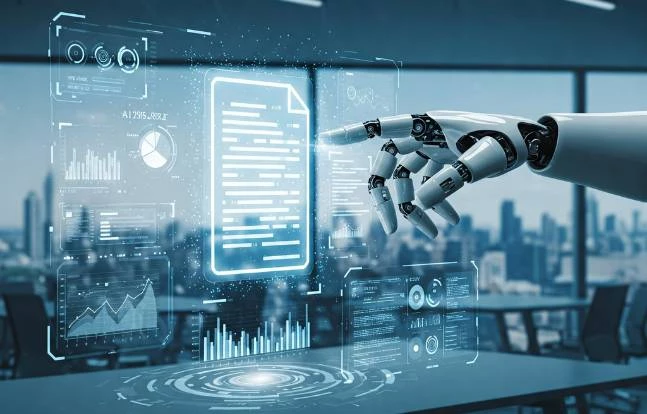
The most visible change is who, or what, is doing the documenting. Modern documentation is increasingly ambient: it happens continuously, automatically, and without anyone deciding to create a record. Consider what routine systems now capture on their own:
AI sits on top of this capture layer as an organiser. It reads damaged or handwritten documents through OCR, extracts structured facts from unstructured text, and summarises thousands of pages into reviewable form. The record keeping that once required a clerk now runs as background software.
The economics of this are worth pausing on. Documentation used to be a cost centre, so organisations recorded only what regulation demanded. When recording is free and automatic, the default flips, and the archive of any given day becomes vastly richer than anyone planned for.
Ambient documentation solves the completeness problem and sharpens the authenticity one. When everything is recorded by machines, the decisive question becomes whether a given machine record is genuine and unaltered. Answering that required borrowing an idea from cryptography.
Chain of custody used to be a paper trail of signatures showing who held a piece of evidence and when. Its digital successor replaces signatures with mathematics. A cryptographic hash acts as a fingerprint for a file: change a single pixel or character, and the fingerprint changes completely.
Hash a file the moment it is collected, log that value with a trusted timestamp, and you can prove months later that the file in front of a judge is bit-for-bit identical to the file pulled from the camera. Write-once storage and tamper-evident audit logs extend the same guarantee across the entire holding period.
The discipline matters as much as the technology. A hash computed a week after collection proves only that nothing changed since that week, and a gap in the log is an opening an opposing expert will drive a truck through. Sound custody is a habit practised from the first minute, not a certificate added at the end.
A final layer removes trust in the custodian itself. Some systems publish batched hashes to independent public ledgers, so even the party holding the evidence cannot quietly rewrite its history. The principle is simple: proof of integrity should not depend on believing any single organisation.
This is the quiet machinery that converts data into evidence. A dashcam clip is just data. A dashcam clip with a capture-time hash, an intact metadata record, and an unbroken custody log is proof. The next step, already underway, is building that proof in from the very first moment.
Instead of reconstructing a file's history after the fact, the industry is moving to sign it at birth. The C2PA standard, backed by Adobe, Microsoft, Google, and camera makers including Sony and Leica, attaches a cryptographically signed manifest to an image or recording documenting the device, the capture time, and every subsequent edit.
Cameras with signing hardware are already shipping, and Content Credentials now surface in mainstream editing tools and search results. On the other side of the ledger, watermarking systems embed detectable signals into AI-generated output at creation, so synthetic content can identify itself.
The combined effect inverts a default assumption. Within a few years, unsigned media in any high-stakes setting will carry the burden of proof, much as unsigned software already does. And no setting is higher stakes, or testing these ideas harder, than a courtroom.
Legal disputes are where documentation standards get stress-tested, because every file faces an opponent paid to discredit it. Accident and injury cases show this most clearly. They now turn on dashcam and helmet camera footage, crash-scene photos, and event data recorder downloads, and as AI image tools spread, opposing insurers challenge authenticity far more aggressively than they did even three years ago.
The shift reaches routine cases, not just headline litigation. For example when a Columbus motorcycle accident lawyer handles a disputed liability claim, helmet camera footage is checked against its own metadata, vehicle telematics are pulled to confirm speed and position, and file hashes are logged from the moment evidence is collected, so nobody can later argue it was altered.
None of this is exotic anymore. It is simply what admissible looks like when the other side knows fabricated imagery is a real possibility. The manual authentication work practitioners perform today is a preview of what provenance standards will eventually automate, and courts are expected to formalise digital provenance requirements the same way they once formalised physical chain of custody.
The pattern also runs in the other direction. Lawyers now subpoena data sources that did not exist a decade ago, from rideshare trip logs to smart intersection cameras, precisely because machine records carry less bias than memory. The same technologies that made fabrication easy are, properly handled, making honest reconstruction of events more complete than it has ever been.
Verification itself is becoming an AI discipline. Forensic models detect splices, lighting inconsistencies, compression anomalies, and sensor noise patterns that human eyes cannot perceive, flagging manipulated frames inside hours of footage. In discovery, machine learning reviews document sets that would take associate teams months, surfacing the handful of records that matter.
Audio gets the same treatment. Voice-clone detection models analyse breathing rhythms, micro-pauses, and spectral artefacts that synthetic speech smooths away, a check that grows more important as recorded calls become routine exhibits in disputes of every size.
An honest caveat belongs here. Detection models are trained on known manipulation techniques and can stumble on novel ones, which is why forensic AI is treated as a screening layer rather than a verdict. The arms race between generation and detection will not end; it will simply keep moving to deeper layers of the file.
That is also why examiners increasingly prefer provenance over detection when both are available. Proving a file was signed at capture is a mathematical fact that does not age, while a detector's opinion is only as current as its training data. Detection fills the gap for the enormous body of unsigned material the world has already produced.
For all the machinery, evidence remains a human judgment. Software can prove a file is unaltered; it cannot say whether the file matters, what it implies, or whether the story it supports is credible. Weighing context is still a professional skill, whether the professional is a judge, an adjuster, or an editor.
There is a wrinkle the industry is only beginning to confront, sometimes called the liar's dividend. Once everyone knows fabrication is possible, genuine records can be waved away as fake, and that denial costs nothing to make. Robust provenance protects honest evidence from that tactic as much as it exposes dishonest evidence.
The skill set around that judgment is shifting, though. Understanding metadata, hashes, and provenance signals is becoming basic literacy for anyone whose work touches records, in the way spreadsheet literacy became unavoidable a generation ago. The professionals who thrive will be the ones who can interrogate a file's technical story, not just its contents.
Follow these threads forward and the near future of documentation comes into focus:
Documentation has always evolved with the tools of its era, from seals to signatures to server logs. The AI era's contribution is stranger than its predecessors: it made records infinitely easy to create and, in the same stroke, forced them to become self-proving.
The transition will be uneven. Legacy archives will never carry capture-time signatures, small organisations will adopt provenance tooling slowly, and disputes will keep landing in the awkward gap between old records and new standards. That gap is exactly where careful custody practices and forensic review earn their keep.
The result is a cleaner definition of an old idea. Data becomes evidence not when it is stored, but when it can tell the verifiable story of its own origin, custody, and integrity. The organisations and professionals adapting to that definition now will be the ones whose records still mean something when it counts.
Share your thoughts about this article.
Be the first to post a comment!

The first wave of generative AI was built for a world of documents, dashboards a...
Parveen Verma1 week ago

More information does not always make a decision easier. A medical report, loan...
Parveen Verma1 month ago
Would you rather spend an hour taking notes by hand or let AI do all the legwork...
Parveen Verma1 month ago
Fireflies.ai crossed a $1 billion valuation in 2026 and has built one of the lar...
Parveen Verma1 month ago
Building cross-platform digital experiences, shipping software tutorials, or lau...
Parveen Verma2 months ago
Creating a professional presentation is often one of the most time-consuming cho...
Parveen Verma2 months ago