
OpenFuture AI is not an app that edits photos or writes copy. It is a directory: a searchable catalog that lists tens of thousands of other AI tools across more than forty categories, so people can browse and filter software in one place. That distinction matters, because the right alternative is not a rival product but a better place to discover tools.
Anyone comparing directories is usually reacting to the same frustration. The catalog is enormous, yet the listings are thin, and it is hard to tell which entries are current, vetted, or even worth clicking. The five directories below each answer that frustration in a different way. Rather than rank them from best to worst, this guide matches each one to the job it does well.
How this comparison was put together. The notes here draw on each platform’s own documentation, public user reviews, and third-party directory analyses. They do not include independent hands-on testing of every directory. Catalog sizes and pricing are self-reported or taken from outside write-ups and change often, so any listing is worth verifying on the source before relying on it.
On breadth, OpenFuture AI delivers. It positions itself as one of the largest AI directories on the web, with a single interface for filtering thousands of tools by category and by pricing signal, from free to paid. For a quick sense of how many tools exist in a niche, it does the job.
The weaknesses are structural rather than cosmetic. Listings are user-submitted and largely unvetted, so the platform does not test or meaningfully describe the tools it hosts, and independent reviewers note that many entries read closer to advertisements than to reviewed profiles. A large share of listings carry no pricing information at all. Ownership is also opaque: there is no named founder, team page, or company detail, which weakens the trust signals a buyer would normally look for.
None of this makes OpenFuture AI useless. It makes it a starting point rather than a finish line, best used to gather names and map a landscape, then verified elsewhere. The alternatives that follow each strengthen one part of that gap.
Different directories optimize for different things. This is the fastest way to match a need to a starting point before reading the detail.
| If the goal is | Start with |
| The broadest possible market scan or competitor research | Toolify |
| Searching by task, as in “an AI that does X” | There’s An AI For That |
| Understanding a whole category before choosing | Futurepedia |
| A short, opinionated shortlist from a trusted curator | FutureTools |
| Human-vetted, brand-safe picks with editorial context | AIChief |
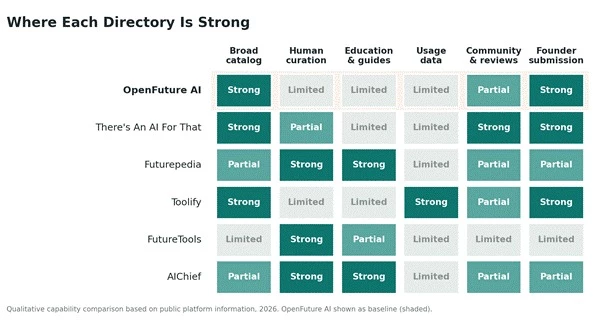
Figure 1. Where each directory is strongest, compared with OpenFuture AI as a baseline.
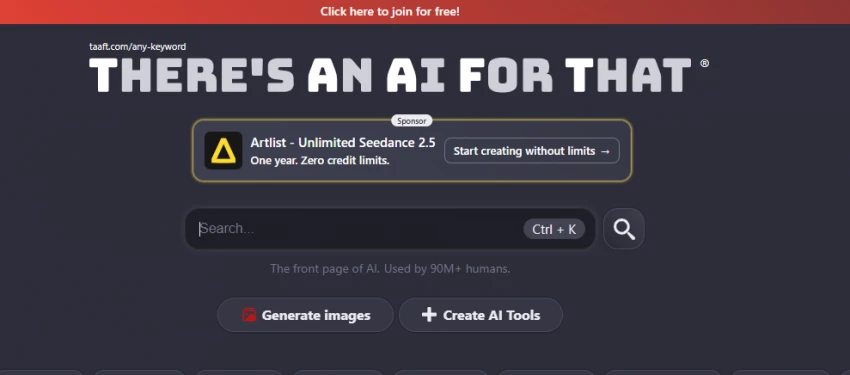
There’s An AI For That is built around a simple, powerful idea: search by the task rather than the category. A query phrased as a job to be done returns tools mapped to that outcome, which suits people who know the problem but not the product. It also maintains one of the largest indexes anywhere and layers in community signals such as upvotes, so popularity is visible at a glance.
That combination of scale and task-first search is what makes it a natural first stop for anyone who found OpenFuture AI too undirected. Where OpenFuture leaves a reader scrolling categories, this platform starts from intent.
The catch. Because the index is vast and partly community-driven, sheer volume can still bury quality, and popularity signals reward marketing as much as merit. It points toward candidates well, but the shortlist still needs checking.
Futurepedia was one of the first AI directories to gain real traction, and its distinguishing move was to pair the catalog with an education layer. Alongside a curated set of several thousand tools and a large registered user base, it runs an AI learning platform with dozens of courses and a deep library of lessons. For someone trying to understand a category rather than just name tools in it, that context is the value.
It suits readers who are still building their mental model of the space, where knowing that a tool exists is only half the problem and knowing how it fits a workflow is the rest.
The catch. Several 2026 reviews flag that parts of the catalog have aged, with listings lagging the current landscape, and that submitting a tool sits behind a paywall. The educational content ages more gracefully than the raw listings, so lean on the former.
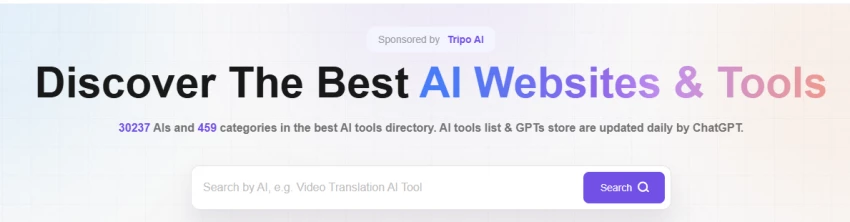
Toolify competes on two fronts: raw scale and data. It reports more than twenty-eight thousand tools across several hundred categories, refreshed daily through automated discovery, which makes it the closest thing to a comprehensive index. Its real differentiator, though, is the traffic and revenue intelligence attached to listings, a layer no other mainstream directory offers for free.
For competitive research, benchmarking a category, or spotting which tools are actually gaining users, that data turns a directory into a research instrument. It is the strongest choice for a broad market scan and long-tail discovery.
The catch. Scale is also the drawback. With a database that large and lightly curated, filtering to something usable takes patience, and the ranking data is best read as a discovery signal rather than a recommendation.

FutureTools takes the opposite approach to the giant indexes. It is a hand-picked, curated collection maintained by a well-known AI creator and paired with a popular newsletter, so the catalog reflects a clear point of view rather than an open submission queue. The result is a smaller list where inclusion means something.
It fits readers who would rather trust a curator’s judgment than wade through thousands of entries, and who value a steady, opinionated feed of what is worth attention.
The catch. A curated list is only as broad as its curator’s attention, so long-tail or very new tools may not appear, and the selection carries the taste and blind spots of one editorial voice.
AIChief positions itself as a brand-safe directory whose listings are tested and edited by people rather than auto-ingested. Around the catalog it publishes editorial work, including guides, comparisons, and courses, which places it between the pure index and the education platform. The pitch is trust: entries are meant to be relevant, useful, and actively maintained.
It works for both newcomers who want a guided path and more experienced users who want to compare options with some editorial framing before committing, which is precisely the vetting layer OpenFuture AI lacks.
The catch. Human curation limits breadth and moves more slowly than automated discovery, so the very newest or most niche tools can be missing, and editorial framing always carries some subjectivity.
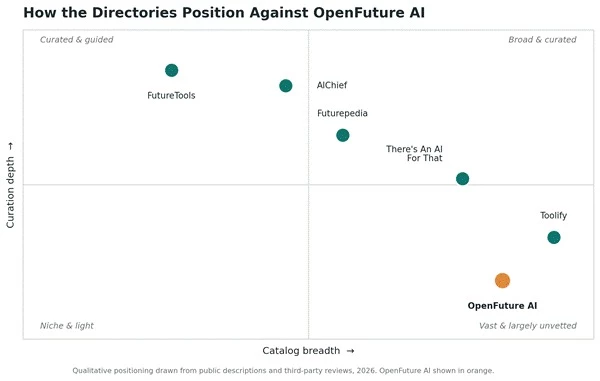
Figure 2. Directories mapped by catalog breadth and curation depth, a qualitative reading of public information.
The picture explains the trade-off at the heart of AI directories.
Toolify and OpenFuture AI sit in the broad, lightly curated corner, strong for scale and market scans but weak on vetting.
There’s An AI For That pushes right with scale plus task-first search.
Futurepedia and AIChief climb into curated territory with editorial and educational context, while FutureTools trades breadth for the deepest point of view.
No single position is best; the right one depends on whether the task rewards coverage or judgment.
Directories are discovery tools, not decision engines, and a few habits keep them useful. Rankings, badges, and featured slots usually reflect popularity, submission date, or paid placement rather than quality, so they are best read as leads to investigate. Pricing, features, and even whether a product still exists should be confirmed on the vendor’s own page before any shortlist hardens, since directory data goes stale quickly.
Cross-checking two directories with different philosophies, one broad and one curated, tends to surface both the obvious options and the vetted ones. It also helps to watch for pay-to-list and affiliate incentives, which quietly shape what appears first. Used this way, a large index like Toolify or OpenFuture AI is ideal for casting a wide net, while a curated source like FutureTools or AIChief is better for narrowing it down with some confidence.
| Directory | Best for | Main strength | Main limitation |
|---|---|---|---|
| OpenFuture AI | Broad discovery | Huge catalog | Limited vetting and thin listings |
| There’s An AI For That | Finding tools by task | Intent-based search | Quality can vary across a large index |
| Futurepedia | Learning before choosing | Educational and editorial context | Some listings may lag behind newer tools |
| Toolify | Market and competitor research | Scale plus traffic and ranking data | Can feel overwhelming |
| FutureTools | Curated recommendations | Strong editorial filtering | Smaller catalog |
| AIChief | Vetted, guided discovery | Human-reviewed listings and comparisons | Less coverage of very niche tools |
If I were using these directories to build an actual shortlist, I would not rely on just one of them.
I would start with Toolify or There’s An AI For That when I wanted to see the widest range of options quickly. Then I would move to FutureTools, AIChief, or Futurepedia to narrow that list and get more context around which tools are actually worth investigating.
That is also where OpenFuture AI fits for me. Its size makes it useful for discovery, but I would treat the listings as leads rather than recommendations. When a directory contains thousands of tools, the real challenge is no longer finding software; it is figuring out which software deserves your time.
For most readers, There’s An AI For That is the strongest OpenFuture AI alternative for task-based discovery, Toolify is better for broad competitive research, and FutureTools is the better choice when you want fewer options with stronger curation. Futurepedia and AIChief sit comfortably in the middle for people who want both discovery and some editorial guidance.
The best approach is therefore not to search for one perfect AI directory. Use a broad directory to discover possibilities, a curated directory to reduce the noise, and the software vendor’s own website to verify pricing, features, and availability before making a final decision.
Share your thoughts about this article.
Be the first to post a comment!

Transparency note before you read further. I have not performed hands on testing...
Deepak Mehra22 hours ago

Meta has released Muse Glimmer, a 30-billion-parameter open-weight AI model desi...
Nitin1 day ago

If you have been trying to figure out what SuperGrok actually costs, you have pr...
Nitin6 days ago

Most AI image generators look the same on the landing page. A prompt box, a few...
Deepak Mehra6 days ago

Nectar AI's pricing page advertises Premium access for $9.99 a month. Multiple i...
Harpreet Singh6 days ago

Akool has built a strong reputation as an all-in-one AI video platform, best kno...
Sakshi Dhingra1 week ago