
AppsFlyer is frequently described as a “standard” in mobile attribution, but user reviews tell a more nuanced story. While many enterprise teams rely on it daily, others report frustration around onboarding, pricing clarity, or support responsiveness.
This review focuses only on real-world user sentiment, drawing from platforms like G2, Software Advice, Trustpilot, Glassdoor, and community discussions on Reddit and Quora.
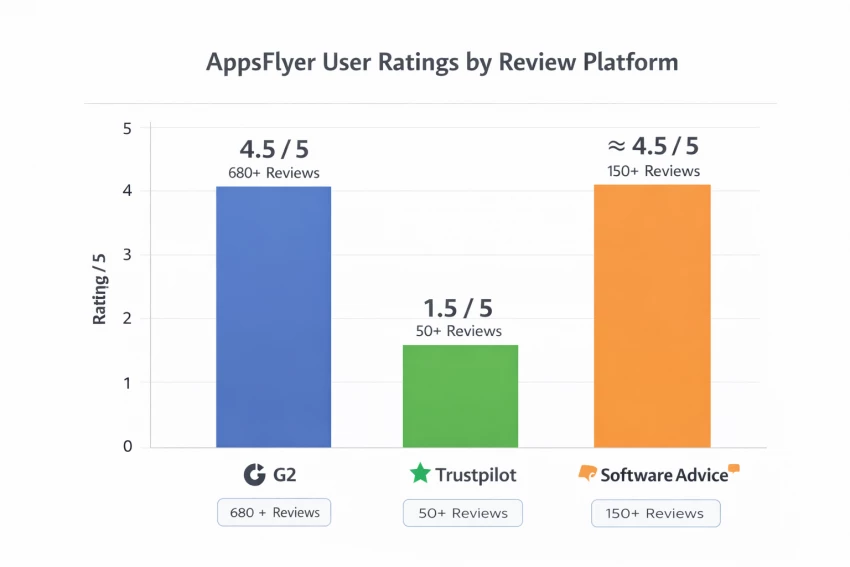
One of the first things that stands out when reviewing AppsFlyer is how sharply ratings differ by platform.
On G2, AppsFlyer holds an average rating of 4.5/5 from 680+ verified reviews, which typically reflects feedback from professionals actively using the platform in a business context. Many reviewers on G2 describe AppsFlyer as reliable, detailed, and difficult to replace once deeply integrated.
In contrast, Trustpilot shows a much lower average rating (around 1.5/5) based on a smaller set of reviews. These reviews often focus less on attribution accuracy and more on billing issues, contract terms, or support delays.
This contrast suggests that AppsFlyer is generally valued by experienced teams, while dissatisfaction appears when expectations around service, pricing transparency, or onboarding are not aligned.
That pattern becomes clearer when we look at what users consistently praise.
Across higher-rated reviews on platforms like G2 and Software Advice, several themes appear repeatedly.
Many users state that AppsFlyer provides stable and defensible attribution data, especially for mobile and CTV campaigns. Reviewers often mention that once events are instrumented correctly, the reporting becomes a dependable source of truth.
This sentiment appears frequently in long-form G2 reviews, where users compare AppsFlyer favorably to in-platform ad network reporting, which they describe as biased or incomplete.
This reliability is often cited as the main reason teams continue using AppsFlyer despite its learning curve.
Another common positive theme is data depth. Users managing large budgets report that AppsFlyer allows them to drill into installs, events, cohorts, and ROAS in ways that simpler tools do not.
Reviews on Software Advice often note that AppsFlyer feels “enterprise-grade,” meaning it assumes users already understand attribution concepts.
That strength, however, is also where some frustration begins to surface.
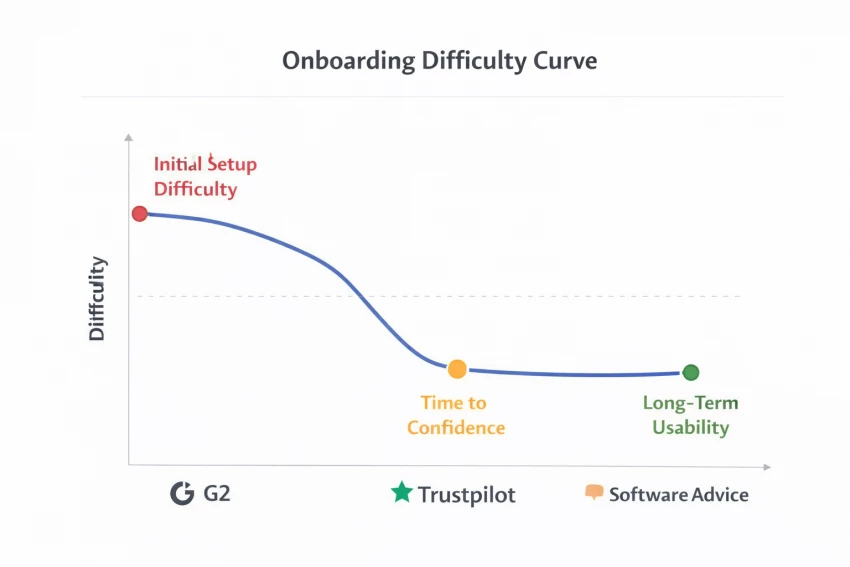
While power users praise AppsFlyer’s depth, many reviewers describe the platform as intimidating for new or small teams.
Several reviews mention that AppsFlyer requires significant setup effort—SDK integration, event naming discipline, and dashboard configuration. Users who expected “plug-and-play” attribution often report confusion during the first few weeks.
On Reddit, one user described their experience as “powerful but unforgiving,” noting that small configuration mistakes led to misleading reports until corrected.
This creates a divide: teams with analytics maturity tend to rate AppsFlyer highly, while teams without it struggle early.
Support quality is one of the most polarizing aspects of AppsFlyer reviews.
On G2, enterprise users often report satisfactory support, especially when dedicated account managers are involved. However, individual users and smaller teams, particularly those leaving reviews on Trustpilot, frequently complain about slow responses, billing confusion, or difficulty resolving contract issues.
Several Trustpilot reviews specifically mention feeling “locked in” or confused about pricing changes, suggesting that communication gaps, not core functionality, drive much of the negative sentiment.
This gap between enterprise and non-enterprise experience appears consistently across platforms.
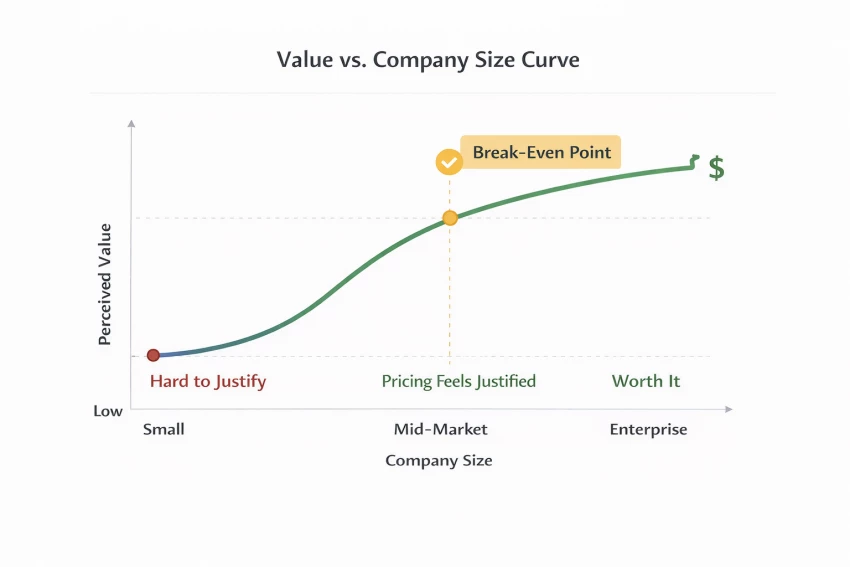
AppsFlyer does not publish simple pricing tiers on its website, which is common for enterprise SaaS but frequently criticized in reviews.
Some users on Quora and Reddit state that AppsFlyer feels expensive unless you are already spending heavily on paid acquisition. Others say the value becomes clear only when attribution disputes or fraud issues arise.
In reviews, pricing dissatisfaction often correlates with:
smaller team size
limited usage of advanced features
lack of dedicated account support
This reinforces the idea that AppsFlyer’s perceived value depends heavily on scale and internal expertise.
AppsFlyer markets itself as privacy-first, but some users still express unease about data handling.
While AppsFlyer publishes extensive privacy documentation on its site, its name has appeared in broader discussions around analytics vendors and data sharing, including mentions in media reporting and regulatory conversations.
In user reviews, this rarely appears as a direct accusation. Instead, it shows up as questions and caution, especially among teams operating in regulated regions.
This makes privacy less of a deal-breaker and more of an evaluation checkpoint for careful buyers.
Looking at employee sentiment on Glassdoor, AppsFlyer maintains a rating of around 4.1/5, with employees often praising company culture, growth opportunities, and technical challenges.
This contrasts with the frustration seen in some customer reviews and suggests that internal execution strength does not always translate into smooth customer experience, particularly for smaller accounts.
For reviewers, this contrast often reinforces the idea that AppsFlyer is built for scale first, with service quality improving as account size grows.
Patterns across review platforms suggest a clear split:
Positive reviewers tend to be:
Negative reviewers tend to be:
This divide explains why AppsFlyer can simultaneously be rated as “excellent” and “frustrating” depending on who is using it.
Based on aggregated review data, AppsFlyer appears to be:
Strong at what it’s designed for: attribution accuracy, analytics depth, and cross-platform measurement
Demanding in practice: setup, learning curve, and configuration matter
Uneven in experience: enterprise users report far fewer issues than smaller customers
AppsFlyer is rarely described as “bad software.” Instead, it is often described as powerful software that punishes poor preparation.
For teams that understand attribution and can commit resources, reviews suggest AppsFlyer becomes indispensable. For others, it can feel expensive, complex, and slow to support.
That tension, not marketing language, is what defines AppsFlyer’s real reputation.
Be the first to post comment!

The first thing that stands out about Dippy AI is not the anime visuals or the N...
Suraj Malik1 day ago

I still remember the first time I installed Remix OS. It didn’t feel like I was...
Sakshi Dhingra1 week ago

Managing remote employees is very different from managing people in an office. W...
Sakshi Dhingra3 weeks ago

A school gradebook sounds like a simple thing until you watch what happens when...
Sakshi Dhingra1 month ago

The Growing Buzz Around EditPro in the AI Editing SpaceIn 2026, the name “EditPr...
Sakshi Dhingra1 month ago

When I first started deploying large language models, I assumed that choosing th...
Sakshi Dhingra1 month ago