Imagine running a small business, juggling customer queries, product information, and marketing content. Now, imagine that instead of hiring a large team of customer service agents or voice actors, you could deploy an AI tool that answers calls, responds to customer queries, and even generates voiceovers for your videos, all in real time. Sounds futuristic, right? But with the power of AI voice agents, that future is now.
In this guide, I'll break down the best AI voice tools available today, showing you which platforms excel at different tasks, their key features, and how you can use them in your own projects.
| Tool | Best For | Key Features |
| Voice.ai | Voice agents, TTS, voice cloning | Voice automation, TTS, multi-language support |
| Murf.ai | TTS, voice cloning, and all-in-one narration | Natural voices, voice modulation, multi-language |
| ElevenLabs | Ultra-realistic voices and TTS for creators | Deep voice synthesis, voice cloning, expressive narration |
| Speechify | Accessibility tools and rapid narration | High-quality voices, quick audio output |

Voice.ai stands out because of its comprehensive set of features. Initially, I was impressed by its ability to clone voices. You can use just a few seconds of an individual's speech and create a voice model that can speak in their exact tone and cadence. But that’s not all:
AI Voice Agents: Voice.ai allows you to build conversational agents capable of answering calls, providing customer service, and holding natural, multi-turn conversations.
Text‑to‑Speech (TTS): With an intuitive interface, the TTS feature supports multiple languages and can replicate different speaking styles. It’s great for audiobooks, tutorials, and interactive learning modules.
Voice Changer & Noise Filtering: Useful for gaming or live streams, this feature lets you transform voices in real time, adding an extra layer of personalization to your interactions.
One of the most impressive aspects is its integration capability. Whether you’re using it with tools like Zendesk, Salesforce, or Slack, Voice.ai ensures seamless connectivity with your existing systems. The platform supports developers with API access to build more tailored, complex workflows. It's a perfect choice for businesses that need not just a tool but a fully integrated voice system.
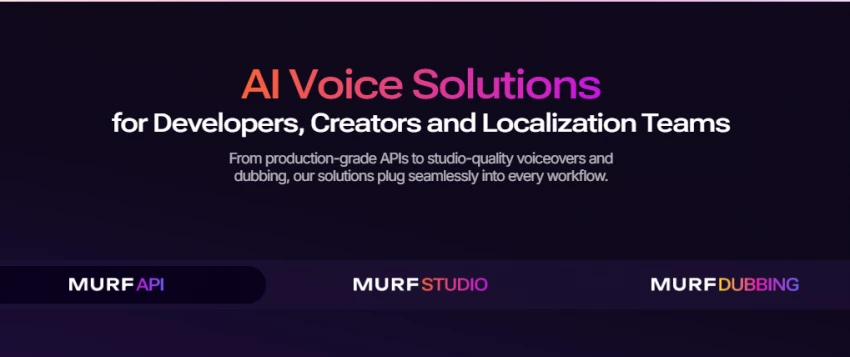
Murf.ai is one of the most versatile voice platforms I’ve encountered, especially for people like me who need to create a wide range of voice-driven content. It doesn’t just focus on TTS; it offers a full suite of features:
Text-to-Speech & Voice Cloning: The voice quality is excellent, and the voices feel natural, with options to adjust tone, pace, and pitch. If you need to clone your voice for brand consistency across multiple projects, Murf makes it easy.
Studio-level Control: You can control the modulation of voices, making it ideal for audio and video content creation. Whether you're narrating an explainer video or recording a podcast, Murf lets you manipulate voices with ease.
Collaborative Features: If you’re working on a team, you’ll appreciate Murf’s ability to collaborate in real-time. Share voice models, make adjustments, and integrate with your existing content pipeline.
With Murf.ai, you're getting not just a TTS system, but an all-in-one content production tool. It’s used by creators and marketers to produce voiceovers for training modules, podcasts, and YouTube videos. If you need to narrate long-form content with different voices, Murf excels.
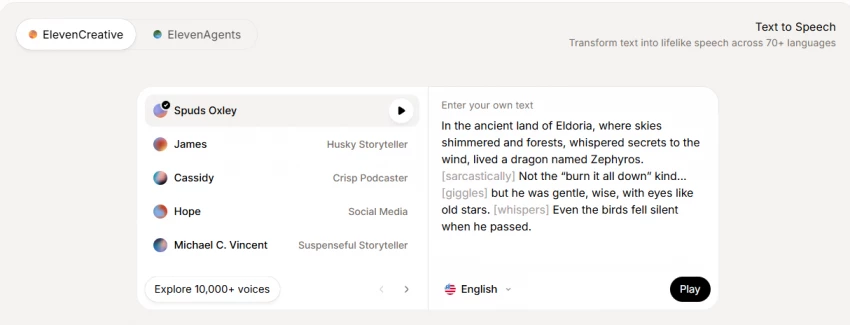
When you need unmatched voice realism, ElevenLabs is the go-to platform. The voices generated by this tool are so lifelike that it's hard to distinguish them from real human speech. Here’s what makes it stand out:
Deep Voice Synthesis: ElevenLabs' deep learning technology produces voices that not only sound real but maintain natural emotion and inflection. Whether you need a corporate tone or an emotional narration, this tool delivers.
Voice Cloning: If you need to replicate someone’s voice for a project (such as a commercial, audiobook, or personalized content), ElevenLabs provides some of the most accurate voice clones on the market.
Advanced Customization: You can fine-tune the speech style, and adjust speech speed and intonation for highly expressive content. Whether you’re making an audiobook or producing a documentary, this tool gives you control over every syllable.
ElevenLabs is primarily aimed at creators who want to produce high-quality audio content but don’t have the time or resources to record everything themselves. If you need high-end voiceovers for projects like commercials, voice acting, or storytelling, this is the tool you should go for.
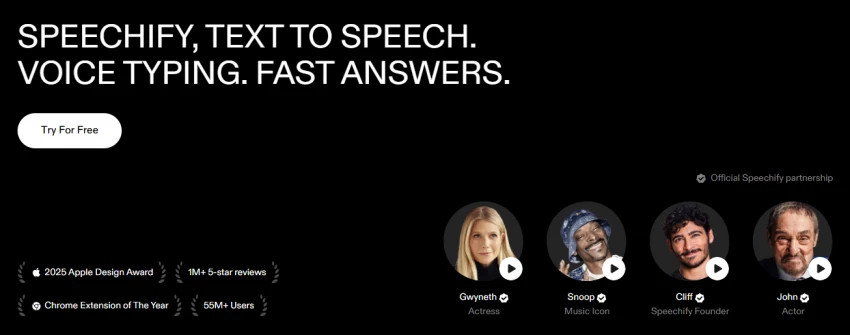
While Speechify isn't designed to be a full-fledged voice agent platform, it shines in its speed and accessibility features. Here’s what you can expect:
Narration Speed: Speechify excels at converting written content into spoken words almost instantly. This makes it a fantastic tool for students, researchers, or anyone who needs to listen to long documents or web articles quickly.
High‑quality Voices: Speechify offers a range of voices, though they are slightly less natural than ElevenLabs. The voices are clear and easy to understand, perfect for content consumption on the go.
Cross-platform Integration: You can use Speechify on multiple devices, including mobile, making it a great tool for on-the-go learning or content consumption while multitasking.
Accessibility Features: If you're visually impaired or need to make content more accessible, Speechify works wonders as it turns written documents into audio efficiently.
For someone like me, who works in a content-heavy environment, it’s been super useful for quickly converting articles, eBooks, and even webpages into audio format. It’s not just for reading; it's great for people who want to process information while doing something else.
Moving into tools that focus more on phone‑centric conversational automation, Retell AI stood out for me because it’s built specifically to handle real‑time voice interactions. It’s designed for enterprises that need AI agents to answer inbound calls, manage outbound outreach, and carry nuanced conversations that reflect human speech patterns.
In tests, Retell’s voice agents have low latency and can operate with turn‑taking logic, meaning they know when to speak and when to listen, a key requirement for natural telephone interactions. I’ve seen this used in automated call centers where agents can complete tasks like appointment scheduling or lead screening without human agents.
AI Voice Agents in Enterprise: According to GetVoIP, AI voice agents are becoming mainstream in the business world, especially for customer service. These agents handle sales calls, support tickets, and more, significantly improving workflow.
Voice Analytics Tools: Some platforms also focus on analytics and voice recognition in business contexts, helping with speech-to-text and sentiment analysis.
Selecting the right AI voice agent depends largely on what you're trying to achieve:
If realism is paramount, ElevenLabs is your best choice.
If you need a voice agent for automation, Voice.ai offers robust features.
If you're creating content and need quick, high-quality voiceover tools, Murf.ai is ideal.
For speed and accessibility, Speechify is a great option for listening on the go.
Each of these tools brings something unique to the table. The key is to match the right tool to your project’s needs, whether that’s generating realistic narration, handling customer service calls, or producing AI voiceovers for content creation.
Be the first to post comment!
The rise of AI-driven platforms has made it easier than ever to engage in rolepl...
Sakshi Dhingra8 hours ago
Creating presentations used to be a tedious and time-consuming task for me. Whet...
Sakshi Dhingra11 hours ago

Over the past few years, I have experimented with many study platforms, flashcar...
Sakshi Dhingra1 day ago
Just a few years ago, creating a professional video meant cameras, lighting, mic...
Sakshi Dhingra1 day ago

I still remember the excitement when Janitor AI first hit the scene. As a longti...
Sakshi Dhingra4 days ago
Why content writing looks different nowA few years ago, most content writers did...
Sakshi Dhingra1 week ago