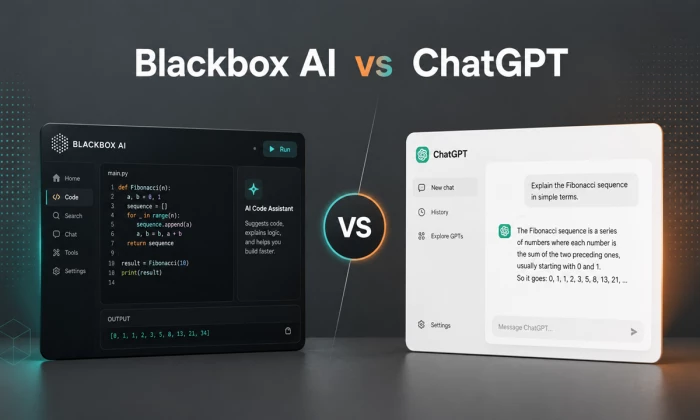
Many developers and AI enthusiasts ask me the same question: is Blackbox AI better than ChatGPT? I have spent the past two weeks running both tools side by side across real client work, from Python refactoring in VS Code to writing technical documentation, and the honest answer is that the question itself is slightly wrong. These are two different products that happen to overlap on one activity: writing code.
Blackbox AI is a coding-first platform that lives inside your editor. ChatGPT is a general-purpose AI assistant that happens to be very good at code among a hundred other things. In this comparison I will walk through verified 2026 pricing, feature-by-feature testing, my own workflow results, and a clear decision guide so you can pick the right tool, or the right combination, for your work.
Quick Answer Blackbox AI is better than ChatGPT for hands-on coding inside an IDE. Its extension works in 35+ editors, and the Pro plan costs $10 per month. ChatGPT is better for everything around the code: documentation, research, planning, and content. Most developers I know, myself included, end up running both, because they solve different problems. |
Blackbox AI launched in 2019 as a code autocomplete extension and has since grown into a full multi-agent coding platform. Its own materials and independent 2026 reviews put its user base at an estimated 30 million developers, with native plugins for more than 35 IDEs including VS Code, the JetBrains family, Android Studio, and Xcode.
ChatGPT, built by OpenAI, needs little introduction. As of mid-2026 it runs on the GPT-5.5 model family for paid users, spans seven pricing tiers from Free to Enterprise, and bundles coding tools (Codex, Agent Mode), research tools (Deep Research), and creative tools (Sora video, Images 2.0) into one subscription.
| Platform | Core Focus | Target Users | Key Strengths |
| Blackbox AI | AI coding assistant and agent platform | Developers, engineering teams | 35+ IDE integrations, multi-model access, autonomous coding agent, low entry price |
| ChatGPT | General-purpose AI assistant | Developers, creators, students, enterprises | Conversational depth, research, writing, coding via Codex, broad ecosystem |
Table 1. High-level positioning of both platforms as of July 2026.
I tested both tools on the same set of tasks: autocomplete speed, multi-file refactoring, explaining unfamiliar code, and generating documentation. The table below summarizes the practical differences I found, combined with each vendor's published capabilities.
| Feature | Blackbox AI | ChatGPT | My Notes |
| Code autocomplete | Yes, inline in 35+ IDEs | Yes, via Codex and IDE extensions | Blackbox feels faster inside the editor |
| Multi-language support | 20+ languages | Broad, all major languages | Both handled Python, JS, and Go well in my tests |
| Agentic coding | Autonomous agent on Pro; Chairman LLM runs multiple models in parallel | Codex Agent and Agent Mode on Plus and above | Both can plan and execute multi-file changes |
| Model access | 400+ models incl. Claude, GPT, Gemini routes | OpenAI models only (GPT-5.5 family) | Blackbox is the multi-model play |
| Conversational context | Code-focused, limited on Free | Strong; up to ~1M tokens on Pro Max | ChatGPT clearly wins for long discussions |
| Non-code output | Basic chat | Text, tables, images, video, research reports | No contest, ChatGPT is far broader |
| Design-to-code | Image-to-code and Figma-to-code | Image understanding, no native Figma pipeline | A genuine Blackbox differentiator for front-end work |
| Data training opt-out | Enterprise plans only | Manual opt-out on consumer tiers; default off for Business/Enterprise | Check this before using either on client code |
Table 2. Feature comparison based on vendor documentation and my hands-on testing, July 2026.
The clearest way to explain the difference is to describe an actual task. I needed to refactor a Python data pipeline: split a 400-line script into modules, add type hints, and write tests.
I installed the Blackbox extension, opened the project, and asked the agent to plan the code. It read the file, proposed a module structure, and applied the changes across new files while I approved each step in Manual Mode.
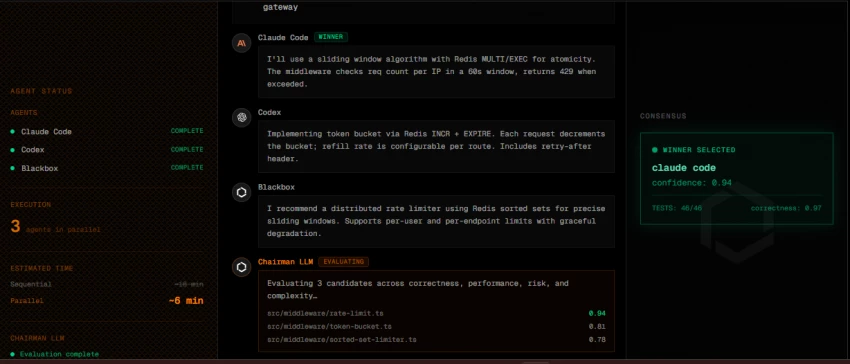
Autocomplete suggestions appeared inline as I cleaned up the results. The whole loop stayed inside the editor. Total time: roughly 40 minutes.
ChatGPT produced equally correct code and, honestly, better explanations of its reasoning. But the browser-based flow meant copying files into the chat, then pasting results back into VS Code and fixing imports by hand. Codex narrows this gap considerably if you set it up, though that setup is an extra step Blackbox simply does not need. Total time: closer to an hour, plus the context-switching tax.
Then the roles flipped. I asked both tools to write a README, an architecture explainer, and a migration note for a junior developer.
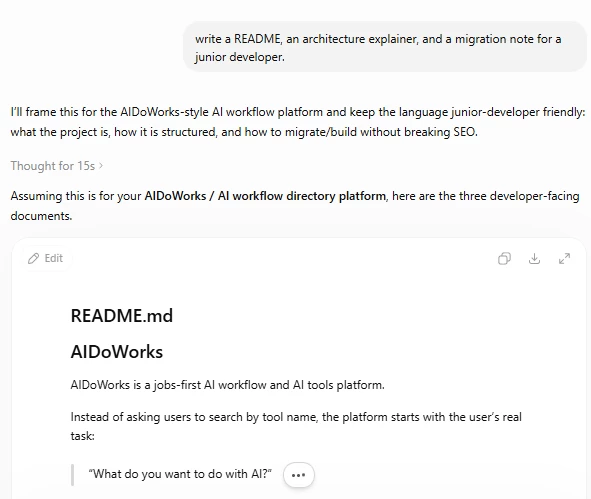
ChatGPT's output was noticeably better structured and needed almost no editing. Blackbox's chat produced serviceable but flat text. For anything a human reads rather than a compiler, ChatGPT won every round.
Neither vendor publishes head-to-head benchmark data for these exact products, so precise accuracy percentages are unspecified. What I can share are my editorial ratings after two weeks of daily use, scored out of 10 across the six dimensions that mattered most in real work.
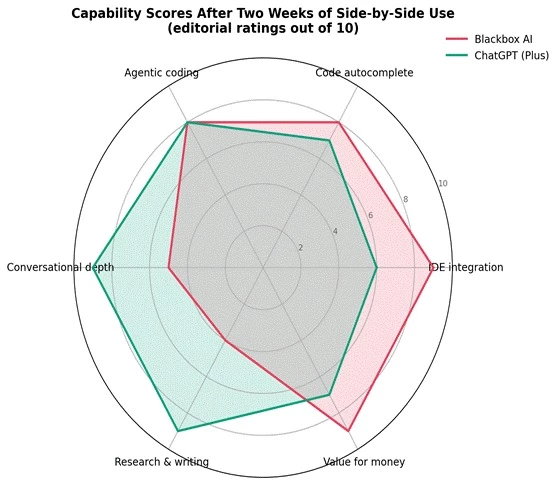
Figure 1. My editorial capability ratings after side-by-side testing. These are subjective scores from personal use, not vendor benchmarks.
Reading the chart: Blackbox AI dominates the left side, the in-editor experience. IDE integration (9/10) and value for money (9/10) are its strongest scores, because a $10 plan that works in 35+ editors is hard to argue with. ChatGPT dominates the right side, scoring 9/10 on both conversational depth and research and writing. The two shapes barely overlap, which is exactly the point: they are strong in different places. Agentic coding is the one dimension where I scored them level at 8/10, since both can now plan and execute multi-file changes autonomously.
Both companies restructured pricing this year, so most older comparison articles are out of date. Blackbox moved to a credit-based four-tier model, and OpenAI added a Go tier in January 2026 and split Pro into two tiers in April 2026. Here is the verified lineup as of July 2026.
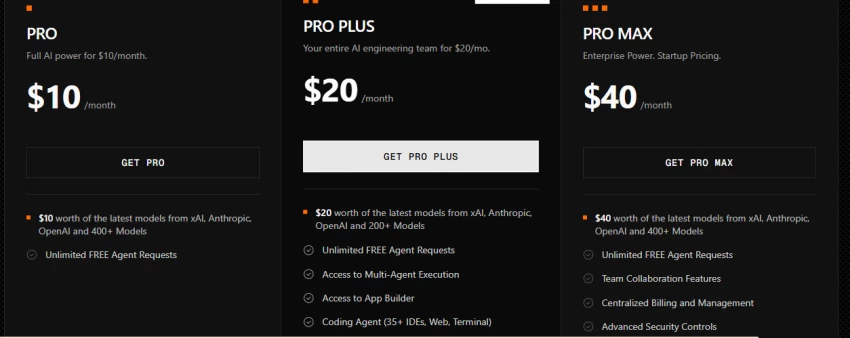
| Blackbox AI Plan | Price | Included |
| Free | $0 | Basic models, daily usage caps, limited context window |
| Pro | $10/mo | $20 in monthly credits, premium models, autonomous coding agent, image-to-code |
| Pro Plus | $20/mo | $40 in credits, E2E chat encryption, Voice Agent access |
| Pro Max | $40/mo | $80 in credits, priority support, highest usage headroom |
| Enterprise | Custom | SAML SSO, training opt-out by default, on-premise deployment options |
Table 3. Blackbox AI pricing per its official pricing page, July 2026. Annual billing cuts Pro to roughly $8 per month.
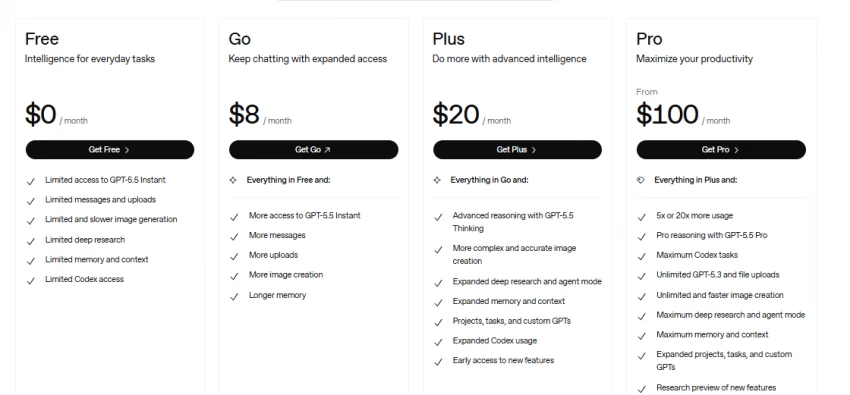
| ChatGPT Plan | Price | Included |
| Free | $0 | GPT-5.3 Instant, 10 messages per 5 hours, ads shown in the US |
| Go | $8/mo | Higher message volume, still ad-supported, no Deep Research or Agent Mode |
| Plus | $20/mo | GPT-5.5, Deep Research (10 runs/mo), Sora, Codex, Agent Mode, Canvas |
| Pro (Codex) | $100/mo | 5x Plus limits, elevated Codex quotas, GPT-5.5 Pro |
| Pro (Max) | $200/mo | 20x Plus limits, 250 Deep Research runs/mo, ~1M token context |
| Business | $20/seat/mo (annual) | Team admin, SSO, no training on your data by default; $25 monthly, 2-seat minimum |
| Enterprise | Custom | Compliance controls, data residency, custom SLAs |
Table 4. ChatGPT pricing per OpenAI's official pricing page, July 2026.
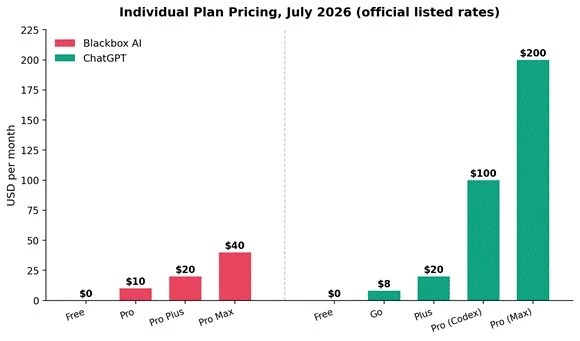
Figure 2. Individual plan pricing side by side. Blackbox tops out at $40 per month while ChatGPT's power tiers reach $200.
Reading the chart: the two lineups only collide at the $20 mark, where Blackbox Pro Plus and ChatGPT Plus compete directly. Below that, Blackbox Pro at $10 undercuts everything OpenAI offers without ads. Above it, the comparison ends: ChatGPT's $100 and $200 tiers buy research volume, video generation, and a million-token context window, which is capacity Blackbox does not sell at any price.
Blackbox credits expire at the end of each 30-day billing cycle and do not roll over. If you have a light coding month, you forfeit unused value. This was the most common pricing complaint I found in developer community threads in early 2026, so budget your tier around your actual usage rather than the headline 2x credit multiplier.
• The IDE integration is genuinely deep, with native plugins for VS Code, the full JetBrains family, Android Studio, and 30 or so more.
• Multi-model access lets you route prompts to Claude, GPT, and Gemini class models under one $10 subscription.
• Image-to-code and Figma-to-code conversion are real time-savers for front-end work.
• The Pro plan is one of the cheapest serious AI coding subscriptions on the market.
• Conversational and writing quality trails ChatGPT by a wide margin, so it is a poor fit for documentation-heavy work.
• Monthly credits expire without rollover, which penalizes irregular usage patterns.
• Code submitted on non-Enterprise plans may be used for model training, which matters for client work.
• Community feedback flags inconsistent support response times outside the Enterprise tier.
• It is the most versatile single subscription in AI: code, research, writing, images, and video under one login.
• Deep Research and Agent Mode on Plus turn it into a genuine research assistant, not just a chatbot.
• Long-context handling is excellent, reaching roughly a million tokens on the top tier.
• The free tier, despite its limits, remains a usable on-ramp for students and casual users.
• The in-IDE experience requires extra setup, and the default browser workflow forces constant copy-paste.
• Free and Go tiers now show ads in the US, and Free caps you at 10 messages per 5 hours.
• Serious coding limits sit behind the $100 and $200 tiers, which is a steep jump from $20.
• You are locked into OpenAI models, with no multi-model routing.
Rather than invent market statistics, I logged my own AI-assisted tasks for two weeks and categorized where each tool earned its keep. The split below reflects a working developer and publisher's week, so your ratios will differ, but the pattern is the useful part.
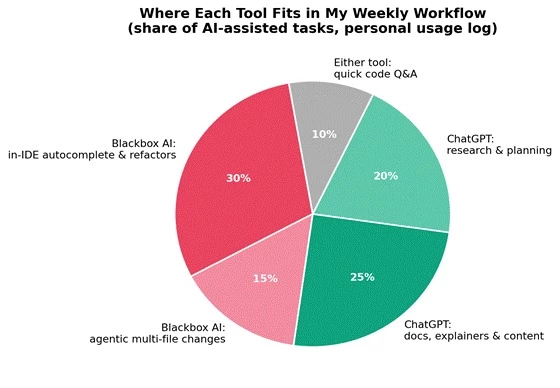
Figure 3. Share of my own AI-assisted tasks over a two-week logging period. Personal usage data, not an industry survey.
Reading the chart: 45% of my AI tasks stayed inside the IDE, and Blackbox handled nearly all of them, split between everyday autocomplete (30%) and larger agentic changes (15%). Another 45% happened outside the editor, in documentation, content drafts, research, and planning, and that share belonged to ChatGPT. The final 10% were quick code questions where either tool gave an equally good answer in seconds. The takeaway is that the tools split my workload almost perfectly in half, which is the strongest argument for running both.
• Developers: Blackbox AI for the write-test-refactor loop, ChatGPT for architecture discussions, code review narratives, and documentation.
• Students: ChatGPT's free tier for learning concepts, Blackbox's free tier for practicing inside a real editor.
• Content and SEO teams: ChatGPT almost exclusively, with Blackbox only relevant if the team ships code.
• Enterprises: both offer Enterprise tiers with SSO and training opt-outs; the choice follows whether the bottleneck is engineering throughput or organization-wide productivity.
| Surface | Blackbox AI | ChatGPT |
| IDEs | 35+ native plugins: VS Code, JetBrains, Android Studio, Xcode | Codex CLI and IDE extensions; web-first by default |
| Chat platforms | Native Slack integration | Business tier connects to 60+ workplace apps |
| Design tools | Figma-to-code pipeline | None native; image understanding only |
| Mobile | iOS and Android apps | iOS and Android apps; Codex Mobile free on all plans since May 2026 |
| API | REST API; bulk model access billed separately from subscriptions | Full OpenAI API, billed per token |
| Voice | Voice Agent on Pro Plus and above | Advanced Voice on Plus and above |
Table 5. Integration surfaces as documented by both vendors, July 2026.
If neither tool fits perfectly, these are the credible 2026 alternatives I would evaluate next. Note that GitHub Copilot moved to a usage-based AI credit model in June 2026, which makes its effective cost harder to predict for heavy users than its old flat fee.
| Alternative | Focus | Strength | Limitation |
| GitHub Copilot | Coding AI | Deep GitHub and PR integration | Now usage-based credits, cost less predictable |
| Cursor | AI-first editor | Purpose-built agentic IDE | Requires switching editors entirely |
| Claude (Anthropic) | Conversational + coding AI | Strong long-context reasoning and Claude Code CLI | Fewer built-in media features than ChatGPT |
| Tabnine | Coding AI | Fully air-gapped on-premise option at $9/user/mo | Weak agentic capabilities, completions-focused |
| Windsurf | AI-first editor | Agentic flows with a gentler learning curve | Smaller ecosystem than Cursor or Copilot |
Table 6. Alternatives based on published 2026 pricing and positioning.
• Choose Blackbox AI if 80% or more of your AI usage is writing code inside an editor, you want multi-model access, and you want to spend $10 rather than $20 or more per month.
• Choose ChatGPT if your work mixes code with research, writing, planning, or content, or if you need Deep Research, long context, and a broader creative toolkit.
• Run both if you are a working developer who also writes docs, blogs, or client communication. Blackbox Pro plus ChatGPT Plus totals $30 per month, which is still cheaper than a single ChatGPT Pro tier.
That last option is where I landed personally. The $30 combined stack covered every task in my two-week log, and neither tool alone came close.
So, is Blackbox AI better than ChatGPT? For the narrow question of writing code inside an IDE, yes, and it does it at half the price of ChatGPT Plus. For everything surrounding the code, and for anyone whose work extends beyond an editor window, ChatGPT remains the more capable and more versatile product.
My recommendation after two weeks of daily use: start with Blackbox's free tier and ChatGPT's free tier, identify which one you keep reaching for, and pay for that one first. If you find yourself wanting both, the $30 combined stack is one of the better value plays in AI tooling right now.
The same tool can be a 4.7 on one site and a 3.9 on another. Here is what is rea...
Nitin1 month ago
Here is the number worth pinning above your budget: in Gartner Digital Markets r...
Deepak Mehra1 month ago

What Artlist AI is in 2026Artlist began as a royalty-free music library. By 2026...
Deepak Mehra1 month ago
Most AI tool failures do not announce themselves. There is no crash, no angry em...
Nitin1 month ago

The best AI image generator in 2026 is Nano Banana 2 for speed, FLUX.2 for photo...
Parveen Verma1 month ago
“Useful” is a slippery word for a coding assistant. A tool can be brilliant at o...
Sakshi Dhingra1 month ago