How this assessment was carried out Findings come from primary sources: the published privacy policy and terms of service, live Google Play and App Store listings, and third-party rating aggregations. Platform marketing claims are treated as claims, not facts, and are labelled where they could not be verified against a primary document. Store ratings, review counts and policy wording change frequently. Every figure here reflects what was publicly visible at the time of writing. |
Somewhere in the privacy policy governing one of the busiest AI companion platforms on the web, a sentence explains where user data is stored. It names no data centre, no cloud provider, no country. Instead it contains a bracketed instruction, left in by whoever prepared the template, telling the company to fill in the blank. Nobody ever did.
That single unfinished line is not an isolated typo. The same document carries at least six more unfilled placeholders, including four in the section that is supposed to disclose which advertising and marketing companies receive user information. A legal template was published as a binding policy, and the fields naming the third parties who handle intimate chat data were simply never completed.
Joyland AI is an AI character and companion platform launched in 2023, offering roleplay, virtual dating and an adult content mode. Hundreds of thousands of people have installed its apps. The question of whether it is safe turns out to be answerable in unusual detail, because the platform's own paperwork and public listings contradict each other repeatedly, and those contradictions are documented below.
Safety is not a single verdict. The platform performs acceptably on some measures and poorly on others, and the distinction matters depending on who is asking.
| Risk area | Assessment | What drives it |
| Malware or fraud risk | Low | Legitimate operating product, valid certificate, no publicly reported breach since 2023 launch |
| Policy transparency | Poor | Privacy policy published with unfilled template placeholders in key disclosure sections |
| Age assurance | Poor | Registration permitted from 13 in some documents; adult mode gated only by self-declaration |
| Third-party data sharing | Concerning | Analytics, advertising and push vendors named in policy; store listing declares the opposite |
| Corporate transparency | Concerning | Multiple company names across store listings, policies and terms with no clear parent entity |
| Content moderation | Inconsistent | Enforcement differs between web and mobile; advertised freedoms exceed what terms permit |
| Account and data deletion | Adequate | Deletion available, though routed through support rather than self-service |
| Suitability for minors | Not suitable | Companion roleplay with an adult mode and no meaningful age verification |
A basic safety question for any platform holding sensitive conversation logs is who is legally accountable for them. Joyland AI does not answer that question consistently.
Different official surfaces name different companies. The Android listing publishes under a Singapore entity. Earlier App Store records attributed the iOS app to a different corporation entirely. The terms of service refer to a distributor arrangement with a Singapore-registered company and route all disputes to arbitration in Singapore, while the privacy policy sits on a separate domain and refers to the operator by a different name again.
| Surface | Entity or detail named |
| Google Play publisher | MINDZEN PTE (Singapore); app listed since December 2023 |
| App Store, earlier records | Attributed to Generatively Inc. before later listings showed the Singapore entity |
| Terms of service | References Joyland.AI and a named Singapore distributor; disputes arbitrated in Singapore |
| Privacy policy | Hosted on a separate domain and written around a differently styled operator name |
| Dispute resolution | Binding arbitration, with a carve-out for qualifying small claims |
| Infrastructure | Site resolves to Alibaba Cloud infrastructure in Santa Clara, running Tengine |
None of this is unlawful. Multi-entity structures with regional distributors are routine in app publishing. The practical consequence for a user, however, is that exercising a data right means identifying which company actually controls the records, and the public documents do not make that obvious.
Marketing pages describe an enthusiastic community. Store data describes something more mixed, and the trend line runs in one direction.
| Source | Rating | Review volume | Notes |
| Google Play, official Android app | 2.41 / 5 | ~1,200 ratings | ~270,000 lifetime downloads |
| Google Play, 2025 aggregation | 3.90 / 5 | ~1,060 reviews | Same listing, earlier snapshot |
| Apple App Store | 2.73 / 5 | 85 ratings | Notably thin volume for the install base |
| Trustpilot | Not established | 5 reviews | Business profile unclaimed |
| Third-party trust score | 42.7 / 100 | Algorithmic | Automated scoring, not an audit |
| Lookalike Play listing | 1.40 / 5 | 5 ratings | Separate developer, discussed below |
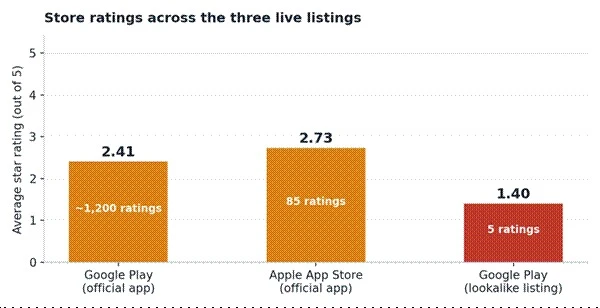
Figure 1: Average star ratings across the three live store listings, with review volume shown inside each bar.
Two things stand out. The first is the Apple listing, which has accumulated only 85 ratings, an unusually thin sample for a platform of this reach and one that makes the 2.73 figure statistically fragile. The second is the Trustpilot presence: five reviews on an unclaimed profile. For a service that has been operating since 2023, that is close to no independent reputational footprint at all.
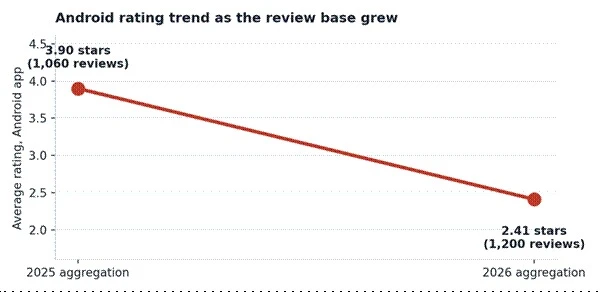
Figure 2: The Android rating fell sharply between aggregations even as the review base grew.
The decline is the more meaningful signal. Ratings that fall while review volume rises usually indicate that newer users are having a worse experience than earlier ones, rather than that a small group of complainants has skewed an average. Recurring themes in negative reviews centre on conversation memory failing within a handful of messages despite premium tiers advertising long-term memory, and on moderation blocking mild content on mobile that passes on the web.
Hands-on testing published elsewhere reaches similar conclusions about the memory and moderation gaps, including this extended review of Joyland AI after weeks of daily use, which documents the same pattern of characters losing context mid-conversation. A collected set of user reviews and complaint themes shows memory loss appearing repeatedly among paying subscribers rather than free users.
This is the most serious documented finding in this review, and it is verifiable by anyone who opens the policy.
The privacy policy governing the platform is a law-firm template that was published without being completed. Bracketed drafting instructions remain visible in the live document, addressed to the company rather than to users. They appear in precisely the sections where a reader would look for the most important disclosures.
| Policy section | What it should disclose | What it actually contains |
| Service providers, introduction | Categories of vendors receiving user data | A bracketed instruction to add the applicable categories |
| CRM platforms | Named vendor and link to its policy | An unfilled placeholder where the name belongs |
| Email marketing | Named vendor and link to its policy | An unfilled placeholder where the name belongs |
| Marketing platforms | Named vendor and link to its policy | An unfilled placeholder where the name belongs |
| Online advertising | Named vendor and link to its policy | An unfilled placeholder where the name belongs |
| Cookie types used | Confirmation of whether targeting cookies are set | A bracketed question asking the company to confirm |
| Data hosting | Where personal data is physically stored | A bracketed instruction to name the servers |
| Security measures | Verified description of controls in place | A bracketed note asking the company to confirm or revise the text |
Why unfilled placeholders matter legally, not just cosmetically Under the GDPR and comparable regimes, a controller must tell users which categories of recipients receive their personal data. A placeholder discloses nothing. The security section is the one that tells users where sensitive chat data physically lives. It names no provider and no jurisdiction. The document also cites the EU-US Privacy Shield as a valid transfer safeguard. That framework was invalidated by the Court of Justice of the European Union in July 2020 and replaced in 2023, which dates the template to before that ruling. |
The retention clause compounds the problem. Rather than committing to a defined period, the policy states that information is kept for as long as the company is “comfortable that it is accurate” and dependable. That is not a retention standard in any recognised sense, because it sets no outer limit and ties deletion to an internal judgement no user can test.
Structural errors reinforce the impression of a document nobody proofread. Two consecutive sections are numbered nine. One section sets a minimum age of sixteen; a later section, discussing children, uses thirteen. A push notification vendor is named with its syllables transposed.
Read past the placeholders and the policy is expansive about collection, which makes the omissions elsewhere more conspicuous.
| Data category | Detail disclosed in the policy |
| Device identifiers | IP address, unique device identifier, and mobile advertising identifiers on both major platforms |
| Location | Geolocation derived from IP, plus GPS-level precise location collected in connection with push notifications |
| Behavioural data | Click-stream activity, on-site behaviour, and search terms entered within the service |
| Analytics vendors | Google Analytics and Quantcast named directly |
| Push notification data | Advertising identifiers, email address, IP, device push token, precise location, network and time zone information |
| Stated purpose | Explicitly includes cross-app, cross-device and other interest-based advertising, analytics and market research |
| Email tracking | Pixels recording whether and when messages are opened, and the device used |
| Cross-referencing | Non-personal data linked to personal data is treated as personal data, indicating profiles are joined |
The combination that deserves attention is precise location plus advertising identifiers plus a stated purpose of cross-device interest-based advertising. On a general utility app that would be ordinary adtech practice. On a platform whose core function is intimate companion roleplay, the same combination means behavioural signals from a sensitive-category service can be joined to a persistent advertising profile.
Google requires developers to complete a data safety declaration describing collection and sharing. The lookalike Android listing examined for this review declares that no data is collected and none is shared with third parties.
That declaration cannot be reconciled with a privacy policy describing IP addresses, device identifiers, advertising identifiers, GPS-level location and interest-based ad targeting. One of the two documents is wrong. A user comparing them has no way to determine which, and the store panel is the one most people actually read.
For a platform built around romantic and companion roleplay with an adult content mode, the minimum age is the single most consequential safety control. Six documents give three different answers.
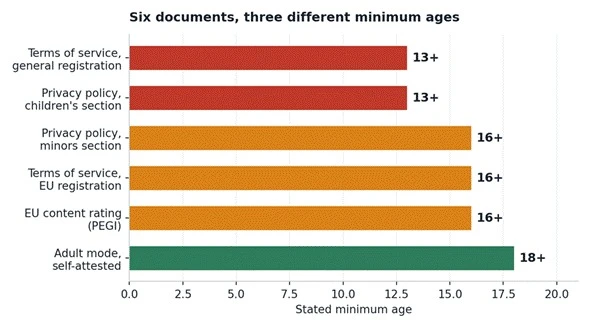
Figure 3: Stated minimum ages across the platform's own documents and store ratings.
| Where the threshold appears | Stated age | Practical effect |
| Terms of service, general registration | 13 | A thirteen-year-old may create an account |
| Privacy policy, children's section | 13 | Mirrors a US framework threshold, not an EU one |
| Privacy policy, minors section | 16 | Directly contradicts the children's section above |
| Terms of service, EU registration | 16 | Applies only to EU users |
| EU content rating | 16 | Assigned by the rating body |
| Adult content mode | 18 | Gated by self-declaration, with no document check |
The gap that matters most The barrier between a registered thirteen-year-old and explicit content is a self-attested age declaration. No identity document, payment-card check or third-party age-assurance step is applied at any tier. Self-declared age checks are widely understood to be ineffective against motivated minors, which is precisely why regulators have begun legislating on the point. Parents evaluating this platform should treat it as an adult service regardless of the lowest number printed in the terms. |
The advertised content proposition and the contractual one do not match, which produces the moderation complaints visible throughout store reviews.
• Marketing describes unrestricted mature roleplay with no censorship filters, while the terms prohibit certain categories of generated imagery outright, with no exception for adult mode.
• Enforcement is stricter on mobile than on the web, so the same message can pass in a browser and be blocked in the app, apparently as a consequence of app store policy rather than a stated content standard.
• Reviewers report benign roleplay phrasing being blocked while the platform simultaneously advertises the absence of filters, which is the source of much of the rating decline.
• Character libraries are largely user-generated and run to hundreds of thousands of entries, a scale at which pre-publication human review is not plausible.
• Companion products are engineered for emotional attachment and session length, a design goal that sits uneasily with users who are lonely, distressed or very young.
The last point is not specific to this platform, but it is the one child-safety researchers have focused on. A 2025 assessment by Common Sense Media with Stanford's Brainstorm Lab rated social AI companions as unacceptable for minors as a category, a conclusion that applies to any service in this class that admits teenagers.
On conventional security, the picture is less alarming than the policy problems suggest.
The caveats are meaningful. Conversations are stored server-side, so anything typed into a companion chat exists on infrastructure the user does not control and cannot audit. The policy does not clarify whether deleted data is purged from backups. Deletion routed through a support email rather than a self-service control introduces delay and depends on the company responding.
The sector context is worth stating plainly. In February 2026, a security researcher found an exposed database belonging to a different AI chat application, reportedly accessing around 300 million messages tied to roughly 25 million users through a misconfiguration. No comparable incident is known here, but that case illustrates what is at stake when intimate conversation logs are held server-side by consumer AI apps.
A search for the platform on Google Play returns a listing that is not the official application, and the distinction is not obvious from the store page.
| Attribute | Official listing | Lookalike listing |
| Publisher | Singapore-registered company | An individual developer account |
| Support contact | Platform support address on the brand domain | A personal free webmail address |
| Developer address | Corporate registration | A residential village address |
| Privacy policy host | Brand-controlled domain | An unrelated third-party file host |
| Rating | 2.41 from ~1,200 ratings | 1.40 from 5 ratings |
| Installs | ~270,000 lifetime | 1,000 plus |
| Advertising | Subscription-funded | Carries advertising |
Practical exposure Installing a lookalike means handing account credentials and conversation content to an unrelated operator whose data practices are described in a policy hosted on a generic file server. Modified installer files distributed on third-party sites promising unlimited premium access are a separate and larger risk. These packages are repackaged binaries from unverified sources and are a well-established malware delivery route. Installation should start from the brand's own website link rather than from a store search, and the publisher name should be checked before any download. |
Companion platforms have moved from novelty to regulatory target within roughly a year, and the requirements now emerging bear directly on the weaknesses identified above.
| Development | Date | Relevance |
| FTC Section 6(b) inquiry into companion chatbots | September 2025 | Orders issued to seven major providers on minor-safety practices |
| New York companion AI law | Effective November 2025 | First US law mandating safeguards, including self-harm protocols |
| California SB 243 | Effective January 2026 | Requires AI disclosure, recurring reminders for minors, and measures limiting explicit content for minors |
| Common Sense Media and Stanford assessment | April 2025 | Rated social AI companions unacceptable for minors |
| Litigation against a competing platform | 2025 to 2026 | Product liability and state attorney general actions over teen exposure |
Notably, the federal inquiry targeted seven large providers. Smaller platforms operating the same product category, including this one, were not among them. That is a gap in coverage rather than a clean bill of health, and the California requirements apply by conduct rather than by company size.
The chart below rates concern level across eight safety domains. These are editorial judgements drawn from the documentary evidence above, not the output of a formal audit, and higher bars indicate greater concern rather than better performance.
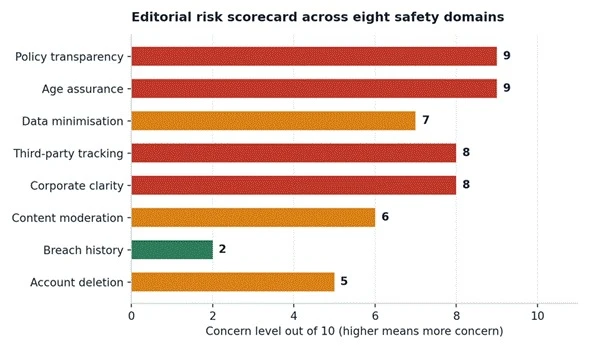
Figure 4: Concern level by safety domain. Higher values indicate greater concern.
The shape is consistent with the evidence. Technical security scores well because there is no breach history and no malware indication. Governance scores badly because the documents that are supposed to explain data handling were published incomplete, and because the age controls are contradictory on paper and self-attested in practice.
1. Treat every message as stored and readable. Conversation logs sit server-side under a policy that does not name the hosting provider.
2. Never enter real identifying details, including full name, employer, address, school, financial information or images of identity documents.
3. Register with a dedicated email address rather than a primary personal or work account, and use a password not reused anywhere else.
4. Disable push notifications, since the policy links that permission to precise location collection and interest-based advertising.
5. Reset the mobile advertising identifier at the device level and limit ad tracking to reduce cross-app profile linkage.
6. Verify the publisher name on any store listing before installing, and never install modified packages from third-party sites.
7. Request written confirmation, when deleting an account, that conversation logs have been purged from backups and not merely deactivated.
8. Parents should treat the platform as an adult service and rely on device-level controls rather than the platform's own age gate.
Joyland AI is not a scam and shows no sign of being malicious. It is a functioning commercial product with a real user base, no known breach history and no malware indicators, and users worried primarily about fraud or infection can set that concern aside.
It is nonetheless a poor custodian of sensitive information on the evidence available. A privacy policy published with unfilled placeholders in the sections naming data recipients and hosting locations is not a minor administrative lapse; it is a failure to make the disclosures data protection law exists to require. A store declaration stating that no data is collected, alongside a policy describing precise location and advertising identifiers, leaves users unable to determine which document to believe.
The age situation is the sharpest concern. A service whose central function is companion roleplay, complete with an adult content mode, should not be reachable by a thirteen-year-old behind a self-declared checkbox, and no reading of the platform's own documents produces a consistent minimum age.
For an adult who understands that conversations are stored, shares nothing identifying, and installs only from the official listing, the platform is usable with managed risk. For minors it is unsuitable, and the platform's own age gate should not be relied upon to keep them out. For anyone inclined to treat an AI companion as a confidant, the safest assumption remains that nothing typed into it is private.
Share your thoughts about this article.
Be the first to post a comment!
Most AI tool failures do not announce themselves. There is no crash, no angry em...
Nitin4 hours ago

Joyland AI won its audience on one promise: an anime character library that keep...
Deepak Mehra1 day ago
Character AI logs around twenty million monthly active users who spend close to...
Deepak Mehra2 days ago

“Useful” is a slippery word for a coding assistant. A tool can be brilliant at o...
Sakshi Dhingra2 days ago

WSUP AI built much of its early appeal around a simple promise: users could star...
Pritam Singh3 days ago

Somewhere right now, someone is deciding whether to upload a photo of their own...
Deepak Mehra3 days ago