Somewhere right now, someone is deciding whether to upload a photo of their own face to a website they found an hour ago. The site promises uncensored AI tools, the free Gems are sitting right there, and the upload button is one tap away. That small, ordinary moment is really what this article is about.
Unlucid AI wears the word uncensored on its homepage like a badge.
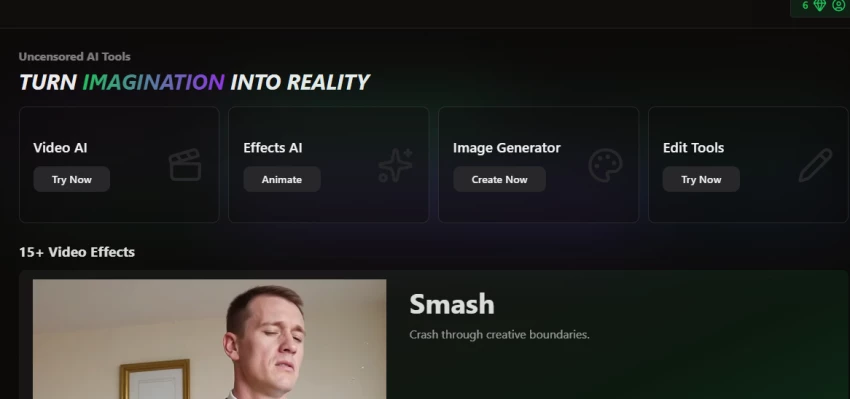
For some people, that is the entire appeal. For others, it is exactly the reason to slow down and ask harder questions. Both instincts are fair, because the honest answer to whether this platform is safe is not a clean yes or a clean no. It is a picture with real green flags, real red flags, and a few gray areas the platform has simply chosen not to clarify. GeniusFirms went through the official pages, cross referenced three independent trust scanners, and read the published analyses of the platform's terms so you do not have to piece the picture together alone.
The short answer Unlucid AI appears to be a functioning product, not a phishing trap. It generates what it promises and lets you download the results. At the same time, the company behind it is anonymous, its data retention practices are unclear, and automated trust scanners openly disagree about it. Reasonably safe territory: casual prompts, fictional images, and small purchases you could afford to lose. Genuinely unsafe territory: other people's photos without consent, anything involving minors, confidential material, and client work. |
Start with the most basic safety question anyone can ask about a website: who runs it? For Unlucid AI, there is no public answer. Scanner records show the domain was registered through Porkbun with WHOIS privacy switched on, and it is barely more than a year old. There is no company name on the site, no team page, no physical address, and no founder standing behind the product with their own name.
None of that proves bad intent. Plenty of small independent developers hide their registration details to dodge spam, and anonymity is common in the corner of the AI world that builds tools mainstream platforms will not. But it changes your position as a user in a very practical way. If something goes wrong with a payment, an upload, or your account, there is no accountable person or legal entity you can point to. You are trusting software run by someone whose name you cannot learn, and that fact should quietly shape every other decision you make on the platform.
Run unlucid.ai through the popular website trust checkers and you get three different answers. Gridinsoft scores the domain 35 out of 100 with a blacklist warning, citing hidden ownership and adult content flags. Scam Detector lands at 49.6 and tags the site as doubtful and medium risk. ScamAdviser, meanwhile, publishes a written summary concluding the site is very likely not a scam but legit, even though earlier third party coverage noted its data surfacing a dismal 1.3 star user review average.
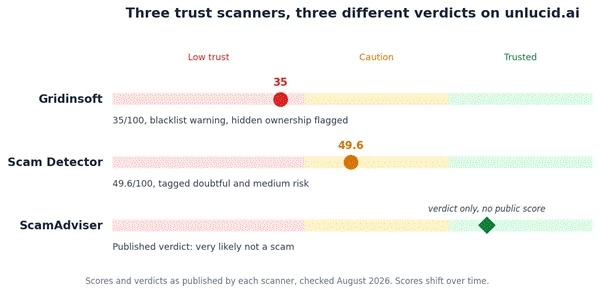
Three independent scanners, checked in August 2026, reaching three different conclusions about the same domain.
Here is the honest way to read that mess. These scanners mostly measure transparency signals: visible ownership, domain age, review depth, and contact options. They rarely catch anyone in the act of fraud. When a site hides its identity and has little review history, scores drop, whether or not anything shady has happened. So the right interpretation is not confirmed scam. It is an unknown quantity. And for a product that accepts card payments and photo uploads, unknown is a real cost in itself.
The near silence on major review platforms like Trustpilot and G2 adds to the same fog. For a closer look at the experiences, complaints, and recurring opinions shared around the platform, our Unlucid AI user reviews overview brings those user signals together in one place. For a tool with this much traffic, limited independent feedback is worth paying attention to.
Zoom in past the scanner scores and the picture gets more specific. Some of the things a cautious user hopes to find are genuinely there. Others are conspicuously absent.
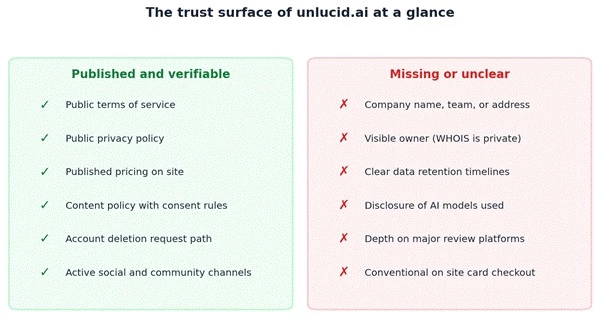
The transparency ledger: what unlucid.ai publishes, and what it keeps to itself.
On the positive side of that ledger, the platform publishes terms of service, a privacy policy, upfront pricing, and a content policy that is far more detailed than the word uncensored suggests. The privacy policy also describes an account deletion path: you request removal by contacting the support address listed in the policy. If you ever use it, keep a copy of your request and any confirmation you receive.
The other column is where trust quietly leaks away. No identity, no stated retention timelines, no disclosure of which AI models power the tools, and a checkout that routes through Telegram rather than a conventional on site card form. Here is the same picture organized by the questions people actually ask:
| Safety question | Where things stand today | Caution level |
| Company identity | Hidden behind WHOIS privacy, with no team, company name, or address published | High |
| Data retention | Not clearly stated in a way ordinary users can find and understand | High |
| Payments | Card checkout routed through Telegram, with dispute support reported as limited | High |
| Content rules | Published policy with consent requirements and strict anti minor rules | Moderate |
| Output ownership | Addressed in the terms, worth reading before any commercial use | Moderate |
| Free tier use | Works without a card, with a watermark on outputs | Low |
Typing a prompt is low stakes. Uploading a photograph is not, and this is where Unlucid AI deserves your slowest thinking. The platform's terms describe something called Facial Reference Technology, which lets users upload a face so the system can generate synthetic images resembling that person. The terms gate this on consent requirements, and published analyses note the platform states it logs attempted uploads involving minors for up to six years.
Sit with both halves of that sentence for a second. The consent rules and the long retention of violation logs are legally cautious signals, and the anti minor stance is exactly what it should be. But a consent checkbox on a website verifies nothing. The technology itself means that any face you upload, yours or anyone else's, can be turned into synthetic images of that person. On a platform that permits explicit content, uploading someone else's face without their enthusiastic, informed yes is not a gray area. It is a way to genuinely harm another human being, and in a growing number of countries it is also a crime.
Then there is the quieter question: what happens to your photo after the generation finishes? The platform does not clearly answer it. Retention periods are not spelled out in an accessible way, and there is no plain statement about whether uploads feed future model training. The safe assumption, here and on any platform this opaque, is that anything you upload may persist somewhere beyond your control. Upload accordingly.
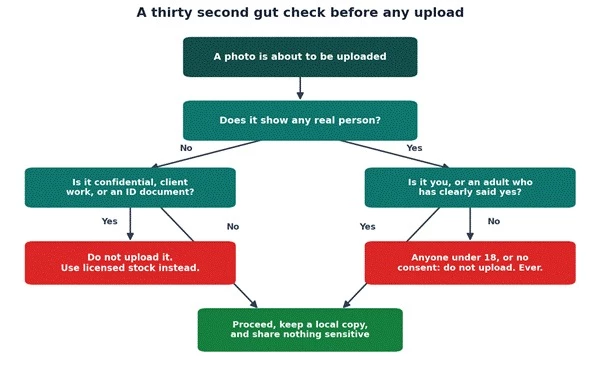
A gut check worth running every single time, no matter how casual the project feels.
The branding says uncensored. The terms say otherwise, and the gap between the two matters. Published analyses of the terms describe an extensive content policy: explicit material is permitted for consenting adults, but there are strict prohibitions around minors, non consensual content, and other harm related categories, with penalties escalating from warnings to permanent account termination. Whatever the homepage implies, this is a moderated platform, and users who treat uncensored as meaning anything goes are the ones most likely to lose their accounts.
Two practical consequences follow. First, you remain legally responsible for what you create under the laws of your own country, and some countries have blocked the platform entirely because of its open policies. The website will not stop you from breaking your local law, and it will not defend you afterward either. Second, independent coverage includes reports of account suspensions landing without clear explanation, alongside limited support to resolve them. That is worth remembering before you store anything of value on the platform, whether that is a large Gem balance or the only copy of something you made. Download your creations as you go, every time.
This might be the most practical warning in the whole article. A separate site at unlucid.info dresses itself up as the same product while advertising completely free and unlimited access, which flatly contradicts how the real platform works. Worse, that lookalike cross promotes a cluster of tools built around stripping clothing from photos of real people, a category tied directly to harassment, image abuse, and criminal liability in many countries. That is not a gray area worth exploring. Treat the entire lookalike ecosystem as a hard no.
The genuine product lives at unlucid.ai and nowhere else. There is no official mobile app either; a guide app floating around Google Play is an unaffiliated third party creation. Bookmark the real domain, type it carefully, and let that be the end of it.
Buying Gems means putting card details somewhere, so it is worth being deliberate about how. The checkout routes card payments through Telegram, with additional options behind a secondary menu. That is unusual rather than automatically sinister, but combined with an anonymous operator and reports of limited support for payment disputes, it argues for defensive habits: use a virtual card or one with strong chargeback protection, start with the smallest $8.99 bundle, and only scale up once the platform has earned it.
The terms reportedly address refunds and generated content ownership, and this is one of those rare cases where reading them before buying is not just lawyer talk. Ten minutes with the refund section is cheap insurance on a $59.99 bundle. And given the account suspension reports, the golden rule from the previous section applies double here: never leave more value sitting in a Gem balance than you would shrug about losing.
Put every risk in this article on one chart and a pattern appears. The everyday risks are money shaped: wasted Gems, watermarks, a disputed charge. Annoying, survivable, and mostly recoverable. The serious risks are people shaped: someone's face used without consent, a minor's photo, confidential material that cannot be un-uploaded, or a lookalike site built for abuse.
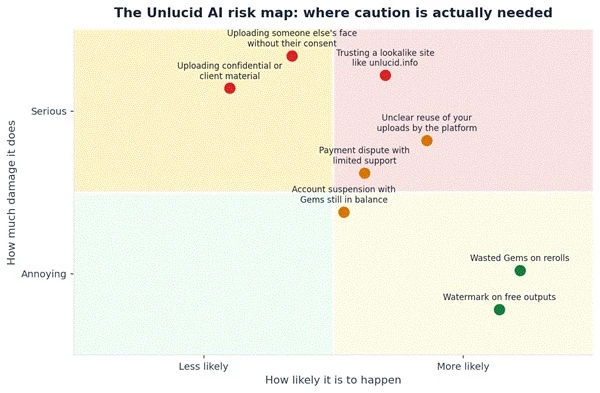
Likelihood against damage: the top of this chart is where safety actually gets decided.
That pattern is also strangely reassuring, because the most serious risks on the map are almost entirely inside your control. The platform cannot upload a photo on your behalf. Every red dot up there is a decision, and decisions can simply be made well.
Pulled together in one place, here is the routine that keeps Unlucid AI in the low stakes sandbox category where it belongs:
• Sign up defensively. Use a unique password and, ideally, an email address that is not tied to your main identity.
• Pay small and pay protected. A virtual or well protected card, the smallest bundle first, and no large Gem balances left sitting around.
• Download everything as you go. Reported suspensions arrive without warning, so the only copy of your work should always be the one on your own device.
• Upload as if nothing gets deleted. Retention is unclear, so nothing confidential, nothing you would regret persisting, and no ID documents ever.
• Hold the hard line on faces. Your own face is your call. Another adult's face needs their clear, informed yes. Anyone under 18 is an absolute never, in any context.
• Stay on the real domain. unlucid.ai is the product. Lookalikes promising unlimited free access are selling something else entirely.
• Leave cleanly. When you are done with the platform, request account deletion through the address in the privacy policy and keep the confirmation.
This assessment was built with the Trust Surface Audit, the five step process GeniusFirms applies when a platform's safety, rather than its features, is the question:
• Official surface review. The live homepage, Gems checkout, and about pages were examined directly in August 2026.
• Scanner cross check. Three independent trust scanners were compared on the same date, with their disagreement reported rather than smoothed over.
• Terms analysis. Policy specifics, including Facial Reference Technology, consent rules, and enforcement measures, were drawn from multiple independent published analyses of the platform's terms.
• Community signal scan. User reports around suspensions, support quality, and payment experiences were reviewed across independent coverage.
• Lookalike verification. The unlucid.info site was checked directly against the genuine product's published pricing model.
Limitations, stated plainly: scanner scores move over time, the platform's terms can change without notice, and policy details summarized here came through published analyses rather than a legal review of the primary documents. Before relying on any specific clause, read the live terms yourself. They are linked from the platform's own footer, which is exactly where a document like that should be found.
Unlucid AI is a functioning product wrapped in an accountability vacuum. The tools work, the pricing is published, the content policy is more serious than the branding admits, and there is no evidence of outright fraud. What is missing is everything that lets you extend real trust: a name behind the site, clear answers about your data, dependable support, and a review history with any depth.
That combination points to a clear posture rather than a ban or a blessing. Used as a low stakes sandbox, with fictional content, pocket change spending, and nothing sensitive uploaded, the platform's risks stay small and mostly annoying. Used carelessly, with real faces, real confidences, or real money at stake, the same platform becomes a genuinely bad bet. The most serious risks here are not hiding in the code. They sit in the small decisions made just before each upload and each purchase, which means they are yours to prevent. The free daily Gems exist precisely so that trust can be tested before it is spent. Spend those first.
Share your thoughts about this article.
Be the first to post a comment!

WSUP AI built much of its early appeal around a simple promise: users could star...
Pritam Singh22 hours ago

Ten gems buys one video on Unlucid AI. That price holds whether the prompt succe...
Deepak Mehra1 day ago
How this comparison was builtEvery price, limit, credit rule and feature stateme...
Sakshi Dhingra4 days ago
Gening AI is free, needs no login, and forgets everything the moment you close t...
Nitin6 days ago

My Quick Answer: If you want the single best free collage maker right now, I rec...
Sakshi Dhingra6 days ago
Transparency note before you read further. I have not performed hands on testing...
Deepak Mehra1 week ago