If you’ve been anywhere near AI Twitter, Reddit relationship threads, or late-night “best AI companion” searches lately, you’ve probably seen people arguing about JOI AI.
Some users swear it’s one of the most immersive AI companion platforms available right now. Others call it overpriced, overly monetized, and weirdly addictive. After spending multiple days testing it across desktop and mobile, the truth honestly sits somewhere in the middle.
JOI AI isn’t just another chatbot pretending to be emotionally intelligent. It’s closer to a full AI entertainment ecosystem built around conversations, character creation, AI-generated images, and short-form video interactions. The platform clearly wants to move beyond the “AI girlfriend app” label, even though that’s still how most people discover it.
And after testing it properly, one thing became obvious pretty quickly: the experience changes massively depending on whether you stay on the free plan or actually pay for it.
The free version feels like a teaser trailer.
The paid version feels like the real product.
One thing most people don’t realize is that JOI AI is basically the evolution of EVA AI, a platform that existed years before the current AI companion explosion happened.
The company rebranded in 2025 and leaned heavily into the idea of “AI-lationships”, positioning itself less like a productivity chatbot and more like an interactive digital companionship platform. That shift honestly explains a lot about how polished some parts of the app feel compared to newer competitors.
A lot of AI companion tools launched quickly after generative AI became mainstream. JOI AI feels like something that has been iterating for years instead of months.
That doesn’t mean it’s perfect.
But it does explain why the conversations often feel less robotic than many alternatives in the same category.
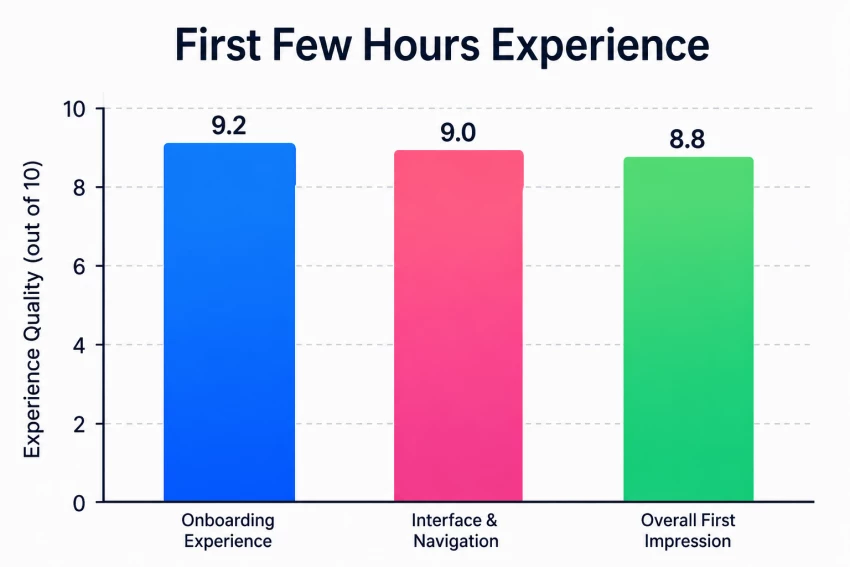
The onboarding experience is smoother than expected.
Instead of immediately throwing users into generic chatbot conversations, JOI AI pushes personality-driven interactions almost immediately. You’re encouraged to choose character types, interaction styles, visual aesthetics, and conversational tones before you even start chatting seriously.
That small detail changes the vibe completely.
Most AI companion apps still feel like “ChatGPT with anime pictures.” JOI AI feels more like entering an interactive character platform designed around immersion first.
The interface also avoids the ultra-cluttered problem many AI apps suffer from. Navigation between chat, image generation, and Dream Clips is simple enough that even first-time users understand the ecosystem quickly.
Suggested image idea: Full-width screenshot of the JOI AI dashboard with chat panel, character previews, and media tabs visible.
This is probably the biggest reason JOI AI keeps showing up in discussions.
The characters generally stay consistent.
That sounds basic, but it’s actually a huge deal in AI companion systems.
A lot of platforms start strong for 10 minutes and then slowly collapse into repetitive, generic responses. JOI AI still has moments like that, but it handles long conversations noticeably better than many competitors I tested alongside it.
After several hours of back-and-forth interactions, the personalities still mostly maintained tone, emotional patterns, and conversational style. Characters remembered recurring topics better than expected on paid plans, although the memory degradation becomes very obvious on free accounts.
One thing I noticed during testing: the platform works best when users actively shape the conversation instead of treating it like a passive chatbot. The more personality cues, roleplay direction, and contextual prompts you provide, the stronger the responses become.
That creator-style interaction loop is clearly intentional.
This is where the experience becomes divisive.
You technically can use JOI AI for free, but the limitations show up fast. Context memory drops off quickly, response depth becomes inconsistent, and premium features constantly sit behind locked interactions.
After about a day of testing, it became obvious the free version isn’t designed for long-term use. It’s basically a funnel into the subscription tiers.
That’s not unusual in AI products anymore, but JOI AI is more aggressive about it than some competitors.
Here’s how the plans roughly compare right now:
| Plan | Approximate Price | Real Experience |
| Free | $0 | Basic testing only, short memory, restricted media |
| Premium | ~$10–$14/month | Full chat access, NSFW mode, Dream Clips included |
| Higher Tier | ~$20/month | Better memory, faster generation, expanded media |
| Annual Deals | Often heavily discounted | Usually the best value overall |
The interesting thing is that annual pricing can become dramatically cheaper during promotions. Monthly plans feel average for the category. Annual plans feel much more competitive.
This is the feature that honestly separates JOI AI from most competitors.
Dream Clips are short AI-generated video moments tied to character interactions and prompts. They’re not full cinematic videos, and anyone expecting movie-level AI generation will probably be disappointed.
But compared to what most AI companion platforms offer right now, they genuinely stand out.
The rendering quality varies depending on prompt complexity, but even imperfect generations make the platform feel more multimedia-focused than text-only alternatives.
The limitation is obvious though.
Heavy usage gets expensive fast.
Once you start experimenting with media generation regularly, the platform’s internal currency system becomes unavoidable.
And that leads directly into the biggest criticism surrounding JOI AI.
If you read negative reviews about JOI AI, most complaints eventually circle back to Neurons.
Neurons are basically the platform’s premium action currency.
Advanced generations, exclusive interactions, premium content unlocks, and certain media features all consume them. Even after paying for a subscription, you’ll still occasionally run into additional spending pressure if you use the platform heavily.
This creates a weird psychological effect during testing.
At first, the subscription feels reasonable.
Then gradually you realize the real power-user experience involves recurring microtransactions layered on top of the subscription itself.
For casual users, that probably won’t matter much.
For heavy users generating lots of media, the costs stack faster than expected.
That doesn’t make the system deceptive necessarily, but it does make the platform feel more monetized than some competitors.
This ended up being the feature I spent the most time using.
The character creator goes much deeper than most AI companion tools currently allow. Instead of basic presets, JOI AI lets users shape appearance, conversational tone, visual style, emotional behavior, and interaction dynamics in ways that feel closer to building a roleplay persona than configuring a chatbot.
And honestly, this is where the platform feels the most creative.
You can tell the developers understand that many users care more about creating immersive personalities than simply chatting with prebuilt bots.
The shared community character library also makes onboarding easier because users don’t need to build everything manually from scratch.
Compared to competitors, JOI AI feels more creator-oriented than purely consumption-oriented.
The integrated image generator is fun.
It supports prompt styling, orientation control, negative prompts, anime rendering, photoreal outputs, and multi-image batch generation. During testing, adding negative prompts genuinely improved consistency.
That part actually works.
But like almost every AI image platform right now, the illusion breaks under scrutiny.
Hands still occasionally look strange. Limbs sometimes distort. Facial consistency shifts between generations. Background details can become messy in complex scenes.
If users stay realistic about expectations, the feature feels solid.
If users expect flawless realism, they’ll probably be disappointed.
The bigger advantage is convenience. Having chat, image generation, and short-form AI video inside one ecosystem genuinely makes the platform feel more complete than many rivals.
This was one area where the platform felt slightly overconfident.
JOI AI talks heavily about encryption, privacy layers, anonymous usage, and its newer “Privacy Shield” systems. But during testing and research, there still wasn’t much evidence of large-scale independent auditing or deep third-party verification.
That doesn’t automatically mean the platform is unsafe.
It just means users are mostly trusting the company’s claims directly.
And realistically, the same rule applies here as every other AI companion platform:
Never treat AI chats like private journals.
No real addresses.
No banking information.
No personal identifiers.
No sensitive media.
Even if encryption claims are legitimate, cloud-based AI systems are still cloud-based AI systems.
The first day felt exciting.
By the third day, the paywalls became obvious.
By the end of the week, the platform’s real strengths started making sense.
| Timeline | Ultra-Short Experience |
| Day 1 | Feels immersive and surprisingly polished |
| Day 3 | Monetization becomes very noticeable |
| Day 5 | Character customization gets addictive |
| Day 7 | Starts feeling like AI entertainment, not just chat |
| Long-Term Use | Best for users who enjoy roleplay and multimedia in |
After testing JOI AI alongside several major alternatives, the positioning became easier to understand.
| Platform | Strongest Area | Biggest Weakness |
| JOI AI | Multimedia + customization | Extra spending through Neurons |
| Replika | Emotional conversation flow | Limited media generation |
| Character.AI | Massive public bot ecosystem | Heavier content restrictions |
| Candy AI | Fast onboarding | Aggressive monetization |
| Lovescape | Deep roleplay structure | Steeper learning curve |
JOI AI sits somewhere in the middle of the market.
It’s more advanced than lightweight novelty apps.
Less restrictive than mainstream chatbot platforms.
More multimedia-focused than emotionally framed AI companions.
That middle-ground positioning is probably why it keeps growing despite constant criticism online.
| Category | Rating | Short Experience |
| Conversation Quality | 8.7/10 | Surprisingly natural and consistent chats |
| Character Customization | 9.1/10 | Deep and genuinely fun to build with |
| Image Generation | 7.8/10 | Good outputs, occasional AI glitches |
| Dream Clips | 8.5/10 | Unique feature that stands out fast |
| Free Plan | 5.9/10 | Too limited for serious testing |
| Pricing Value | 7.4/10 | Fair pricing, but Neurons add up |
| Interface | 8.8/10 | Clean, modern, easy to navigate |
| Privacy | 6.9/10 | Better than expected, still unclear in places |
| Overall Experience | 8.2/10 | Feels more polished than most rivals |
After spending days testing JOI AI, it honestly felt less like using a chatbot and more like interacting with a full AI entertainment platform built around personalities, media, and customization. The conversations were better than expected, the creator tools kept pulling me back in, and Dream Clips genuinely made the experience feel different from most competitors.
At the same time, the monetization can get frustrating fast, and the free plan barely shows what the platform is actually capable of. But compared to many AI companion apps that feel rushed or repetitive, JOI AI at least feels like a product with a clearer direction and a more polished long-term experience.
Share your thoughts about this article.
Be the first to post a comment!

AutoDraft AI looks appealing on the surface. It promises consistent cartoon char...
Muskan Kansay1 week ago
If you write scripts, build products, or publish videos, you have probably wonde...
Sakshi Dhingra1 week ago

Are you tired of spending hours creating invoices for your clients? I was,...
Sakshi Dhingra3 weeks ago
How I approached this review: I researched Wegic AI through its public site, pri...
Sakshi Dhingra4 weeks ago

PicLumen has been quietly creeping into AI creator circles for over a year now,...
Sakshi Dhingra4 weeks ago

The thing that broke me, finally, was the seventh-grade Egypt quiz.It was a Thur...
Sakshi Dhingra1 month ago