Character AI logs around twenty million monthly active users who spend close to seventy five minutes a day inside a library of more than ten million characters.
Joyland AI answers with roughly sixty thousand hand tuned anime personas and something Character AI refuses to offer: an uncensored mode. That single split, scale and polish against freedom and depth, is the whole comparison.

Both platforms sit near the top of the character chat category in 2026, yet they solve different problems. Character AI is the mass market front door built for safe, endless variety. Joyland AI is the specialist anime roleplay app that trades reach for creative control. What follows scores the two across ten categories, declares a winner in each, and lands on a clear recommendation for different kinds of user.
Character AI takes seven of ten rounds and the higher overall mark, winning on library size, polish, value, and discovery. Joyland AI takes three rounds that matter enormously to the right person: content freedom, deep character customization, and anime persona consistency. Neither is objectively better. The right pick depends on whether uncensored, deeply customized anime roleplay is a must have or a nice to have.
| Aspect | Joyland AI | Character AI |
| Launched | 2023 | 2021 |
| Library size | ~60,000 anime personas | 10 million plus characters |
| Content policy | SFW and NSFW after age check | Strictly SFW, tightening |
| Memory | Inconsistent, resets in long chats | Context plus pinned facts, c.ai+ larger |
| Multimedia | Text and avatar led | Voice calls, image gen, group scenes |
| Customization | Deep, imports character cards | Easy editor, less depth |
| Apps | Mobile app, no login entry | Polished iOS and Android |
| Free tier | Limited, credit gated | Broadly usable, now with ads |
| Entry paid | Standard $9.99, Premium $19.99 | c.ai+ $9.99 |
| Best for | Uncensored anime roleplay | Broad creative roleplay, beginners |
Figures reflect reporting current to the update date and can change by billing term and region.
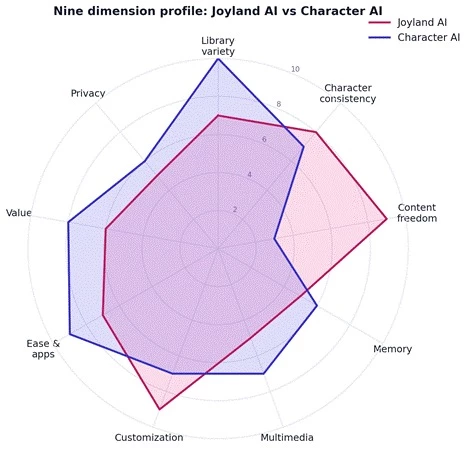
Both platforms profiled across nine dimensions. Character AI covers more ground overall; Joyland AI spikes on content freedom and customization.
This head to head uses the Round by Round Face Off, a model that judges two platforms across ten equally weighted categories and awards each round to one side. No first hand testing was performed for this article. Scores are an editorial synthesis of published pricing, stated content policies, feature disclosures, and a spread of independent 2026 user reviews, rather than a single reviewer's play through.
Each platform earns a score from 0 to 10 in every round. The higher score takes the round, the round wins are tallied, and an overall mark out of 5 sums it up. Prices and content rules in this category move quickly, so every figure below should be confirmed on the platform before subscribing.
Each category below gets the same treatment: why it matters, how each platform handles it in practice, an honest note on the trade off, and who takes the round. Scores are out of 10, and the higher score wins the category.
The first thing anyone notices in a character chat app is the catalogue. Library size shapes how long novelty lasts, how niche a taste can be served, and how hard the discovery tools have to work. This opening round is pure scale, and scale is exactly where Character AI built its reputation.
Joyland AI. The catalogue sits at roughly sixty thousand personas, weighted heavily toward the anime styles its audience came for. That focus is a genuine feature for anime fans, since a smaller, themed library is faster to browse without wading through low effort bots. The limitation is just as clear: interests outside anime are thinly served, and heavy users who chew through characters quickly reach the edges of the collection fast.
Character AI. This runs on a different order of magnitude, with a community catalogue reported at more than ten million characters spanning anime, fiction, history, education, gaming, and original companions. Trending lists, category browsing, and strong search turn that volume into something navigable rather than overwhelming, and it scores a perfect 10 here. For the odds of finding an existing character that already fits a specific idea, nothing in this matchup is close.
Round to Character AI Ten million characters against sixty thousand, with better discovery layered on top, makes this the most lopsided round of the ten.
Raw numbers hide a quieter question that matters more in long sessions: does a character actually stay in character? A persona that drifts, forgets its own traits, or breaks the fourth wall mid scene quietly wrecks immersion, and this is where a tighter, more curated focus starts to pay off.
Joyland AI. Reviewers repeatedly single out its ability to hold a persona's voice, mannerisms, and emotional tone across an extended anime roleplay. Because the library is curated and the platform is tuned specifically for immersive storytelling, characters tend to behave the way their description promises from the first message to the last. Within its lane, that reliability is one of its strongest cards.
Character AI. The underlying writing quality is high, arguably higher than Joyland's on a sentence by sentence basis. The problem is interruption. Tightening safety filters increasingly break otherwise harmless scenes with disclaimers, refusals, or abrupt topic changes, and that stop and start rhythm fractures the sense of a stable character far more than a slightly weaker turn of phrase ever would.
The real distinction is between prose quality and roleplay reliability. Character AI often writes a better single reply, yet Joyland more consistently sustains the illusion across a whole session.
Round to Joyland AI For uninterrupted, in character roleplay, Joyland's steadiness beats prose polish that filters keep undercutting.
No single factor separates these two platforms as sharply as content policy, and it is the number one reason people migrate away from Character AI in the first place. This round is less about degrees of strictness and more about a hard line one platform draws and the other refuses to.
Joyland AI. It runs a dual mode system. A clean, safe for work experience sits alongside an adult mode that unlocks after age verification, handing mature roleplay and romance writers a wide creative canvas with far fewer hard stops. That openness is central to both its identity and its pull for anyone leaving a stricter service.
Character AI. It is strictly safe for work by design, and the moderation has grown tighter over time rather than looser. Prompts that once passed now trigger blocks, and crucially the paid c.ai+ tier does not unlock mature content, so spending more changes nothing about the ceiling. The filtering exists for legitimate safety and legal reasons, but for the user it remains a firm wall.
This is a values and use case divide rather than a quality one. For strictly clean roleplay the wall is irrelevant, and for anything mature it is completely decisive.
Round to Joyland AI For unrestricted or adult roleplay, Joyland wins outright, because Character AI does not compete in that space at all.
A companion that forgets last week's storyline, or a detail shared five messages ago, feels less like a relationship and more like a reset button. Memory is a weak spot for both platforms, so this round is really about which one disappoints less rather than which one excels.
Joyland AI. Long term memory is advertised as a Premium selling point, but multiple 2026 assessments report that the promise does not fully hold. Context tends to slip in longer sessions, and users describe having to re feed plot points and character details by hand to keep a story coherent, which quietly undercuts the paid pitch that memory is meant to justify.
Character AI. It pairs rolling conversation context with the ability to pin specific facts a character should always remember, and c.ai+ raises the effective memory ceiling further. It is still shorter than what dedicated companion apps deliver, and very long arcs will still shed detail, but the pinning system gives it steadier, more predictable recall than Joyland manages by default.
Neither platform leads the wider category on memory. Between just these two, the deciding factor is reliability, and Character AI's tooling is the more dependable of the pair.
Round to Character AI Pinned facts and a larger paid context window edge out Joyland's inconsistent recall.
Text is the heart of roleplay, but voice, images, and on screen presence turn a conversation into something closer to a scene. This round measures how much sensory range each platform adds beyond the written word.
Joyland AI. The experience centers on text paired with a character avatar, and the media features are modest next to purpose built companion apps. The avatar puts a face to the conversation, which helps, but voice and generated imagery are not the draw, so sessions stay largely on the page.
Character AI. Real investment has gone into presence here. Voice calls let a character speak aloud, an image generator visualizes scenes and characters, and multi character group chats can stage a conversation between several personas at once. None of these top the specialist multimedia apps, but bundled together they hand Character AI a clear sensory edge in this particular matchup.
Round to Character AI Voice and image generation give Character AI a comfortable multimedia win over Joyland's text first design.
Some users browse, others build. For the builders, the depth of the creation tools matters more than the size of the public library, and this is a round where Joyland's power user roots clearly show.
Joyland AI. It offers detailed creation fields and, importantly, supports importing character cards in JSON or PNG formats from tools such as TavernAI and SillyTavern. That interoperability is a real power user feature, letting creators carry finely tuned characters into the platform instead of rebuilding them from scratch, which is a workflow serious roleplayers value highly.
Character AI. The character editor is friendly and approachable, which fits its mainstream audience well, but it is noticeably shallower. There is no external card import, and advanced personality shaping is more limited, so ambitious creators tend to hit a ceiling sooner than they would on Joyland.
The split mirrors each platform's identity almost exactly. Character AI optimizes for the casual creator, while Joyland rewards the dedicated one.
Round to Joyland AI Card import and deeper creation fields make Joyland the stronger tool for serious character builders.
Daily use lives or dies on friction. How fast a first chat starts, how stable the apps feel, and how clean the interface looks all decide whether a platform becomes a habit or a tab that gets closed.
Joyland AI. It ships a capable mobile experience and, notably, a no login entry point that lets a newcomer start chatting almost immediately, which meaningfully lowers the barrier to a first session. The apps are solid and dependable without quite being category leading.
Character AI. It has the most polished iOS and Android apps in character chat, with a clean interface, reliable performance, and the smoothest discovery in the group. The one real blemish arrived in early 2026, when full screen mid chat ads appeared on the free tier, an interruption many users describe as jarring. Even accounting for that, the overall app quality still sets the bar.
Joyland wins the very first thirty seconds with instant access, but Character AI wins the hundredth hour with polish and stability.
Round to Character AI Despite the new ads, Character AI's app quality and overall polish take the round.
Value is never the sticker price alone. It is the combination of what the free tier delivers and what the paid tiers actually unlock, and these two platforms structure that bargain very differently.
Joyland AI. The free tier is deliberately narrow. Credit gating and daily caps arrive quickly, nudging users toward Standard at about 9.99 dollars a month for unlimited chat, an NSFW unlock, and short term memory, or Premium at about 19.99 dollars for advanced memory and priority speed. The experience most of its users actually want sits behind the paywall, which pushes the real cost of the platform higher than the entry price suggests.
Character AI. The free tier is broadly usable, with full library access and roughly a hundred messages a day, which is enough that many people never pay at all. The single c.ai+ upgrade near 9.99 dollars adds an ad free experience, priority speed, voice calls, and the newest models, but it stays genuinely optional rather than essential.
The math favors Character AI twice over: its free tier does more, and its paid ceiling is lower.
Round to Character AI A stronger free tier and no expensive second tier make Character AI the better value.
These platforms accumulate months of personal, sometimes intimate conversation, so how they handle that data is not a footnote. Both carry real gaps, and this round is about which one inspires slightly more confidence.
Joyland AI. Independent assessments place its safety near 3.2 out of 5, citing vague encryption disclosures and broad third party data sharing. For a service that actively invites deeply personal chat, that thin documentation is a meaningful weakness, and privacy conscious users would do well to read the policy closely before committing months of conversation to it.
Character AI. It carries more scrutiny, including public lawsuits and sustained press attention, but it has also built more safety infrastructure in response, such as age assurance measures and clearer AI disclaimers. Its data practices are far from spotless, and the new ad system raises fresh questions of its own, yet the transparency and tooling still edge out Joyland's.
Neither platform should be mistaken for private. The honest advice for both is the same: avoid sharing real identifying details in any chat.
Round to Character AI More safety tooling and clearer disclosures give Character AI the round, if narrowly.
A platform is more than its models. An active community keeps the catalogue fresh, surfaces the best characters, and turns solo chatting into something shared, and that advantage compounds over time.
Joyland AI. It supports a community ranking system and the Joybook feature, which lets users turn private chats into shareable, interactive stories. It is a thoughtful social layer that suits its anime storytelling audience, even though the overall community is the smaller of the two.
Character AI. Its community is one of the largest in consumer AI, and its discovery surfaces, trending characters, and creator ecosystem are the most developed in the category. That scale feeds a virtuous cycle: more creators make more characters, which draws more users, which attracts still more creators.
Round to Character AI Community scale and discovery depth hand the final round to Character AI.
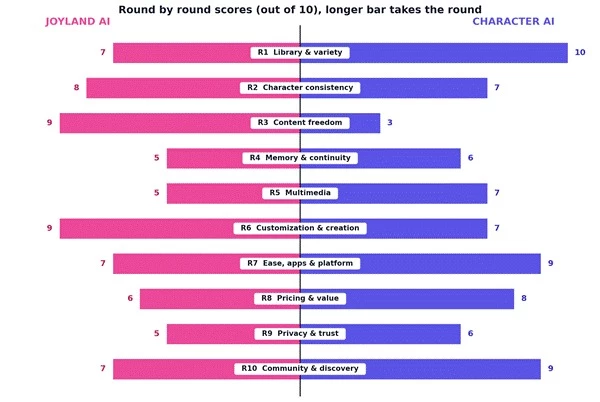
The full scorecard. Character AI takes seven rounds, Joyland AI takes three, and the three Joyland wins are the ones that decide it for uncensored anime fans.
The price ladders tell the value story cleanly. Both platforms are free to start, but the free tiers are not equal, and the paid ladders differ in shape.
Joyland AI. A tightly capped free tier, then Standard near $9.99 a month for unlimited chat, NSFW unlock, and short term memory, and Premium near $19.99 for advanced memory and priority speed.
Character AI. A generous free tier with full library access and roughly a hundred messages a day, then a single c.ai+ tier near $9.99 for no ads, priority speed, voice calls, and the newest models.
The practical takeaway: Character AI can be used seriously for free, so its subscription is optional for most. Joyland's best features, especially NSFW and better memory, sit behind a paywall, so its real cost is higher for the experience most of its users actually want.
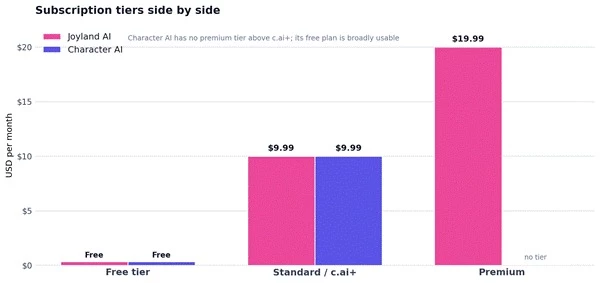
Both start free, but Joyland climbs to a $19.99 Premium tier while Character AI stops at a single $9.99 upgrade.
The scorecard points to a simple routing based on what matters most.
For most people and total beginners: Character AI. The largest library, the smoothest apps, and a free tier that rarely needs upgrading.
Best for uncensored or mature roleplay: Joyland AI. The dual mode is the deciding feature that Character AI simply does not offer.
For anime persona builders: Joyland AI. Deeper creation fields and character card import reward users who craft their own characters.
Best for voice and multimedia: Character AI. Voice calls and image generation add presence that Joyland lacks.
For value on a budget: Character AI. A genuinely usable free tier beats a capped one that funnels toward paid plans.
A common pattern actually uses both: Character AI for broad, everyday, safe for work roleplay and discovery, and Joyland AI when a session needs uncensored anime depth that Character AI will not allow.
| Category | Joyland AI | Character AI | Round |
| Library and variety | 7 | 10 | Character AI |
| Character consistency | 8 | 7 | Joyland AI |
| Content freedom | 9 | 3 | Joyland AI |
| Memory and continuity | 5 | 6 | Character AI |
| Multimedia | 5 | 7 | Character AI |
| Customization and creation | 9 | 7 | Joyland AI |
| Ease, apps and platform | 7 | 9 | Character AI |
| Pricing and value | 6 | 8 | Character AI |
| Privacy and trust | 5 | 6 | Character AI |
| Community and discovery | 7 | 9 | Character AI |
| Rounds won | 3 | 7 | 10 total |
| Overall rating (out of 5) | 3.7 | 4.3 |
Character AI wins the head to head on points, taking seven of ten rounds and the higher overall rating, because it is the more complete platform for the widest audience. The library is unmatched, the apps are the smoothest around, the free tier is genuinely useful, and voice plus discovery round out an experience that suits almost anyone starting with character chat.
Joyland AI loses the tally but wins the argument for a specific reader. Its three round victories, content freedom, character consistency, and deep customization, are exactly the features that send people away from Character AI's tightening filters in the first place. For uncensored anime roleplay built on hand crafted characters, it remains the stronger tool despite the higher effective cost and thinner privacy record.
The clean takeaway: pick Character AI for breadth, polish, and value, and pick Joyland AI when uncensored, deeply customized anime roleplay is the whole point. Many users keep both and switch based on the session.
Share your thoughts about this article.
Be the first to post a comment!

“Useful” is a slippery word for a coding assistant. A tool can be brilliant at o...
Sakshi Dhingra20 hours ago

WSUP AI built much of its early appeal around a simple promise: users could star...
Pritam Singh1 day ago

Somewhere right now, someone is deciding whether to upload a photo of their own...
Deepak Mehra1 day ago
Ten gems buys one video on Unlucid AI. That price holds whether the prompt succe...
Deepak Mehra2 days ago
How this comparison was builtEvery price, limit, credit rule and feature stateme...
Sakshi Dhingra5 days ago

Gening AI is free, needs no login, and forgets everything the moment you close t...
Nitin1 week ago