A few months ago, I noticed something interesting while working on multiple content workflows. Tools that once felt interchangeable started behaving very differently.
Two years ago, choosing between Rytr and Writesonic felt like picking between two similar options. Both helped write blogs, ads, and emails. Both relied on similar AI models. The differences were mostly surface-level.
That is no longer the case.
Over the past year, Writesonic has shifted aggressively toward something much bigger than writing, positioning itself as a Generative Engine Optimization (GEO) platform. Meanwhile, Rytr has stayed focused on what it originally did best: fast, affordable short-form writing.
The result?
These tools are no longer direct competitors.
| Use Case | Best Tool |
| Short-form content (ads, emails, captions) | Rytr |
| SEO + AI search visibility (ChatGPT, Google AI, etc.) | Writesonic |
| Budget-focused users | Rytr |
| Agencies / brands with marketing goals | Writesonic |
If your thinking is: “I just need to write faster” → go with Rytr
If your thinking is: “I need visibility in AI + search” → go with Writesonic
Most comparisons miss this completely, they assume both tools solve the same problem.
They don’t.
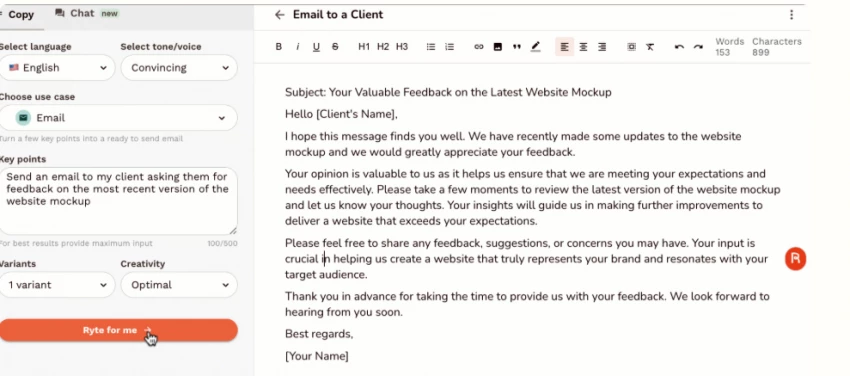
It’s a pure writing assistant.
Open → generate → edit → publish.
No complexity. No ecosystem.
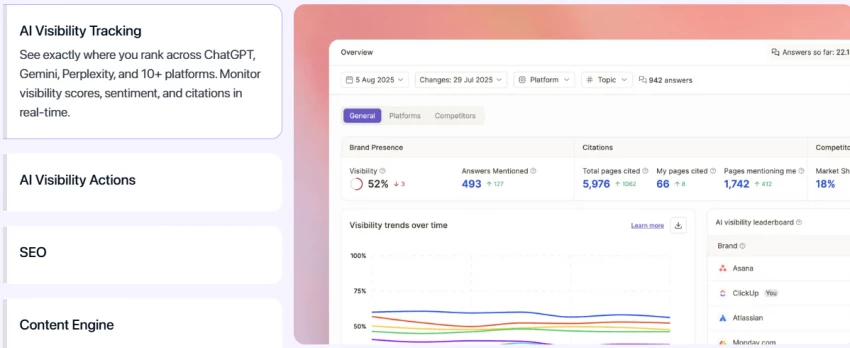
Writesonic is no longer just about writing, it’s about getting your content discovered across AI platforms.
| Plan Level | Rytr | Writesonic |
| Free | 10,000 characters | Limited access |
| Entry | $9/month (unlimited) | ~$39/month |
| Mid | $29/month (max plan) | ~$99–$199/month |
| Advanced | N/A | $399+ |
Rytr’s highest plan = cheaper than Writesonic’s entry plan
Writesonic’s real value (GEO) is locked in higher tiers
This is not pricing difference, it’s business model difference
| Feature | Rytr | Writesonic |
| Templates | ~40 (short-form focused) | 80–100+ |
| Long-form writing | Weak beyond ~1,000 words | Strong structured output |
| SEO tools | Basic | Full suite |
| AI chatbot | No | (Chatsonic) |
| GEO tracking | No | (core feature) |
| Integrations | Limited | Extensive (Zapier, WP, etc.) |
| Ease of use | Very simple | Moderate learning curve |
Pattern is clear:
Rytr = simplicity + cost
Writesonic = ecosystem + strategy
| Aspect | Rytr | Writesonic |
| Best for | Ad copy, emails, social posts | Long-form drafts, structured articles |
| Output style | Natural and quick variations | Structured but slightly rigid |
| Long-form performance | Weak beyond ~1,000 words | Handles long-form better |
| Common issues | Repetition, loss of flow, stitched feel | Robotic tone, needs refinement |
| Editing required | Minimal for short-form | Moderate to high for publishing |
| Overall usability | Ready faster for short content | Requires editing but better structure |
Key distinction:
Rytr works best when speed matters in short-form content, while Writesonic is more useful when you need structured long-form drafts that you’re willing to refine before publishing.
| Pros | Cons |
| Very affordable | Poor long-form output |
| Fast generation | Limited integrations |
| Easy to use | Not SEO-focused |
| Unlimited usage | Basic ecosystem |
| Pros | Cons |
| Strong long-form structure | Expensive |
| SEO + GEO tools | Credit-based anxiety |
| AI visibility tracking | Needs editing |
| Full ecosystem | Complex pricing |
The real cost isn’t subscription — it’s editing time.
Rytr:
Cheap generation
More manual editing
Writesonic:
Expensive tool
Less structural editing needed
Your decision should depend on:
“Is my time more expensive than the tool?”
When you go beyond feature comparisons and look at real user feedback across platforms like G2, Reddit, and review forums, both Rytr and Writesonic appear similarly rated on the surface. Most platforms place them in a strong range, typically around 4.5 to 4.7 out of 5. But those numbers don’t tell the full story.
What stands out is how differently users describe their experience with each tool. Rytr is consistently appreciated for its simplicity, affordability, and speed. Many freelancers and small teams highlight that it delivers exactly what they expect without adding complexity. At the same time, users often mention that it struggles when pushed into long-form content, where structure and depth become important.
Writesonic, on the other hand, is usually rated higher for its broader capabilities. Users often point to its structured article generation, SEO tools, and integrations as key strengths. However, the feedback is not entirely positive. A recurring theme is that the output feels slightly mechanical and requires editing before it becomes publishable. Some users also mention that the pricing structure and feature access can feel restrictive.
Across both tools, one consistent insight emerges: neither is considered a complete replacement for human writing. Users treat them as assistants rather than final solutions, especially when content quality and originality matter.
| Aspect | Rytr | Writesonic |
| Overall rating trend | ~4.5–4.7 / 5 | ~4.6–4.7 / 5 |
| What users like most | Simplicity, affordability, speed | Features, structure, SEO capabilities |
| Common praise | Quick outputs, easy to use | Strong long-form drafts, better workflow tools |
| Common complaints | Weak long-form quality, limited depth | Robotic tone, needs editing |
| Ease of use | Very easy, beginner-friendly | Moderate, slight learning curve |
| Value perception | High value for money | High value for advanced users |
| Editing requirement | Low (short-form) | Moderate to high (long-form) |
After spending a significant amount of time using both tools across different types of work, I’ve stopped thinking about this as a direct comparison. They don’t really compete anymore in the way most people assume.
Rytr feels like a tool I reach for when I want to move quickly without overthinking. It’s simple, predictable, and does exactly what I expect for short-form content. I don’t have to worry about credits, complex settings, or workflows. But at the same time, I know its limits. The moment I try to stretch it into long-form content, I end up doing more work manually.
Writesonic, on the other hand, feels like a system rather than just a tool. When I’m working on structured articles, SEO content, or anything that needs to perform beyond just “reading well,” it gives me a stronger starting point. But I’ve never found myself publishing its output as-is. It always needs editing — sometimes light, sometimes significant — especially to remove that slightly mechanical tone.
If I had to rate them based on how I actually use them:
| Tool | My Rating | Why |
| Rytr | 8.2 / 10 | Excellent for speed, cost, and short-form usability |
| Writesonic | 8.6 / 10 | Better for structure, SEO workflows, and long-form drafts |
The difference is small, but it reflects something important. Writesonic is more capable overall, but Rytr is easier to rely on daily without friction.
If your goal is to write faster and keep things simple, Rytr still makes more sense.
If your goal is to build content that performs across search and AI platforms, Writesonic is the more forward-looking option.
What I’ve learned from using both is this:
the wrong choice isn’t picking one over the other — it’s picking a tool that doesn’t match the kind of work you actually do.
Share your thoughts about this article.
Be the first to post a comment!

The same tool can be a 4.7 on one site and a 3.9 on another. Here is what is rea...
Nitin4 weeks ago

Here is the number worth pinning above your budget: in Gartner Digital Markets r...
Deepak Mehra4 weeks ago

What Artlist AI is in 2026Artlist began as a royalty-free music library. By 2026...
Deepak Mehra1 month ago

Most AI tool failures do not announce themselves. There is no crash, no angry em...
Nitin1 month ago

The best AI image generator in 2026 is Nano Banana 2 for speed, FLUX.2 for photo...
Parveen Verma1 month ago

“Useful” is a slippery word for a coding assistant. A tool can be brilliant at o...
Sakshi Dhingra1 month ago