Few software websites have survived as many internet eras as Softonic. Launched in the late 1990s, long before app stores or cloud distribution became normal, Softonic helped shape how people discovered and downloaded software online.
Today, it remains one of the most visited software portals in the world. At the same time, it also carries one of the most debated reputations in the download ecosystem. This review looks at Softonic as a business, a platform, and a domain, without exaggeration or dismissal.
Official website: https://www.softonic.com/
Softonic began in 1997 in Barcelona, Spain, created by Tomás Diago as a university project focused on sharing software. At a time when finding programs online was fragmented and risky, Softonic offered something simple. A centralized catalogue, categorized listings, and localized language support.
As broadband expanded globally, Softonic scaled quickly.
Early Growth Highlights
By the early 2010s, Softonic had become one of the largest software directories on the internet, particularly strong in emerging markets and non English speaking regions.
Between roughly 2007 and 2015, Softonic introduced a proprietary installer known as the Softonic Downloader. Instead of delivering original vendor installers directly, the platform wrapped downloads in its own installer.
This decision had long lasting consequences.
Why the Downloader Became Controversial
Security vendors such as Malwarebytes later classified the installer under potential unwanted programs, not as malware, but as adware behaviour.
In 2014, Google removed advertising support from Softonic, causing a sharp revenue collapse. By 2015, nearly half of the company’s workforce was laid off.
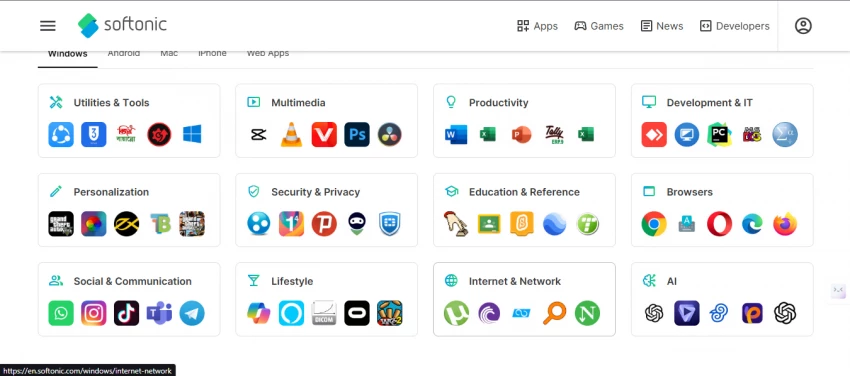
In early 2015, Softonic appointed a new CEO with experience in download platforms. One of the first actions taken was the permanent shutdown of the Softonic Downloader.
The company shifted to a direct download model, where users receive the original installer from the software developer rather than a Softonic wrapper.
Post 2015 Changes
While the technical change was immediate, reputation recovery proved much slower.
As of 2026, Softonic operates as a large scale software discovery and content platform.
Current Platform Characteristics
Traffic data shows that India alone accounts for more than a quarter of all visits, with the majority of users accessing the site via mobile devices.
Softonic no longer relies on software bundling. Its revenue model today is more conventional and diversified.
Financial disclosures indicate that Softonic’s revenue reached approximately 28.4 million euros in 2024, marking its strongest performance since the pre crisis years.
Despite operational improvements, user sentiment remains mixed to negative across review platforms.
What Users Commonly Report
Reddit discussions and YouTube videos frequently advise users to avoid third party download portals altogether, regardless of improvements made.
Positive reviews exist, but they are outweighed by historical distrust rather than recent technical issues.
Reasonable Use Cases
Situations Where Caution Is Warranted
Softonic is a legitimate and financially stable platform that has clearly evolved since its most controversial period. The company has removed the practices that caused the greatest harm and rebuilt its business around advertising, content, and partnerships.
However, reputation does not reset as easily as infrastructure.
For many users, Softonic remains defined by its past rather than its present. As a result, it occupies a unique position in 2026. Large, functional, and widely used, yet still approached with caution.
The most practical approach is balanced. Softonic can be useful for discovering software and reading reviews. When it comes to downloading, official developer sites and curated alternatives remain the safer default.
That tension between scale and trust is the story Softonic continues to live with today
Be the first to post comment!

Managing remote employees is very different from managing people in an office. W...
Sakshi Dhingra2 weeks ago

A school gradebook sounds like a simple thing until you watch what happens when...
Sakshi Dhingra3 weeks ago

The Growing Buzz Around EditPro in the AI Editing SpaceIn 2026, the name “EditPr...
Sakshi Dhingra3 weeks ago

When I first started deploying large language models, I assumed that choosing th...
Sakshi Dhingra3 weeks ago
PDF files are everywhere, from business contracts and academic papers to invoice...
Suraj Malik1 month ago
The Xender APK has remained relevant for one simple reason: it solves a very rea...
Sakshi Dhingra1 month ago