
Ten gems buys one video on Unlucid AI. That price holds whether the prompt succeeds on the first attempt or the fourth, and it does not move when the output specification changes. PixVerse meters the identical job differently. Its V6 model charges 18 credits for every second of 1080p output, rising to 23 credits per second once native audio is switched on.
The gap is not a rounding difference. A fifteen-second 1080p clip with audio consumes 345 credits on PixVerse, roughly $3.45 at the published pay-as-you-go rate. Unlucid delivers its most expensive possible video for $0.75 and its cheapest for $0.48. Two platforms chasing the same short-form creator have reached opposite conclusions about what a generated clip is, and that disagreement runs deeper than pricing.
This comparison examines both against the requirements of short-form vertical video specifically: the clips that feed Reels, Shorts and TikTok, where aspect ratio is fixed, loop points are visible, and a failed generation costs the same as a successful one.
Unlucid AI runs entirely in a browser across four surfaces: Video AI, Effects AI, Create Image and Edit Image. Its video output is driven primarily by a library of more than fifteen one-click effects, with names such as Dance, Squish, Zoom, Smash, Reveal, Flying and Earth Zoom Out. The template supplies the motion. The platform positions itself openly as an uncensored creative tool and bills through a gem currency with no subscription attached.
PixVerse was built by AISphere, a Beijing-based studio also operating as Aishi Technology, and launched in January 2024. Its flagship V6 model shipped on March 30, 2026, alongside two siblings: C1, tuned for cinematic continuity, and R1, a real-time interactive engine. The company reports service across more than 177 countries. Around the models sit an API platform, a command line interface, a node-based Canvas workflow builder, an agent interface, a marketing hub and a library of mini-apps.

The asymmetry matters more than any individual feature. PixVerse publishes per-second billing tables, a model capability matrix, version history and API documentation. Unlucid publishes none of that: no model disclosure, no resolution ceiling, no duration specification, and limited information about the company behind it. For one weekend of experiments that gap is academic. For anyone building a posting schedule, the gap is the decision.
VERIFICATION NOTE Pricing and specification figures in this comparison were retrieved in August 2026 from unlucid.ai/gems and the PixVerse platform documentation. Both platforms revise pricing and ship model updates frequently, and third-party listings for Unlucid AI carry conflicting specification claims that its official pages do not confirm. |
Short-form video fails in ways that general video benchmarks do not measure. A clip can be technically impressive and still be unusable because it cannot be exported at nine by sixteen, because the motion drifts in the final second where the loop point sits, or because the platform generating it makes the account risky to run. The Scroll-Stop Readiness Framework weights six dimensions against those specific failure modes.
| Dimension | Weight | Assessment focus |
| Output Fidelity | 25% | Resolution ceiling, artifact rate, detail retention on faces, hands and on-screen text |
| Motion and Coherence | 20% | Temporal stability across the full clip, subject identity retention, physical plausibility |
| Format and Duration Control | 15% | Aspect ratio range, duration granularity, start and end frame control |
| Iteration Economics | 15% | True cost per usable clip after retries, credit expiry, predictability of spend |
| Distribution Safety | 15% | Commercial licensing clarity, watermark policy, moderation posture, brand risk |
| Workflow Depth | 10% | Batch generation, API access, character consistency tooling, post-generation editing |
This assessment draws on published specifications, official pricing documentation, independent leaderboard placement and aggregated creator reporting. It is not a controlled prompt-for-prompt laboratory benchmark run across both platforms under matched conditions. Where output-quality observations originate in third-party testing, they are identified as such rather than presented as original results.
That distinction carries weight because both platforms ship updates constantly. Unlucid's changelog records effect additions in January, February, April and July 2026. PixVerse released V6 in March 2026 and has since added Growth Studio and further tooling. Any quality claim about either platform carries an expiry date, and readers should verify current pricing at checkout before committing.
| Attribute | Unlucid AI | PixVerse |
| Current video engine | Not disclosed | V6, plus C1 and R1 |
| Maximum resolution | Not published | 1080p native |
| Clip duration | Not published | 1 to 15 seconds |
| Aspect ratios | Landscape or portrait | 16:9, 9:16, 1:1, 4:3, 3:4, 21:9 |
| Native audio | Not offered | Music, effects and dialogue |
| Start and end frame control | Not offered | Supported, chained keyframes |
| Character consistency | Reference image input | Character Lock, multi-image |
| Preset effects | 15+ one-click effects | Template library plus mini-apps |
| Post-generation editing | Not available | Extend, restyle, upscale, lip sync |
| Developer access | Not published | API, CLI and MCP documented |
| Billing model | Flat 10 gems per video | Metered per second of output |
| Free tier | Daily gems, balance capped | Daily credits, watermarked |
| Independent benchmark | Not listed | Top five, image-to-video arena |
The video surface splits into two paths. Video AI accepts a text prompt with an optional starting image and a prompt enhancer. Effects AI applies one of the preset transformations to an uploaded still, with the template rather than the prompt supplying the motion.
The second path is where the platform is genuinely strong. Preset effects sidestep the hardest problem in short-form generation, which is describing motion precisely enough in text. A creator who uploads a portrait and selects a transformation gets a predictable result because the motion is pre-authored rather than inferred. That reliability is why the effect library, not the text-to-video engine, drives most of the platform's visible output.
Control depth stops there. Third-party testing reports no aspect ratio or duration selection before generation on the effects path, no editing after generation, and no seed or camera parameters exposed. The platform does not publish which models power its video engine, which makes independent verification of any output claim impossible.
Gem pricing is unusually legible. The official gems page lists 120 gems at $8.99, 450 at $29.99 and 1,250 at $59.99, and states those bundles cover up to 12, 45 and 125 videos respectively. That implies a flat ten gems per video, holding regardless of settings. Effective cost per generation therefore runs from $0.75 on the smallest bundle down to $0.48 on the largest.
The flat rate cuts both ways. It removes the resolution-versus-budget calculation entirely, a real advantage for high-volume experimentation. It also means a discarded generation costs exactly as much as a keeper, and creators consistently report needing several attempts. Daily free gems are available, but the running balance is reported to cap near 100, which supports evaluation rather than production.
| STRENGTHS | LIMITATIONS |
| Flat ten-gem cost removes resolution and duration budgeting | No published model, resolution ceiling or duration specification |
| Preset effect library produces reliable motion without prompt engineering | No aspect ratio or duration selection on the effects path |
| No subscription required, and gems carry over between sessions | No editing, extension or upscaling after generation |
| Paid bundles remove watermarks across images, edits and videos | Failed generations consume gems at the full rate |
| Browser-based with no installation, GPU or model setup | Free balance caps near 100 gems, short of a posting schedule |
| Reference image input gives usable stylistic steering | Effect library includes adult presets that complicate brand and workplace use |
| Content policy accommodates subject matter other platforms block | Absent from every independent video generation leaderboard |
V6 replaced fixed duration tiers with per-second generation from one to fifteen seconds, at 360p, 540p, 720p or 1080p, across six aspect ratios. The release added native audio produced in the same pass as the video, more than twenty parameterized camera controls covering focal length, aperture and depth of field, and a multi-shot engine that plans cuts inside a single prompt.
Three of those matter disproportionately for vertical short-form. Nine-by-sixteen output is a first-class option rather than a crop. Per-second duration control means a clip can be generated at the exact length a hook requires instead of trimmed down from a preset. Start and end frame control makes loop points deliberate, which is the difference between a clip that repeats cleanly in a feed and one that visibly jumps.
Reported weaknesses are specific rather than general. Creator discussions following the V6 launch flag inconsistent lip sync on dialogue scenes and a steep learning curve across the camera parameters. Multi-shot consistency is reported as weaker on V6 than on the C1 sibling, which was tuned for continuity rather than control breadth.
PixVerse publishes a per-second credit table. V6 at 1080p costs 18 credits per second without audio and 23 with it. At 720p the same output drops to 9 and 12 credits per second, and at 360p to 5 and 7. Credit packs begin at $10 for 1,000 credits, placing a single credit at one cent.
Run against real clip lengths, the spread is wide. Five seconds at 720p without audio costs 45 credits, or $0.45, which sits below Unlucid's smallest bundle rate. The same five seconds at 1080p with audio costs 115 credits, or $1.15. Fifteen seconds at 1080p with audio reaches 345 credits, or $3.45.
Two structural caveats apply. Monthly membership credits expire at the billing date with no rollover, while separately purchased credit packs do not. And creators widely report needing two to five generations per usable clip, which multiplies every figure above before a single video is posted.
| STRENGTHS | LIMITATIONS |
| Per-second duration control from one to fifteen seconds | Cost scales steeply with resolution, duration and audio |
| Native 1080p output with 9:16 as a first-class aspect ratio | Membership credits expire monthly with no rollover |
| Audio, music and sound effects generated in the same pass | Free tier renders watermarked at reduced resolution |
| Start and end frame control makes loop points deliberate | Lip sync on dialogue reported as inconsistent since the V6 launch |
| Published per-second credit table with no pricing ambiguity | Camera parameter set carries a meaningful learning curve |
| Documented API, CLI and node-based Canvas for repeatable workflows | Multi-shot consistency reported as weaker than the C1 sibling |
| Character Lock holds subject identity across regenerations | Recurring billing, refund and cancellation complaints on review platforms |
| Extend, restyle, upscale and lip sync available after generation | Content moderation reported as aggressive on ordinary uploads |
Sticker price is not production cost. The figure that decides a monthly budget is the cost of a clip a creator actually posts, which folds in every attempt that did not work.
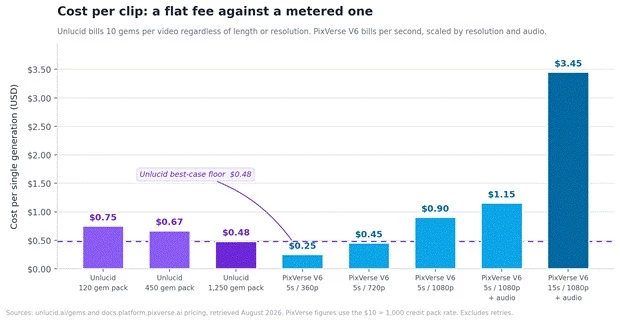
Figure 1. Per-generation cost at published rates. Unlucid bills a flat ten gems per video; PixVerse V6 bills per second of output.
The retry multiplier reshapes the comparison. Applying the two-to-five attempts creators commonly report produces the following monthly picture for a schedule of thirty posted clips.
| Scenario | Unlucid (1,250 pack) | PixVerse 5s / 720p | PixVerse 5s / 1080p + audio |
| Single generation | $0.48 | $0.45 | $1.15 |
| Two attempts per keeper | $0.96 | $0.90 | $2.30 |
| Three attempts per keeper | $1.44 | $1.35 | $3.45 |
| 30 posted clips, three attempts | $43.20 | $40.50 | $103.50 |
The math flatters neither platform. At matched settings around 720p the two land within cents of each other, and PixVerse is marginally cheaper. Divergence only opens up when output specification rises, and that is precisely where Unlucid cannot follow, because it does not publish a resolution ceiling or offer a 1080p toggle to pay for. The premium PixVerse charges buys a specification Unlucid does not sell at any price.
Blind pairwise voting is the least gameable quality signal available for generative video. On the Artificial Analysis image-to-video arena, PixVerse V6 records an Elo of 1327, fifth among models evaluated without audio, behind Gemini Omni Flash, MiniMax H3, Dreamina Seedance 2.0 and Grok's imagine-video model.
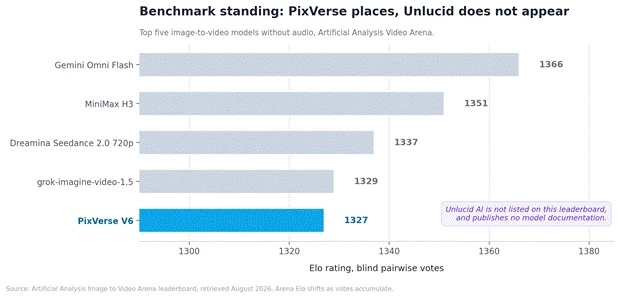
Figure 2. Top five image-to-video models by arena Elo, silent track. Standings shift as votes accumulate.
Fifth place is a genuine result rather than a marketing one, and it arrives with a caveat the leaderboard itself makes explicit: arena standings move week to week as new models enter and votes accumulate. PixVerse ranks materially lower on the audio-enabled track than on the silent one, which lines up precisely with the creator reports about lip sync inconsistency.
Unlucid AI does not appear on the leaderboard at all. That absence is not evidence of poor output. It does mean no independent, blind, third-party quality signal exists for the platform, and every assessment that does exist comes from individual reviewers testing under uncontrolled conditions with prompts and settings that cannot be reproduced. For a creator committing a month of production to a tool, the difference between a measured fifth place and no measurement is substantial.
Short-form video is published to platforms that run their own enforcement. Tool choice therefore carries downstream risk that specification tables do not capture.
Unlucid positions itself explicitly as an uncensored creative platform, and its public effects gallery includes adult-oriented presets alongside the mainstream ones. For a creator making personal work, that permissiveness is the product's core appeal and the stated reason a segment of its user base chose it over filtered alternatives. For an agency, a brand account, or anyone generating on a work device, it is a material consideration: the tool appears in browser history, in expense records, and in any audit of the production stack.
Transparency compounds the question. Independent domain-trust services flag limited published ownership and company information. In fairness, the platform's current privacy policy does specify that uploaded material is held in cloud storage for up to 48 hours after processing before automatic deletion, and its terms address ownership of generated content and prohibited uses. That is more disclosure than older reviews credit. Company-level detail nonetheless remains thinner than established software vendors publish.
PixVerse runs the opposite posture. Moderation is strict enough that creators regularly report ordinary photographs rejected by the content filter, which reads as a workflow irritation rather than a distribution risk. Paid tiers carry commercial usage rights and remove watermarks, while the free tier does neither, making it unsuitable for monetized output. The recurring complaints against PixVerse concern billing rather than content: cancellation friction, refund handling, and credits consumed by generations that failed to complete.
Both platforms carry thin formal review coverage relative to their usage, which is common across consumer AI video and worth stating plainly. Each holds a single review on G2 at the time of writing, a sample far too small to weigh.
Aggregated creator feedback compiled in this overview of Unlucid AI user reviews places the platform at 3.2 out of 5 across seven weighted categories. Creative freedom scores highest at 4.5, reflecting the reference-image support and relaxed filtering that draw users in. Safety and trust score lowest at 2.0, with professional readiness at 2.5 and video capabilities specifically at 3.0. The shape of that scorecard is internally consistent: users like what the platform allows and distrust what it does not disclose.
PixVerse sentiment splits along a different axis. App store ratings are strong and volume is high, driven by the template effects that produced the platform's viral moments. Trustpilot feedback runs considerably more cautious, and the complaint categories cluster tightly around billing rather than output: unexpected charges, cancellation difficulty, and credits spent on generations that errored out mid-render. Creator forums add a consistent practical note about prompt adherence, with simple instructions occasionally producing unrelated results and consuming credits in the process.
Read together, the two sentiment profiles describe different risks. The risk with Unlucid is that the output will not be good enough, or that the platform will not be around. The risk with PixVerse is that the output will be good and the bill will be larger than planned.
| Dimension | Weight | Unlucid AI | PixVerse |
| Output Fidelity | 25% | 5.0 | 8.5 |
| Motion and Coherence | 20% | 5.5 | 8.0 |
| Format and Duration Control | 15% | 4.0 | 9.0 |
| Iteration Economics | 15% | 6.5 | 6.0 |
| Distribution Safety | 15% | 3.0 | 8.0 |
| Workflow Depth | 10% | 3.5 | 9.0 |
| Weighted overall | 100% | 4.7 / 10 | 8.1 / 10 |
Iteration economics is the single dimension Unlucid takes, and it takes it narrowly. Every other dimension favors PixVerse, and the three that decide whether a clip ships (fidelity, format control and workflow depth) favor it by wide margins.
| Creator profile | Better fit | Reasoning |
| Daily Reels or Shorts posting | PixVerse | Native 9:16, per-second duration control and watermark-free paid output |
| Client or agency campaign work | PixVerse | Commercial licensing clarity, documented specifications, procurement-friendly vendor detail |
| High-volume concept testing | Unlucid AI | Flat per-video fee makes a hundred throwaway attempts financially predictable |
| Effect-driven viral formats | Either | Both ship one-click template libraries; PixVerse output resolves higher |
| Dialogue or voiced content | PixVerse | Native audio and lip sync exist, though both warrant a review pass |
| Automated or batch pipelines | PixVerse | Documented API, CLI and Canvas; Unlucid publishes no developer access |
| Content outside standard filters | Unlucid AI | Permissive policy is the platform's defining feature and its stated draw |
| Brand-managed social accounts | PixVerse | Effect library and transparency profile make Unlucid difficult to approve |
For short-form video specifically, PixVerse is the stronger tool and the gap is not close. It scores 8.1 against 4.7 on the Scroll-Stop Readiness Framework, and it wins on every dimension that decides whether a clip ships: native 1080p, per-second duration control, nine-by-sixteen as a first-class format, deliberate loop points through start and end frame control, and a documented workflow that survives contact with a posting calendar.
Unlucid takes one dimension outright. A flat ten-gem fee is the better economic model when the work is high-volume experimentation and output specification does not matter, and the preset effects library removes the hardest part of short-form generation by pre-authoring the motion. Those are real advantages, narrowly scoped.
The honest framing is that these two are not competing for the same job. Unlucid is a sandbox: fast, permissive, cheap per attempt, and structurally incapable of anchoring a production calendar because it does not publish the specifications a calendar depends on. PixVerse is production tooling with a consumer front end, priced accordingly, and carrying billing complaints that deserve attention before a subscription starts rather than after.
A creator posting three times a week to Reels or Shorts should budget for a mid-tier PixVerse plan and expect real cost to land near three times the sticker figure once retries are counted.
A creator experimenting with visual ideas, working outside the content restrictions other platforms enforce, or generating for personal rather than commercial use will find Unlucid's flat pricing and effect library the better fit for that specific work. Anyone choosing between them on output quality alone has already been given the answer: only one of the two submits to independent measurement.
Share your thoughts about this article.
Be the first to post a comment!

How this comparison was builtEvery price, limit, credit rule and feature stateme...
Sakshi Dhingra3 days ago

Gening AI is free, needs no login, and forgets everything the moment you close t...
Nitin5 days ago

My Quick Answer: If you want the single best free collage maker right now, I rec...
Sakshi Dhingra6 days ago

Transparency note before you read further. I have not performed hands on testing...
Deepak Mehra6 days ago

OpenFuture AI is not an app that edits photos or writes copy. It is a directory:...
Harpreet Singh1 week ago

Meta has released Muse Glimmer, a 30-billion-parameter open-weight AI model desi...
Nitin1 week ago