Free anime streaming platforms are often discussed in fragments, safety here, legality there, features somewhere else. What’s usually missing is a single, complete evaluation that looks at everything together: access, quality, reliability, risk, and long-term viability.
This article does exactly that for Zoro TV and the broader network of sites now associated with the “Zoro” name.
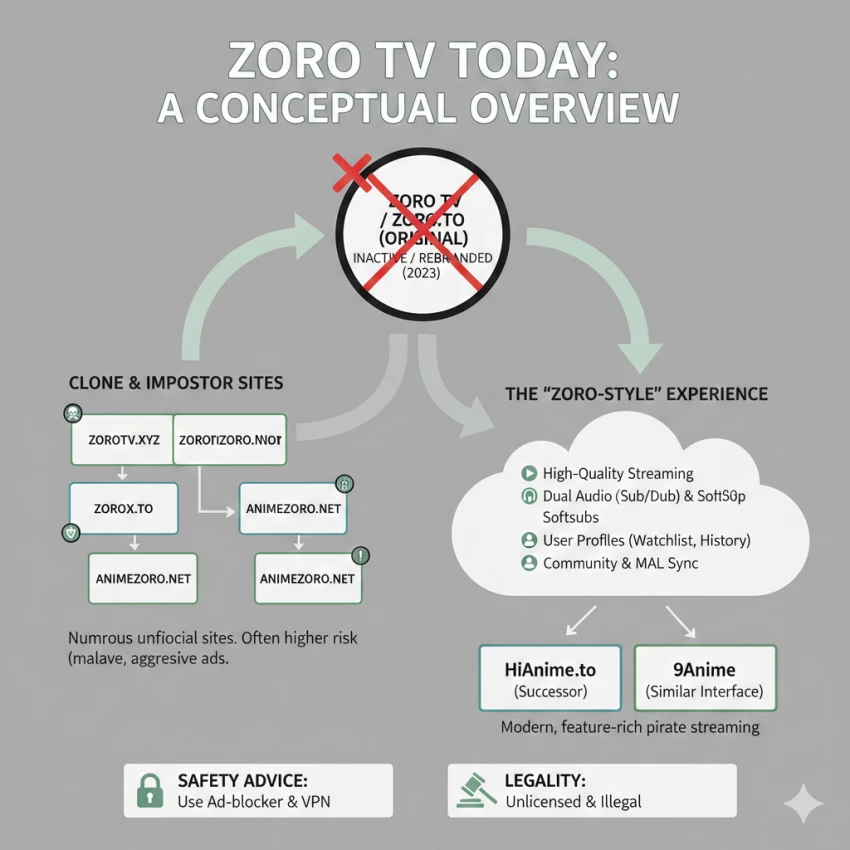
Zoro TV is no longer a single, stable website.
The original Zoro.to, once one of the most visited anime piracy platforms globally, no longer exists in its original form. What remains is:
When people say “Zoro TV,” they usually mean any site that looks and behaves like the old Zoro.to.
From a pure accessibility standpoint, Zoro-style sites score extremely high.
This frictionless access is the single biggest reason these platforms continue to attract traffic, even in 2025.
Trade-off:
The lack of accounts also means:
In terms of sheer volume, Zoro-style platforms outperform most legal services.
Typical coverage includes:
This broad coverage is why many users treat Zoro TV as a “fallback library” when content is missing from paid platforms.
Weakness:
Large library ≠ reliable library.
What works well
Where it breaks down
The video itself is usually fine.
The surrounding interface is where frustration accumulates.
Zoro-style sites are popular partly because the UI is familiar and efficient.
Common elements include:
However, UI consistency is fragile:
This makes Zoro TV usable for short-term viewing, not long-term tracking.
Zoro TV is free, but it is not cost-free.
Typical monetization methods:
Most negative user feedback is not about anime quality, but about:
In practical terms, users “pay” with:
It’s important to be accurate, not sensational.
Lower-risk actions
Higher-risk actions
Security complaints almost always trace back to ad networks, not the anime files themselves.
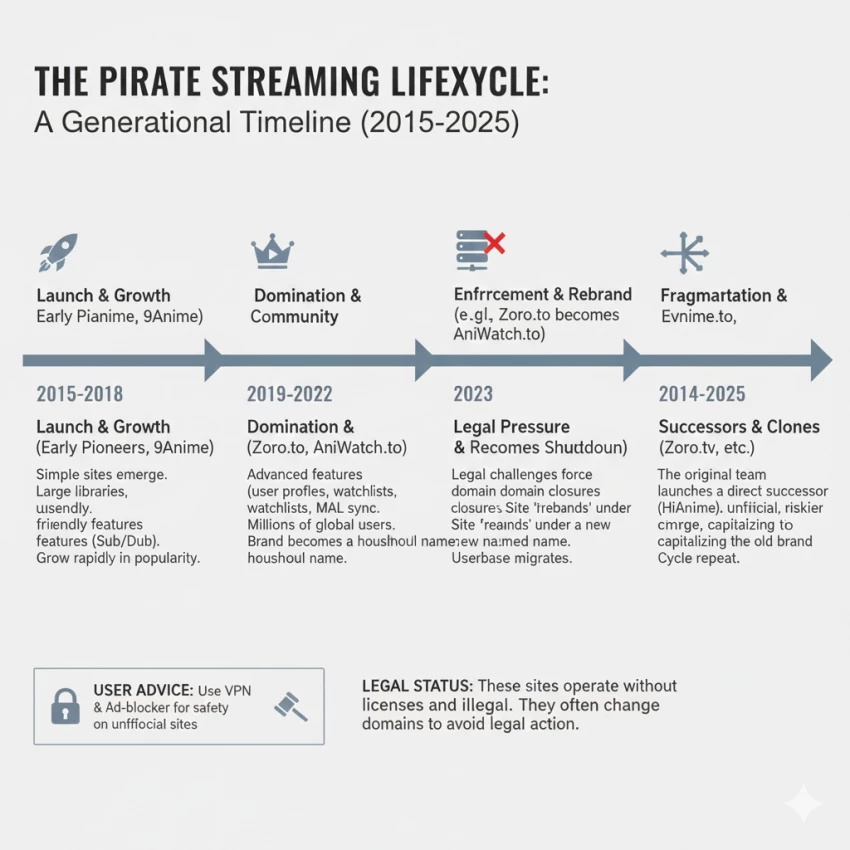
Zoro TV and its clones operate without content licenses.
As a result:
This instability is structural, not accidental.
If a site becomes too popular, it attracts attention, and eventually disappears.
| Factor | Zoro-Style Sites | Legal Platforms |
| Cost | Free | Paid |
| Library size | Very large | Limited by licenses |
| Stability | Unstable | High |
| Safety | Variable | Strong |
| Longevity | Short-term | Long-term |
Legal platforms like Crunchyroll or Netflix trade breadth for stability, safety, and accountability.
Zoro TV trades stability for access.
It may suit:
It does not suit:
Zoro TV exists because of unresolved gaps in the legal streaming ecosystem:
Until those gaps close globally, platforms like Zoro TV will continue to reappear under new names.
Zoro TV is neither a miracle nor a scam.
It is a temporary solution:
Used with awareness, it functions as a stopgap.
Used without caution, it becomes frustrating, or risky.
Understanding that balance is the key to evaluating Zoro TV honestly.
Be the first to post comment!
Few software websites have survived as many internet eras as Softonic. Launched...
Suraj Malik2 days ago
PDF files are everywhere, from business contracts and academic papers to invoice...
Suraj Malik5 days ago
The Xender APK has remained relevant for one simple reason: it solves a very rea...
Sakshi Dhingra6 days ago
In January 2026, something happened in AI that didn’t feel like a product launch...
Suraj Malik1 week ago
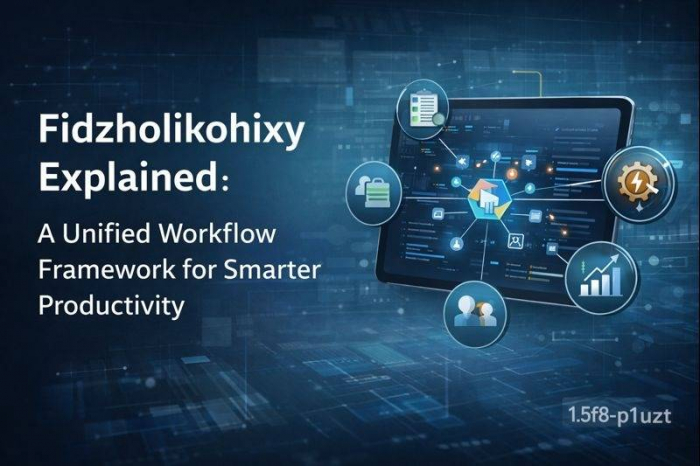
1. Meaning of Fidzholikohixy :Fidzholikohixy refers to a conceptual product...
Cheshta Upmanyu1 week ago
1) What Chub Venus AI is?➔ Platform purpose and core concept-Chub (and “Ven...
Cheshta Upmanyu1 week ago