
Not long ago, a buyer looking for new software opened Google, skimmed ten blue links, and clicked around for an afternoon. That habit is fading fast. Today a growing share of your buyers open ChatGPT or Perplexity, type something like “best CRM for a mid-market SaaS team,” and read a short, confident answer that names three or four tools. If your product is one of those names, you often win the deal before a sales rep says a word. If it is not, you are usually invisible.
Gartner expects traditional search volume to fall by around 25% as people shift to AI assistants and chatbots. Search Engine Land has reported that roughly 85% of AI-referred web traffic now comes through ChatGPT, with Perplexity and Google’s AI answers splitting most of the rest. The takeaway is simple: getting cited by these engines is no longer a nice-to-have. It is turning into the front door for SaaS discovery.
The good news is that citations are not random, and they are not a black box you have to pray at. They follow patterns you can measure and influence. This guide walks through exactly how the engines decide who to quote, why ChatGPT and Perplexity behave so differently, and a seven-step process you can start this week.
Traditional SEO rewarded links and keywords. AI engines work differently. Most of them use retrieval-augmented generation (RAG): before writing an answer, the model searches a set of indexed sources, then composes a reply from the passages it trusts most. Think of it as a research assistant who reads first and writes second. Three forces decide whether your brand makes the cut.
AI systems look for agreement. When several unrelated places describe your product the same way, your review profile, a few listicles, a Reddit thread, a YouTube walkthrough, and your own site, the engine gains confidence and cites you. Research summarized by Profound and Semrush describes this as a consensus signal. If you only exist on your own website with no outside validation, the model treats your claims with suspicion and skips you.
These models care whether they understand what your company is, not just how many links point at it. Ahrefs analyzed 75,000 brands and found that brand-mention frequency correlates with AI answer presence at roughly three times the strength of backlinks. Branded search volume and branded anchor text predicted visibility better than classic Domain Rating. Being a familiar, well-defined entity in the training corpus beats being a link target.
A model can only quote a sentence it can lift cleanly. A statistic buried in a long paragraph gets extracted less often than the same number in a table row or a bolded standalone claim. A University of Tokyo and Tsukuba study in 2026 found that structural changes alone, independent of the actual writing, produced a consistent 17.3% lift in citation rates across six engines. How you format matters almost as much as what you say.
This is the mistake that sinks most GEO efforts. People optimize for “AI search” as if it were one thing. In practice the two biggest engines pull from almost opposite source pools. One brand audited in early 2026 appeared in 18 of 25 priority queries on ChatGPT and just 2 of 25 on Perplexity, with the exact same content. The difference was a strong Wikipedia entity and Forbes mentions on one side, and zero Reddit presence on the other.
Here is how the two engines differ in what they reward.
| What it favors | ChatGPT | Perplexity |
| Top source type | Wikipedia (~48% of top citations), plus Forbes, NYT and established trade press | Reddit (~47% of top citations), fresh blog posts and original research |
| Content recency | Rewards “this week,” leans on a Bing-powered retrieval layer | Rewards “this month,” runs real-time retrieval on almost every query |
| Your own site | Weighs page clarity and crawler access more heavily | Weighs third-party evidence more heavily |
| Citation density | Cites fewer sources per answer | Cites roughly 3x as many sources per answer, so more open slots |
| Where to invest | Wikipedia entity, editorial PR, fast well-structured pages | Reddit and community presence, review sites, frequent fresh content |
Table 1. ChatGPT and Perplexity reward different signals. Treat them as two channels with a shared content foundation.
A useful way to picture this: Perplexity leans on third-party content, so evidence work pays off there. ChatGPT leans on your own site and consensus references, so page clarity, a Wikipedia presence, and crawler access matter more. Run both jobs and every engine improves at once.
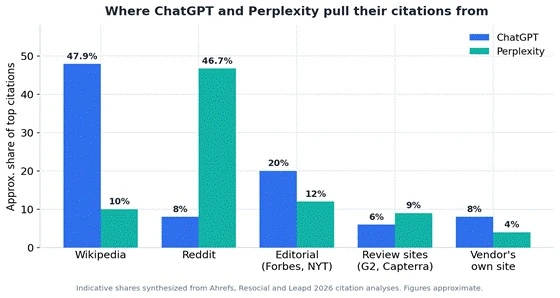
Figure 1. Approximate share of top citations by source type. ChatGPT skews to Wikipedia and editorial media; Perplexity skews hard to Reddit. Shares are indicative, synthesized from 2026 citation analyses by Ahrefs, Resocial and Leapd.
You do not need to do everything at once. Work through these in order. The early steps tell you where you stand and fix the foundations; the later steps compound over time.
You cannot improve what you have not measured. Before changing anything, run your real buyer questions through both engines and write down what happens.
Your core metric here is AI visibility: the percentage of category-relevant answers that mention you. If you are named in 4 of 20 answers, that is 20%. Now you have a baseline to beat.
If the engines do not clearly understand who you are, nothing else you do will land. This is the highest-leverage foundation, and most teams skip it.
A note on schema: it helps engines parse you, but do not expect magic from the markup alone. Search Engine Roundtable confirmed that ChatGPT and Perplexity read structured data much like ordinary page text. Semantic clarity is what moves the needle. Schema simply makes that clarity easier to read.
This is the consensus signal in action. AI engines trust what many independent sources say about you far more than what you say about yourself. One analysis put brand-owned About, FAQ, and Home pages at just 4.5% of branded citations, less than a tenth of what reviews and social proof contribute.
Think of it as two jobs running in parallel: earn the third-party evidence the engines trust, and make your own pages the source they quote. The next step handles that second job.
This is where the most reliable research comes in. The Princeton and Georgia Tech GEO study (Aggarwal et al., ACM KDD 2024) tested nine content tactics across roughly 10,000 queries on a generative engine pipeline, then validated the findings on Perplexity. Five tactics clearly increased citation rates. Two actively hurt.
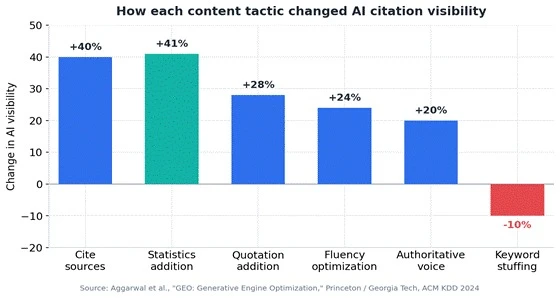
Figure 2. Impact of content tactics on AI citation visibility, from the Princeton / Georgia Tech GEO study (KDD 2024). Adding statistics and citing sources were the strongest levers. Keyword stuffing lowered visibility.
Translated into things you can do this week:
One structural detail worth repeating: how a statistic appears matters as much as its presence. The same data point extracts far better as a table row or an isolated bold claim than when it is buried mid-paragraph. Put your best numbers where a machine can grab them.
Content and evidence do most of the work, but a few technical factors quietly gate everything. The most striking is speed.
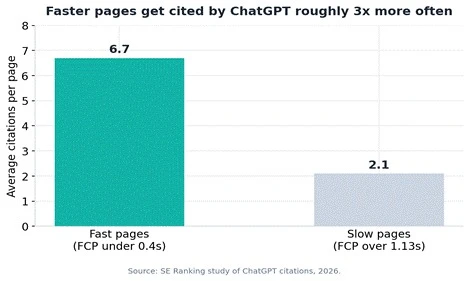
Figure 3. Faster pages get cited far more often. SE Ranking found pages with First Contentful Paint under 0.4 seconds averaged 6.7 ChatGPT citations, versus 2.1 for pages slower than 1.13 seconds.
Alongside speed, cover these:
With the foundation in place, split your effort to match each engine’s citation DNA. The table below turns the earlier differences into a short action list.
| Priority | For ChatGPT | For Perplexity |
| Top move | Secure a Wikipedia entity and keep it accurate | Build honest Reddit and community presence |
| Media | Earn editorial mentions in Forbes and trade press | Publish fresh original research and blog posts often |
| On-site | Prioritize page speed, clarity and crawler access | Add visible statistics and named, verifiable sources |
| Cadence | Refresh key pages to stay current | Update very frequently; it rewards “this month” |
Table 2. A short per-engine action list built on the same content foundation.
Citations move. Studies have observed AI citations fluctuating 40% to 60% month over month, so consistency of signal matters as much as the initial push. Treat AI visibility like any other channel: measure it on a schedule and act on what you see.
| Metric | What it tells you | Target direction |
| AI visibility | Share of category answers that mention you | Steadily up |
| Citation rate | Share of relevant answers that cite your content | Steadily up |
| Share of voice | Your mentions versus competitors | Gaining on rivals |
| Sentiment | How the engine describes you when it does | Accurate, positive |
| Referred conversions | Revenue from AI-referred visits | Up, and tracked |
Table 3. The five metrics worth watching. Re-run your prompt set monthly and compare against your Step 1 baseline.
Doing this by hand across hundreds of prompts gets painful quickly. A category of GEO monitoring tools now tracks brand mentions across many engines and benchmarks you against competitors. Whether you use a tool or a spreadsheet, the discipline is the same: fixed prompt set, fixed schedule, honest comparison.
This is a compounding channel, not an overnight switch. Most SaaS teams that implement the fundamentals see initial citations within two to four weeks, with citation density building over three to six months as the evidence layer thickens and engines re-crawl. Perplexity can react within hours because it retrieves in real time, while ChatGPT tends to surface new content after indexing catches up. Set expectations accordingly and keep the baseline you recorded in Step 1 close by, because the honest before-and-after comparison is what keeps the effort funded.
• Treating both engines as one channel. You can be everywhere in ChatGPT and nowhere in Perplexity with identical content.
• Polishing your own pages while ignoring outside evidence. Your own site is a small slice of branded citations. Reviews and independent coverage do the heavy lifting.
• Chasing keywords. Stuffing measurably lowers visibility. Write for a human and format for a machine.
• Skipping the entity layer. Thin entity signals mean you get passed over no matter how well you rank in Google.
• Optimizing once and walking away. Citations drift month to month. Consistency beats a single big push.
Getting cited by ChatGPT and Perplexity comes down to two jobs done together: earn the independent evidence these engines trust, and make your own pages the cleanest source they can quote. Understand who you are as an entity, back it with reviews and third-party coverage, write pages packed with sourced statistics and standalone claims, keep them fast and fresh, and measure the results every month against a baseline. Do that consistently and you stop hoping the AI mentions you, and start showing up in the answer your buyer reads first.
Share your thoughts about this article.
Be the first to post a comment!