Relay.app spent five years building AI-powered workflow automation as an alternative to Zapier. On July 16, 2026, its homepage was replaced with a single line saying the service was shutting down. Free accounts stopped working on August 15. Paid customers had until September 14 to rebuild every automation somewhere else.
That sequence plays out across the AI tool market every month. A product launches, builds a loyal user base, then vanishes with a few weeks of warning and takes stored work and configured workflows along with it. Big names are not exempt. OpenAI announced the end of its Sora video app on March 24, 2026, roughly six months after launch.
Most of these closures were visible well before the announcement. Pricing pages change. Changelogs go quiet. Founders update their LinkedIn profiles. A model provider ships the same feature for free. This guide turns those scattered clues into a repeatable check called the DURABLE Framework, so a buyer can judge a tool's odds before handing over a budget line or a team's daily process.
Quick answer An AI tool is likely to fail within a year when it resells a single model with a thin interface on top, charges flat prices for compute-heavy work, shows falling traffic, and does something a model provider or large software suite could add as a feature. Poor data export makes the damage worse when it happens. The seven DURABLE signals below score each of these risks out of 100. |
The AI market in 2026 runs on two contradictory numbers. Venture investment reached a record $412.7 billion in the first half of the year, up 30 percent, according to Crunchbase and PitchBook figures cited by SimpleClosure. In the same period, SimpleClosure, a firm that manages company wind-downs, handled more shutdowns than it did in the first half of 2025. Money is flowing in and companies are closing at the same time, which tells a buyer that funding headlines are a poor guide to survival.
AI companies made up 14.4 percent of all SimpleClosure shutdowns in H1 2026, down from 15.9 percent across 2025 and 17.7 percent in 2024. The falling share can look reassuring, but it is a share of a growing pile. More closures overall means the absolute number of dead AI products keeps climbing.
The more revealing figure is the money left in the bank at closure. The median B2B SaaS company shut down with $11,900 remaining, and one in five hit zero. The median AI company closed with $30,000. AI founders are often choosing to stop before the cash runs out, usually because growth stalled or a bigger platform made the product pointless. A tool can have a recent funding round and still be one board meeting away from closing.
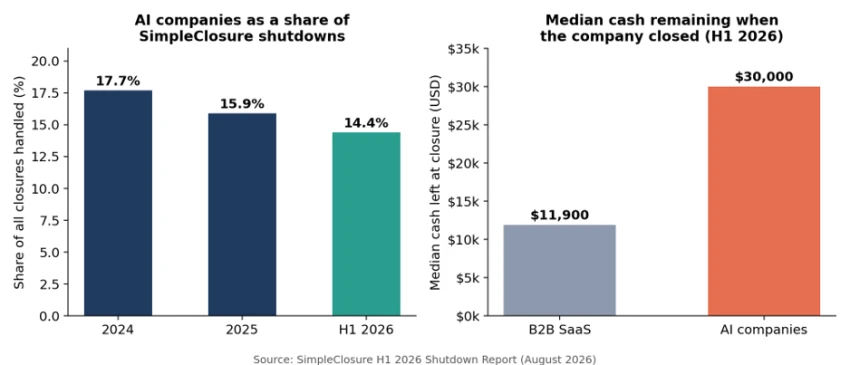
Figure 1: AI companies' share of SimpleClosure shutdowns and median cash at closure. Source: SimpleClosure H1 2026 Shutdown Report.
Traditional software costs almost nothing to serve to one more customer. AI software does not work that way. Every prompt runs a model, and every model call costs money in GPU time. ICONIQ's January 2026 State of AI report found that inference alone averages about 23 percent of revenue at scaling-stage AI B2B companies.
The result shows up in gross margins. ICONIQ puts the average AI product gross margin at 41 percent in 2024 and 45 percent in 2025, with projections of about 53 percent for 2026 and 59 percent for 2027. Bessemer Venture Partners places AI gross margins at 50 to 60 percent against 80 to 90 percent for classic SaaS.
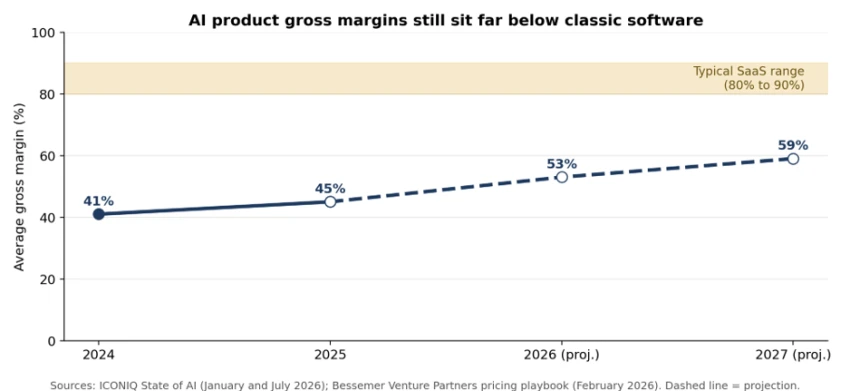
Figure 2: Average AI product gross margins versus the typical SaaS range. Sources: ICONIQ, Bessemer Venture Partners.
For a buyer, this matters because thin margins force pricing changes. When heavy users cost more to serve than they pay, a company has two options: raise prices and cap usage, or burn cash until the next funding round. GitHub Copilot moved to usage-based billing on June 1, 2026, a sign that even well-funded products cannot keep flat pricing on compute-heavy features. Smaller tools that keep offering unlimited plans on video, image, voice or agent workloads are usually subsidizing those plans with investor money.
Few AI startups die through a formal bankruptcy. A European Corporate Governance Institute study found that most failed startups never reach a formal bankruptcy. They are sold off for parts or quietly wound down, and many never make the news. The most visible version is the reverse acqui-hire, where a large company hires the founders and licenses the technology while the product itself is left behind.
Microsoft did this with Inflection. Google did it with Character.AI and Windsurf. Amazon did it with Adept and Covariant. Relay.app followed a similar path when its founder and part of the team joined Google's Chrome division. For customers, a reverse acqui-hire often means the product keeps running on a skeleton crew for a few months before the lights go off.
Looking back at recent closures, the warning signs were rarely hidden. The table below lists six notable cases alongside the signal that appeared before each announcement.
| Product | What it did | End of service | Reported cause | Visible warning sign |
|---|---|---|---|---|
| Sora app (OpenAI) | Consumer AI video app with a social feed | Announced Mar 24, 2026; app offline Apr 26, 2026 | High running costs and a shift toward business tools | Installs and in-app spending fell month over month; December 2025 downloads dropped 32% from November |
| Relay.app | AI agent workflow automation | Free tier Aug 15, 2026; paid plans Sep 14, 2026 | Large platforms added similar automation; team joined Google | OpenAI and Google shipping native agent and automation features |
| Yupp | Free playground comparing 800+ models side by side | March 2026 | Founders said product-market fit never became strong enough | Free product with crypto rewards and no obvious paying customer |
| Humane AI Pin | Wearable AI assistant | Feb 28, 2025 (devices stopped working) | Assets sold to HP for $116 million | Harsh reviews and reports of returns outpacing sales |
| Builder.ai | AI-assisted custom app development | Insolvency filing, May 2025 | Revenue overstatement and a creditor seizing funds | Reports that much of the 'AI' work relied on human engineers |
| Google dark web report | Breach monitoring for Google One users | Scans stopped Jan 15, 2026; data deleted Feb 16, 2026 | Google said the tool did not offer useful follow-up steps | Low engagement with a feature bundled into a larger plan |
Two patterns stand out. First, the size of the parent company offered no protection. OpenAI and Google both closed products with active users. Second, notice periods were short. Humane owners got about ten days before their devices stopped working. Relay's free users got 30.
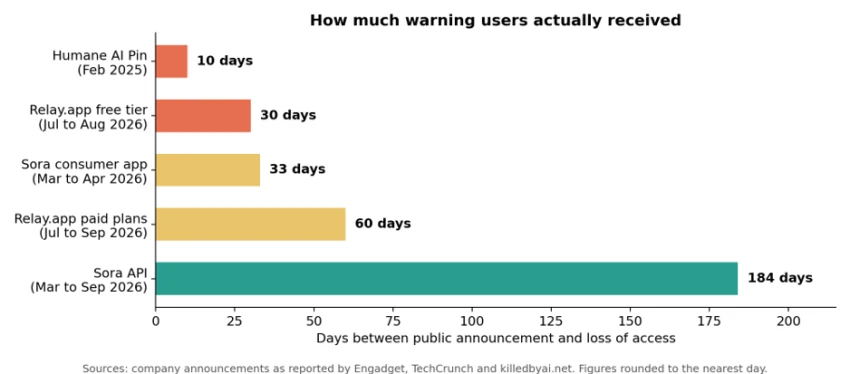
Figure 3: Days between each public shutdown announcement and the point where users lost access.
What the notice data means A month of warning is the norm, not the exception. Any tool that stores work a team cannot recreate in 30 days needs a tested export routine long before trouble appears. |
DURABLE is an acronym for the seven areas worth checking. Each carries a weight based on how strongly it predicted the failures reviewed for this guide. Absorption risk gets the most weight because it was the single most common cause of death in the 2025 and 2026 closures.
| Letter | Signal | Core question | Weight |
|---|---|---|---|
| D | Dependency on one model provider | Does the product still exist if its model supplier changes terms or ships a competing feature? | 15 |
| U | Unit economics | Does the pricing cover the compute each customer consumes? | 15 |
| R | Retention and real usage | Are traffic and community activity growing or shrinking? | 15 |
| A | Absorption risk | Could a model provider or big software suite add this as a free feature? | 20 |
| B | Backing and runway | When did the company last raise money, and how long ago was that? | 10 |
| L | Leadership and team activity | Are founders still there, and is the team still shipping? | 10 |
| E | Exit readiness | Can users get their data out cleanly if the tool closes? | 15 |
| Total | 100 |
A tool that sends every request to one external model and wraps the answer in a nicer interface has little of its own. Google Cloud VP Darren Mowry warned in February 2026 that startups wrapping thin intellectual property around Gemini or GPT-5 face extinction. The practical test is simple: if the model provider revoked the API key tomorrow, would anything valuable be left?
How to check:
Nobody outside a company sees its books, but the pricing page gives away a lot. Flagship model APIs in 2026 charge around $5 per million input tokens and $30 per million output tokens at the top end. A tool charging $9 a month for unlimited long-form generation or unlimited video is almost certainly losing money on its heaviest users.
The Internet Archive's Wayback Machine makes pricing history easy to check. Pulling up the pricing page from six and twelve months ago takes about two minutes.
Sora topped the US App Store after launch, then faded. Analytics firm Appfigures reported successive monthly declines in installs and spending at the start of 2026, and December downloads were down 32 percent from November, a month when most apps grow. The decline was public months before the shutdown.
Absorption risk is the chance that a much larger company adds the tool's main feature to a product people already pay for. It carries the highest weight in the framework because it killed more tools in 2025 and 2026 than any other cause. Custom GPTs wiped out dozens of simple chatbot builders. When ChatGPT added voice and memory, several standalone assistants lost their reason to exist. Relay.app lost ground as OpenAI and Google built agent automation into their own tools.
The check takes five minutes. Open ChatGPT, Gemini, Claude and Microsoft Copilot, then the suites a team already uses, such as Microsoft 365, Google Workspace, Canva, Notion or Adobe, and try to do the same job. If the built-in version gets 80 percent of the result, the standalone tool is exposed.
Tools that survive absorption usually own something the giants lack: a regulated niche, a proprietary dataset, deep integration into an industry workflow, or a customer base too specialized for a large platform to chase.
Funding is the weakest predictor on its own, which is why it carries only 10 points. The SimpleClosure data shows AI companies often close with cash still in the bank. Still, time since the last raise matters. Most seed and Series A companies plan for 18 to 24 months of runway, so a tool that last raised money two years ago and has announced nothing since is in a delicate window.
Teams leave before products do. LinkedIn shows headcount trends on company pages, and founder profiles often change months before an announcement. The Relay.app founder joined Google soon after the shutdown notice, a pattern repeated in most reverse acqui-hires.
Exit readiness does not predict whether a tool will close. It predicts how much a closure will hurt. Humane customers had about ten days, and many lost stored data. Google deleted dark web report data one month after the scans stopped. A tool with clean export and a written shutdown policy turns a crisis into an afternoon of work.
The audit below runs the seven signals in the most time-efficient order. It needs only free or freemium research tools and a browser. Record the points for each signal as the audit goes.
Write one sentence describing what the tool does that a user would pay for. 'Turns meeting recordings into action items' is a core job. 'AI-powered productivity platform' is marketing copy. If the core job cannot fit in one plain sentence, that is already a mild warning.
Take the core job to ChatGPT, Gemini, Claude and Microsoft Copilot, plus any suite the team already pays for. Try the same task with the same input. Score the A signal: 16 to 20 points if no general tool comes close, 8 to 15 if the general tool is noticeably worse, 0 to 7 if it is roughly as good.
Note any unlimited offers or lifetime deals. Then load the same page in the Wayback Machine from six and twelve months ago. Score the U signal based on how sustainable the pricing looks and how often it has changed.
Pull the 12-month traffic chart from Similarweb or Semrush, or app estimates from Appfigures for mobile products. Check the date of the latest community post and the last ten reviews. Score the R signal.
Look up the last funding round on Crunchbase and the headcount chart on LinkedIn. Scan the founders' profiles. Score the B and L signals together, since they draw on the same sources.
Review the changelog, status page, model settings and security page. Find out which model providers power the product and whether any in-house technology exists. Score the D signal and adjust L if the changelog has stalled.
Export a sample project and open the file. Search the terms of service for 'termination', 'discontinue', 'notice' and 'data retention'. Score the E signal.
The table lists the research tools used across the audit.
| Tool | What it shows | Used in step | Cost |
|---|---|---|---|
| Wayback Machine (web.archive.org) | Past versions of pricing and feature pages | 3 | Free |
| Similarweb | Monthly web visits and traffic trend | 4 | Free tier with limits |
| Semrush or Ahrefs | Organic traffic trend and branded search volume | 4 | Paid, trial available |
| Appfigures or Sensor Tower | App downloads and revenue estimates | 4 | Limited free data |
| Crunchbase | Funding rounds and investors | 5 | Free tier with limits |
| LinkedIn company page | Headcount growth and departures | 5 | Free |
| Google Trends | Search interest for the brand name over time | 4 | Free |
| Product status page and changelog | Outage history and release cadence | 6 | Free |
Add the points from all seven signals for a total out of 100. The table sets out what full marks and zero marks look like for each signal, which keeps scoring consistent when more than one person runs audits.
| Signal | Max | Full marks look like | Zero marks look like |
|---|---|---|---|
| Dependency | 15 | Multiple model providers or proprietary data | One API and outages that mirror the provider |
| Unit economics | 15 | Usage-based pricing, stable for 12 months | Lifetime deals or unlimited plans on video or agents |
| Retention | 15 | Traffic flat or growing and recent positive reviews | Traffic down 30%+ in a year and a dead community |
| Absorption | 20 | Serves a niche no large platform will chase | ChatGPT or a suite already does the job equally well |
| Backing | 10 | Profitable, or raised within 12 months | No news for 24+ months, or recent layoffs |
| Leadership | 10 | Founders in place and weekly releases | Founders gone, changelog silent for months |
| Exit readiness | 15 | Full export and a written notice commitment | No export and no shutdown clause |
| Score | Band | Recommended action |
|---|---|---|
| 80 to 100 | Durable | Annual billing is reasonable. Re-run the audit every six months. |
| 60 to 79 | Watch | Stay on monthly billing. Re-audit every quarter and keep exports current. |
| 40 to 59 | At Risk | Export data monthly, document all prompts and settings, and shortlist a replacement. |
| Below 40 | Plan the exit | Avoid prepaying. Move critical work to an alternative within 90 days. |
Tools that sit inside a daily, revenue-linked workflow deserve stricter treatment. For those, a score of 60 to 79 should be handled as At Risk, because the cost of a surprise shutdown is much higher.
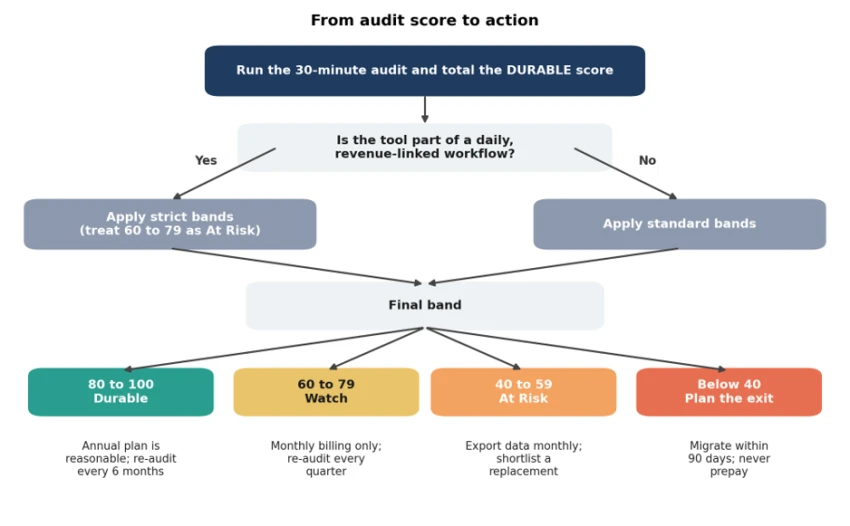
Figure 4: Decision flow from DURABLE score to action.
The two tools below are composites built from common patterns, not real products. Tool A is a generic AI headline writer sold on a $7 unlimited plan with a lifetime deal. Tool B is an AI contract review product built for mid-sized law firms, trained on a licensed clause library, with usage-based pricing.
| Signal | Max | Tool A: headline writer | Tool B: legal contract review |
|---|---|---|---|
| Dependency | 15 | 3 (single API, no own tech) | 12 (two providers plus a licensed clause dataset) |
| Unit economics | 15 | 4 (unlimited plan plus lifetime deal) | 11 (per-document pricing, one change in a year) |
| Retention | 15 | 6 (traffic down about 35% in 12 months) | 12 (steady traffic, active user forum) |
| Absorption | 20 | 3 (every chatbot writes headlines) | 17 (legal workflow too narrow for suites) |
| Backing | 10 | 5 (small seed round 20 months ago) | 7 (Series A 14 months ago) |
| Leadership | 10 | 4 (changelog quiet for two months) | 8 (monthly releases, fast support) |
| Exit readiness | 15 | 3 (copy and paste only) | 13 (full export and API) |
| Total | 100 | 28: Plan the exit | 80: Durable |
The radar chart makes the difference obvious. Tool A is weak everywhere, but its absorption score alone would sink it. Tool B has soft spots in funding and pricing, yet none of them threaten the product's reason to exist.
Category alone does not decide a tool's fate, but some categories start with a heavier handicap. The ratings below are an editorial assessment based on the shutdown patterns and margin data covered above.
| Category | Absorption risk | Cost pressure | Why |
|---|---|---|---|
| Chatbot wrappers and custom assistants | Very high | Medium | Custom GPTs, Gemini Gems, Claude Projects and Copilot agents cover the core use for free or within existing plans |
| General AI writing assistants | High | Medium | Every major chatbot and office suite now drafts and rewrites text |
| AI meeting note takers | High | Medium | Zoom, Microsoft Teams, Google Meet and Webex ship built-in summaries |
| AI workflow automation | High | High | Model providers are adding agents and connectors directly; Relay.app closed in 2026 |
| Consumer AI video generators | Medium | Very high | Video inference is expensive; even OpenAI closed the Sora app |
| Consumer AI image generators | High | High | Canva, Adobe, Microsoft Designer and the major chatbots include image generation |
| AI companion and character apps | Medium | High | Long conversations are costly to serve; Figgs AI closed over maintenance costs |
| AI coding assistants | Medium | High | Crowded field with heavy compute use; Copilot moved to usage billing |
| Vertical AI for regulated industries | Low | Medium | Legal and medical tools rely on domain data and compliance work giants avoid |
| Area | Red flag | Green flag |
|---|---|---|
| Pricing | Lifetime deal on a compute-heavy product | Usage-based or tiered credits that match real cost |
| Pricing history | Three or more plan changes in six months | Stable pricing with advance notice of changes |
| Product | Core feature available free in ChatGPT or Gemini | Proprietary data, niche workflow or deep integrations |
| Technology | One model API, no choice of provider | Multiple providers or in-house fine-tuned models |
| Usage | Traffic down 30% or more over a year | Flat or growing traffic and branded search |
| Community | Last Discord announcement months ago | Staff answering questions within days |
| Team | Founders listed elsewhere, headcount shrinking | Stable leadership and active hiring |
| Shipping | Changelog silent for a quarter | Regular release notes with real fixes |
| Data | No export or export without history | Full export plus API for backups |
| Terms | No mention of shutdown or data return | Written notice period and data return window |
A low score does not mean dropping the tool today. It means reducing the cost of being wrong. The steps below apply to any tool in the At Risk or Plan the Exit bands.
Move to Monthly Billing
Annual plans and lifetime deals lock money into a product that may not be there to deliver. The discount on an annual plan rarely makes up for losing six unused months.
Export on a Schedule
Set a recurring calendar reminder to export data monthly, and store the files somewhere the team controls. If the tool has an API, a simple scheduled script can handle backups automatically.
Keep Prompts and Settings Outside the Tool
Prompt templates, style guides, brand voice instructions and automation logic are often the most valuable part of a setup and the hardest to rebuild. Keeping a copy in a shared document means a migration takes hours instead of weeks.
Shortlist a Replacement Before It Is Needed
Run the same DURABLE audit on two alternatives and keep the results on file. When a shutdown notice arrives with 30 days of warning, the evaluation work is already done.
Negotiate Exit Terms in Business Contracts
Teams on business or enterprise plans can ask for a minimum notice period and a guaranteed data return window. For critical systems, source code or data escrow is also worth requesting. Vendors confident in their future rarely object to these clauses. Resistance is itself useful information.
No framework can predict with certainty which AI company will still exist a year from now. The goal of the DURABLE Framework is narrower and more useful: identify where the risk is concentrated before a tool becomes difficult to replace.
The clearest warning signs usually appear in combination. A product that depends on one model provider, offers unsustainable pricing, is losing usage, ships updates less often, and can already be replaced by features inside ChatGPT, Gemini, Copilot or another large platform deserves more scrutiny than its homepage, funding announcement or customer count might suggest.
For buyers, the biggest mistake is treating an AI subscription like ordinary software. AI products can carry higher operating costs, move faster, depend heavily on third-party models and become redundant after a single major platform release. That makes vendor resilience and exit readiness part of the purchasing decision, not something to think about after a shutdown notice arrives.
A 30-minute audit cannot eliminate that risk, but it can change how much of it you accept. High-scoring tools can justify deeper integration. Mid-range tools call for shorter billing commitments and regular exports. Low-scoring tools may still be useful, but they should not become the only place where important data, workflows, prompts or institutional knowledge live.
The practical rule is simple: do not judge an AI tool only by what it can do today. Judge it by whether its economics, differentiation, team and data portability give it a reason to still exist tomorrow.
Share your thoughts about this article.
Be the first to post a comment!