Directory listings still attract qualified visitors in 2026, but only on platforms that people actually use for business discovery, comparison or local search. Many directories now provide little or no meaningful traffic, which is exactly why the honest answer has become more useful than the easy one. BrightLocal's 2026 Local Consumer Review Survey reports Google's share of local discovery slipping from 83% to 71% in one year while AI tools leapt from 6% to 45%, reshaping how buyers reach business profiles and websites. The directories that remain valuable are the ones where real buyers browse, compare and decide. The rest are a tax on time and budget. This article explains what separates the two and how any business can measure the difference with data from its own analytics.
Yes, but not uniformly. A relevant directory listing can send direct referral visits, produce profile views that never reach the website, generate leads that happen inside the directory, and in some cases contribute indirect search-visibility benefits. These four outcomes are different, and combining them into a single traffic number hides the only ones that matter commercially.
Some listings receive steady visits because the directory itself has an active audience searching inside it. Others remain inactive because the directory now exists mainly to collect listing fees rather than to serve buyers. Jasmine Directory's 2026 audit reported that nearly three-quarters of general business directory listings now generate zero leads, with that figure projected to reach 80% by year-end. The pattern is not random. It tracks directly to whether a directory has live buyers inside it.
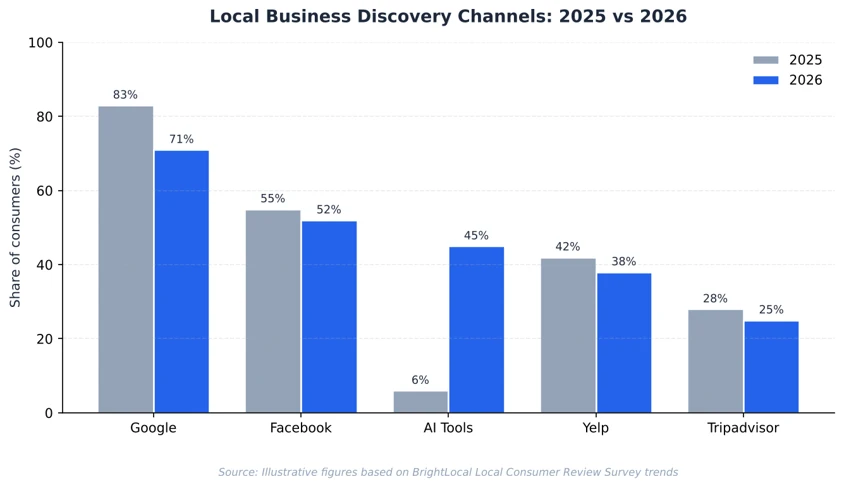
Figure 1. Local business discovery channels, 2025 vs 2026. Illustrative figures based on BrightLocal survey trends.
Qualified traffic does not mean more traffic. It means visitors who are closer to a buying decision when they arrive. A person browsing a category inside a directory has already narrowed the field: they know the type of product, service or company they need. That intent gap is the real reason directory referrals can out-convert generic search visitors.
Four categories of visitor arrive from directories, and only two of them typically convert:
A listing on a general business directory tends to reach the first two groups. A listing on a specialised comparison site such as G2, Clutch or Houzz tends to reach the last two. The directory's audience, category depth and review structure determine which visitor type dominates, not the directory's claimed authority score.
Five directory types still earn their place in a 2026 marketing mix, each for different reasons and with a different main limitation.
| Directory type | Typical audience | Why visitors use it | Best suited for | Main limitation |
|---|---|---|---|---|
| Local business directories | Nearby customers | Find services close by | Location-based businesses | Few website clicks |
| Software review directories | Software buyers | Compare products | SaaS companies | Strong competition |
| Agency / service directories | Business decision-makers | Evaluate providers | Agencies and consultants | Profile quality matters |
| Industry-specific directories | Niche buyers | Find specialist suppliers | B2B and specialist firms | Smaller audience |
| General directories | Broad audience | Discover listed businesses | Limited use cases | Often weak buyer intent |
Table 1. Directory types mapped to audience, intent, best fit and limitation.
Being well known is not the same as being useful. A general directory with a famous name can still send zero qualified traffic to a niche B2B service, while a small industry-specific directory with a tight audience can send a handful of highly profitable buyers each month.
Credibility starts with admitting where directories fail. Listings stall for predictable reasons:
Treating every directory listing as a guaranteed growth lever is how businesses waste months of marketing time. A directory earns its spot each quarter by producing measurable activity, not by appearing on a 2016 list of "top 50 submissions".
A simple evaluation framework filters out directories that cannot possibly justify the time to set them up. The seven questions below work for local businesses, agencies and SaaS companies alike.
1. Does the directory serve the business's actual target audience?
2. Whether it ranks or appears for relevant discovery searches on Google?
3. Are comparable businesses already active there, with recent profile updates?
4. Does it provide useful comparison information: pricing, reviews, filters, features?
5. Can a visitor take a meaningful action — visit the website, call, request a quote?
6. If referral traffic and leads actually be measured?
7. Does the expected business value justify both the listing cost and the maintenance time?
These signals outweigh third-party authority scores. A high DA score on a directory nobody uses is a statistic about links, not about buyers.
| Criterion | What to look for | Weight | How to verify |
|---|---|---|---|
| Audience relevance | Match with your buyers | 25% | Check who visits (Similarweb, user polls) |
| Visible buyer activity | Reviews, comments, listings updated | 20% | Look at recent activity dates |
| Profile usefulness | Allows rich info, images, CTAs | 15% | Compare profile fields offered |
| Tracking options | UTM-friendly link, GA4 visibility | 15% | Test link routing |
| Category quality | Narrow enough to stand out | 15% | Count peer listings per category |
| Cost fit | Expected leads > annual fee | 10% | Model cost per qualified lead |
Table 2. Directory evaluation scorecard — an editorial framework, not a validated model.
GA4 is the practical starting point for most businesses. Referral traffic sits in Reports → Acquisition → Traffic Acquisition, filtered by the "Referral" channel. Switching the primary dimension to Session Source / Medium shows which directories actually send visits. For a complete walkthrough of how referral traffic is classified and reported, Google's own Analytics Help centre documents the Traffic Acquisition report in depth.
Four practical steps turn GA4 into an honest directory-performance dashboard:
1. Filter the Traffic Acquisition report to "Referral" and add Session source / medium as a dimension.
2. Tag each outbound link from a directory profile with a UTM parameter where the directory allows it (for example utm_source=clutch utm_medium=directory).
3. Mark meaningful outcomes as key events in GA4: lead form submissions, demo requests, pricing-page views, downloads.
4. Review engagement rate, average engagement time and conversion rate per directory across at least a quarter of data.
For rules on content quality and link schemes that affect how Google treats directory links in search, Google's official Search Central documentation is the authoritative reference and should be checked before any large-scale submission campaign.
Two cautions keep measurement honest. First, GA4 under-reports referral traffic: visits with stripped referrers land in Direct, so what shows up is a floor, not the ceiling. Second, small sample sizes make conclusions unreliable. A directory producing three leads in a month may be lucky or genuinely qualified, the signal becomes trustworthy only after several months of consistent data.
Consider two hypothetical directories, chosen to make the point concrete:
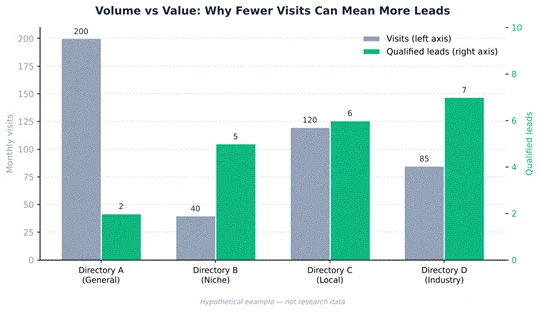
Figure 3. Hypothetical comparison of visit volume and qualified-lead output across four directory types.
| Metric | Directory A | Directory B | Difference | Winner |
|---|---|---|---|---|
| Monthly visits | 200 | 40 | 5× more (A) | A |
| Qualified leads | 2 | 5 | 2.5× more (B) | B |
| Conversion rate | 1.0% | 12.5% | 12.5× higher | B |
| Annual listing cost | $600 | $900 | +$300 (B) | A |
| Cost per qualified lead | $25 | $15 | -$10 (B) | B |
Table 3. Illustrative calculation showing why visitor count alone misleads directory evaluation.
Directory B sends five times fewer visits but produces more than double the qualified leads, at a lower cost per lead. If buyer value and sales cycle are comparable, Directory B is the better investment despite looking weaker on a top-level traffic chart. This is why engagement rate and conversion rate per source matter more than raw visit counts.
Free listings on major platforms, Google Business Profile, Bing Places, Apple Maps, LinkedIn Company Pages are worth claiming for virtually any business. The only cost is the maintenance time to keep NAP (name, address, phone) data consistent, and the downside risk of not claiming is that an incorrect or unclaimed profile may surface instead.
Paid directory listings are a different calculation. A paid tier works when the directory's own organic traffic is strong and the upgrade genuinely increases visibility inside that traffic. It fails when the directory is reselling visibility it does not actually have. The simple formula below sets a defensible threshold:
Cost per qualified lead = Annual listing fee ÷ Qualified leads produced in the year
If the cost per qualified lead from a paid directory sits meaningfully above the business's blended cost per lead from other channels, the money moves elsewhere. Paid never outperforms free as a rule — it outperforms free only when the directory's audience is the right audience, and that is an empirical question answered by measurement.
AI-powered recommendation systems have shifted some discovery behaviour away from traditional directory browsing. BrightLocal reports that 45% of US consumers used AI tools to discover local businesses in 2026, up from 6% a year earlier. That change pulls in two directions for directories.
On one hand, AI assistants often cite review-rich and comparison-heavy sites, including specialist directories, when producing recommendations. A well-maintained listing on an authoritative directory contributes to the entity data AI systems draw on. On the other hand, there is no verified evidence that simply being on more directories increases visibility inside ChatGPT, Google AI Overviews, Perplexity or Gemini. The claim that "directory submissions improve AI search visibility" is premature as a general rule. What matters is being on sources those systems actually retrieve, which overlaps with the same quality signals this article has already covered: real audiences, real reviews, real buyer behaviour.
A workable 2026 plan rejects mass submission and prioritises audience fit. The following sequence has been used successfully by local service businesses, agencies and SaaS teams:
1. Identify 15–30 directories where real buyers in the business's category visibly spend time.
2. Prioritise audience fit over authority scores or listing counts.
3. Create complete, accurate profiles with logo, description, contact details, service list and recent portfolio or product information.
4. Select the narrowest relevant category the directory offers, not the broadest.
5. Add specific evidence: client logos, verified reviews, case studies, pricing clarity.
6. Keep business details current, hours, services, contact fields, because incomplete profiles underperform.
7. Tag outbound links with UTMs where possible and set GA4 key events for each conversion action.
8. Review performance after two full quarters, not two weeks.
9. Remove or deprioritise listings that produce no measurable outcomes after six to nine months.
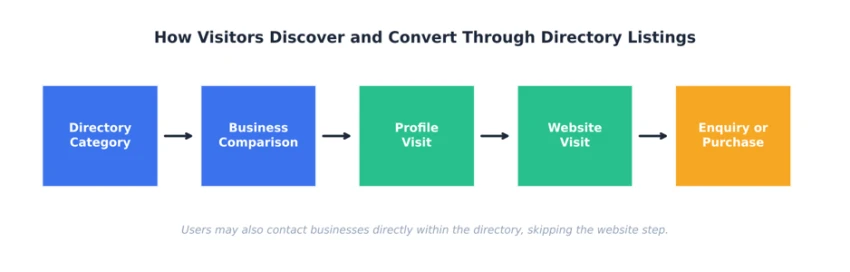
Figure 4. Visitor journey through a directory listing — from category browse to enquiry or purchase.
Directory strategy does not generalise cleanly across business models. A local service business plays a different game to a B2B agency or a SaaS product, and the same effort yields different outcomes.
| Business type | Top directory priorities | Realistic win | Avoid |
|---|---|---|---|
| Local service provider | Google Business Profile, Apple Maps, Yelp, industry trade bodies | Phone calls and direction requests from nearby buyers | National general directories with no local filter |
| B2B agency | Clutch, DesignRush, The Manifest, niche industry rosters | Shortlist invitations and RFPs from in-market buyers | Low-quality link farms disguised as directories |
| SaaS product | G2, Capterra, Product Hunt, category-specific review sites | Comparison traffic and trial sign-ups from evaluators | Paid tiers with no proof of referral volume |
Table 4. Priorities, realistic outcomes and traps by business type.
Directory listings remain worthwhile in 2026 for businesses whose buyers actually use the directories involved. That is a narrower set than many marketing playbooks suggest, but it is not an empty one. Local service providers benefit most from Google Business Profile and a handful of location-anchored directories. B2B agencies gain real pipeline from Clutch and similar review-first platforms. SaaS products benefit from G2, Capterra and category-specific review sites where buyers already compare alternatives.
What has changed is not whether directories work. It is how businesses measure them. Visitor counts no longer substitute for qualified-lead counts. Authority scores no longer substitute for buyer activity. A directory earns its continued place each quarter, measured on the same evidence used to judge any other channel: lead quality, conversion rate, cost per acquisition and revenue produced.
For most businesses the correct 2026 posture is to maintain 15–30 carefully chosen directory profiles, measure them honestly in GA4, and reinvest the time saved from mass submission into the remaining channels that move the needle.
Share your thoughts about this article.
Be the first to post a comment!