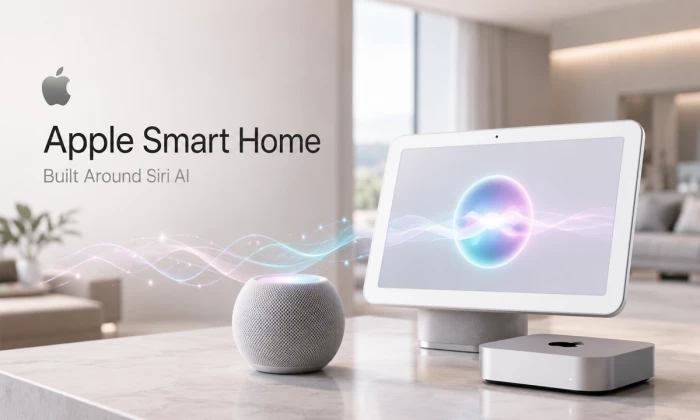
Apple is reportedly preparing its biggest smart-home expansion yet, with a new display-based home hub, an upgraded Apple TV and a refreshed HomePod mini built around the company’s recently announced Siri AI assistant.
The new Apple TV and HomePod mini could arrive during autumn 2026, while the long-rumoured smart-home display is expected sometime between October 2026 and early 2027. Apple has not officially announced these products, and the release window could still change.
A Seven-Inch Display Could Become Apple’s Home Control Centre
The centrepiece of Apple’s reported strategy is a roughly seven-inch square touchscreen designed to work as a shared controller for the home.
According to reporting based on Bloomberg’s information, the device would run a new operating system derived from tvOS. Its interface could combine the app-grid familiarity of iOS with the glanceable widgets and information panels commonly associated with watchOS.
The display is expected to manage connected lights, cameras, locks, thermostats and other HomeKit or Matter-compatible products. It may also support video calls, music playback, home-security monitoring and Apple’s Intercom feature.
One of its more ambitious reported capabilities is automatic personalisation. Cameras and sensors could identify who is standing near the device and adjust the information shown, including calendars, notifications, widgets, icon sizes and text. This would make it less like a permanently mounted iPad and more like a shared home computer that changes according to the person using it.
Siri AI Is the Real Product Behind the Hardware
Apple is not simply trying to place another screen in the kitchen. It is trying to turn Siri into the intelligence layer connecting the entire home.
At WWDC 2026, Apple introduced Siri AI as a substantially rebuilt assistant with conversational abilities, personal-context understanding, onscreen awareness and access to current information from the web. Apple says the assistant can locate information across messages, emails, photographs and notes while performing actions in apps such as Messages, Music and Reminders.
Those abilities could become particularly useful on a shared home device. A user might ask Siri to display a family calendar, locate a recipe mentioned in a message, show a security-camera feed or prepare a home scene that changes the lighting, temperature and entertainment system simultaneously.
Apple previously delayed some of Siri’s promised personal-context and app-control features after acknowledging that development was taking longer than expected. The reported smart-display project was also pushed back, suggesting the hardware could not be released until the new assistant was ready to support it.
Siri AI is currently expected to enter beta later in 2026, initially in English. Apple has also said it will not initially be available on iPhone and iPad in the European Union, while availability in China remains subject to regulatory approval. It is not yet clear how those restrictions would affect a dedicated smart-home product.
A Faster Apple TV and Smarter HomePod Mini Could Arrive First
Before the dedicated display appears, Apple is expected to update two products that already act as home hubs: Apple TV and HomePod mini.
The current Apple TV 4K can automate accessories, provide remote access to connected devices and manage HomeKit and Matter products. Apple’s existing Wi-Fi and Ethernet model also supports Thread networking, an important technology for connecting low-power smart-home accessories.
A new Apple TV is expected to receive faster hardware and deeper integration with Siri AI. The upgrade could allow more smart-home commands and AI processing to happen locally instead of relying entirely on remote servers.
The HomePod mini is also expected to retain its familiar compact design while gaining a faster processor and improved Siri capabilities. The present model already includes four microphones for far-field Siri commands, temperature and humidity sensors, Thread networking, Intercom support and an Ultra Wideband chip for proximity-based interactions.
Together, the products could form a distributed home network: Apple TV handling entertainment and automation, HomePod mini providing voice access throughout different rooms, and the new display offering a shared visual interface.
Apple Is Also Exploring Cameras and Home Robots
Apple’s plans reportedly extend beyond speakers and displays. The company is said to be working on its own high-end security camera, which would place it in more direct competition with Amazon’s Ring ecosystem and Google’s Nest cameras.
A more advanced version of the home display is also reportedly under development. That device could use a larger screen attached to a robotic arm capable of turning towards the user during conversations or video calls.
These products appear to be further away than the initial home hub, Apple TV and HomePod mini. None has been officially confirmed, and Apple could modify or cancel the projects before commercial release.
Apple Already Has the Ecosystem to Support the Expansion
Apple enters the smart-home market with a major distribution advantage. The company said in January 2026 that its installed base had surpassed 2.5 billion active devices. That gives Apple a vast network of iPhones, iPads, Macs, watches and televisions that could connect directly with its future home products.
Siri’s existing scale is also significant. Apple has previously said the assistant processes approximately 1.5 billion user requests each day. Even a relatively small improvement in the percentage of those requests involving home control could generate substantial usage for new Apple hardware.
The broader category continues to grow. Fortune Business Insights estimates that the global smart-speaker market will increase from $16.61 billion in 2026 to $34.08 billion by 2034, representing a projected compound annual growth rate of 9.4%.
Privacy Could Be Apple’s Strongest Advantage
Amazon and Google entered the smart-home display market years before Apple, but Apple may attempt to differentiate its products through local processing, ecosystem integration and privacy.
Apple says information in its Home app is stored in a format that it cannot read. Communication between Apple devices, home hubs and accessories is encrypted end to end, while many accessory commands are processed through devices inside the home rather than through an external cloud service.
Apple’s Matter implementation also allows compatible accessories from different manufacturers and ecosystems to work together while requiring user permission before an app can add or access a device.
However, a more personalised Siri introduces a difficult trade-off. For the home hub to recognise family members, display individual information and control sensitive devices, it needs access to cameras, microphones, messages and household activity.
Apple’s biggest challenge will therefore not be producing an attractive screen. It will be proving that Siri can understand different users, protect personal information and reliably control high-consequence devices such as locks, cameras and alarms.
The Launch Still Depends on Execution
Apple’s reported smart-home roadmap looks more coordinated than its previous efforts. Rather than selling isolated hardware, the company appears to be building a connected system around Siri AI, Apple Home, Matter and its existing devices.
But the strategy depends heavily on Siri working as promised. If the assistant can recognise context, understand natural requests and coordinate devices reliably, Apple’s smart-home display could become one of the most useful products in its ecosystem.
If Siri struggles with accuracy or faces another delay, the home hub risks becoming an expensive control panel offering functions that users can already access through an iPhone, HomePod or Apple TV.
For now, the new Apple TV and HomePod mini are expected to be the first signs of this strategy, followed by the display-based home hub between late 2026 and early 2027. Until Apple announces the products, their specifications, pricing and availability should still be treated as reported plans rather than confirmed launch details.