Friend AI Pendant Now Talks Back, but Costs $249
by Pritam Singh - 1 month ago - 5 min read
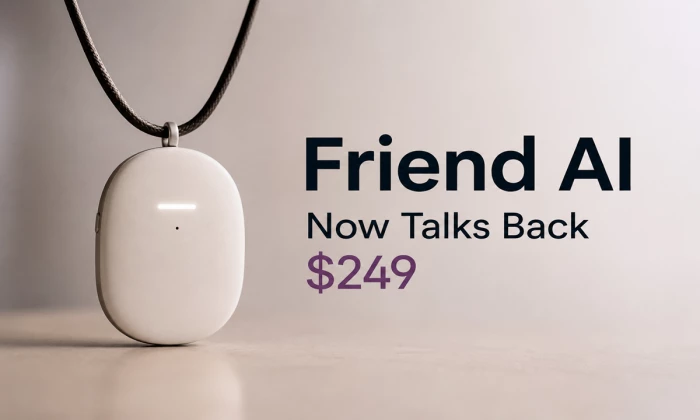
Friend, the controversial AI companion designed to hang around a user’s neck, is returning with a major upgrade. The new version can finally speak aloud rather than sending every response to a smartphone.
Founder Avi Schiffmann announced the updated device as “Friend 2.0” on July 30, although the product continues to be sold simply as Friend. The most noticeable change is a built-in speaker that allows the pendant to respond directly to its wearer with a voice and personality of its own.
That added voice, however, comes with a substantial price increase.
Friend’s Price Has More Than Doubled Since Its Original Launch
The new Friend pendant costs $249. When the device was first announced in 2024, it carried a $99 preorder price with no subscription requirement. It was subsequently sold for $129 before the latest relaunch.
Compared with the original $99 launch price, the new model is approximately 152% more expensive. Even compared with the more recent $129 price, Friend has increased the cost by roughly 93%.
The company is also introducing an optional $10-per-month subscription. Without the plan, the AI reportedly remembers conversations for up to 30 days. Subscribers can extend that memory beyond the 30-day limit. A customer who buys the pendant and keeps the subscription for a full year would therefore spend $369 during the first 12 months.
This marks a notable shift from the original pitch, which promoted Friend as a one-time hardware purchase without a recurring fee.
The Pendant Can Now Talk Directly to Its Owner
The first Friend pendant continuously collected conversational context but delivered its replies through text messages on the user’s iPhone. The updated model adds a speaker to the back, making the interaction more immediate and potentially more personal.
The hardware is slightly bulkier because of the new speaker, while its underlying AI has reportedly moved to OpenAI’s latest models. Friend’s previous product information said the platform was built on Google’s Gemini models, suggesting the relaunch includes a significant change to its AI infrastructure as well as its physical design.
Every new pendant arrives with a randomly assigned voice and personality. Owners cannot change the voice, rename the device or select a different personality after receiving it. The idea appears to be that users must get to know the particular Friend they receive, rather than configuring it like a conventional digital assistant.
The company’s new advertisement demonstrates this more emotionally focused approach. In one scene, the pendant responds to a woman discussing a former relationship. Another wearer talks about his filmmaking ambitions and receives encouragement from the device. The product is being positioned less as a productivity tool and more as a persistent confidant that comments on its owner’s life.
Schiffmann has said he does not see Friend as an assistant or romantic partner. Instead, he describes it as an unusual form of confidant whose exact place in a person’s life may be difficult to define.
Friend Wants Ten Times More Sales This Time
Schiffmann says the company sold approximately 5,000 units of the original pendant. For the second version, his target is 50,000 devices—a tenfold increase. Reaching that number at the new $249 hardware price would represent nearly $12.5 million in gross device sales before subscriptions, returns, manufacturing expenses and other costs are considered.
International availability may be more limited, however. Schiffmann indicated that Friend may withdraw from the European Union because complying with the region’s General Data Protection Regulation would make the product too expensive to offer there.
Privacy is an especially important issue for Friend because its usefulness depends on listening to conversations and understanding what is happening around the wearer. The company has previously described the pendant as using passive listening to provide its AI with more context and said it can hear the environment around the user while it is being worn.
Friend Is Still Embracing Its Controversial Reputation
Friend has attracted attention not only because of its technology but also because of its unusually provocative marketing.
Schiffmann reportedly spent $1.8 million to acquire the Friend.com domain, a major portion of the startup’s early funding. The company later covered parts of the New York City subway system with advertisements promoting artificial companionship. Many of those ads were defaced by people objecting to AI being marketed as a replacement for human connection.
Rather than moving away from that reaction, Schiffmann has frequently treated the controversy as part of the brand. The new campaign once again focuses on isolated or emotionally vulnerable moments in which a person turns to the pendant for encouragement, reassurance or companionship.
Friend is also returning to a difficult market for dedicated AI hardware. Humane’s AI Pin, one of the most heavily promoted AI wearables, failed to gain mainstream adoption and its consumer business was shut down less than a year after the product reached customers.
Friend is taking a different approach by avoiding claims that it will replace a smartphone. Its purpose is narrower and more emotional: it listens, remembers and talks back.
The addition of a speaker makes that promise more convincing than before, but the $249 price and optional subscription also raise expectations considerably. Friend now needs to prove that hearing an AI companion speak aloud offers enough value to justify paying nearly twice the device’s previous retail price, and potentially another $120 every year for longer memory.