Meta Develops Humanoid Robot Max With China's Fourier
by Nitin - 4 hours ago - 6 min read
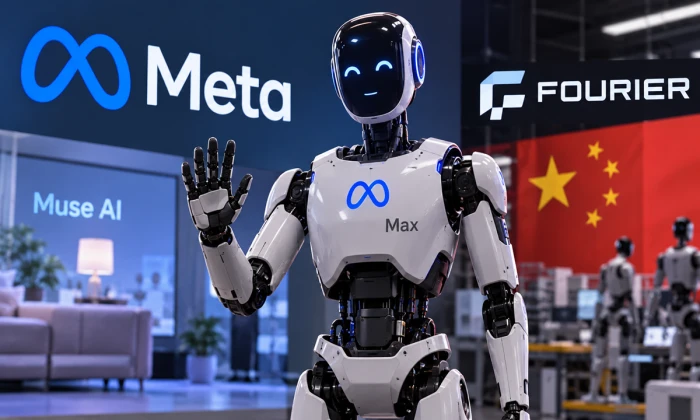
Meta has built a prototype humanoid robot with the Chinese startup Fourier and is working on a follow-up model, The Information reported on Saturday, citing people familiar with the project. The machine carries the internal codename Max. Reuters relayed the account the same day and noted that it could not independently verify the details. Neither Meta nor Fourier has disclosed the arrangement publicly, and the companies have not commented on the specifics of the work.
The report frames the collaboration as a research effort rather than a product launch. Meta told The Information that its work with Fourier is for internal research and experimentation, that it has no plans to sell the units, and that no launch date has been set. The company has not published a specification sheet, a price, or a production budget for any commercial robot.
Inside the Max prototype
According to the reporting, the Max prototype stands roughly 1.5 meters tall, just under five feet, and weighs about 48 kilograms, or 106 pounds. It runs on Nvidia's Jetson Thor chip, the company's flagship on-board computer for robots, which Nvidia positions as powerful enough to run large AI models locally instead of routing every decision to a remote server.
The robot's hardware is built for interaction. A display mimics facial expressions, built-in speakers give it a voice, and five-fingered hands are designed to grip small objects. Meta showed the machine to a group of employees at an internal robotics summit in late August, roughly three months after the build began.
Built to carry Meta's Muse AI
Inside Meta, the robot is described as a physical embodiment of Muse, the company's consumer AI agent, with household tasks as the intended use. That framing places the hardware in service of Meta's software ambitions rather than the other way around. The stated goal is a robot that can eventually take on everyday chores, a category that current humanoids still struggle with.
Li-Chen Miller, Meta's vice president of product for robotics, spent close to two months at Fourier's factory in Shanghai during the collaboration, the report said, a sign of how closely the two teams worked on the physical build.
A second version is already underway
Meta and Fourier began developing a successor, referred to as Max 2, in September. The follow-up is expected to feature a redesigned torso, improved hands for manipulating objects, a built-in projector, and additional sensors to help the robot navigate stairs, along with other routine refinements. The quick move to a second generation suggests the first prototype was a starting point rather than a finished design.
Why Meta leaned on a Chinese partner?
The tie-up underscores how central Chinese hardware makers have become to the global humanoid supply chain. Fourier belongs to a cluster of Chinese startups that have drawn attention for producing robot bodies and components faster and more cheaply than many Western rivals. A Meta spokesperson acknowledged that some components remain difficult to source in the United States, leaving the company exposed to the same supply constraints as the wider industry.
The division of labor is the point. Meta is concentrating on the AI, sensors, and software layer while leaning on an outside manufacturer for the body that walks, balances, and grips. Building a capable physical platform and making it genuinely useful are different engineering problems, and they rarely sit inside one company.
Regulatory pressure in Washington
The Chinese partnership also carries political risk. In August, the Federal Communications Commission proposed cutting an import exemption for certain restricted devices from 4,000 units to just 40. If adopted, that change would make it harder for Meta to bring Chinese-built robots into the United States for testing, complicating any path from a Shanghai workshop to American homes.
Meta is also hiring engineers in Shanghai and Shenzhen to move its robotics projects from prototypes toward manufacturing, a step that signals ambitions beyond pure research even as the company insists the current work stays internal.
Who Fourier is?
Fourier, founded in Shanghai in 2015, began as a rehabilitation robotics specialist, building exoskeletons and training machines for hospitals and clinics before moving into general-purpose humanoids. It released the GR-1 in 2023, billed as the world's first mass-produced humanoid, followed by the GR-2 in 2024. Its current public model is the GR-3, a 165-centimeter machine with 55 degrees of freedom that combines visual, audio, and tactile sensing. The GR-3 went on sale in October 2025 and made its United States debut at CES in January 2026.
The company says it had delivered more than 10,000 robots in total, counting its rehabilitation units, by the first quarter of 2025. It is backed by investors including SoftBank and Prosperity7 Ventures, and reported a Series E round totaling close to 800 million yuan. A separate 2025 deal valued the company at roughly 8 billion yuan before that financing.
Where this fits in Meta's robotics push?
The Fourier work is one strand of a broader bet on embodied AI inside Meta. In May 2026, the company acquired Assured Robot Intelligence, a startup building AI models meant to help robots understand and respond to human behavior, and folded its founders into its research organization. Meta's leadership has described humanoid robots as a possible physical extension of its AI agent rather than a near-term consumer device.
A finished Meta robot would put the company in the same arena as Tesla, which is ramping limited production of its Optimus humanoid. For now, the two efforts are at different stages, and Meta has not committed to a branded consumer product.
What is still unknown
Much about the project remains undisclosed. There is no confirmed specification, cost, or timeline for a shippable robot, and the companies have not said whether the relationship is a research platform, a supplier arrangement, or the first step toward a Meta-branded machine. The reporting rests on people familiar with the work rather than any formal announcement, and the primary account sits behind a paywall, which leaves parts of it unverified outside those directly involved.
For investors, the near-term financial impact looks limited, since Meta has ruled out selling the prototypes and set no launch date. The more durable signal may be strategic: a large technology company willing to rely on outside hardware partners while it owns the software could move robots from demonstration to deployment faster than a go-it-alone approach would allow.